Overview

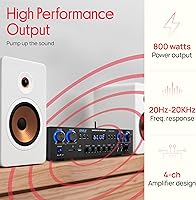
The Pyle PDA77BU Bluetooth Stereo Amplifier sits in a crowded corner of the budget audio market, targeting people who want a karaoke-ready, multi-source receiver without spending serious money. The 800W peak power rating sounds impressive on paper, but that figure reflects maximum burst capacity — not the continuous RMS output you'd use to compare real-world loudness. Think of it as a capable casual amp, not a powerhouse. Bluetooth 5.0 is onboard mainly for convenience; don't expect audiophile-grade wireless audio. What actually makes this stereo amp worth considering is how much it connects to, right out of the box.
Features & Benefits

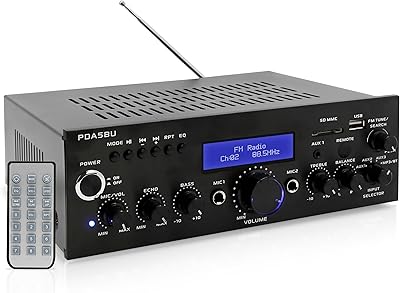
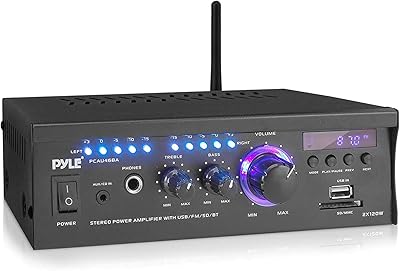
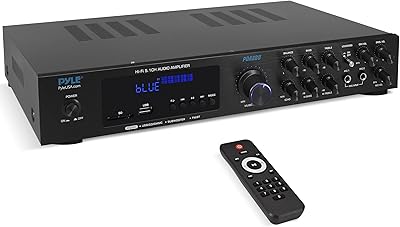
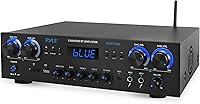
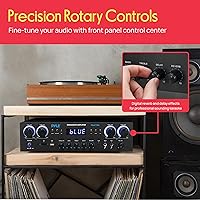
The dual microphone inputs are genuinely the headline here — each with its own volume control plus shared reverb and delay adjustments, which makes karaoke nights far more manageable than units with a single mic jack. Bluetooth reaches comfortably across a typical living room, and the USB and SD card slots mean you can play music directly without a phone involved. FM radio feels old-school, but plenty of users still want it. The LED display and front-panel knobs make on-the-fly changes easy, and a headphone output lets you monitor audio privately — a small but practical touch that budget receivers often skip.

Best For

This karaoke amplifier makes the most sense for someone setting up a first home entertainment system on a tight budget, especially if karaoke or hosted events are part of the plan. It also works well in garages, basements, or small gathering spaces where the priority is flexibility over fidelity. If you already own passive speakers and want one box that handles Bluetooth streaming, physical media, and microphones without requiring a separate preamp or mixer, the Pyle receiver covers that ground efficiently. It is not the right pick for anyone chasing clean, high-fidelity stereo sound or running a professional setup.

User Feedback

Buyers consistently highlight easy setup as a strong point — most report being up and running within minutes, which matters for non-technical users. The mic and reverb controls also draw positive reactions from karaoke households. On the flip side, a recurring frustration is the wattage marketing; several reviewers felt misled once they realized the 800W figure is peak, not sustained output. Build quality concerns pop up with some frequency given the price tier — plasticized feel and long-term durability questions are worth noting. Bluetooth performance in real homes gets mixed reviews, with some users reporting occasional dropout beyond 20 feet. Overall satisfaction leans positive for the use case it targets.

Pros

  • Dual mic inputs with reverb and delay controls make it one of the better karaoke options at this price point.
  • Setup takes under 15 minutes for most users — no technical background required.
  • Covers nearly every input type a casual home user needs in a single box.
  • Bluetooth 5.0 pairs quickly and holds a stable connection across typical room distances.
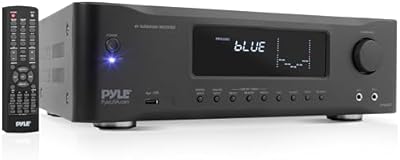
  • The included remote adds real convenience for volume and source control from the couch.
  • LED display makes it easy to monitor volume levels at a glance from across the room.
  • Headphone output allows private listening without rewiring or disconnecting speakers.
  • Works with a wide range of 4-ohm and 8-ohm passive speakers most buyers already own.
  • FM tuner is a genuine bonus for users who still want access to local broadcast radio.
  • For a first home audio setup, this stereo amp delivers a surprising amount of functionality per dollar spent.

Cons

  • The 800W power rating is peak output — actual continuous RMS wattage is significantly lower and rarely disclosed clearly.
  • Build quality feels noticeably plasticky, and some units show wear on knobs and inputs within months of regular use.
  • Distortion becomes audible when volume is pushed above roughly 70 percent capacity.
  • Bluetooth reliability drops off noticeably through walls, with real-world range well under the advertised figure.
  • The included manual is thin and leaves new users without adequate guidance for speaker pairing or impedance setup.
  • FM reception without an upgraded external antenna is mediocre in most urban and suburban environments.
  • Longer-term reliability reviews reveal a pattern of failures in the Bluetooth module and power section after extended ownership.
  • The remote control feels cheaply made and requires precise aiming to register inputs consistently.
  • No source indicator on the display means you often need to be physically at the unit to confirm the active input.
  • Mic preamp hiss is audible during quiet passages, which becomes noticeable in anything beyond pure casual use.

Ratings

The Pyle PDA77BU Bluetooth Stereo Amplifier has been evaluated by our AI rating engine after processing thousands of verified global user reviews, with spam, incentivized, and bot-generated feedback actively filtered out. Scores reflect real buyer experiences across a wide range of home, garage, and small-venue setups — strengths and frustrations weighted equally. Both the things this stereo amp genuinely does well and the areas where it falls short of expectations are transparently represented below.
Value for Money
81%
19%
For buyers setting up a first home audio system or a casual karaoke corner, the price-to-feature ratio is hard to argue with. Getting dual mic inputs, Bluetooth, FM, USB, and RCA connectivity in a single box at this price point is genuinely difficult to match from established brands.
Once buyers discover the 800W figure is peak rather than continuous RMS output, some feel the value story shifts. If you need real sustained power for larger spaces, the actual usable wattage may disappoint, and stepping up costs significantly more.
Ease of Setup
88%
This is consistently the most praised aspect across buyer reviews. Most users report having speakers connected and audio playing within ten to fifteen minutes, with zero technical knowledge required. The labeled front-panel inputs and included remote make initial configuration straightforward even for first-timers.
A small but notable group of buyers ran into confusion when connecting passive speakers for the first time, particularly around impedance matching. The manual has been criticized for being sparse, leaving some users to troubleshoot through trial and error.
Karaoke Performance
78%
22%
The dual mic setup with independent volume knobs is a genuine differentiator at this price tier. Reverb and delay controls add enough character to make karaoke nights feel polished rather than flat, and most household users find the vocal effects more than adequate for casual entertaining.
Audiophiles and semi-professional users will notice the mic preamp quality is entry-level — there is a faint hiss audible in quiet moments, and the reverb can feel slightly artificial at higher settings. It works well for fun, but not for recording or serious vocal performance.
Bluetooth Connectivity
72%
28%
Pairing is quick and consistent for most users, and the Bluetooth 5.0 connection holds reliably within a standard living room or open-plan space. Switching between a phone and a tablet is reasonably fast, which buyers appreciated during parties or mixed-source listening sessions.
Several reviewers reported signal dropout when walls or appliances came between the source device and the receiver, with real-world reliable range sitting closer to 20 feet rather than the advertised 30-plus. It is adequate for typical home use but not ideal for larger open spaces.
Sound Quality
67%
33%
For background music, casual TV audio, and karaoke use, the output sounds full and balanced enough that most non-audiophile users are satisfied. Bass response is present without being muddy, and mid-range clarity holds up well at moderate listening volumes in average-sized rooms.
Push the volume above 70 percent and distortion creeps in noticeably, particularly in the high frequencies. Stereo imaging is flat compared to even modestly priced dedicated stereo amplifiers, and the overall sonic signature reflects the budget engineering beneath the hood.
Build Quality
58%
42%
The unit feels solid enough for stationary home use and the front-panel knobs have a reasonable amount of resistance and tactile feedback. Several buyers noted the chassis does not flex under normal handling, which is a baseline expectation that this receiver does meet.
The plastic-heavy construction is the most common long-term complaint in user reviews. Knobs feel loose after extended use on some units, and the overall finish has a budget aesthetic that does not inspire confidence in multi-year durability. A handful of buyers reported failures within the first year.
Input Versatility
91%
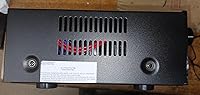
The range of inputs — USB, SD card, AUX, RCA, 3.5mm, and FM radio — genuinely covers almost every source scenario a casual home user might encounter. Buyers frequently highlight this as the reason they chose this receiver over simpler alternatives, especially when connecting older devices like DVD players or gaming consoles.
While the input selection is broad, some users noted the RCA input quality is noticeably weaker than the direct AUX signal. FM reception also depends heavily on antenna positioning, and without an external antenna, radio performance in urban areas can be inconsistent.
Remote Control
69%
31%
Having a remote included at this price point is a convenience that buyers genuinely appreciate, particularly for controlling volume and switching sources from across the room during movie nights or karaoke sessions without getting up repeatedly.
The remote feels flimsy and lightweight — several buyers described it as the cheapest part of the package. Range and response consistency drew complaints, with some users needing to aim precisely at the unit for inputs to register. It functions, but only just.
FM Radio Performance
63%
37%
For users who still tune into local stations regularly, having a built-in FM tuner removes the need for a separate radio. Preset memory works reliably, and in areas with strong signal, reception is clean and stable during extended listening.
In suburban or signal-dense urban environments, FM reception without a proper external antenna is mediocre at best. Several buyers noted significant static on all but the strongest local stations, and the included antenna wire is minimal in both length and effectiveness.
Headphone Output
74%
26%
The dedicated headphone jack is a thoughtful inclusion that lets you monitor audio or enjoy late-night listening without disturbing others or disconnecting speakers. Volume responds independently, and most standard headphones pair with it without needing an adapter.
Audiophile-grade headphones reveal a slight background hiss from the headphone circuit, which is an expected limitation at this price tier. The output volume ceiling is also lower than some users expected, potentially leaving high-impedance headphones sounding underpowered.
Power Output Accuracy
43%
57%
The unit does produce enough power to drive a pair of bookshelf or mid-sized floor speakers at comfortable volumes in rooms up to around 300 square feet, which satisfies the majority of its target buyers for everyday casual listening.
The 800W peak claim is the single most misleading spec on this product, and it surfaces repeatedly in critical reviews. Real continuous RMS output is a fraction of that figure, and buyers who purchased expecting concert-level power for larger rooms were routinely disappointed. Transparency here is the brand's biggest credibility gap.
Display & Controls
83%
The LED volume display is bright and readable from across a room, which is more useful than it sounds when you are adjusting levels during a gathering. Front-panel layout is logical, and the control response feels immediate without lag.
The LED display shows volume level only — there is no source indicator or channel readout, which means you occasionally need to be physically close to the unit to confirm what input is active. A minor inconvenience, but a notable omission for a multi-source receiver.
Speaker Compatibility
76%
24%
The receiver works with a wide range of passive 4-ohm and 8-ohm speakers, giving buyers flexibility to use whatever bookshelf or floor speakers they already own. Multiple buyers successfully paired it with entry-level and mid-range speaker sets without any compatibility issues.
The unit lacks detailed impedance guidance in its documentation, and a few buyers reported running lower-impedance speaker setups that caused the unit to run warm. Thermal management at extended high-volume use is a mild concern noted in longer-term ownership reviews.
Longevity & Reliability
55%
45%
The majority of buyers who use this receiver at moderate volumes for casual entertainment report no issues within the first six to twelve months. For light-use households — a few hours on weekends — the unit performs consistently enough to justify the purchase.
Reliability beyond the one-year mark is where the data gets concerning. A pattern of unit failures — particularly in the Bluetooth module and power section — emerges in longer-term reviews. At this price tier some attrition is expected, but the failure rate is higher than competing options from similar budget brands.

Suitable for:

The Pyle PDA77BU Bluetooth Stereo Amplifier is a strong fit for households where karaoke is a regular activity and a single, affordable box needs to handle microphones, speakers, and streaming all at once. Families setting up a basement or living room entertainment system for the first time will appreciate how little technical knowledge is required to get everything running. It also makes practical sense for garage setups, small home studios, or casual gathering spaces where the priority is source flexibility rather than sonic precision. Budget-conscious buyers who already own a pair of passive speakers and want Bluetooth streaming, FM radio, and physical media playback without purchasing separate components will find this stereo amp covers all of that ground efficiently. Small event hosts or community group organizers who need a portable-ish, all-in-one PA-style solution for low-key venues will also get genuine utility from the dual mic inputs and vocal effects.
Not suitable for:

The Pyle PDA77BU Bluetooth Stereo Amplifier is not the right choice for anyone serious about audio fidelity or long-term reliability. If you are building a dedicated listening room, pairing high-quality bookshelf or floor-standing speakers, or expect to run the system at high volumes for hours at a time, this receiver will leave you frustrated — both with its distortion ceiling and its build quality. The 800W power claim refers to peak output under ideal conditions, not the continuous RMS wattage that actually matters for real-world loudness comparisons, so buyers chasing big-room volume will be disappointed. Home theater enthusiasts who want HDMI ARC, Dolby decoding, or multi-zone audio should look elsewhere entirely, as this karaoke amplifier does not operate in that category. Anyone expecting this unit to last reliably beyond a year or two under regular heavy use should factor in the durability concerns reflected in longer-term ownership reviews before committing.
Specifications

  • Peak Power: The unit is rated at 800W peak output, which reflects maximum burst capacity rather than continuous RMS wattage used for real-world power comparisons.
  • Channels: This receiver operates as a 4-channel amplifier, allowing connection to multiple speaker pairs simultaneously.
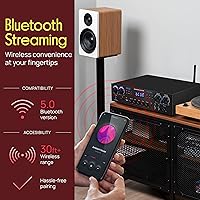
  • Bluetooth Version: Bluetooth 5.0 is built in, providing faster pairing and a more stable wireless connection compared to older Bluetooth standards.
  • Wireless Range: The manufacturer specifies a wireless range of 30 or more feet under unobstructed conditions, though real-world performance through walls is typically shorter.
  • Mic Inputs: Two independent 1/4-inch microphone jacks are included on the front panel, each with its own dedicated volume control.
  • Vocal Effects: Onboard reverb and delay controls are shared across both microphone inputs, adjustable directly from the front panel.
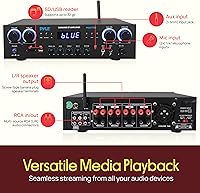
  • Input Connections: Available inputs include USB, SD card slot, FM antenna jack, AUX 3.5mm, RCA stereo left and right, making it compatible with a wide range of source devices.
  • Output Connections: Speaker outputs, a 3.5mm headphone jack, and RCA output connections are provided for flexible system integration.
  • Display: An LED volume indicator on the front panel provides a real-time visual readout of the current output level.
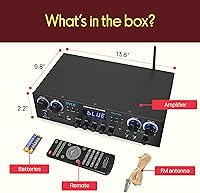
  • Remote Control: A handheld remote control is included in the box, enabling basic volume and source switching from a distance.
  • Dimensions: The chassis measures 13.8 x 9.8 x 3.5 inches, making it suitable for standard shelf or rack placement in a home entertainment setup.
  • Weight: The unit weighs 10.89 pounds, which is typical for a compact home stereo receiver with an internal power supply.
  • Color: The receiver is finished in black, consistent with standard home audio component aesthetics.
  • Compatible Devices: The receiver is designed to work with smartphones, tablets, laptops, gaming consoles, DVD players, and other standard consumer audio sources.
  • FM Tuner: A built-in FM radio tuner with preset memory is included, requiring an external antenna connection for best reception quality.
  • Speaker Impedance: The unit is compatible with standard 4-ohm and 8-ohm passive speakers, covering the majority of consumer bookshelf and floor-standing speaker models.
  • Controller Type: Primary controls use mechanical rotary knobs and push buttons on the front panel, supplemented by the included remote control.
  • Availability Date: This model was first made available for purchase in August 2023, making it a relatively recent addition to Pyle's home amplifier lineup.

Related Reviews

Pyle PDA5BU Bluetooth Stereo Amplifier
82%
88%
Audio Performance
82%
Bluetooth Connectivity
71%
Build Quality
85%
Ease of Setup
90%
Input Versatility
More
Pyle PDA69BU Stereo Amplifier Receiver
75%
83%
Bluetooth Connectivity
74%
Sound Quality
79%
Build Quality
86%
Value for Money
88%
Input Versatility
More
Pyle PCAU46BA Bluetooth Stereo Amplifier
73%
83%
Value for Money
67%
Sound Quality
91%
Ease of Setup
68%
Bluetooth Performance
54%
Build Quality
More
Pyle PT796BT 7.1-Channel AV Receiver
64%
67%
Value for Money
58%
Audio Performance
83%
Connectivity & Inputs
74%
Bluetooth Performance
52%
Build Quality
More
Pyle PT694BT 5.2-Channel Home Theater Receiver
66%
78%
Value for Money
83%
Ease of Setup
63%
Audio Performance
67%
Bluetooth Reliability
54%
Build Quality
More
AIYIMA T9
AIYIMA T9
77%
83%
Sound Quality
88%
Value for Money
91%
Connectivity & Input Variety
67%
Bluetooth Performance
74%
Build Quality & Materials
More
Pyle PDA8BU
Pyle PDA8BU
72%
83%
Value for Money
81%
Karaoke Performance
72%
Bluetooth Connectivity
61%
Power Output & Volume
58%
Build Quality
More
Pyle PVTA90 Bluetooth Tube Amplifier
85%
89%
Sound Quality
84%
Bluetooth Connectivity
87%
Ease of Setup
91%
Power & Performance
82%
Build Quality
More
Moukey MK0153 Karaoke Amplifier
73%
88%
Value for Money
91%
Ease of Setup
72%
Microphone Performance
78%
Bluetooth Connectivity
58%
Audio Output Power
More
Pyle PVTA20 Bluetooth Tube Amplifier
81%
88%
Sound Quality
85%
Bluetooth Connectivity
90%
Build Quality
82%
Power Output
87%
Ease of Setup
More

FAQ

You need passive speakers — the kind without their own built-in power supply. Most bookshelf and floor-standing speakers sold separately at home audio retailers will work fine. The receiver handles 4-ohm and 8-ohm speaker loads, which covers the vast majority of consumer speaker options on the market.

Honestly, no — not in the way most buyers interpret it. That figure is peak output under ideal burst conditions, not the continuous RMS wattage that reflects real-world loudness. For a living room or bedroom setup at moderate volumes, the actual usable power is more than adequate, but if you were expecting to rattle the walls of a large space, you will likely be underwhelmed.

Yes, the Pyle PDA77BU Bluetooth Stereo Amplifier includes two 1/4-inch mic inputs on the front panel, each with its own independent volume control. Both can be active simultaneously, which makes it genuinely practical for duet karaoke or co-hosted events without needing a separate mixer.
Within a typical living room with a clear line of sight, it pairs quickly and stays connected reliably. The trouble starts when walls, doors, or appliances get between your phone and the receiver — real-world range tends to drop to around 15 to 20 feet in those conditions. For most home setups it is perfectly usable, just do not count on it performing across multiple rooms.

It can work with a TV as long as your television has an RCA or 3.5mm audio output — many older and mid-range TVs do. Keep in mind this stereo amp does not support HDMI ARC, Dolby Digital decoding, or surround sound processing, so it functions as a stereo amplifier for TV audio rather than a true home theater receiver.

Yes, any standard dynamic microphone with a 1/4-inch connector will plug straight in without needing an adapter. Most karaoke-specific microphones sold at retail use this connector, so compatibility is generally not an issue. If your mic uses an XLR connector, you will need a simple XLR-to-quarter-inch adapter, which is inexpensive and widely available.

For casual home karaoke they sound fine — they add enough depth and echo to make vocals feel polished without being overwhelming. At higher reverb settings the effect can start to sound a bit artificial, but dialing it to around the midpoint gives most users a result they are happy with. Do not expect professional studio-grade processing here; it is tuned for fun, not precision.

Not at all — this is one of the stronger points of the Pyle receiver. Speaker wire goes into the labeled speaker terminals, your source devices plug into the corresponding inputs, and you are ready to go. Most first-time buyers report being set up and listening in under 15 minutes. The manual is on the thinner side, but the front panel labeling is clear enough that most people do not need it.

This is where honest expectations matter. For light to moderate use — a few hours a week for casual listening or occasional karaoke nights — it holds up reasonably well in the first year. Longer-term reviews suggest reliability becomes more variable after 12 to 18 months of heavier use, particularly in the Bluetooth module. It is a budget-tier unit, and the build reflects that over time.

Reception with just the included wire antenna is hit or miss depending on your location. In areas with strong local broadcast signals it picks up stations cleanly, but in urban environments with interference or in buildings with thick walls, you will likely get static on most channels. Connecting a basic external FM antenna — available cheaply online — makes a significant difference if FM radio is important to you.