Overview

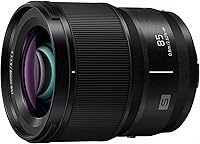
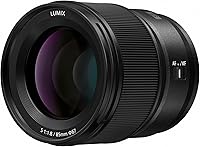
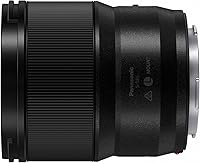
The Panasonic LUMIX S-S85 85mm F1.8 Lens is Panasonic's native portrait prime for the L-Mount ecosystem, and at its price point it punches well above what you might expect. The 85mm focal length has been a portrait staple for decades, compressing backgrounds naturally while keeping enough working distance to avoid crowding your subject. What surprises you when you first pick it up is how small it feels. Despite proper weather sealing, it barely tips the scales at around a pound — a genuine rarity for a full-frame prime. This is a lens built for photographers committed to the L-Mount system who want a capable, no-fuss portrait tool.
Features & Benefits

The F1.8 aperture is the obvious headliner. Wide open, backgrounds dissolve into soft, layered blur — the kind of defocus that flatters a subject without looking artificially processed. In low light, that extra stop over F2 makes a real difference during available-light portraits indoors. For video work, focus breathing suppression is quietly one of the best reasons to choose this portrait lens over a cheaper third-party option — rack focus between subjects and the frame stays locked, no unwanted zoom effect. The weather sealing covers dust, freeze, and splash resistance, though Panasonic's own documentation includes an asterisk on splash protection, so it is not fully waterproof. Autofocus is reliable for static portraits but trails Sony's equivalent when tracking fast-moving subjects.

Best For

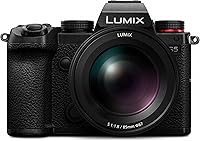
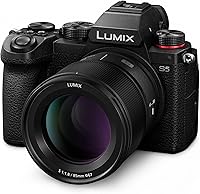
Portrait and headshot photographers will feel right at home with this 85mm prime. The compression at this focal length does flattering work — faces look natural, backgrounds fall away cleanly, and you never feel like you are crowding your subject. Travel photographers will appreciate how little space it takes up in a bag; a pound of glass is easy to forget is there. Hybrid shooters running interviews or talking-head setups will find the suppressed focus breathing genuinely useful on longer takes. It pairs especially well with the LUMIX S5 II or S1, rounding out a zoom-plus-prime kit without meaningful added bulk. If you are already in the L-Mount ecosystem, this portrait lens fills a real gap without demanding much deliberation.

User Feedback

With a 4.7-star average across more than 130 ratings, buyers are broadly satisfied — praise centers on a consistent trio: sharpness wide open, compact size, and strong value relative to the asking price. Video users specifically highlight how cleanly the S-S85 handles focus pulls without the frame appearing to zoom. Outdoor photographers report the weather resistance holds up in light rain and dusty conditions, though nobody is stress-testing it in a downpour. The recurring criticism worth flagging is autofocus speed — compared to Sony FE or Canon RF 85mm options at comparable prices, tracking active subjects falls noticeably short. Bokeh quality earns high marks overall, though a handful of reviewers mention faint onion-ring patterns in specular highlights that pricier L-Mount primes tend to avoid.

Pros

  • Wide F1.8 aperture produces genuinely smooth background blur that flatters portrait subjects in almost any setting.
  • At roughly one pound, the S-S85 is remarkably easy to carry all day without fatigue.
  • Focus breathing is well suppressed, making it a reliable choice for video work without extra gear.
  • Sharpness wide open is strong enough that you rarely feel the need to stop down for cleaner results.
  • Native L-Mount design means no adapter lag or compatibility compromises on LUMIX S and Leica SL bodies.
  • Weather sealing adds real confidence when shooting outdoors in dusty or lightly damp conditions.
  • Quiet autofocus motor keeps things unobtrusive during live events or on-camera video recording.
  • Compact dimensions make it a natural companion to a mid-size mirrorless body without front-heavy imbalance.
  • At its price tier, this portrait lens offers a strong value proposition compared to other native L-Mount primes.

Cons

  • Continuous autofocus tracking lags noticeably behind Sony FE and Canon RF 85mm options at similar prices.
  • Splash resistance comes with an asterisk in Panasonic's documentation — it is not a substitute for full weatherproofing.
  • Specular highlights can show faint onion-ring bokeh patterns that more expensive alternatives handle more cleanly.
  • The L-Mount ecosystem remains niche, limiting resale demand and second-hand market options compared to Sony E or Canon RF.
  • No optical image stabilization built in, so you are relying entirely on in-body stabilization for handheld work.
  • At 85mm on a full-frame body, it is a tight fit for environmental portraits or any work requiring more context in the frame.
  • Some users find the manual focus ring travel too short for precise fine-tuning in critical focus situations.

Ratings

The scores below for the Panasonic LUMIX S-S85 85mm F1.8 Lens were generated by our AI engine after analyzing verified buyer reviews from across global markets, with spam, bot activity, and incentivized feedback actively filtered out. Ratings reflect the full picture — where this portrait prime genuinely impresses and where real users have run into friction. Both strengths and recurring pain points are weighted transparently so you can make a confident buying decision.

Image Sharpness
92%
Reviewers consistently praise the center sharpness wide open at F1.8, noting that portraits come out crisp without needing to stop down first. Even in challenging light, fine details like eyelashes and fabric texture resolve cleanly, which is exactly what portrait photographers lean on this lens to deliver.
A small number of users note that corner sharpness on full-frame sensors trails slightly behind pricier L-Mount primes when shooting flat subjects like documents or walls. For portrait work this is largely irrelevant, but architectural or product photographers may notice it.
Bokeh Quality
84%
Background blur at F1.8 is smooth and gradual, with transitions that feel natural rather than abrupt — a real asset when you want subjects to pop against outdoor backgrounds. Most users shooting headshots and environmental portraits find the rendering flattering and consistent across a range of backgrounds.
Some reviewers who pixel-peep carefully report faint onion-ring patterns in specular highlights, a side effect of the lens element design. It rarely shows up in typical portrait scenarios but becomes noticeable against backgrounds with small bright light sources like fairy lights or distant street lamps.
Autofocus Performance
71%
29%
For static portraits, seated subjects, and controlled studio sessions, the autofocus is reliable and quiet enough to stay unobtrusive. Video users appreciate that AF transitions are smooth during scripted takes, keeping interview footage clean without jarring hunting behavior.
Continuous tracking on moving subjects is where users consistently report frustration — photographers switching from Sony A7 or Canon R-series bodies notice the gap immediately. Tracking a child running across a frame or a subject making sudden movements exposes limitations that can cost you keepers during fast-paced shoots.
Build Quality
83%
The lens feels solid in hand without any of the flex or plastic creaking you sometimes get at this price tier. Mount tolerances are tight, and the focus and aperture rings turn with a satisfying, well-damped resistance that suggests careful manufacturing rather than cost-cutting.
The barrel is primarily engineering plastic rather than full metal construction, which some buyers feel is inconsistent with the premium price expectation. It does not feel flimsy, but it does not feel like a Leica-built lens either, and direct comparisons make that evident.
Weather Sealing
74%
26%
Photographers shooting outdoors in dusty conditions, cold mountain environments, or light drizzle report that the sealing holds up well in practice. Travel and wedding photographers mention taking it into unpredictable weather without incident, which adds real confidence when you cannot control your shooting environment.
Panasonic's own specification sheet includes an asterisk on splash resistance, and savvy buyers have noticed this caveat. The protection is conditional rather than rated to any IP standard, so shooting in sustained rain or near bodies of water remains a calculated risk rather than a covered scenario.
Portability & Size
93%
At roughly one pound, this is one of the lightest native full-frame 85mm primes available from any major manufacturer. Travel photographers specifically call out how easy it is to carry all day on a mirrorless body without shoulder fatigue — a real advantage over heavier F1.4 alternatives.
The compact size occasionally makes manual focus adjustments trickier for photographers who prefer a longer, more deliberate focus ring throw. A few users with larger hands also find the grip area on the barrel feels slightly short, especially when shooting one-handed.
Video Performance
88%
Focus breathing suppression works as advertised — users doing interview setups and documentary work note that rack focuses between subjects stay clean without the frame appearing to zoom, which saves meaningful time in post. The quiet AF motor also keeps audio tracks free of mechanical noise during live recording.
While focus breathing is well controlled, continuous autofocus tracking during handheld video of moving subjects can still produce occasional hesitation before locking. Users recording active subjects rather than seated interview scenarios find this more noticeable than those doing controlled, static video work.
Low-Light Capability
86%
The F1.8 aperture gives you a meaningful light-gathering advantage in candle-lit venues, indoor event spaces, and late golden-hour sessions where you cannot add artificial light. Paired with a LUMIX S body that handles high ISO cleanly, users report being able to shoot in conditions that would push a slower lens to its limits.
Without built-in optical stabilization, handheld shooting in very low light still requires either a fast shutter speed or reliance on the camera body's IBIS system. Users with older L-Mount bodies that lack strong in-body stabilization find the low-light advantage partially offset by motion blur from hand shake.
Value for Money
87%
Within the L-Mount ecosystem, this 85mm prime sits at a price point that buyers consistently describe as reasonable relative to what the lens actually delivers. Compared to equivalent Leica or higher-end Sigma L-Mount options, most users feel the trade-offs are minor enough to justify the savings.
Cross-ecosystem comparisons are less flattering — Sony and Canon offer 85mm primes at similar or lower prices with faster autofocus systems. If you are not already committed to L-Mount, the value argument weakens because the ecosystem lock-in is part of the equation.
Compatibility & Ecosystem Fit
81%
19%
Native L-Mount integration means full electronic communication with Panasonic, Leica, and Sigma bodies — no adapter quirks, no AF speed penalties, and proper EXIF data recorded for every shot. For users already deep in the ecosystem, this native fit is a quiet but meaningful advantage over adapted lenses.
The L-Mount ecosystem itself remains smaller than Sony E or Canon RF, which limits the second-hand market, resale value, and the range of accessories and competing options available. New buyers entering the mirrorless market for the first time may find fewer support resources and community guides compared to larger ecosystems.
Minimum Focus Distance
67%
33%
At around 0.8 meters, the closest focus distance is adequate for tight headshots and upper-body portraits where you want natural compression without crowding the subject. Most portrait photographers find this range practical for their core use cases.
Users who hoped to pull double duty with light product or detail photography quickly find the minimum focus distance too limiting. You cannot get meaningfully close to small subjects, and the magnification ratio is far below what any dedicated macro lens would offer, narrowing the overall versatility of this portrait lens.
Handling & Ergonomics
79%
21%
The balance on mid-sized LUMIX S bodies feels natural — neither front-heavy nor awkward to hold for extended shooting sessions. Rings are well positioned, and switching between autofocus and manual focus is intuitive enough that most users adapt quickly without consulting the manual.
The aperture ring has no physical click stops, which some photographers prefer for discreet aperture changes during events. Others find the lack of tactile feedback makes it too easy to accidentally nudge the aperture setting while adjusting grip during a fast-moving shoot.
Consistency Across Apertures
82%
18%
Stopping down from F1.8 to F2.8 or F4 produces a meaningful jump in edge-to-edge consistency and contrast, which users shooting in controlled environments appreciate when they want maximum technical precision. Color rendering stays neutral and consistent across the aperture range.
A small group of technically focused reviewers note slight focus shift when transitioning between wide and stopped-down apertures — a known characteristic of some fast primes. It is rarely an issue in practice but can trip up photographers doing precise technical work at a single focal plane.

Suitable for:

The Panasonic LUMIX S-S85 85mm F1.8 Lens is an excellent fit for portrait and headshot photographers who are already invested in the L-Mount system and want a lightweight, capable prime that does not demand a second bag to carry. If you shoot primarily with a LUMIX S5 II, S1, or a Leica SL body and rely heavily on a versatile zoom for everyday work, this 85mm prime slots in naturally as your dedicated people-shooter without disrupting a compact travel kit. Hybrid shooters who split time between stills and video will find the focus breathing suppression genuinely useful — it keeps interview footage and documentary-style talking-head shots clean without expensive post-production fixes. Outdoor photographers working in variable conditions will appreciate that this portrait lens holds up against dust and light moisture, adding real-world durability to what could otherwise be a studio-only tool. For anyone committed to building out an L-Mount kit thoughtfully, it is one of the more logical and well-priced additions available at this focal length.
Not suitable for:

The Panasonic LUMIX S-S85 85mm F1.8 Lens is a harder sell if you shoot fast-moving subjects as your primary work — sports, kids in motion, or event photography where unpredictable action demands snappy, confident tracking autofocus. Photographers coming from Sony A7 or Canon R-series systems will notice that the AF responsiveness in those ecosystems feels more decisive, especially in continuous tracking scenarios. If you are not yet in the L-Mount world, this lens alone is not a reason to switch — the ecosystem is smaller, and adapting it to other mounts defeats its native performance advantages. Shooters who demand the absolute smoothest bokeh with zero specular highlight artifacts may find the rendering slightly behind what higher-priced L-Mount primes deliver. And anyone expecting full waterproofing should know that Panasonic's own splash-resistance claim comes with caveats — this lens can handle a light drizzle, but it is not designed for serious wet-weather shooting.
Specifications

  • Focal Length: Fixed 85mm focal length optimized for full-frame portrait and short telephoto work.
  • Max Aperture: Maximum aperture of F1.8 enables shallow depth of field and strong performance in low-light conditions.
  • Lens Mount: L-Mount (Leica L) interface provides native compatibility across the L-Mount Alliance ecosystem.
  • Format Coverage: Designed for full-frame 35mm sensors, covering the complete image circle without vignetting on supported bodies.
  • Compatible Systems: Works natively with Panasonic LUMIX S series, Leica SL series, and Sigma fp full-frame mirrorless cameras.
  • Weight: Approximately 355g (roughly 1 lb), making it one of the more portable native full-frame primes in its class.
  • Dimensions: Measures 3.23 inches in length and 2.9 inches in diameter, keeping the overall footprint compact for everyday carry.
  • Weather Sealing: Rated dust-resistant, freeze-resistant, and splash-resistant, though Panasonic notes splash protection is conditional and not equivalent to full waterproofing.
  • Focus Breathing: Engineered with active focus breathing suppression to maintain consistent framing during focus pulls in video recording.
  • Autofocus System: Supports autofocus operation with quiet motor drive suitable for stills and on-camera video recording.
  • Minimum Aperture: Minimum aperture of F16 allows for controlled depth of field and creative exposure flexibility across shooting scenarios.
  • Model Number: Officially designated as model S-S85 by Panasonic, used for cross-reference across regional product listings.
  • Manufacturer: Designed and manufactured by Panasonic Corporation in Japan under the LUMIX S lens line.
  • Release Date: First made available in November 2020 as part of Panasonic's expanding native L-Mount prime lens lineup.
  • Filter Thread: Accepts 67mm screw-in filters, a standard size that keeps accessory costs reasonable for most photographers.
  • Aperture Blades: Features a 9-blade rounded aperture diaphragm designed to produce smooth, circular bokeh highlights at wide apertures.
  • Construction: Lens barrel is constructed from a combination of engineering plastics and metal components for a balance of durability and reduced weight.
  • ASIN: Amazon Standard Identification Number for this product is B08M24BV12, used for direct marketplace lookup.

Related Reviews

Panasonic S-S35 35mm F1.8 Prime Lens
83%
93%
Optical Sharpness
91%
Build Quality
67%
Autofocus Performance
88%
Video Usability
94%
Portability & Size
More
Panasonic LUMIX 8-18mm F2.8-4.0 Lens
89%
91%
Image Quality
88%
Autofocus Performance
89%
Build Quality & Durability
84%
Ease of Use
90%
Video Performance
More
Panasonic LUMIX S 70-300mm Telephoto Lens
80%
89%
Image Sharpness
92%
Optical Image Stabilization
78%
Macro Performance
91%
Build Quality & Weather Sealing
71%
Autofocus Speed & Accuracy
More
VILTROX 85mm F1.8 Z Portrait Lens
76%
78%
Autofocus Performance
83%
Image Sharpness
81%
Bokeh Quality
76%
Build Quality
86%
Value for Money
More
Panasonic LUMIX S 24-105mm F4 Lens
88%
94%
Image Quality
91%
Weather Sealing & Durability
88%
Low-Light Performance
84%
Ease of Use
90%
Stabilization Performance
More
BENOISON 85mm f1.8 Portrait Lens for Nikon F
83%
91%
Image Quality
85%
Manual Focus Control
88%
Build Quality
70%
Ease of Use
82%
Low Light Performance
More
Panasonic LUMIX G 25mm F1.7 Mirrorless Lens
79%
91%
Optical Sharpness
83%
Autofocus Performance
88%
Low-Light Capability
87%
Video Usability
62%
Build Quality
More
Lightdow 85mm f1.8 Portrait Lens for Nikon F-Mount Cameras
83%
92%
Value for Money
88%
Sharpness
65%
Manual Focus Ease
83%
Build Quality
90%
Bokeh/Background Blur
More
BENOISON 85mm f/1.8 Portrait Prime Lens
76%
83%
Bokeh & Background Separation
88%
Value for Money
71%
Build Quality & Feel
74%
Optical Sharpness (Center)
66%
Manual Focus Accuracy
More
Meike 85mm F1.8 AF STM Sony E Mount Lens
85%
92%
Value for Money
88%
Autofocus Speed and Accuracy
90%
Image Quality
85%
Bokeh and Background Blur
78%
Low-Light Performance
More

FAQ

Yes, all three brands — Panasonic, Leica, and Sigma — share the L-Mount standard through the L-Mount Alliance, so this 85mm prime attaches and communicates natively with any L-Mount body, including the Leica SL2 and Sigma fp. You get full autofocus, aperture control, and image stabilization coordination without an adapter.

For relatively predictable movement — someone walking toward you, a subject shifting position during a portrait session — the AF handles things well enough. Where it falls short is rapid, unpredictable action like sports or young children running at full speed. If fast continuous tracking is central to your work, competing systems from Sony or Canon still have a meaningful edge at this focal length.

At F1.8, background blur is smooth and gradual rather than abrupt, which suits portrait work well. Most users find the rendering flattering and natural-looking. The one honest caveat is that specular highlights — small bright points of light in the background — can occasionally show faint onion-ring patterns at wide apertures, which is a characteristic of the lens element design. It is not distracting in typical portraits but becomes visible if you pixel-peep.

That is exactly what the focus breathing suppression addresses. When you pull focus between subjects, the apparent field of view stays stable rather than subtly widening or narrowing. For interview setups, documentary work, or any talking-head recording, this makes a real practical difference and saves cleanup time in post.

Panasonic describes the S-S85 as dust-resistant, freeze-resistant, and splash-resistant, but their own documentation includes an asterisk on splash resistance — it is not rated for sustained rain or submersion. Light drizzle or dusty outdoor conditions? Fine. Shooting through a downpour or near crashing waves? You would be taking a risk. Pair it with a similarly sealed body and exercise reasonable caution.

The filter thread is 67mm, which is a common size and easy to find in polarizers, ND filters, and UV protectors without premium pricing. The front element does not rotate during autofocus operation, which makes using circular polarizers straightforward — you set the polarizer angle and it stays put.

The Sigma 85mm F1.4 Art delivers a slightly wider maximum aperture and is widely regarded as having more refined bokeh rendering, but it is also significantly heavier and costs considerably more. The Panasonic LUMIX S-S85 85mm F1.8 Lens trades a third of a stop and some optical refinement for a dramatically smaller, lighter package at a lower price. For most portrait photographers, the real-world difference in image quality is subtle; the difference in portability is not.
No, there is no optical stabilization inside this portrait lens. You are relying entirely on whatever in-body stabilization your camera offers. On the LUMIX S5 II or S1R with their Dual I.S. systems, handheld shooting at moderate shutter speeds is comfortable. If your body lacks IBIS, you will need to be mindful of shutter speed to avoid blur from camera shake.

It depends on your space. Indoors in a small room, 85mm on a full-frame body requires a fair bit of distance between you and your subject to fit more than a head-and-shoulders crop. In a standard-sized room it is manageable, but in a tight studio or home setting you may find yourself backing into walls. For more flexibility indoors, a 50mm or 35mm prime gives you more breathing room, while 85mm truly shines in open spaces or outdoors.

The minimum focusing distance is approximately 0.8 meters (just under 3 feet), which is typical for a portrait prime of this type. It is not designed for macro work and will not get you particularly close to small subjects. For tight detail shots of products or flowers, a dedicated macro lens would serve you much better.

Where to Buy