Overview

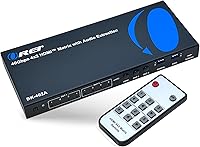
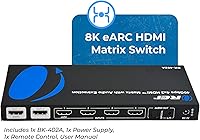
The OREI BK-402A 8K eARC HDMI Matrix Switch 4x2 sits in a sweet spot for AV hobbyists who need real routing flexibility without spending serious money on professional gear. It takes four HDMI sources and distributes them across two outputs simultaneously — handy when you are feeding both a projector and a TV from the same shelf of devices. While the 8K label is technically accurate, the practical story here is 4K at 120Hz, which matters far more to anyone running a current-gen console or a high-refresh display. The unit itself is compact enough to disappear behind a cabinet, and the inclusion of eARC audio extraction at this price point is genuinely rare.
Features & Benefits

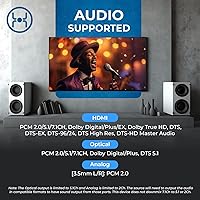
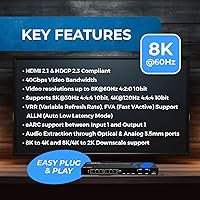
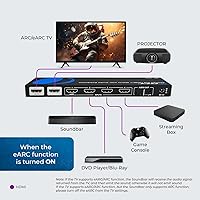
What separates a matrix switch from a basic splitter is true routing control — and the BK-402A delivers that cleanly. Any of its four inputs can be directed to either output independently, so you can watch different sources on two screens at the same time. The built-in EDID management quietly handles the handshake negotiations that cause blank screens and dropped signals when multiple devices are connected. Audio extraction supports lossless formats like Dolby TrueHD and DTS-HD Master Audio, and eARC lets a compatible soundbar pull high-quality audio directly over HDMI. Note that Sonos Arc is unsupported — OREI is explicit about this, so check your soundbar model before purchasing.

Best For

This HDMI matrix switch makes the most sense for people juggling multiple sources across two displays. The most common setup it solves: a PS5 or Xbox Series X that needs to feed both a living room TV and a gaming monitor, or a home theater room where a projector and a backup TV share the same Blu-ray player, Apple TV, and streaming stick. It is also a solid pick for anyone whose soundbar lacks HDMI inputs but still wants lossless audio — the audio extraction port handles that without needing a separate DAC. Users who want to avoid enterprise-grade complexity but still need EDID and HDCP control will find this a practical, right-sized option.

User Feedback

With a 4.3-out-of-5 rating across over 240 reviews, the BK-402A earns its marks mostly through reliable performance with current-gen consoles — the 4K@120Hz handshake with PS5 and Xbox Series X gets consistent praise. Setup gets positive mentions too, though several buyers wish the included documentation went deeper on EDID configuration. On the less positive side, eARC compatibility appears to vary: some soundbar pairings work without issue, while others require troubleshooting. The remote works, but its range won't impress anyone used to premium gear. Overall, value for the feature set is the phrase that comes up repeatedly — buyers feel they are getting professional-grade routing capability without the price tag that usually comes with it.

Pros

  • True 4x2 matrix routing lets you send any source to any display independently, not just mirror or split.
  • Reliable 4K@120Hz handshake with PS5 and Xbox Series X is consistently confirmed by real-world buyers.
  • Audio extraction supports lossless formats including Dolby TrueHD and DTS-HD Master Audio out of the box.
  • EDID management actively prevents the blank-screen handshake failures that plague cheaper passive splitters.
  • eARC support lets a compatible soundbar receive high-quality audio over a single HDMI cable without extra adapters.
  • HDCP 2.3 compliance keeps protected 4K content — streaming and disc — playing without errors on modern displays.
  • Compact footprint makes it easy to install inside a media cabinet without consuming a dedicated shelf.
  • CEC integration means most users can switch inputs directly from their TV remote in day-to-day use.
  • Dual-voltage power supply with an international adapter included makes it usable worldwide without a separate converter.
  • Strong value-to-feature ratio: few competing units offer this combination of routing, audio extraction, and EDID control at this price tier.

Cons

  • eARC compatibility is inconsistent across soundbar brands, requiring trial and error in non-standard configurations.
  • Sonos Arc is explicitly unsupported — a meaningful exclusion given how popular that soundbar is among the target audience.
  • The included manual is thin and leaves EDID mode configuration largely unexplained.
  • IR remote range is limited and unreliable when the unit is installed inside a closed AV cabinet.
  • No app control, web interface, or IP-based switching means smart home integration is simply not possible.
  • Plastic build feels underwhelming for a piece of infrastructure intended to run continuously for years.
  • Port labeling is small and difficult to read in the low-light conditions typical of rack or cabinet installations.
  • CEC performance varies significantly depending on TV brand and firmware, making it unreliable in mixed-brand setups.
  • One-year warranty is shorter than what many buyers expect for permanently installed AV infrastructure.
  • Users with displays limited to older HDCP versions may encounter protected-content playback errors with certain sources.

Ratings

The OREI BK-402A 8K eARC HDMI Matrix Switch 4x2 earns its 4.3-star average from a pool of verified buyers that our AI has analyzed globally, filtering out incentivized reviews and bot-pattern submissions to surface what real AV enthusiasts actually experience. Scores below reflect both the genuine strengths that make this switcher stand out at its price tier and the friction points that crop up in edge-case setups. Nothing has been smoothed over — where buyers ran into trouble, the scores and commentary reflect that honestly.
Signal Reliability & Handshake
88%
The 4K@120Hz handshake with PS5 and Xbox Series X is the most consistently praised aspect across buyer reviews. Users running high-refresh gaming setups report that the signal locks in quickly and stays stable during extended sessions without dropout or renegotiation delays.
A smaller segment of users — typically those with older TVs or budget HDMI cables — report occasional handshake failures that require power cycling the unit. The issue seems tied to source device firmware rather than the switcher itself, but it still creates frustration.
Audio Extraction Quality
84%
Buyers who needed a way to get lossless audio to a soundbar without rewiring their entire rack found the extraction port genuinely useful. Dolby TrueHD and DTS-HD Master Audio pass through cleanly according to most who tested with AV receivers and compatible soundbars.
eARC compatibility is not universal — certain soundbar models, particularly those with stricter HDMI handshake requirements, report inconsistent audio sync or failed eARC negotiation. Sonos Arc users should know upfront that this switcher explicitly does not support that product.
Routing Flexibility
91%
The 4-in, 2-out matrix architecture is the core reason most buyers chose this over a simpler splitter or switch. Being able to send any source to any output — or mirror one source to both displays simultaneously — covers a wide range of real home theater and gaming room layouts.
There is no app or web-based control interface, so managing routing remotely beyond IR and CEC is not an option. Power users who want scripted switching or integration with a smart home controller will hit a ceiling fairly quickly.
EDID Management
82%
18%
For buyers who have dealt with blank screens or resolution mismatches when swapping sources, the built-in EDID management is a quiet but meaningful feature. Several reviewers specifically noted that it eliminated the persistent handshake loops they experienced with cheaper passive splitters.
The EDID configuration options are not well documented in the included manual, and there is no on-screen interface to confirm active EDID settings. Users who need fine-grained EDID control often rely on trial and error or community forums rather than official guidance.
Value for Money
89%
Across review threads, the value-to-feature ratio is the most frequently cited reason buyers recommend this unit to others. Getting a true matrix switch with audio extraction, eARC, EDID management, and HDCP 2.3 support in one compact box at this price is genuinely hard to match in the current market.
A handful of buyers felt the price was slightly aggressive given the eARC compatibility gaps and the thin documentation. If Sonos Arc support or deep EDID customization is a requirement, spending more on a competing unit may be the more cost-effective path in the long run.
Build Quality & Form Factor
76%
24%
The chassis is compact and tidy — at just over a pound and roughly the footprint of a thick paperback, it tucks behind AV racks or wall-mount shelves without demanding dedicated shelf space. The matte finish handles fingerprints reasonably well in enclosed cabinet installations.
The enclosure feels plasticky compared to pricier matrix switches, and a few buyers noted that the port labeling is small and hard to read in low-light rack environments. Nothing feels fragile, but it does not inspire the same confidence as metal-bodied alternatives.
Remote Control Usability
67%
33%
The included IR remote covers the basic switching and audio control functions well enough for typical couch-distance use in a standard living room. CEC support means many users can avoid the remote entirely by controlling everything through their TV remote.
Remote range is the most common minor complaint — users in larger rooms or those with the unit tucked inside a closed cabinet find the IR signal unreliable. There is no RF or Bluetooth option, and the remote itself feels lightweight and low-cost relative to the device it controls.
Setup & Installation
81%
19%
Most reviewers describe the initial setup as straightforward for anyone with prior AV wiring experience. Plugging in sources, connecting displays, and getting a basic signal path working typically takes under fifteen minutes according to buyer accounts.
The manual is the weak point — it covers the basics but leaves EDID modes, CEC configuration, and audio extraction setup underdocumented. Less experienced users report needing to search online forums to fill the gaps, which adds unnecessary friction to what should be a simple process.
HDR & Color Fidelity
78%
22%
HDR10, HDR10+, and Dolby Vision pass through without noticeable degradation according to buyers using calibrated displays. Streaming and disc-based HDR content tested by reviewers showed consistent tone mapping behavior across both connected outputs.
HLG performance receives fewer mentions, and some users on older HDR-capable displays noted occasional HDR handshake quirks when switching between sources mid-session. These are intermittent and seem display-dependent rather than a consistent unit-level issue.
HDCP Compliance
86%
HDCP 2.3 support means protected 4K content from Netflix, Disney Plus, and 4K Blu-ray players passes through to both outputs without triggering content protection errors. Buyers running mixed environments with older HDCP 2.2 devices also report backward compatibility working as expected.
A small number of users with very old displays — those limited to HDCP 1.4 — encountered playback errors on protected content. This is largely an ecosystem-level limitation rather than a switcher defect, but it is worth noting for anyone with legacy displays still in rotation.
CEC Control Integration
73%
27%
CEC worked reliably for straightforward setups — users with a single TV brand and compatible devices found that source switching triggered through their TV remote without needing to touch the BK-402A directly. It simplifies daily use once properly configured.
CEC behavior varies significantly across TV brands and firmware versions, and the switcher's CEC implementation has been described as basic. Users mixing brands — say, an LG TV with a Sony receiver and a Samsung soundbar — report inconsistent or non-functional CEC responses.
Compatibility Breadth
79%
21%
The switcher works across a wide range of source devices including streaming sticks, Blu-ray players, and current-gen consoles without requiring mode changes or special configuration. International buyers appreciate the dual-voltage power supply with adapter included in the box.
The explicit lack of Sonos Arc eARC support narrows the appeal for a meaningful slice of the target audience. Buyers with less common AV configurations — particularly custom-installed systems with IP-based control — may find the compatibility list more limiting than the spec sheet implies.
Warranty & Brand Support
71%
29%
OREI includes a one-year warranty and has a track record of responding to buyer questions through Amazon's messaging system. Several reviewers mention receiving helpful troubleshooting guidance directly from the brand when standard setup steps did not resolve their issues.
One year is on the shorter end for a piece of AV infrastructure that buyers expect to run continuously for years. Post-warranty support experiences are harder to verify, and there is no extended protection plan offered directly by the manufacturer at time of purchase.

Suitable for:

The OREI BK-402A 8K eARC HDMI Matrix Switch 4x2 is built for the kind of AV enthusiast who has outgrown simple switching and needs genuine routing control across multiple displays. If you are running a projector and a TV in the same room — or a gaming monitor alongside a living room screen — and want to feed both from a shared pool of sources without constantly swapping cables, this switcher was designed with your setup in mind. Console gamers who own both a PS5 and an Xbox, or who want a single device feeding a TV and a dedicated gaming monitor at 4K@120Hz, will find the matrix architecture genuinely practical. It also suits cord-cutters managing a growing shelf of devices: a streaming stick, a Blu-ray player, and a game console can all live connected simultaneously, with no unplugging required. Users whose soundbars lack sufficient HDMI inputs but still demand lossless audio will appreciate the extraction port, which handles Dolby TrueHD and DTS-HD Master Audio without a separate DAC in the chain.
Not suitable for:

The OREI BK-402A 8K eARC HDMI Matrix Switch 4x2 has real limitations that make it the wrong tool for certain buyers, and it is worth being direct about them. If your soundbar is a Sonos Arc, stop here — OREI explicitly states this combination is unsupported, and no amount of configuration will change that. Users who want smart home integration, IP-based control, or scripted switching automation will hit a hard wall, since control is limited to IR remote and CEC only. The documentation is genuinely thin, so if you are not already comfortable navigating EDID settings and HDCP troubleshooting through community forums, the setup experience may feel more frustrating than it should. Those with legacy displays capped at older HDCP standards may also encounter content protection errors when playing back 4K streaming or disc content. Finally, buyers expecting build quality on par with rack-mount AV gear will likely be underwhelmed — the plastic enclosure is functional but not premium.

Specifications

  • Input Ports: The unit provides four HDMI input ports, allowing up to four source devices to be connected simultaneously.
  • Output Ports: Two HDMI output ports enable independent or mirrored signal routing to two separate displays at the same time.
  • Max Resolution: Maximum supported resolution is 8K at 60Hz, with full passthrough for 4K at 120Hz for high-frame-rate gaming and streaming.
  • Audio Extraction: A dedicated audio extraction output delivers digital audio independently from the video signal, supporting lossless and compressed formats.
  • Audio Formats: Supported audio formats include LPCM, Dolby Digital, Dolby TrueHD, DTS, DTS-HD Master Audio, and DSD.
  • eARC Support: eARC is supported on the HDMI output for compatible soundbars, with the explicit exception of the Sonos Arc, which is not supported.
  • HDR Formats: The switcher passes through HDR10, HDR10+, Dolby Vision, and HLG without re-encoding or degrading the signal.
  • HDCP Version: HDCP 2.3 compliance ensures protected 4K and 8K content from streaming services and physical disc players is handled correctly.
  • EDID Management: Built-in EDID management allows the unit to negotiate optimal resolution and audio capabilities between sources and displays automatically.
  • CEC Control: CEC support enables input switching and basic device control to be operated through a connected TV remote without touching the unit directly.
  • IR Remote: An IR remote control is included in the box for manual input and output switching from a standard viewing distance.
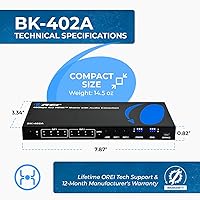
  • Dimensions: The unit measures 8 x 3.5 x 1 inches, making it compact enough to install inside a media cabinet or behind a wall-mount TV.
  • Weight: At 1.1 pounds, the switcher is lightweight and does not require dedicated rack mounting or reinforced shelf support.
  • Power Supply: The included power adapter is dual-voltage compatible, and an international plug adapter is provided for use outside the United States.
  • Warranty: OREI covers the unit with a one-year limited warranty backed by direct manufacturer support.
  • Release Date: The BK-402A became available in February 2024, making it a current-generation product designed around modern HDMI 2.1 use cases.

Related Reviews

OREI UHD-402D 4x2 HDMI Matrix Switch
78%
88%
Video Signal Quality
84%
Audio Extraction
71%
ARC Implementation
82%
EDID Management & Downscaling
86%
Setup & Ease of Use
More
Yinker 4K HDMI Matrix Switch 4x4
83%
82%
Performance and Signal Stability
88%
Ease of Use
85%
Flexibility in Control Options
79%
Build Quality
90%
Setup and Installation
More
OREI UHDS-401A
OREI UHDS-401A
71%
74%
4K Signal Reliability
83%
Audio Extraction Quality
51%
ARC Functionality
86%
Format Compatibility
62%
Build Quality & Design
More
Portta N2MT42AX 4x2 HDMI Matrix
78%
83%
Signal Reliability
88%
4K & HDR Performance
86%
Audio Extraction Quality
91%
EDID Management
72%
ARC Functionality
More
StarTech VS222HDQ 2x2 HDMI Matrix Switch
74%
88%
Build Quality
91%
Switching Reliability
83%
EDID Emulation
31%
4K and Resolution Support
86%
Ease of Setup
More
MT-VIKI 4x4 HDMI Matrix Switch
86%
88%
Performance
91%
Build Quality
85%
Ease of Setup
72%
Remote Control Responsiveness
90%
Audio Extraction Quality
More
ANXQQ 8K HDMI KVM Switch 4-Port
84%
94%
Resolution Quality
88%
Ease of Setup
82%
Switching Performance
79%
Build Quality
91%
Compatibility with Systems
More
StarTech.com 4-Port 8K HDMI Switch
85%
88%
Value for Money
92%
Performance in Gaming
85%
Ease of Use
90%
Picture Quality (HDR Support)
87%
Build Quality
More
FERRISA 8K HDMI 2.1 Switch 4-in-1
77%
91%
Ease of Setup
78%
Auto-Switching Reliability
88%
4K@120Hz Performance
61%
8K Signal Stability
74%
Remote Control Usability
More
Camgeet HDMI KVM Switch 2 Port 8K@60Hz
85%
91%
Performance
88%
Ease of Use
85%
Build Quality
90%
Compatibility
86%
Switching Speed
More

FAQ

Yes, and this is one of its strongest real-world use cases. Buyers running a PS5 or Xbox Series X report consistent 4K@120Hz signal lock without needing to adjust console output settings. Just make sure you are using certified HDMI 2.1 cables between the consoles and the switcher.

No — the OREI BK-402A 8K eARC HDMI Matrix Switch 4x2 explicitly does not support the Sonos Arc. This is stated clearly by the manufacturer, so if your soundbar is a Sonos Arc, this unit is not compatible and you should look at alternatives.
Yes, that is the key difference between this and a basic splitter. As a true matrix switch, it can route any of the four inputs to either output independently — so you can watch different content on two separate screens simultaneously from different source devices.

The audio extraction output separates the audio signal from the HDMI stream and sends it to a receiver or soundbar that does not support HDMI ARC or eARC. It supports lossless formats like Dolby TrueHD and DTS-HD Master Audio, so you are not sacrificing audio quality by using it.

In most cases, yes. EDID-related handshake failures — where the display and source cannot agree on resolution or audio capabilities — are exactly what the built-in EDID management is designed to prevent. It pre-negotiates and stores the correct EDID profile so sources do not get confused when you switch between them.

Basic automation is possible through CEC, which lets you trigger input changes via your TV remote or CEC-compatible control systems. However, there is no IP control, RS-232 port, or app interface, so deep smart home integration through platforms like Control4 or Home Assistant is not supported natively.

The manufacturer does not specify a maximum certified cable length, but as a general rule for HDMI 2.1 at 4K@120Hz, passive cables up to about 6 feet work reliably. For longer runs, use active HDMI 2.1 cables or fiber optic HDMI cables to avoid signal degradation.

Dolby Vision passes through intact. The switcher supports Dolby Vision as a passthrough format, meaning it forwards the signal to your display without altering it, provided your display and source both support Dolby Vision natively.

Probably not reliably. The IR remote requires line-of-sight to the front IR receiver, so a closed cabinet door will block the signal. If cabinet installation is your plan, you would need an IR extender or rely on CEC control through your TV remote instead.

The box includes the matrix switch unit itself, a power adapter with a US plug, an international plug adapter for non-US use, the IR remote control, and a basic operation manual. No HDMI cables are included, so you will need to supply your own for all inputs and outputs.