
Overview

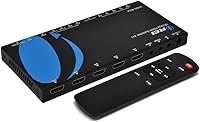
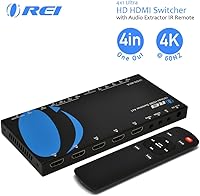
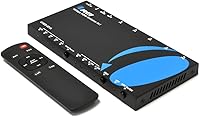
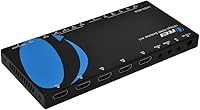
The OREI UHDS-401A is a 4-input HDMI switch with built-in audio extraction, designed for home theater owners who've run out of ports and patience. Launched in 2019, it sits in a competitive mid-range space where buyers expect solid 4K performance without paying premium AV receiver prices. That's a reasonable ask — and mostly this switcher delivers. Still, its 3.5-star rating from 70 buyers tells a nuanced story. It's not a product that fails outright; it's one where satisfaction depends heavily on your specific setup and expectations. Competing against cheaper no-frills switches and higher-end AV receivers, it carves out a niche for users who specifically need audio extraction alongside switching.

Features & Benefits

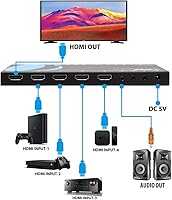
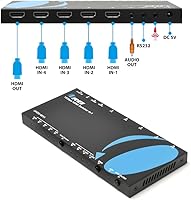
At its core, this HDMI switcher handles four HDMI 2.0 sources at full 4K@60Hz, with HDCP 2.2 compliance meaning your 4K Blu-ray player or streaming device won't throw a handshake error. The real differentiator, though, is audio extraction. Rather than forcing all audio through your TV's limited processing, this audio-extracting switcher breaks the signal out to an optical TosLink or analog L/R output — so your soundbar gets a clean, direct feed. It supports Dolby TrueHD, DTS-HD Master Audio, and PCM up to 7.1 channels. HDR10, HDR10+, and Dolby Vision pass through without issues. There's also an RS-232 control port, which is essentially a serial connection used in custom AV installations to let automation systems control the switch programmatically — useful for dedicated media rooms.

Best For

The OREI 4x1 switch makes the most sense for home theater setups where the TV's HDMI ports are already maxed out by a gaming console, a streaming stick, and a Blu-ray player. If your TV supports ARC but you want audio routed cleanly to a soundbar without a full receiver in the chain, this fills that gap well. It's also a practical choice for international buyers — the dual-voltage power supply with an included plug adapter is a thoughtful inclusion you don't always see at this price tier. Those running semi-custom AV setups with control systems will appreciate the RS-232 port. Casual users who just need basic switching can find cheaper options; this one earns its keep when audio flexibility is genuinely part of the requirement.

User Feedback

The mixed rating here is worth taking seriously. Buyers who got what they needed tend to praise the audio extraction reliability and the breadth of format support — Dolby TrueHD passing cleanly to a soundbar is genuinely useful. Where things go sideways is ARC. A meaningful slice of negative reviews traces back to buyers expecting eARC performance, which this switcher doesn't support; standard ARC only. Handshake issues with certain 4K HDR sources also surface occasionally. The remote is functional but unremarkable. Build quality gets a lukewarm response — it feels appropriate for the price, not exceptional. OREI's customer support earns decent mentions for responsiveness. Long-term reliability appears inconsistent based on older reviews. Understand your use case before buying, because the gap between a satisfied and frustrated owner often comes down to one mismatched expectation.

Pros

  • Routes Dolby TrueHD and DTS-HD Master Audio directly to a soundbar via optical output, bypassing TV audio processing entirely.
  • HDCP 2.2 compliance prevents content protection errors with 4K Blu-ray and streaming sources.
  • Dolby Vision, HDR10, and HDR10+ pass through without visible signal degradation in typical home theater use.
  • Dual-voltage power supply with an international adapter included — useful for buyers outside North America.
  • RS-232 port enables programmatic control in custom or semi-custom AV installations without IR line-of-sight.
  • Broad audio format support covers virtually every source format a home theater setup is likely to use.
  • Compact footprint tucks away easily behind a TV stand or inside a media cabinet.
  • OREI's customer support gets positive mentions for responsiveness on standard troubleshooting issues.
  • This HDMI switcher consolidates four sources into one display without requiring a costly AV receiver upgrade.

Cons

  • Standard ARC support only — eARC is not supported, causing real compatibility failures in modern soundbar setups.
  • HDMI handshake failures occur when switching between sources with differing HDR profiles, sometimes requiring a full power-cycle.
  • Build quality feels lightweight for the price, with HDMI port loosening reported by users who swap cables frequently.
  • IR remote has limited range and poor angle tolerance, making it unreliable in real-world room layouts.
  • User manual provides minimal troubleshooting guidance for anything beyond a basic plug-and-play configuration.
  • Longevity concerns emerge in reviews from owners past the 18-month mark, particularly around port integrity and power supply.
  • RS-232 documentation is thin, leaving non-professional installers without usable command references.
  • Occasional multi-channel PCM audio extraction issues reported with gaming consoles as the source device.
  • One-year warranty feels short given the durability patterns reported by longer-term owners.

Ratings

The OREI UHDS-401A earns a polarizing but instructive rating profile — our AI analyzed verified buyer reviews from multiple global markets, actively filtering out incentivized and bot-generated feedback, to surface what real users consistently experienced. Scores reflect both the genuine strengths this audio-extracting switcher brings to crowded home theater setups and the recurring frustrations that have kept it from a higher overall standing. Nothing here is glossed over: where buyers struggled, the scores reflect it honestly.

4K Signal Reliability
74%
26%
Most buyers report stable 4K@60Hz output once the device is properly configured, with HDR10 and Dolby Vision passing through without visible degradation. For users running a streaming stick, console, and Blu-ray player through one display, the picture quality holds up well in day-to-day switching.
A recurring complaint involves HDMI handshake failures — particularly when switching between sources that have different HDR profiles. Some users report having to power-cycle connected devices after switching, which is disruptive in an otherwise clean setup.
Audio Extraction Quality
83%
The optical TosLink output is the standout feature for most satisfied buyers. Routing Dolby TrueHD or DTS-HD Master Audio directly to a soundbar — bypassing the TV entirely — is exactly what this switcher was built for, and it handles that task with consistent results across most configurations.
Analog L/R output quality gets fewer mentions but draws occasional criticism for background hiss in quiet listening environments. Users with more discerning audio setups noticed a slight quality floor compared to a direct source connection, though for typical home theater use it remains acceptable.
ARC Functionality
51%
49%
When ARC works as intended — TV sending audio back through the switch to an external speaker — buyers in the right setup find it genuinely useful for consolidating cables. Those with ARC-compatible TVs and basic soundbars tend to report fewer issues.
This is the single biggest source of negative reviews. A large portion of frustrated buyers confused ARC with eARC, which this device does not support. Even among those with standard ARC TVs, reliability is inconsistent — some report audio cutting out intermittently or ARC simply failing to initialize without explanation.
Format Compatibility
86%
Support for PCM, Dolby TrueHD, and DTS-HD Master Audio up to 7.1 channels covers virtually every source format a home theater owner is likely to throw at it. Buyers using older AV receivers alongside newer 4K sources appreciated not having to compromise on audio format pass-through.
While the format list is broad on paper, a few users noted that certain edge-case audio configurations — particularly multi-channel PCM from gaming consoles — did not always extract cleanly. These are niche scenarios, but worth knowing if your setup leans heavily on console audio.
Build Quality & Design
62%
38%
The compact footprint — roughly the size of a thick paperback — means it tucks away neatly behind a TV stand or inside a media cabinet without demanding much real estate. The all-black chassis looks neutral and inoffensive alongside most AV gear.
At this price tier, buyers expect solid construction, and several longer-term owners noted the casing feels noticeably lightweight and somewhat hollow. Port resistance is adequate initially but a few reviewers mentioned HDMI ports loosening with frequent cable swapping over time.
IR Remote & Control
58%
42%
The included IR remote covers basic source switching without requiring you to reach behind the TV or press buttons on the unit itself. For fixed installations where the receiver cable is placed in line-of-sight, it works reliably at short distances.
Range and angle sensitivity draw consistent criticism — the remote frequently requires precise aiming and close proximity. Users who mount their TV above a fireplace or place the switcher inside a closed cabinet find the IR control frustratingly unreliable in practice.
RS-232 & Custom Control
77%
23%
For installers managing a dedicated media room or a small commercial display setup, the RS-232 serial port is a meaningful inclusion at this price. It allows automation controllers like Control4 or simple serial scripts to switch inputs programmatically without IR line-of-sight requirements.
This feature is entirely wasted on the average home buyer, and the documentation around it is thin. Users who attempted RS-232 control without prior custom-install experience reported difficulty finding usable command sets, and OREI's support resources on this point are limited.
Setup & Installation
69%
31%
Plug-and-play behavior works well for straightforward setups — connect four sources, connect the display, power it on, and most users are switching inputs within minutes. The included IR receiver cable gives some flexibility in where you physically position the unit.
More complex configurations involving ARC, audio extraction, and HDR simultaneously tend to require trial and error. The user manual is functional but thin on troubleshooting guidance, and buyers chasing specific audio routing scenarios often end up on forums to solve problems the documentation doesn't address.
HDCP 2.2 Compliance
81%
19%
HDCP 2.2 support means protected 4K content from Netflix, Disney+, and 4K Blu-ray players passes through without triggering content protection errors — a baseline requirement that cheaper switches often fail to meet. Buyers upgrading from older switches specifically cited this as a key reason for choosing this model.
A small number of users reported intermittent HDCP handshake failures with specific source and display combinations, even when all devices nominally supported HDCP 2.2. These failures appear configuration-dependent rather than a universal defect, but they are real enough to mention.
Value for Money
67%
33%
For buyers who specifically need audio extraction alongside 4K switching, the price is defensible — standalone audio extractors plus a basic switch would cost more combined. The feature set on paper punches reasonably above its weight for home theater use cases.
For buyers who do not need audio extraction, cheaper and often more reliable alternatives exist. Several reviewers felt the inconsistent ARC performance and build quality undermined the value proposition, particularly given that the product has been on the market since 2019 without a hardware revision.
International Usability
84%
The dual-voltage power supply and included international plug adapter make this a practical option for buyers outside North America — a detail that competing products at this price often skip entirely. International buyers specifically called this out as a deciding factor.
While the adapter inclusion is appreciated, a few international users noted that the adapter quality feels flimsy and suggested sourcing a country-specific power cable separately for long-term use. A minor point, but relevant for buyers planning a permanent installation abroad.
Longevity & Durability
56%
44%
Buyers who have used this HDMI switcher for a year or more without issue tend to report stable performance when the unit lives in a fixed, undisturbed installation. Low heat output during normal operation is a reassuring sign for always-on media room setups.
A pattern emerges in older reviews where units developed intermittent failures after 18 to 24 months — particularly around HDMI port integrity and power supply reliability. The one-year warranty is therefore a meaningful limitation given the longevity concerns some buyers have documented.
Customer Support
72%
28%
OREI's lifetime customer support commitment gets genuine positive mentions, with several buyers noting that the support team was responsive and helpful when troubleshooting ARC or HDR issues remotely. For a mid-tier brand, that accessibility stands out.
Support quality appears inconsistent depending on the complexity of the issue. Buyers with standard problems generally report good experiences, while those chasing nuanced ARC or RS-232 configurations noted that support responses were generic and did not always resolve the specific technical problem.

Suitable for:

The OREI UHDS-401A is a strong match for home theater owners who have genuinely outgrown their TV's built-in HDMI ports and need a reliable way to manage multiple 4K sources — a gaming console, a streaming device, and a Blu-ray player all competing for one display. Where this switcher earns its keep most convincingly is in setups where audio needs to travel a separate path: if you want Dolby TrueHD or DTS-HD Master Audio routed directly to a soundbar via optical output, without a full AV receiver in the chain, this audio-extracting switcher fills that role at a price that makes sense. It's also a practical pick for international buyers, since the dual-voltage supply and included plug adapter remove a friction point that similarly priced competitors often ignore. AV hobbyists who run semi-custom setups and want serial control over their switcher — via the RS-232 port — will find that capability genuinely useful without having to step up to a significantly more expensive unit. If your use case maps cleanly onto those scenarios, this HDMI switcher is likely to satisfy.

Not suitable for:

Buyers expecting eARC support should look elsewhere — the OREI UHDS-401A supports standard ARC only, and this distinction has been the root cause of a disproportionate share of its negative reviews. If your soundbar or AV receiver relies on eARC to pass lossless audio from the TV back to the speaker system, this switcher will not fulfill that requirement, full stop. It's also not the right choice for buyers who need nothing more than basic input switching without audio extraction — simpler, cheaper, and often more stable alternatives exist for that narrower need. Users who prioritize long-term durability should factor in reports from owners past the 18-month mark describing port degradation and intermittent power supply issues; the one-year warranty offers limited coverage in that context. Finally, anyone planning to rely heavily on the IR remote in a large room, a high-mounted TV setup, or a closed media cabinet will likely find the short-range, angle-sensitive control frustrating enough to be a genuine daily annoyance.

Specifications

  • HDMI Inputs: The unit accepts four HDMI 2.0 source connections simultaneously, allowing a console, streaming device, Blu-ray player, and a fourth source to remain physically connected at all times.
  • HDMI Output: A single HDMI 2.0 output connects to the display, carrying video and audio signals at up to 18Gbps bandwidth.
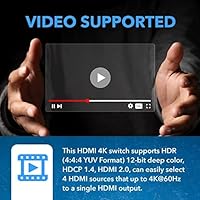
  • Max Resolution: Video output supports up to 4K at 60Hz, delivering full ultra-high-definition playback from compatible sources.
  • HDR Support: The device passes through HDR10, HDR10+, and Dolby Vision signals without conversion or quality reduction.
  • HDCP Version: HDCP 2.2 compliance ensures compatibility with copy-protected 4K content from streaming services and physical media players.
  • Audio Extraction: A dedicated optical TosLink output and a stereo analog L/R output allow audio to be sent independently to a soundbar or stereo receiver without involving the TV.
  • Audio Formats: Supported audio formats include PCM stereo, Dolby TrueHD, and DTS-HD Master Audio, with multi-channel support up to 7.1 channels.
  • ARC Support: The device supports Audio Return Channel, enabling a compatible TV to send audio back through the switch to an external speaker system via the optical or analog outputs.
  • Video Bandwidth: Total video bandwidth is rated at 18Gbps, which is the standard ceiling for HDMI 2.0 and sufficient for 4K@60Hz with HDR color depth.
  • Control Options: Input selection can be managed via the included IR remote, a front-panel button, or an RS-232 serial control port for integration with automation systems.
  • IR Receiver: An IR receiver extension cable is included, allowing the IR sensor to be positioned separately from the unit for improved remote line-of-sight in enclosed installations.
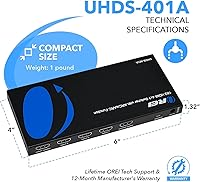
  • Dimensions: The unit measures 4 x 6 x 1 inches, making it compact enough to sit behind a TV stand or inside most media cabinet shelving.
  • Weight: The device weighs 1.32 pounds, light enough for shelf mounting or cable-managed installations without additional support hardware.
  • Power Supply: The included power adapter supports dual-voltage input, and an international plug converter is provided in the box for use outside North America.
  • 3D Support: Full 3D video pass-through is supported for compatible 3D source and display combinations.
  • Color & Finish: The chassis is finished in matte black, designed to blend unobtrusively with standard AV equipment in a home theater rack or cabinet.
  • Package Contents: The box includes the 4x1 switcher, a power adapter, an IR receiver cable, a 3.5mm to optical converter, an IR remote, and a printed user manual.
  • Warranty: OREI provides a one-year limited hardware warranty alongside a lifetime customer support commitment covering troubleshooting and configuration assistance.
  • Manufacturer: The device is designed and sold by OREI, a US-based AV accessories brand specializing in HDMI distribution, signal conversion, and display extension products.
  • Model Number: The official model number is OR-HDY-401A, which may be referenced when contacting support or searching for firmware and documentation.

Related Reviews
OREI UHD-402D 4x2 HDMI Matrix Switch
78%
88%
Video Signal Quality
84%
Audio Extraction
71%
ARC Implementation
82%
EDID Management & Downscaling
86%
Setup & Ease of Use
More
OREI UHD-404R 4x4 HDMI Matrix Switcher
81%
88%
Signal Reliability
86%
4K Performance
91%
Downscaling Capability
79%
HDR & Audio Passthrough
84%
Setup & Ease of Use
More
OREI UHD-EXB400R-K 4K HDMI Extender over Ethernet
86%
91%
Long-Range HDMI Performance
87%
Ease of Installation
93%
Video Quality (4K, HDR)
85%
Compatibility with Devices
89%
Power over Cable (PoC) Effectiveness
More
Adasion 15x56 Binoculars
73%
83%
Optical Clarity
77%
Low-Light Performance
61%
Magnification Usability
81%
Build Quality & Durability
88%
Waterproofing & Weather Resistance
More
Spedal FF931 4K Webcam
76%
83%
Image Quality
88%
Wide-Angle Performance
76%
Low-Light Performance
67%
Microphone Quality
79%
Remote Control Usability
More
OREI EX-500IR HDMI Extender
88%
94%
Transmission Distance
92%
Signal Quality
89%
Ease of Installation
85%
Build Quality
88%
Power over Cable (PoC) Functionality
More
CRUA 27″ 4K UHD Monitor
83%
91%
Display Quality
94%
Color Accuracy
88%
Ease of Setup
85%
Build Quality
74%
Gaming Performance
More
SPUNALP UHD 8K Underwater Camera
85%
93%
Image Quality
89%
Build Durability
85%
Waterproof Performance
80%
Battery Life
67%
Wi-Fi Performance
More
ToLuLu UHD 4K Webcam with Microphone
83%
89%
Video Quality
85%
Audio Quality
93%
Ease of Setup
87%
Privacy Features
80%
Build Quality
More
Optoma UHD38X 4K UHD Projector
86%
93%
Display Quality
91%
Gaming Performance
88%
Brightness
90%
Color Accuracy
92%
Input Lag
More

FAQ

It supports standard ARC only — eARC is not available on this device. This is probably the most important thing to verify before buying. If your soundbar or AV receiver relies on eARC to receive lossless audio from your TV, this switcher will not support that signal path. Standard ARC handles formats like compressed Dolby Digital, but not the uncompressed lossless streams that eARC enables.

Yes, that is the primary use case this device is designed for. The HDMI output carries the full video and audio signal to your TV, while the optical or analog outputs simultaneously send audio to a soundbar or receiver. You do not have to choose between the two — both run concurrently.

Yes, for 4K@60Hz it works fine with current-generation consoles. Keep in mind this is an HDMI 2.0 device with 18Gbps bandwidth, so it does not support the 4K@120Hz or HDMI 2.1 features those consoles are capable of. If 120Hz gaming is important to you, you will need an HDMI 2.1 switcher instead.

The OREI UHDS-401A does support auto-switching, where it detects a newly powered source and switches to it automatically. However, auto-switching behavior can be inconsistent depending on how your devices power on. Manual switching via the remote or front button is more reliable if you want predictable control over which source is active.

Yes, and this is exactly the kind of setup it is built for. Connect your sources to the switcher's HDMI inputs, run the HDMI output to your TV, and then connect the switcher's optical output directly to your soundbar. This routes audio from the active HDMI source straight to the soundbar without depending on your TV to pass it through.

Honestly, for most home buyers it means nothing practical. RS-232 is a serial communication port used by custom AV installers to connect the switcher to a home automation controller — systems like Control4 or Crestron — so the installer can write scripts to switch inputs programmatically. If you are not setting up a custom-controlled media room, you will simply never use this port.

ARC reliability through an HDMI switch is a known challenge because the ARC signal has to travel in the opposite direction through the same HDMI cable that carries video downstream. The specific combination of TV firmware, switcher, and speaker system can cause handshake instability. Try using a high-quality HDMI cable between the switcher and TV, and check whether your TV's HDMI-CEC settings are interfering with the ARC negotiation — disabling CEC sometimes stabilizes ARC on its own.

The included remote is functional for basic use but has notable limitations in range and angle sensitivity. If your switcher is tucked inside a media cabinet or your TV is wall-mounted at an angle, the remote will frustrate you quickly. For dedicated home theater setups, most users eventually incorporate this switcher into a universal remote or control system rather than relying on the stock remote long-term.

Yes, Dolby Vision pass-through is supported, and Apple TV 4K is one of the more common sources users pair with this HDMI switcher. As long as your TV also supports Dolby Vision, the signal passes through without any adjustment needed on your part. Just make sure your HDMI cables between the Apple TV, the switcher, and the TV are all rated for 18Gbps to avoid signal issues.

Based on owner feedback over time, most units perform reliably for the first year or so with light to moderate use in a fixed installation. Problems that do emerge in older units tend to involve HDMI port looseness from frequent cable swapping, or intermittent power supply behavior. If you plan to leave it permanently installed without regularly changing cables, longevity tends to be better than for setups where inputs are frequently swapped.