Overview

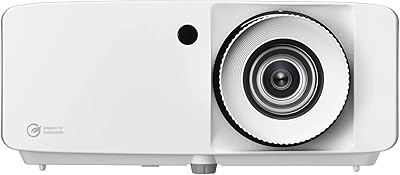
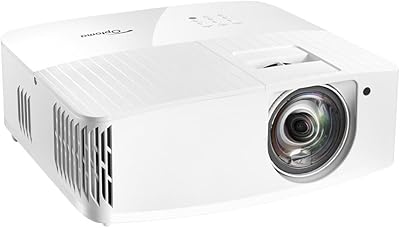
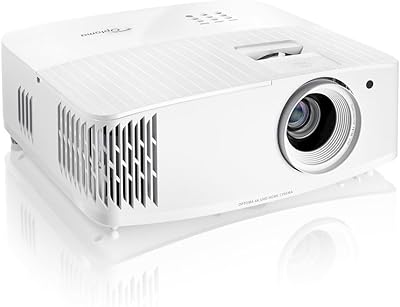
The Optoma UHD38X 4K UHD Projector sits in an interesting spot in the market — bright enough for a living room setup, fast enough for serious gaming, and compact enough to not dominate a shelf. It's not the projector for the purist who wants absolute black levels and total darkness; this Optoma gaming projector is built for people who actually use their space. Rated 3.9 out of 5 stars across nearly 340 reviews, it's well-regarded but not without trade-offs. The honest read: it excels in active, mixed-use environments and rewards buyers who know what they're asking of it.
Features & Benefits

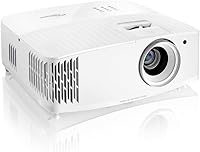
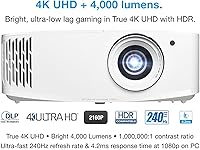
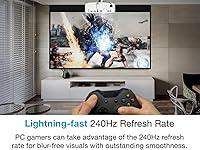
At its core, what separates the UHD38X from cheaper 4K options is the combination of brightness and speed. With 4000 lumens on tap, you can watch in a room with the curtains open — a genuine rarity among projectors at this size and price point. The 240Hz refresh rate at 1080p, paired with a 4.2ms input lag, makes this one of the most responsive projectors you'll find for console or PC gaming. Throw in HDR10 and HLG support, flexible optical zoom, and ±40° vertical keystone correction, and installation becomes far less of a headache than with most standard-throw units. Connectivity is thorough too: dual HDMI 2.0 ports, optical audio output, and even a 12V trigger for smarter home setups.

Best For

The UHD38X really earns its keep for a specific kind of buyer. Competitive gamers who want a large-screen experience — think PS5 or Xbox on a 120-inch image — without the input lag penalty most projectors impose will find this hard to beat. It's equally well-suited to sports fans and casual movie watchers who refuse to black out their living rooms just to get decent picture quality. First-time projector buyers upgrading from a TV will appreciate the straightforward setup and installation flexibility. If you're a dedicated cinephile seeking the deepest blacks and most accurate HDR rendering, this 4K DLP projector may leave you wanting more — but for everyone else, it covers a lot of ground.

User Feedback

Across reviews, a clear pattern emerges. Owners consistently praise the brightness and smoothness, with many noting how well it holds up in rooms that aren't purpose-built for projection. The setup experience gets positive marks too, with the zoom and keystone adjustments saving real frustration. On the downside, fan noise at higher brightness levels is a recurring complaint — noticeable enough to bother some users during quiet scenes. Built-in audio is minimal, so a separate sound solution is essentially required. A number of buyers have also flagged lamp longevity concerns, which is worth keeping in mind — lamp replacement is an eventual reality with any DLP projector of this type.

Pros

  • At 4000 lumens, the UHD38X delivers one of the brightest pictures available in a standard-throw 4K projector at this price tier.
  • A 4.2ms input lag at 1080p 240Hz makes this Optoma gaming projector genuinely competitive for fast-paced gaming sessions.
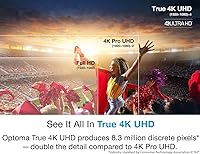
  • True 4K UHD resolution produces sharp, detailed images that hold up well on screens up to 120 inches.
  • The 1.1x optical zoom and ±40° vertical keystone correction make placement far more forgiving than most comparable projectors.
  • Dual HDMI 2.0 ports with HDCP 2.2 support mean you can keep a console and a streaming device connected simultaneously.
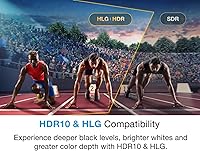
  • HDR10 and HLG compatibility adds meaningful dynamic range improvement over SDR content when the source material supports it.
  • Lamp life rated up to 15,000 hours means years of regular use before a replacement becomes necessary.
  • At roughly 10 pounds, the UHD38X is portable enough to move between rooms or pack for a backyard setup without much hassle.
  • Setup receives consistent praise from owners — the controls are intuitive and the image adjustments work as advertised.
  • The optical audio output and 12V trigger make it a practical fit for buyers integrating this into a broader home theater system.

Cons

  • Fan noise at higher brightness levels is noticeable enough to be distracting during quiet scenes or dialogue-heavy content.
  • Built-in speakers are essentially unusable for any serious viewing — a separate audio solution is a near-mandatory additional purchase.
  • HDR tone mapping out of the box requires manual calibration to get the best results; default settings disappoint some buyers.
  • Input lag at native 4K rises to 16.7ms, which is acceptable but noticeably slower than the headline 1080p gaming figure.
  • Being a lamp-based projector, bulb replacement is an eventual cost that laser alternatives avoid entirely.
  • The 1.1x zoom range is useful but limited; buyers with unusual room dimensions may still struggle to find an ideal placement.
  • Color accuracy in cinema modes has drawn criticism from more discerning viewers who compare it against dedicated home theater units.
  • No smart TV functionality is built in, so a streaming stick or external media player is required for app-based content.
  • The contrast ratio, while strong on paper, can feel less impressive in dark scenes compared to projectors using newer light sources.
  • At 10.1 pounds, it is manageable but not as ultraportable as some rivals that target similar mixed-use audiences.

Ratings

The scores below reflect an AI-driven analysis of verified global buyer reviews for the Optoma UHD38X 4K UHD Projector, with spam, bot activity, and incentivized feedback actively filtered out before scoring. Each category is rated to transparently surface both what this Optoma gaming projector does genuinely well and where real buyers have run into friction. The result is an honest, composite picture of ownership — not a marketing summary.

Gaming Performance
91%
Among projectors, the UHD38X sits at the top tier for gaming responsiveness. Buyers running PS5 and Xbox Series X consistently praise the smoothness at 1080p 240Hz, and the 4.2ms input lag is something most of them didn't expect to find outside a dedicated gaming monitor. Fast-paced titles feel genuinely reactive at this screen size.
At native 4K the input lag climbs to 16.7ms, which is fine for casual play but may frustrate competitive players who insist on the lowest latency possible at all times. A small number of users also noted that switching between gaming and cinema modes requires a manual reset that some found fiddly.
Brightness & Ambient Light Handling
88%
Four thousand lumens is a meaningful number in practice — owners report being able to watch sports and game in rooms with curtains partially open without the image washing out. This is the feature that most frequently surprises first-time buyers who expected to need a blacked-out room.
At maximum brightness the fan ramps up considerably, which creates a trade-off between image punch and acoustic comfort. A handful of users also noted that sustained use at peak brightness led to faster-than-expected lamp dimming over the first year of ownership.
Picture Clarity & Resolution
86%
The native 4K DLP panel produces genuinely sharp edges and fine detail that scales well up to 120-inch images without obvious softness. Text, stadium crowd detail in sports, and texture in games all benefit from the resolution bump over 1080p projectors in the same price range.
Some viewers feel the out-of-box sharpness settings are pushed a touch too hard, creating a slightly artificial edge-enhancement look on cinematic content. Adjusting the image processor settings helps, but it requires time with the menus that not every buyer wants to spend.
HDR Performance
63%
37%
HDR10 and HLG support is present and does lift compatible content above SDR in visible ways — highlights pop more and gradients look smoother when the source is a properly mastered HDR stream or disc. Buyers coming from a 1080p projector will notice the difference.
Buyers arriving from an OLED or high-end LCD TV will find the HDR tone mapping underwhelming without calibration. Bright highlights can clip awkwardly and shadow detail in dark scenes suffers more than it should. This is a known limitation of lamp-based projectors at this tier and the UHD38X is not an exception.
Fan Noise
54%
46%
In eco or reduced brightness modes, the fan runs at an acceptable level and most users report it fading into the background after a few minutes of watching. For gaming sessions where audio is coming through a soundbar anyway, it rarely registers as an issue.
At full brightness, the fan noise is consistently flagged in negative reviews — it's audible over dialogue in quiet scenes and can be genuinely distracting in a small room. This is the single most common complaint across the entire review set and it pulls the overall owner satisfaction score down meaningfully.
Installation Flexibility
82%
18%
The combination of 1.1x optical zoom and ±40° vertical keystone correction gives buyers real options when placing this projector in rooms that weren't designed for projection. Multiple owners cite this as a reason the setup process went smoother than expected.
The 1.1x zoom range is on the narrow side, so buyers with unusual room dimensions or fixed furniture layouts may still find themselves constrained. Lens shift is not available, which puts more reliance on keystone correction — and heavy keystone adjustment does reduce image quality slightly.
Build Quality & Design
77%
23%
The chassis feels solid and well-assembled out of the box, and at 10.1 pounds it sits in a comfortable middle ground between desktop and portable use. The matte finish resists fingerprints reasonably well and the overall footprint is compact for what the projector delivers.
A few buyers have noted that the input panel layout feels cramped when multiple cables are connected simultaneously. The remote control, while functional, feels noticeably cheaper than the projector itself and a few owners reported button responsiveness issues over time.
Built-in Audio
31%
69%
There is technically a built-in speaker and it handles basic system sounds and menu navigation without issue. For a temporary or portable setup in a pinch, it can produce speech intelligibility at close range.
Virtually every owner who comments on audio describes it as inadequate for any real content consumption. It lacks bass, distorts at higher volumes, and provides no stereo separation. An external audio solution — whether a soundbar or AV receiver — is effectively mandatory for this projector to reach its potential.
Connectivity
84%
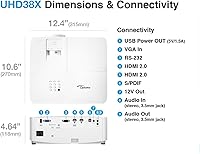
Two HDMI 2.0 ports with HDCP 2.2 means you can keep a game console and a streaming source connected at the same time without swapping cables. The optical audio output, 12V trigger, and RS-232C port make it genuinely useful in more advanced home theater setups.
There is no Wi-Fi or Bluetooth built in, so all content delivery requires a physical connection or an external streaming device. VGA input, useful for older laptops and office use, is also absent on this model, which is a minor but real gap for some buyers.
Setup & Ease of Use
81%
19%
Most buyers describe the initial setup as approachable — the menus are logically organized and the keystone and zoom controls are easy to locate. First-time projector owners particularly appreciate that the image calibration doesn't require professional tools to get to a watchable result.
Dialing in the full picture quality — color temperature, gamma, HDR tone mapping — does require patience and some baseline knowledge. Buyers who expect a plug-and-play experience may find the default settings leave room for improvement that takes time to address.
Value for Money
74%
26%
For buyers whose primary use case is gaming or sports in a bright room, the UHD38X delivers a combination of specs that would cost significantly more in competing models. The 240Hz capability and high lumen output at this price tier represent genuine engineering value.
For buyers who lean toward cinematic use, the money spent here buys a projector that falls short on HDR accuracy and audio in ways that matter. Factoring in the eventual lamp replacement cost also softens the long-term value proposition compared to laser alternatives that are beginning to close the price gap.
Lamp & Long-term Reliability
67%
33%
The 15,000-hour lamp rating is generous and for typical household use translates to many years before replacement becomes necessary. A majority of owners have not experienced lamp failure within the standard review window and praise the projector's consistency over time.
A meaningful minority of reviewers report noticeable brightness degradation before the rated lamp life is reached, particularly among users who run the projector at maximum brightness regularly. Lamp replacement costs are real and should be factored into the total cost of ownership from the start.
4K Content Compatibility
79%
21%
The dual HDMI 2.0 ports with HDCP 2.2 compliance mean 4K Blu-ray players, streaming sticks, and current-gen consoles all work without handshake issues. Most buyers report a smooth plug-and-play experience with major 4K sources.
Some users encountered HDCP negotiation hiccups with specific streaming devices that required cycling power or switching HDMI ports to resolve. These issues appear device-specific rather than systemic but are worth knowing about if you use a less common streaming source.

Suitable for:

The Optoma UHD38X 4K UHD Projector is a strong match for anyone who wants a large-screen experience without engineering their living space around it. Gamers — whether on a PS5, Xbox, or PC — will appreciate the 240Hz refresh rate at 1080p and the 4.2ms input lag, which is genuinely competitive even against high-end gaming monitors at this screen size. Sports fans who gather in rooms with ambient light will benefit from the 4000-lumen output, which keeps the image punchy and readable without forcing everyone to sit in the dark. It also makes a compelling first projector for buyers upgrading from a large TV, since setup is approachable and the optical zoom plus vertical keystone correction give real flexibility on placement. If your household uses the same screen for weekend gaming, movie nights, and the occasional big match, this 4K DLP projector handles that rotation without obvious compromise.
Not suitable for:

The Optoma UHD38X 4K UHD Projector is not the right tool for the dedicated home cinema enthusiast who prioritizes absolute picture accuracy above all else. Its HDR tone mapping, while functional, does not match what laser or higher-end lamp projectors can achieve in a properly darkened room — buyers expecting reference-level HDR performance will likely walk away underwhelmed. The built-in audio is minimal to the point of being a placeholder, so anyone without a separate sound system will need to budget for one immediately. Fan noise at peak brightness is a genuine issue in quiet viewing environments, which can undercut the immersion that a large screen is supposed to create. Long-term cost is also a factor: this is a lamp-based unit, and eventual bulb replacement is a real maintenance consideration that buyers on tight ongoing budgets should factor in before purchasing.
Specifications

  • Resolution: The projector outputs native 4K UHD at 3840x2160 pixels using DLP technology for sharp, detailed imagery across the full screen.
  • Brightness: Rated at 4000 ANSI lumens, which is high enough to maintain a watchable image in rooms with ambient light present.
  • Contrast Ratio: Specified at 1,000,000:1, which on paper supports deep blacks and strong highlight separation in compatible content.
  • Refresh Rate: Supports up to 240Hz at 1080p resolution, dropping to standard rates at native 4K for most content sources.
  • Input Lag: Measured at 4.2ms in Enhanced Gaming Mode at 1080p 240Hz, and 16.7ms at 4K UHD for console and PC use.
  • HDR Support: Compatible with HDR10 and HLG formats, providing improved dynamic range when paired with a compatible HDR source.
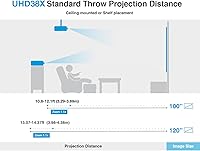
  • Throw Distance: Projects a 120″ image from approximately 13.1 feet away, making it a standard-throw unit suited to mid-sized rooms.
  • Optical Zoom: Features 1.1x optical zoom, allowing minor adjustment of image size without physically relocating the projector.
  • Keystone Correction: Offers ±40° vertical keystone correction to compensate for off-axis placement and reduce geometric image distortion.
  • Lamp Life: Rated up to 15,000 hours in the appropriate power mode, though real-world longevity varies with brightness settings used.
  • Connectivity: Includes 2x HDMI 2.0 with HDCP 2.2, USB 2.0 service port, USB power output at 5V 1.5A, RS-232C, and a 12V trigger.
  • Audio I/O: Equipped with a 3.5mm audio input, 3.5mm audio output, and an S/PDIF optical audio output for external sound systems.
  • Display Type: Standard-throw DLP projector designed for placement roughly 10 to 14 feet from the projection surface in typical installs.
  • Dimensions: The unit measures 10.6 x 12.4 x 4.6 inches, keeping it reasonably compact for a full-spec 4K DLP projector.
  • Weight: Weighs 10.1 pounds, making it manageable for repositioning but better suited to a semi-permanent shelf or mount setup.
  • Light Source: Uses a traditional lamp-based light source, which will require bulb replacement at some point during the projector's lifespan.
  • Technology: Built on DLP (Digital Light Processing) projection technology, which typically delivers sharp edges and reliable color consistency over time.
  • Model Number: The official model designation is UHD38X-SL, which distinguishes it from adjacent models in the Optoma UHD lineup.

Related Reviews

Optoma UHZ66 4K Laser Projector
77%
93%
Image Quality
89%
Brightness Performance
88%
Build Quality
91%
Installation Flexibility
83%
Gaming Performance
More
Optoma UHD35STX Short Throw 4K Projector
72%
88%
Short Throw Performance
83%
Image Sharpness & 4K Detail
84%
Gaming Responsiveness
61%
Brightness & Ambient Light Handling
67%
Color Accuracy
More
Optoma UHD35X 4K DLP Projector
69%
88%
Image Sharpness
79%
Brightness Performance
71%
Contrast & Black Levels
63%
Color Accuracy
82%
Gaming Performance
More
GooDee GD500PLUS 4K Google TV Smart Projector
73%
88%
Smart Platform & App Ecosystem
71%
Picture Quality
58%
Brightness & Ambient Light Performance
79%
Auto Focus & Keystone Correction
66%
Built-in Audio
More
LG CineBeam HU70LAB 4K UHD Projector
76%
88%
Image Quality
58%
Brightness & Ambient Light
91%
Color Accuracy
63%
Setup & Installation
79%
Smart Platform & Apps
More
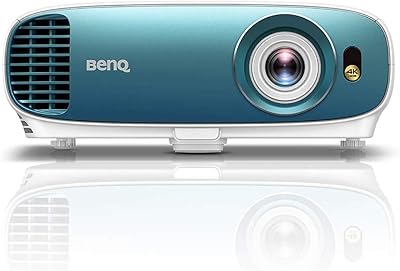
BenQ TK800M 4K UHD Home Theater Projector
86%
93%
Picture Quality
89%
Brightness
91%
Gaming Performance (Low Input Lag)
85%
Ease of Setup
88%
Connectivity Options
More
Epson Home Cinema 5050UB 4K Projector
77%
93%
Image Quality
91%
Color Accuracy
89%
Contrast & Black Levels
87%
HDR Performance
84%
Installation Flexibility
More
Epson Home Cinema 3200 4K PRO-UHD Projector
83%
93%
Image Quality
89%
Brightness Performance
74%
Ease of Setup
91%
HDR Performance
88%
Gaming Performance
More
Epson Home Cinema 3800 4K Projector
75%
93%
Color Accuracy
91%
Brightness Performance
78%
Image Sharpness & 4K Detail
82%
HDR Performance
84%
Contrast & Black Levels
More
LG HU810PW 4K Dual Laser CineBeam Projector
77%
94%
Picture Quality
92%
Color Accuracy
88%
Contrast & Black Levels
71%
Brightness & Ambient Light Handling
86%
HDR Performance
More

FAQ

Yes, and honestly that's one of its stronger selling points. At 4000 lumens, the UHD38X holds up well in rooms with some ambient light — curtains drawn but lights partially on is a realistic use case. A fully lit room will still wash out the image somewhat, but it performs better than most projectors in its class under mixed lighting conditions.

For most gamers, yes. The Optoma UHD38X 4K UHD Projector hits 4.2ms input lag at 1080p 240Hz in Enhanced Gaming Mode, which is quick enough for fast-paced titles on PS5 or Xbox. At native 4K, lag rises to around 16.7ms — still playable, but not the headline number. If you game primarily at 1080p, the performance is genuinely impressive for a projector.
Practically speaking, yes. The built-in audio on this 4K DLP projector is minimal and not intended for serious listening. Most buyers pair it with a soundbar, AV receiver, or external speakers using the 3.5mm audio output or the optical S/PDIF port. Budget for that separately if you haven't already.

You'll need about 13.1 feet of throw distance to hit a 120-inch image. The 1.1x optical zoom gives you a little flexibility around that figure, but you should measure your room carefully before purchasing — especially if your seating arrangement is fixed.

Fan noise is one of the more consistent criticisms from real owners. At higher brightness settings, the fan is audible — enough to notice during quiet moments in a film or during pauses in a game. If you plan to use it at full brightness in a small or acoustically quiet room, it's worth being aware of going in.

It's functional but not exceptional. HDR10 and HLG support means compatible content does look noticeably better than SDR, but the tone mapping out of the box tends to need some manual adjustment to really shine. If you're coming from a high-end OLED TV and expecting that level of HDR precision, this projector will feel like a step down in that specific area.

Optoma rates the lamp at up to 15,000 hours, which translates to years of regular use for most households. That said, lamp brightness gradually fades before it fails outright, so you may notice the image getting dimmer before any sudden cutout. Replacement lamps typically run between 70 and 150 dollars depending on the source, so it's a real but manageable long-term cost.

Yes, the UHD38X supports ceiling mounting and the vertical keystone correction helps dial in the geometry once it's installed. You'll want a compatible third-party mount — Optoma doesn't bundle one in the box. If you plan to mount it, factor in the roughly 10-pound weight when selecting a bracket.

Absolutely. There's a USB power port rated at 5V 1.5A on the unit, which is enough to power most streaming sticks like a Fire Stick or Chromecast. Plug the stick into one of the HDMI 2.0 ports and power it via USB, and you've got a self-contained streaming setup without running extra cables.

It depends on your priorities. If you want a significantly larger image and you're okay with adding a soundbar and spending a bit of time on calibration, the transition is very manageable — most TV users find the UHD38X setup straightforward. Where it won't match a good TV is in absolute contrast, black depth, and out-of-box color accuracy. But for sheer screen size and gaming responsiveness at this price point, it's a compelling step up.

Where to Buy