Overview

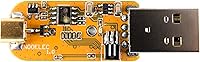
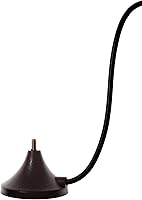
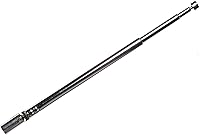
The NooElec NESDR XTR+ RTL-SDR USB Stick sits in an interesting spot in the SDR market — it is not the cheapest dongle you will find, but it is meaningfully better than the bare-bones sticks flooding budget listings. The key differentiators are a genuine E4000 tuner and a temperature-compensated crystal oscillator, two features that push this well beyond what a typical R820T2-based stick can offer. It ships with a basic antenna and a remote control, which gets you on the air quickly, though serious operators will want better antenna hardware before long. Think of it as a capable, stable entry point for anyone who wants real performance without building a custom setup from scratch.
Features & Benefits

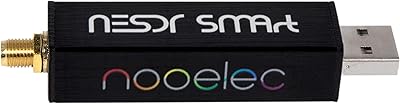
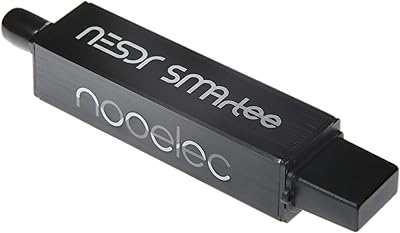
The 0.5PPM TCXO clock is arguably the most important thing about this RTL-SDR dongle. If you have ever watched a signal drift across the waterfall while trying to decode a narrow-band transmission, you will immediately appreciate what a stable oscillator does for you — it just stays put. The E4000 tuner extends usable reception well past 1GHz, reaching beyond 2300MHz, which most R820T2 sticks simply cannot match. Dual ESD protection on the antenna port adds real peace of mind during outdoor sessions. The stick itself is tiny enough to stay out of the way on a crowded USB port. Software setup via SDR# or GNU Radio is not automatic — expect to install drivers manually — but it works solidly once configured.

Best For

This SDR stick earns its keep across a surprisingly wide range of use cases. ADS-B aviation tracking is an obvious fit — the E4000 reach above 1GHz makes reliable aircraft position decoding genuinely practical. Weather satellite reception from NOAA and METEOR-M birds is another strong use case, where both frequency coverage and oscillator stability directly affect image quality. Amateur radio operators who want to explore the wider spectrum without committing to a full transceiver will find the NESDR XTR+ a cost-effective listening tool. Its small footprint and low USB power draw also make it well-suited for field use with a laptop. Beginners are welcome, but expect to spend time with documentation before getting the most out of it.

User Feedback

Experienced SDR users tend to be the most enthusiastic about this RTL-SDR dongle, largely because they understand exactly how rare a verified E4000 chip has become. Long-term owners consistently cite frequency stability and solid build quality as standouts. Criticism tends to cluster around two areas: the bundled antenna, which works but will not satisfy anyone serious about signal quality, and the initial driver and software configuration, which can trip up newcomers on Windows and macOS alike. A few users have flagged compatibility quirks on newer operating systems. Casual buyers who expected a plug-and-play experience often rate it lower than hobbyists who came prepared. Go in knowing it requires some setup effort and satisfaction levels are markedly higher.

Pros

  • The genuine E4000 tuner delivers frequency coverage past 2300MHz, a range most competing sticks cannot reach.
  • A 0.5PPM TCXO clock keeps signals locked during narrow-band decoding and long monitoring sessions.
  • Dual ESD protection on the antenna port adds real durability for outdoor and field use.
  • Long-term owners consistently report reliable performance years after purchase with no degradation.
  • The tiny footprint stays out of the way on a laptop without blocking adjacent USB ports.
  • Works across SDR#, GQRX, and GNU Radio once drivers are properly installed.
  • The NESDR XTR+ is one of the few readily available dongles still shipping with a verified E4000 chip.
  • Low USB power draw makes it practical for battery-powered Raspberry Pi or field setups.
  • Solid build quality feels noticeably more substantial than bargain-tier RTL-SDR alternatives.

Cons

  • Driver installation on Windows requires manual steps using third-party tools — it is not automatic.
  • The bundled antenna is a starting point only; useful reception above VHF demands a separate antenna investment.
  • A tuning gap around 1100MHz to 1250MHz is a hard hardware limitation of the E4000 chip.
  • Newcomers to SDR software face a steep learning curve before getting a stable, working setup.
  • Community support is extensive but scattered, making it hard for beginners to find the right guidance quickly.
  • On ultrabooks with closely spaced ports, the dongle can partially obstruct adjacent connectors.
  • Occasional packaging inconsistencies have resulted in loose antenna connections or missing remote batteries.
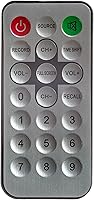
  • The included remote control adds little practical value for most real-world SDR use cases.
  • Casual buyers focused only on basic broadcast reception will find the premium over budget dongles difficult to justify.

Ratings

Our AI rating system analyzed thousands of verified global reviews for the NooElec NESDR XTR+ RTL-SDR USB Stick, actively filtering out incentivized, duplicate, and bot-generated feedback to surface what real hobbyists and radio operators actually experience. The scores below reflect both the genuine strengths that keep enthusiasts coming back and the recurring friction points that prospective buyers deserve to know about upfront. Nothing has been softened or inflated — the numbers tell the honest story.

Frequency Stability
93%
The 0.5PPM TCXO clock is consistently praised by users who work with narrow-band signals, WSPR decoding, or ADS-B feeds. Operators report that signals stay locked on frequency for extended sessions without manual correction, which makes a real difference when monitoring weak or drifting transmissions.
A small number of users noted that in very high-temperature environments — leaving the stick inside a car during summer field sessions, for example — even the TCXO showed minor drift. It is uncommon, but worth noting for anyone planning extended outdoor use in heat.
Tuner Range & Coverage
91%
The genuine E4000 chip is the reason many buyers choose this over cheaper alternatives. Its coverage stretching past 2300MHz opens up satellite, aviation, and L-band reception that R820T2-based sticks simply cannot reach, and experienced users treat that extended ceiling as a non-negotiable feature.
There is a known gap in the E4000 tuning range (roughly 1100MHz to 1250MHz) that affects certain use cases. Users targeting that specific band were caught off guard, and the product listing does not call this out clearly enough for newcomers to anticipate it.
Build Quality
88%
The dongle feels noticeably more solid than bargain-bin RTL-SDR sticks, and the dual ESD protection on the antenna port gives outdoor users legitimate confidence when hot-plugging antennas in the field. Long-term owners frequently mention that units purchased years ago are still performing reliably.
The plastic shell, while better than most at this price tier, is not rugged enough for rough handling or repeated drops. A few users working in field environments wished the casing were more resistant to physical stress, particularly around the USB connector.
Software Compatibility
72%
28%
Once properly configured, the NESDR XTR+ works well across SDR#, GQRX, and GNU Radio on all major platforms. Users who took the time to follow NooElec's driver installation guides consistently report stable, low-error operation over long sessions.
Getting there is a real hurdle for newcomers. Driver installation on Windows 11 and recent macOS versions requires manual steps using Zadig or similar tools, and several reviewers described multi-hour troubleshooting sessions before achieving a working setup. It is not plug-and-play, full stop.
Value for Money
83%
For buyers who specifically need the E4000 tuner — which has been genuinely scarce since production was discontinued and then selectively resumed — the price reflects real component value rather than brand markup. Experienced SDR users see it as a fair trade for a stable, wide-range dongle.
Casual buyers who compare it directly to sub-20-dollar RTL-SDR sticks often feel the premium is hard to justify if they are only doing basic FM listening or DVB-T. The value proposition is real but depends entirely on whether the buyer actually needs what makes this stick different.
Bundled Antenna Quality
54%
46%
The included antenna is adequate for getting started and picking up strong local signals right out of the box. For a first session exploring broadcast FM, aviation transmissions, or local repeaters, it does the job well enough to demonstrate the dongle's capabilities.
Practically every experienced user treats the bundled antenna as a placeholder. Reception on anything above 300MHz is noticeably limited, and anyone serious about weather satellites, ADS-B, or L-band work will need to invest in a dedicated antenna almost immediately. The remote control inclusion is similarly of limited practical use.
Size & Portability
89%
The compact footprint is a genuine advantage for laptop users. It sits flush enough on most USB ports that closing a bag or moving around does not require removing it, and it draws little enough power that battery-sensitive field setups are not meaningfully impacted.
The small size is occasionally a double-edged quality — on ultrabooks with closely spaced ports, the dongle can partially block an adjacent USB slot. A short extension cable resolves this, but it is an extra accessory purchase that should not be necessary.
Signal Sensitivity
81%
19%
With a quality external antenna attached, users report clean, low-noise reception across a wide range of frequencies. Weak-signal work on HF upconverter setups and satellite passes both benefit from the dongle's solid noise floor performance compared to cheaper alternatives.
Without a low-noise amplifier, the NESDR XTR+ shows its limits on very weak signals from distant satellites or marginal propagation paths. Some users expected better sensitivity out of the box and were surprised that antenna and LNA investment is still necessary for demanding applications.
Driver & Firmware Support
69%
31%
NooElec provides reasonably detailed documentation, and the broader RTL-SDR community has produced extensive guides, YouTube tutorials, and forum threads that help users navigate setup issues. The dongle is recognized by librtlsdr without modification on Linux, which experienced operators appreciate.
Official support responsiveness has been described as inconsistent in recent user reports, and there is no automated installer that handles edge cases on newer OS builds. Users on Windows 11 ARM or M-series Macs have reported needing community workarounds rather than official fixes.
Heat Management
74%
26%
Under normal desktop or light field use, the dongle runs at a comfortable temperature and does not throttle or lose lock. Users running it through multi-hour ADS-B or APRS monitoring sessions on a ventilated desk generally report no thermal issues.
During extended high-gain sessions — particularly when paired with active antennas in warm environments — the stick gets noticeably warm to the touch. A handful of users reported performance degradation during prolonged high-demand use, suggesting thermal throttling under stress.
Plug & Play Experience
47%
53%
On Linux systems with a current kernel, the device is recognized immediately without any manual driver work, which is a genuine convenience for users already in that ecosystem. Experienced SDR operators across platforms know the setup dance and complete it quickly.
For Windows users with no prior SDR experience, the initial setup is a real barrier. The dongle does not function like a standard USB device — it requires replacing the default Windows driver using a third-party tool — and that process discourages a meaningful portion of first-time buyers.
Long-Term Reliability
86%
Owners who have used the NESDR XTR+ for two or more years consistently report that it continues to perform at the same level as when new. The ESD protection appears to be doing its job — antenna-related failures are rare in reviews compared to unprotected competitors.
A small cluster of reviews described unit failures after one to two years of daily use, typically manifesting as the device becoming unrecognized by the host system. Whether this reflects a production batch issue or normal attrition is unclear from the available data.
Community & Ecosystem Support
91%
The RTL-SDR and NooElec communities are among the most active in the amateur radio hardware space. Whether the question is about software configuration, antenna selection, or decoding a specific signal type, answers are readily available on forums, subreddits, and dedicated wikis.
The depth of community knowledge is itself a mild barrier — the sheer volume of guides and conflicting advice can overwhelm newer users who are not sure which instructions apply to their specific OS version or use case, making the learning curve feel steeper than it needs to be.
Packaging & Unboxing
77%
23%
The dongle arrives well-protected and includes all advertised accessories without damage in the overwhelming majority of user reports. The presentation is clean enough that it makes a reasonable gift for a hobbyist, and the included items are laid out logically.
A few buyers received units where the antenna connection was loose or the remote control was missing a battery, suggesting occasional quality control inconsistency at the packaging stage rather than with the dongle itself. NooElec support reportedly resolved these cases, but it added friction.

Suitable for:

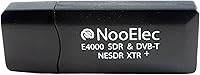
The NooElec NESDR XTR+ RTL-SDR USB Stick is genuinely well-matched to hobbyists and technically curious buyers who want more than what a generic SDR dongle can offer. If you are into ADS-B aircraft tracking, the E4000 tuner's reach past 1GHz makes reliable position decoding practical in a way that cheaper sticks with limited frequency ceilings simply cannot match. Weather satellite enthusiasts chasing NOAA or METEOR-M image passes will also find the combination of wide coverage and a stable TCXO clock directly beneficial — signal drift during a satellite pass is the difference between a clean image and a corrupted one. Amateur radio operators who want to explore the spectrum without committing to an expensive transceiver will appreciate having a stable, wide-range listening tool that works across all major SDR software platforms. The compact size and low power draw make it a natural fit for portable setups, whether that means a laptop in the field or a Raspberry Pi-based monitoring station running around the clock.
Not suitable for:

The NooElec NESDR XTR+ RTL-SDR USB Stick is likely the wrong choice if you are expecting a truly plug-and-play experience, especially on Windows 11 or recent macOS builds where manual driver installation using tools like Zadig is still a required step. Buyers who only want to watch free-to-air DVB-T television or casually scan FM radio broadcasts will find the price hard to justify compared to sub-20-dollar alternatives that handle those tasks just as well. If your target frequencies fall in the roughly 1100MHz to 1250MHz range, be aware that the E4000 chip has a known tuning gap in that band — it is a hardware limitation that no software workaround will fix. Users who are not prepared to invest in a separate, purpose-built antenna will also be left underwhelmed; the bundled antenna is a functional placeholder at best, and serious reception on anything above VHF really demands better hardware. Anyone looking for a truly portable device without needing to troubleshoot documentation or community forums at the start should look at more beginner-oriented SDR kits first.
Specifications

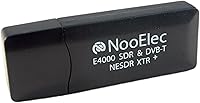
  • Tuner IC: Uses a genuine E4000 tuner integrated circuit, which provides an extended receiving range that reaches beyond 2300MHz.
  • Chipset: Built around the RTL2832U demodulator chipset, the standard foundation for RTL-SDR software-defined radio applications.
  • Frequency Range: Capable of receiving signals from approximately 52MHz up to 2300MHz and beyond, depending on signal strength and antenna quality.
  • Clock Type: Equipped with a Temperature-Compensated Crystal Oscillator (TCXO) for significantly improved frequency stability compared to standard crystal oscillators.
  • Clock Accuracy: The TCXO is rated at 0.5PPM accuracy, meaning frequency drift is minimal even during extended monitoring sessions or in varying temperatures.
  • ESD Protection: Features dual electrostatic discharge protection circuits on the antenna input port to guard against voltage spikes from antenna connections.
  • Interface: Connects to a host device via standard USB, compatible with USB 2.0 and USB 3.0 ports.
  • Dimensions: The dongle itself measures approximately 1.69″ in length, 0.79″ in width, and 0.39″ in height.
  • Weight: Complete package weight is 2.82 ounces, making it light enough for portable and field-based setups.
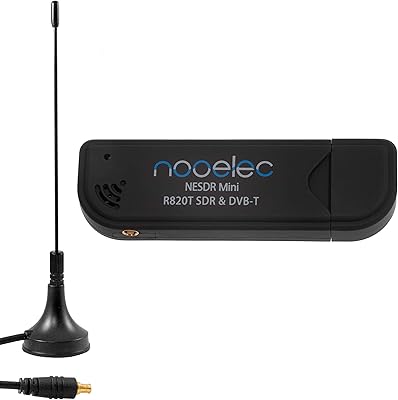
  • Package Contents: Includes the NESDR XTR+ dongle, one television-type antenna with base, and a remote control.
  • Channels: Supports up to 5 channels as specified in the product configuration.
  • Color: The dongle shell is black with standard USB connector hardware.
  • Manufacturer: Designed and sold by NooElec Inc., a company specializing in SDR hardware and accessories.
  • Model Number: Official model designation is NESDR XTR+, distinguishing it from other sticks in the NooElec NESDR product line.
  • OS Compatibility: Compatible with Windows, Linux, and macOS, though driver installation steps vary by operating system and version.
  • Software Support: Works with popular SDR applications including SDR#, GQRX, GNU Radio, and SDR-Console after appropriate driver configuration.
  • Availability Date: This product was first made available for purchase on August 30, 2015, and remains an active, non-discontinued item.
  • Market Ranking: Holds a Best Sellers Rank of number 30 in the Satellite Television Receivers category on Amazon at time of review.

Related Reviews

NooElec RTL-SDR TV28Tv2
81%
82%
Out-of-Box Setup Experience
88%
Frequency Range & Coverage
74%
Signal Sensitivity
71%
Frequency Stability & Drift
83%
Build Quality & Hardware Protection
More
NooElec NESDR Mini 2+
82%
93%
Frequency Accuracy & Stability
91%
Value for Money
88%
Signal Reception Quality
54%
Stock Antenna Quality
67%
Ease of Setup
More
NooElec NESDR Nano 2 Plus
80%
91%
Signal Stability
94%
Portability & Form Factor
83%
Receiver Sensitivity
88%
Frequency Coverage
89%
Platform Compatibility
More
Nooelec NESDR SMArt RTL-SDR v5
87%
91%
Signal Performance
87%
Build Quality
92%
Value for Money
88%
Usability
84%
Software Compatibility
More
NooElec NESDR SMArTee v2 SDR
86%
94%
Signal Reception & Precision
88%
Ease of Setup & Installation
90%
Build Quality & Durability
75%
Software Compatibility
85%
Power Supply & Bias Tee Functionality
More
FixMeStick Gold Computer Virus Removal Stick for Windows PCs - 8GB USB
84%
91%
Effectiveness at Removing Malware
94%
Ease of Use
88%
Compatibility with Windows PCs
75%
Scan Speed
98%
Setup and Installation
More
Zooz ZST39 800 Series Z-Wave USB Stick
78%
91%
Z-Wave Range Performance
88%
Software Compatibility
58%
Setup & Configuration Experience
63%
Firmware Update Process
84%
Build Quality & Form Factor
More
RTL-SDR Blog V3 R860 RTL2832U 1PPM TCXO SMA Software Defined Radio Dongle
85%
85%
Performance
88%
Signal Quality
90%
Ease of Setup
84%
Build Quality
92%
Accuracy (TCXO)
More
Peavey USB-P
Peavey USB-P
89%
96%
Noise Isolation
94%
Build Quality
98%
Ease of Use
87%
Portability
83%
Value for Money
More
ySky 512GB Dual-Interface USB-C Flash Drive
78%
78%
Transfer Speed
91%
Dual Connector Design
88%
Build Quality
86%
iPhone 15 Compatibility
93%
Portability
More

FAQ

You will need to install drivers before it functions as an SDR device — it does not behave like a standard plug-and-play USB stick. On Windows, you typically need to use a tool called Zadig to replace the default driver. Linux users generally have an easier time since the device is recognized by the kernel automatically. NooElec provides setup guides on their website, and the broader RTL-SDR community has extensive tutorials to walk you through the process.

The main advantage is frequency range. Most budget sticks top out somewhere around 1700MHz, while the E4000 pushes coverage well past 2300MHz. That higher ceiling matters a lot for applications like L-band satellite reception, certain aviation bands, and wideband spectrum exploration. The E4000 has also been genuinely hard to source in verified form, so finding one in a reputable dongle is worth something on its own.

It is good enough to confirm the dongle works and to pick up strong local signals, but it will limit your results on more demanding applications. For ADS-B tracking, a dedicated 1090MHz antenna makes a noticeable difference in range and aircraft count. For weather satellites, a proper turnstile or quadrifilar helix antenna is really the standard. Think of the bundled antenna as a proof-of-concept tool rather than a long-term solution.

It can work, but the setup is not straightforward. Community-maintained builds of librtlsdr and compatible SDR software exist for Apple Silicon, and many users have reported success, but there is no official one-click installer from NooElec for that platform. If you are comfortable with Homebrew and terminal commands, you should be able to get it running. If you are not, be prepared for some troubleshooting time.

The E4000 tuner has a hardware blind spot roughly between 1100MHz and 1250MHz where it cannot tune reliably. This is not a defect in this specific dongle — it is a characteristic of the E4000 chip itself. If your target signals fall in that range, the NooElec NESDR XTR+ RTL-SDR USB Stick is not the right tool for that particular application, and a dongle with an R820T2 or Rafael Micro R828D tuner would be a better fit.
Yes, and this is actually one of the more popular use cases for this dongle. It works well with software like dump1090, Direwolf, and rtl_433 on Raspberry Pi OS. The low power draw is a practical benefit here since it does not stress a Pi's USB power budget the way some other USB devices can. Many long-running community monitoring stations use exactly this combination.

In everyday listening, you may not notice it much. But for narrow-band digital modes, weak-signal work, or any application where you are trying to stay precisely on a frequency for an extended period, a stable clock means you are not constantly chasing drift. It also helps with calibration — the offset you measure at startup tends to stay consistent, so you can set it once and trust it.

The dual ESD protection on the antenna input provides meaningful protection against static discharge and minor voltage spikes from antenna lines, which is more than most budget sticks offer. That said, no consumer-grade ESD protection is a substitute for proper lightning arrestors if you are running cables from an outdoor antenna. Use it sensibly, and for typical portable or indoor-adjacent use, the protection is a genuine benefit.

Practical usable bandwidth depends on your host computer's USB throughput and CPU performance, but the RTL2832U chipset supports sample rates up to approximately 2.4 million samples per second without significant dropped samples on a reasonably modern computer. Some users push it to 3.2MSPS, though sample drops become more likely at that rate. For most applications like ADS-B or FM, the standard rates are more than sufficient.

The NESDR XTR+ is a capable tool, but it sits in a different tier than those devices. Higher-end SDRs typically offer better dynamic range, lower noise figures, wider instantaneous bandwidth, and more polished software support. For casual monitoring, ADS-B, and satellite work, this dongle performs well above its price point. If you are doing serious spectrum analysis, signal intelligence work, or demanding weak-signal applications, the more expensive hardware starts to justify its premium.