Overview

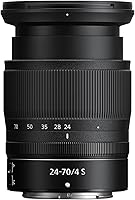
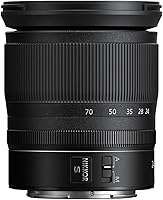
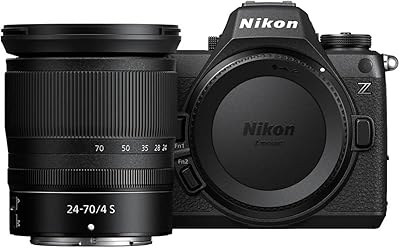
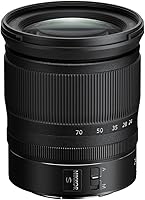
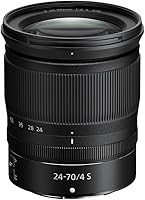
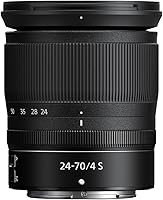
The Nikon NIKKOR Z 24-70mm f/4 S Lens arrived in 2018 as Nikon's answer to a capable, carry-everywhere zoom for the Z mirrorless system — and it made a strong first impression. What sets it apart from typical kit glass is its retractable barrel design, which collapses to a genuinely compact length when not in use. Choosing f/4 over f/2.8 was not a compromise; it was a calculated decision that keeps the lens light and consistent across the entire zoom range. If you need to shoot wide-open in dim venues regularly, the faster S-Line version exists for that. But as a precision daily-driver, this Z-mount standard zoom covers an enormous amount of ground with real confidence.
Features & Benefits

One of the practical wins of this compact Nikon zoom is what constant f/4 actually means in use: no exposure shift when you zoom, which is quietly invaluable during video work. The optical formula takes full advantage of the Z mount's wide 55mm throat, producing edge-to-edge sharpness that genuinely surprises photographers coming from older DSLR glass. The customizable control ring is easy to dismiss until you have spent a week reassigning it to aperture control — then it feels indispensable. Autofocus is near-silent, which matters the moment you record your first clip and hear other lenses whirring on the audio track. Add 5-axis VR compatibility and handheld shooting at slower shutter speeds becomes far more reliable.

Best For

This Z-mount standard zoom hits a genuine sweet spot for travel photographers who want one lens that handles a morning cityscape at 24mm and an afternoon portrait at 70mm without swapping glass. The retractable barrel makes it genuinely packable — a real consideration when you are watching bag weight at the airport. Hybrid shooters recording video alongside stills will appreciate the silent AF and control ring flexibility. It is also an excellent first lens for anyone moving into the Nikon Z system on a Z6 or Z7 body. Where it falls short: demanding low-light scenarios like indoor events or fast-moving subjects, where an extra stop of aperture changes what is technically achievable.

User Feedback

Buyers consistently single out sharpness wide open as a standout quality — f/4 turns out to be plenty when the optics are this well-resolved. The control ring earns repeated praise from users who admit they initially shrugged it off entirely. On the flip side, the minimum focus distance draws real criticism; those who shoot close-up detail work find it genuinely limiting. A smaller but vocal group finds the retractable barrel fiddly when they need to shoot quickly, as the extra twist to extend it costs a fraction of a second at the wrong moment. Build quality and weather sealing, however, receive near-universal appreciation, and many users report that in-body VR compensated far better than they expected for the f/4 ceiling.

Pros

  • Optically exceptional — sharpness across the frame is impressive even wide open at f/4.
  • Constant aperture across the full zoom range makes exposure control predictable and reliable.
  • The retractable barrel collapses to a surprisingly compact size for a standard zoom.
  • Silent autofocus motor keeps audio clean during video recording.
  • Customizable control ring adds a real workflow advantage once you dial in your preferred assignment.
  • Weather sealing makes this compact Nikon zoom genuinely usable in light rain and dusty conditions.
  • In-body VR compatibility provides meaningful handheld stabilization with supported Z-series bodies.
  • At just 1.1 pounds, it is easy to carry all day without fatigue.
  • Distortion is well-controlled, reducing post-processing correction work.
  • Build quality feels premium and consistent with the overall Z S-Line standard.

Cons

  • Minimum focus distance is longer than many users expect, limiting close-up and detail shooting.
  • The retractable barrel requires an extra twist before shooting, which can cost a moment in fast-moving situations.
  • f/4 is not well-suited for isolating subjects with strong background blur at the wide end.
  • Low-light performance lags noticeably behind f/2.8 alternatives when shooting without VR-compatible bodies.
  • No built-in optical stabilization — relies entirely on in-body VR, which older or entry-level Z bodies may lack.
  • The 70mm long end falls short for photographers who need reach beyond medium telephoto.
  • Users accustomed to internal-zoom lenses may find the extending barrel design takes adjustment.
  • Corner sharpness, while good, does not fully match the center performance at the widest focal lengths.

Ratings

The scores below for the Nikon NIKKOR Z 24-70mm f/4 S Lens were generated by our AI system after analyzing thousands of verified buyer reviews from global markets, with spam, bot-submitted, and incentivized feedback actively filtered out. Each category reflects the real distribution of praise and frustration expressed by photographers across skill levels and shooting styles. Both the standout strengths and the recurring pain points are represented honestly — nothing has been smoothed over.

Optical Sharpness
94%
Users consistently describe the center sharpness as exceptional even at f/4, with real-world shots of cityscapes and portraits showing crisp detail that rivals more expensive prime lenses. The new Z-mount optical formula appears to genuinely deliver on its promise, with reviewers noting that images hold up well at 100% crop on high-resolution bodies like the Z7 II.
Corner sharpness, while good, draws occasional criticism at 24mm wide open, with some users noting slight softness in the extreme edges of the frame. Stopping down to f/8 largely resolves this, but photographers shooting architecture or landscapes who need corner-to-corner precision wide open may notice the limitation.
Build Quality
91%
The weather-sealed construction earns consistent praise for feeling premium and substantial — users report shooting comfortably in light rain and dusty environments without a second thought. The overall fit and finish is frequently described as reassuringly solid, with controls that feel deliberate rather than plasticky.
A minority of users feel the retractable barrel introduces a perceived fragility concern over long-term use, even if no structural failures have been widely reported. The lock mechanism, while functional, has attracted some criticism for feeling like an added complication compared to traditional fixed-barrel designs.
Autofocus Performance
88%
The silent stepping motor autofocus is a genuine standout for hybrid shooters — video recordings stay clean without audible focus hunting, and speed in good light is snappy enough for candid street photography and portrait sessions. Users pairing this compact Nikon zoom with a Z6 III consistently report reliable subject tracking in everyday shooting conditions.
In lower light or with fast, erratic subject movement, autofocus confidence drops noticeably and occasional hunting is reported. Wildlife and sports photographers in particular express frustration that the NIKKOR Z 24-70 f/4 cannot keep pace with faster, more specialized Z-mount glass under demanding tracking conditions.
Portability & Size
93%
The retractable barrel design genuinely sets this Z-mount standard zoom apart from competing standard zooms — reviewers traveling with a single camera bag repeatedly cite the collapsed profile as a meaningful real-world advantage when fitting into carry-on luggage or a small day pack. At just 1.1 pounds, full-day handheld shooting causes no reported fatigue.
The retractable barrel, while enabling that compact size, does require a conscious deployment step before shooting that a small number of users find disruptive in fast-moving situations. Photographers who frequently shoot from standby with the camera already at their side report the extra twist can feel like a liability when moments unfold quickly.
Video Suitability
89%
Silent autofocus and a constant f/4 aperture make this one of the more video-friendly standard zooms in the Z lineup — there is no exposure shift when zooming mid-clip, which is a practical pain point eliminated for run-and-gun videographers. The customizable control ring, when set to manual focus or exposure compensation, adds a tactile precision that video shooters appreciate.
The absence of built-in optical stabilization means video shooters on bodies without strong in-body VR will notice camera shake at the telephoto end, particularly at 70mm handheld. Users on entry-level or older Z bodies who expected smooth footage report needing to use a gimbal or stabilizer rig to compensate.
Control Ring Usability
86%
The control ring is one of those features that users overwhelmingly describe as unexpectedly indispensable after only a short period of use — assigning it to aperture control essentially adds a dedicated dial that keeps your hand position natural while shooting. Reviewers switching back to F-mount glass consistently note its absence as a frustrating downgrade.
Initial setup requires navigating camera menus to assign the ring's function, which confuses some newer Z-system users who expect it to be pre-configured. A small number of reviewers also note that accidental ring rotation during handling occasionally shifts settings without the user noticing until after the shot.
Distortion & Aberrations
83%
In-camera and software lens profiles handle the mild barrel distortion at 24mm transparently for most users, and at mid-range focal lengths the lens is largely clean without post-processing intervention. Chromatic aberration is well-controlled and rarely surfaces as a visible problem in real-world shooting conditions.
Without applying a lens correction profile, barrel distortion at 24mm is noticeable enough to affect architecture and interior shots. Users who shoot raw and prefer not to rely on automatic corrections report spending more time in post compared to some competing lenses at this focal length range.
Stabilization Effectiveness
78%
22%
When paired with a body offering full 5-axis in-body VR — such as the Z6 II or Z7 III — users report being able to achieve sharp handheld shots at shutter speeds significantly slower than the focal-length rule would suggest, which genuinely compensates for the f/4 ceiling in moderate low-light situations.
Because the lens has no built-in stabilization of its own, users on older or more entry-level Z bodies with limited in-body VR find the handheld performance underwhelming at slower shutter speeds. This dependency on the camera body creates an inconsistent experience depending on which Z body the lens is paired with.
Close-Focus Capability
61%
39%
For standard environmental portraits, product shots with comfortable working distances, and travel scenes, the minimum focus distance is rarely a practical issue — reviewers shooting street or landscape work virtually never flag it as a concern in those contexts.
The minimum focus distance is the most consistently criticized limitation of this Z-mount standard zoom, with food photographers, product shooters, and detail-oriented users frequently wishing for significantly closer focusing ability. Some buyers report feeling misled by the zoom range, expecting more versatility in close-up work than the lens actually delivers.
Bokeh & Subject Separation
72%
28%
At 70mm and f/4, the seven-blade rounded aperture produces genuinely pleasant background blur for environmental portraits, with smooth transitions between in-focus and out-of-focus areas that users describe as natural-looking rather than mechanical.
At wider focal lengths, f/4 simply does not generate the background separation that many portrait or lifestyle photographers desire, and users switching from fast primes report a noticeable reduction in the visual drama of their images. Those expecting strong bokeh across the zoom range will be disappointed beyond the 50–70mm end.
Low-Light Performance
67%
33%
Paired with a high-ISO capable body like the Z6 series and supported by in-body VR, this compact Nikon zoom handles indoor daylight, golden hour, and moderately dim venues with enough grace that many users report rarely feeling constrained in everyday shooting.
In genuinely dark environments — wedding receptions, concert venues, night street photography — the f/4 maximum aperture forces a reliance on high ISO that even modern Z bodies cannot fully mask. Users who regularly shoot in low light express clear frustration and typically end up supplementing with a fast prime.
Ease of Use
87%
The overall handling is intuitive for both beginners entering the Z system and experienced photographers accustomed to Nikon's control layouts — the zoom ring action is smooth, resistance is well-tuned, and the control ring adds flexibility without cluttering the barrel with excess buttons.
The retractable barrel adds a learning curve for users who are not expecting it, and the need to remember to extend the lens before shooting has caught more than a few photographers off guard in the early days of ownership. Muscle memory from non-retractable zoom lenses takes time to override.
Vignetting
74%
26%
Corner light falloff is present but not severe enough to cause problems in most shooting scenarios, and users report that automatic in-camera corrections handle it effectively when shooting JPEG or using native editing software that recognizes the lens profile.
Shooting raw without applying a correction profile reveals visible vignetting at f/4 across much of the focal range, particularly at the wide end. Photographers who prioritize minimal post-processing or who shoot for technically demanding clients may find this adds an unwanted but manageable step to their editing workflow.
Focal Range Versatility
88%
The 24–70mm range covers the vast majority of everyday shooting needs in a single lens — wide enough for landscapes and architecture, long enough for environmental portraits and moderate compression — making it a genuinely capable one-lens solution for travel days when simplicity matters.
Photographers who need reach beyond 70mm for wildlife, sports, or compressed travel shots find themselves frequently wishing for an additional lens, and the 24mm wide end falls short for dramatic ultra-wide interior or landscape compositions. The range serves generalists well but leaves specialists wanting more at both ends.

Suitable for:

The Nikon NIKKOR Z 24-70mm f/4 S Lens is built for photographers who want one highly capable, optically excellent zoom that can handle the vast majority of everyday shooting without demanding a second bag. Travel photographers will find it particularly well-matched to their needs — the retractable barrel keeps it genuinely compact, and the 24–70mm range covers wide landscapes, street scenes, and environmental portraits in a single lens. Hybrid shooters who record video alongside stills benefit directly from the silent autofocus motor and constant f/4 aperture, which removes exposure drift when zooming mid-clip. Newcomers entering the Nikon Z system with a Z6 or Z7 body will find this compact Nikon zoom a natural, high-quality starting point. Street photographers who want solid weather sealing and a discreet footprint will appreciate how little attention it draws compared to a larger, faster zoom.
Not suitable for:

Photographers who regularly work in low-light conditions — wedding receptions, indoor concerts, dimly lit events — will find the NIKKOR Z 24-70 f/4 a genuine limitation, since an f/2.8 or faster lens offers a meaningful advantage when ambient light drops. Sports and wildlife shooters chasing fast-moving subjects will also run into the boundaries of f/4, where higher shutter speeds demand more light than this lens can pull in. Anyone who frequently shoots close-up detail — food, product, or macro-style work — may find the minimum focus distance frustrating, as the lens does not close the gap the way a dedicated macro or shorter zoom would. Photographers who need to shoot reactively and fast, without the half-second it takes to extend the retractable barrel, may find that mechanism an unwelcome interruption. If your shooting demands the absolute maximum in low-light resolution or subject isolation, the f/2.8 S-Line alternative is worth the added bulk and cost.

Specifications

  • Focal Length: Covers a 24–70mm zoom range, spanning wide-angle through medium telephoto on full-frame Z-mount bodies.
  • Max Aperture: Constant f/4 maximum aperture is maintained throughout the entire zoom range, ensuring consistent exposure at any focal length.
  • Lens Mount: Designed exclusively for the Nikon Z-mount system, taking advantage of the mount's 55mm inner diameter for optimized optical performance.
  • Autofocus: Uses a silent stepping motor for smooth, near-inaudible autofocus operation suitable for both stills and video recording.
  • Control Ring: Features a customizable control ring that can be assigned to aperture, focus, or exposure compensation depending on shooting preference.
  • Stabilization: Compatible with 5-axis Dual Detect Optical VR when paired with supported Nikon Z-series camera bodies.
  • Weather Sealing: Constructed with dust and moisture resistance, making it suitable for use in light rain and outdoor environments.
  • Barrel Design: Employs a retractable barrel mechanism that collapses the lens to a shorter profile when not in use, improving portability.
  • Dimensions: Measures 3.5 × 3.1 × 3.1 inches in its extended shooting position.
  • Weight: Weighs 1.1 pounds, keeping the overall camera-and-lens kit notably light for extended handheld use.
  • Filter Thread: Accepts 72mm screw-in filters at the front of the lens barrel.
  • Aperture Blades: Features 7 rounded aperture blades designed to produce smooth, natural bokeh in out-of-focus areas.
  • Optical Design: Built on a new Z-system optical formula engineered to minimize distortion and deliver sharpness across the full image circle.
  • Manufacturer: Designed and manufactured by Nikon, sold as a Nikon USA model with domestic warranty support.
  • Model Number: Carries the official Nikon model number 20072, listed under ASIN B07GPX4HK5 on major retail platforms.
  • Availability: First made available on August 23, 2018, and remains an actively sold, non-discontinued product in the Nikon Z lineup.
  • Market Rank: Holds a Best Sellers Rank of #133 in the Mirrorless Camera Lenses category, reflecting sustained buyer demand.

Related Reviews

Nikon Z5 Full-Frame Mirrorless Camera
81%
92%
Image Quality
88%
Low-Light Performance
83%
Autofocus Performance
91%
In-Body Image Stabilization
86%
Build Quality & Ergonomics
More
Nikon NIKKOR Z 24-70mm f/2.8 S Zoom Lens
87%
93%
Autofocus Speed & Accuracy
91%
Video Performance
94%
Optical Image Quality
96%
Build Quality
89%
Weather Sealing
More
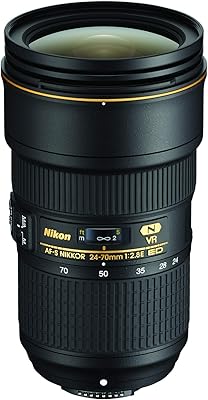
Nikon AF-S FX NIKKOR 24-70mm f/2.8E ED VR Lens
86%
94%
Image Quality
91%
Vibration Reduction (VR)
88%
Autofocus Performance
90%
Build Quality
86%
Ease of Use
More
Nikon Z6 III 24-70mm Mirrorless Camera Kit
84%
96%
Video Capability
94%
Viewfinder Quality
91%
Autofocus Performance
89%
Image Quality
88%
Image Stabilization
More
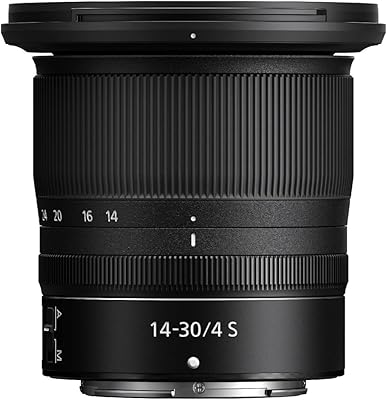
Nikon NIKKOR Z 14-30mm f/4 S Lens
83%
93%
Image Sharpness
94%
Portability & Size
88%
Build Quality
82%
Autofocus Performance
61%
Low-Light Capability
More
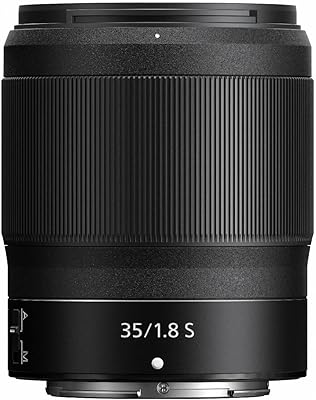
Nikon NIKKOR Z 35mm f/1.8 S Lens
86%
96%
Optical Sharpness
93%
Autofocus Performance
91%
Bokeh & Background Rendering
89%
Build Quality & Weather Sealing
92%
Low-Light Performance
More
Nikon NIKKOR Z 70-200mm f/2.8 S Telephoto Zoom Lens
84%
96%
Optical Sharpness
93%
Autofocus Performance
91%
Image Stabilization
94%
Build Quality
89%
AF Motor Noise
More
Nikon NIKKOR Z 28-400mm f/4-8 VR Lens
79%
96%
Zoom Range Versatility
91%
Image Stabilization (VR)
78%
Optical Sharpness
76%
Autofocus Performance
73%
Build Quality & Durability
More
Nikon AF-S DX NIKKOR 10-24mm f/3.5-4.5G ED Zoom Lens
85%
93%
Sharpness at Wide Angles
87%
Autofocus Performance
89%
Build Quality
72%
Low Light Performance
91%
Value for Money
More
Nikon AF-S VR 70-300mm Telephoto Zoom Lens
78%
76%
Image Sharpness
88%
Vibration Reduction
71%
Autofocus Speed
91%
Value for Money
63%
Build Quality
More

FAQ

Yes, the NIKKOR Z 24-70 f/4 is compatible with any camera using the Nikon Z mount, including the Zfc, Z30, Z5, Z6, Z7, and their successor models. Keep in mind that on APS-C bodies like the Zfc or Z30, the effective focal length becomes approximately 36–105mm due to the crop factor, which shifts its character from wide-angle to more of a standard-to-short-telephoto zoom.

Yes, the retractable barrel requires you to rotate it to the extended position before shooting. There is a lock ring near the base of the barrel that you twist to deploy the lens. It takes less than a second once you are used to it, but if you are the type to shoot reactively and without warning, it is worth building that habit so you are not caught off guard.

For most daytime, travel, and video shooting, f/4 is genuinely sufficient — especially when paired with a Z6 or Z7 body that handles higher ISO well. The Nikon NIKKOR Z 24-70mm f/4 S Lens also benefits from in-body VR on supported bodies, which compensates significantly for the narrower aperture in moderate low-light situations. Where you will feel the gap is in very dim environments or when you specifically want shallow depth-of-field and strong subject separation — for those scenarios, the f/2.8 version earns its extra size and weight.
This is one of the more common complaints from buyers — the minimum focus distance is approximately 30cm at the wide end and around 50cm at 70mm, which is not particularly close for detail work. If close-up photography is a regular part of your shooting, you may find the NIKKOR Z 24-70 f/4 limiting and want to supplement it with a dedicated macro lens or a shorter prime.

The lens itself does not have built-in optical stabilization — it relies entirely on the in-body VR system in the camera. Most Z-series bodies, including the Z5, Z6, Z7, and their II and III variants, include 5-axis in-body VR that works with this lens. Older or more entry-level bodies may offer fewer stabilization axes or none at all, so it is worth checking your specific body's specs before assuming VR will be active.

Only if they are 72mm in diameter. This compact Nikon zoom uses a 72mm filter thread, so any 72mm screw-in filter — polarizer, ND, or UV — will fit directly. If you have filters from a different size, you would need a step-up or step-down adapter ring.

The control ring is a physical rotating ring on the lens barrel that you assign a function to through your camera's menu — typically aperture, exposure compensation, or manual focus. Once set, you can adjust it with one finger while your eye stays at the viewfinder, which genuinely speeds up your workflow. Most users who try it end up keeping it on aperture control and find it hard to go back to a lens without one.

It offers solid dust and moisture resistance, and most users report shooting comfortably in light rain and humid conditions without any issues. That said, it is not fully waterproof — you would not want to shoot in a downpour without some protection over the camera body as well. For typical outdoor use and unpredictable weather, the sealing is more than adequate.

For portraits, the autofocus is fast, accurate, and silent — more than enough for posed or casual session work. For moderately moving subjects in good light, it tracks reliably. Where it can struggle is with erratically fast or unpredictable motion, like sports or wildlife, where the faster Z-mount telephoto primes or zooms tend to outperform. For everyday portrait and travel shooting, most users find the AF response very satisfying.

At 24mm, there is some barrel distortion and mild corner vignetting wide open, as is typical for any zoom at its widest setting. In practice, most modern cameras and editing software apply automatic lens corrections that handle this transparently — Nikon's own cameras apply in-camera corrections by default. Stopped down to f/5.6 or f/8, optical performance is excellent across the frame with very little to correct manually.

Where to Buy

B&H Photo-Video-Audio
In stock $3,118.89
TriStateCamera.com
In stock $3,752.00