Overview

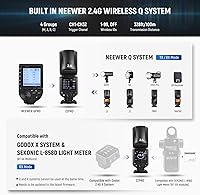
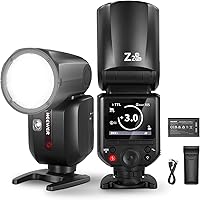
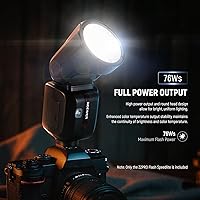
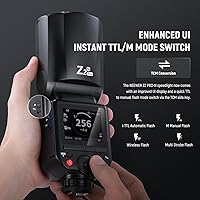
The NEEWER Z2PRO-N TTL Round Head Flash Speedlite arrived in late 2024 as a serious mid-range option for Nikon shooters who want softer, more wrapping light without buying a full studio strobe. The circular head produces a naturally diffused spread that rectangular speedlites simply can't match at this price point. At 76Ws, it punches noticeably harder than most 60Ws hotshoe flashes — a real difference when bouncing off high ceilings or fighting ambient light. The upgraded UI and new TCM quick-switch between TTL and manual are genuine usability improvements, not just spec-sheet padding. Cross-compatibility with the Godox 2.4G X system opens this Nikon flash to a far wider audience than Nikon-only wireless ever could.
Features & Benefits

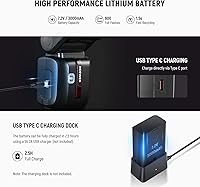
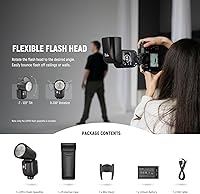
The Z2PRO-N's 76Ws output is roughly 25% more power than a typical 60Ws speedlite — a real difference when pushing light through a softbox or bouncing off a distant wall. 1/8000s HSS lets you shoot wide-open in harsh midday sun and still get clean, naturally blurred backgrounds. The one-touch TCM switch saves real time; you're not fumbling through menus mid-shoot just to drop into manual power. The head swings a full 330° and tilts from -7° to 120°, giving you bounce flexibility most rectangular flashes can't match. Battery life is strong at 600 full-power flashes with a 1.5-second recycle time and USB-C charging — no proprietary cables needed.

Best For

This Nikon flash is a natural fit for portrait and event photographers shooting Z-series or D-series bodies who want reliable TTL metering and faster wireless control than optical triggers provide. The round head design genuinely matters here — it produces a softer, more even spread of light that works especially well for close-range portraiture without a modifier. If you're already invested in the Godox ecosystem and running an Xpro or X2 trigger, the Z2PRO-N slots in as a Nikon-native unit without forcing you to rebuild your trigger setup. It's also a strong pick for outdoor shooters relying on HSS in bright conditions. Less ideal if your workflow requires Q and X systems running simultaneously.

User Feedback

Early buyers have settled around a 4.7-star average across over 240 ratings — a strong signal for a flash that only launched in late 2024. Most praise centers on accurate TTL performance, the quality of light from the round head, and how much cleaner the new menu interface feels compared to older NEEWER units. USB-C charging earns consistent approval from working photographers. Where it gets more nuanced: several users note that Godox compatibility requires the latest firmware installed, and the Q and X wireless systems cannot run simultaneously — a real limitation for hybrid setups. The D810 incompatibility is also worth confirming before purchase if you shoot with that specific body.

Pros

  • Round head produces noticeably softer, more flattering light than rectangular speedlites — even without a modifier.
  • 76Ws output is meaningfully stronger than most 60Ws competitors at a similar price point.
  • TTL metering is consistently accurate across Nikon Z-series and D-series bodies in real shooting conditions.
  • 600 full-power flashes per charge handles full wedding receptions and long events without a battery swap.
  • USB-C charging works with standard power banks — no proprietary charger required in the field.
  • 1/8000s HSS lets you shoot wide-open outdoors in harsh sunlight with clean background separation.
  • The TCM one-touch TTL-to-manual switch genuinely saves time during fast-paced, mode-switching shoots.
  • Compatible with Godox X system triggers, making it a practical addition to mixed-brand wireless setups.
  • 1.5-second full-power recycle time keeps up comfortably with event shooting pace.
  • Rated to 100,000 flashes — built for long-term professional use, not a disposable entry-level unit.

Cons

  • Godox X system compatibility requires the latest firmware installed — and the update process has frustrated several buyers.
  • NEEWER Q and Godox X wireless systems cannot run simultaneously, limiting complex multi-flash setups.
  • Nikon D810 owners are completely locked out — compatibility is explicitly unsupported with no workaround.
  • No weather sealing makes outdoor use in rain or high humidity a real risk without additional protection.
  • Modeling lamps are too dim to be useful in anything brighter than a dark, controlled environment.
  • Recycle time creeps above the rated 1.5 seconds during sustained high-volume full-power bursts.
  • Firmware update documentation is underdeveloped, leading to failed update attempts for some users.
  • The head pivot lacks positive click-stops, which can cause drift when heavier magnetic modifiers are attached.
  • HSS output drops significantly above 1/2000s, meaning very bright conditions may push you to maximum power faster than expected.
  • Screen readability in direct sunlight is limited, making outdoor menu navigation more difficult than it should be.

Ratings

The NEEWER Z2PRO-N TTL Round Head Flash Speedlite earns a strong overall standing based on AI analysis of verified global buyer reviews, with spam, bot activity, and incentivized feedback actively filtered out before scoring. Across categories ranging from wireless reliability to light quality, the scores reflect what real photographers consistently reported — both the genuine strengths and the friction points that matter before you commit to a purchase.
TTL Accuracy
91%
Photographers shooting fast-moving events — weddings, receptions, candid portraiture — consistently report that the TTL metering locks in natural-looking exposures with minimal correction needed. The automatic metering handles tricky mixed-lighting situations reliably, which builds real confidence when you can't reshoot a moment.
A small number of users noted occasional TTL overexposure when shooting against highly reflective surfaces or very bright backgrounds. It's manageable with flash exposure compensation, but shooters expecting perfect auto results in extreme conditions may need to dial in manually.
Light Quality
88%
The round head is the Z2PRO-N's most talked-about physical attribute for good reason — buyers consistently describe the light as noticeably softer and more flattering compared to standard rectangular speedlites, even without a modifier attached. Portrait photographers in particular appreciate the more natural catchlights it produces in subjects' eyes.
At longer focal lengths or when shooting subjects at distance, the round head's diffusion advantage narrows considerably compared to a bare rectangular flash. A few users also noted that the color temperature consistency across power levels, while generally good, isn't quite on par with higher-end studio strobes.
Battery Life & Charging
86%
Six hundred full-power flashes per charge is genuinely impressive for a hotshoe flash, and most event photographers report comfortably getting through a full wedding reception without a battery swap. USB-C charging is a practical win — you can top it off from a power bank between sessions without carrying a dedicated charger.
The 2.5-hour charge time from flat is on the longer side if you're in a back-to-back shoot situation. A handful of buyers also flagged that the battery life estimate drops noticeably if you're firing HSS or stroboscopic bursts repeatedly, which is worth factoring into longer outdoor sessions.
Wireless Reliability
79%
21%
Within the native NEEWER Q system, the 2.4G wireless performs solidly at real-world event distances — buyers report consistent triggering across large halls and outdoor spaces up to the rated 100-meter range. Godox X system compatibility via the RX COMPAT menu is a genuine bonus for photographers already running Xpro or X2 triggers.
The Godox cross-compatibility comes with real conditions attached: it requires the latest firmware installed, and the Q and X systems cannot run at the same time. Photographers running a mixed Godox and NEEWER setup have flagged this as a meaningful workflow limitation, and a few found the firmware update process less straightforward than expected.
Build Quality
84%
Buyers consistently describe the Z2PRO-N as feeling more substantial and premium than earlier NEEWER speedlites — the housing feels dense rather than hollow, and the hot shoe mount mechanism draws specific praise for its solid, wobble-free fit. The quartz tube rated to 100,000 flashes signals genuine durability engineering rather than planned obsolescence.
It is not weather-sealed, which limits its use in light rain or high-humidity outdoor conditions without protective measures. A small number of buyers noted that the plastic finish around the head connection shows wear marks after extended use in bags, suggesting the coating is more cosmetically vulnerable than the core structure.
HSS Performance
87%
Outdoor portrait photographers using Nikon Z-series bodies report that the 1/8000s HSS sync works reliably for shooting at wide apertures in midday sun — the kind of bright conditions where sync speed limitations would otherwise force you to stop down and lose the background separation you're after.
As with all HSS flash implementations, there is a power trade-off at very high sync speeds — effective output drops noticeably above 1/2000s, which can push you closer to maximum power than expected in very bright conditions. This is a physics limitation rather than a product flaw, but new HSS users occasionally find it surprising.
UI & Controls
83%
The upgraded interface draws genuine praise from users who switched from older NEEWER or budget-tier speedlites — the layout is described as cleaner, more logically organized, and faster to navigate mid-session. The TCM one-touch TTL-to-manual switch in particular earns consistent appreciation from photographers who regularly swap modes.
A learning curve exists for first-time NEEWER users unfamiliar with the menu structure. A few buyers found the button labeling on the rear panel slightly ambiguous until they spent time with the manual, and the screen readability in direct sunlight was flagged as less than ideal by a handful of outdoor shooters.
Recycle Time
89%
The 1.5-second full-power recycle time is fast enough that most event and portrait photographers report it keeps up comfortably with their shooting pace. At reduced power levels the recycle drops further, making it genuinely responsive for burst-style work without the frustrating lag some cheaper flashes impose.
Under sustained high-volume shooting — think back-to-back full-power bursts during a reception — a handful of users noted the recycle time crept closer to 2 seconds once the unit warmed up. The cooling system handles heat well overall, but the recycle consistency at sustained load is slightly below what the spec sheet implies.
Compatibility — Nikon Bodies
76%
24%
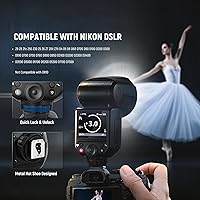
Coverage across Nikon's Z-series mirrorless lineup and most current D-series DSLRs is broad and reliable, with TTL and HSS functions confirmed working across the Z9, Z6II, Z7II, D850, D750, and other popular bodies. Buyers using current Nikon systems report no meaningful compatibility issues out of the box.
The D810 exclusion is a notable gap — it's a popular professional body and its omission is an unexplained limitation that has frustrated several buyers. Older D-series bodies (D60, D100) are listed as compatible but real-world TTL consistency on those platforms is less documented in user feedback.
Modeling Lamp Usefulness
71%
29%
The dual LED modeling lamps are practically useful for pre-visualizing light direction and shadow fall in dim studio or indoor environments — buyers doing close-range portrait work appreciate being able to see the light before committing to a shot. Ten brightness levels give a reasonable degree of control for positioning.
At 2W total, the modeling lamps are too dim to be useful in anything but a dark or semi-controlled environment. Outdoor use or brightly lit indoor spaces render them essentially invisible, and several buyers noted they stopped using the feature once they moved beyond controlled studio-style setups.
Head Flexibility & Bounce Range
88%
The 330-degree swivel and -7 to 120-degree tilt range gives photographers genuine creative flexibility for bounce configurations — buyers regularly mention using the downward tilt for macro work and the rearward bounce for indoor event coverage without switching gear. The resistance on the pivot joints feels precise rather than stiff or loose.
The head lock mechanism, while functional, lacks the positive click-stop precision that some higher-end speedlites offer — a small number of users reported the head drifting slightly under the weight of larger magnetic modifiers during extended shoots.
Value for Money
82%
18%
Across user feedback, the consensus is that the Z2PRO-N delivers a strong feature-to-price ratio relative to comparable round-head speedlites in its segment. The combination of 76Ws output, HSS, TTL, and cross-system wireless in one unit represents a tangible package for mid-tier flash buyers.
Buyers comparing it against Godox's own V1 round-head flash — a direct and well-established competitor — note that the difference in price doesn't always translate into a meaningful performance advantage. For Godox-native users, the case for switching ecosystems requires more justification than specs alone provide.
Firmware & Software Support
67%
33%
USB-C firmware updates are a practical inclusion — being able to plug into a laptop and update without proprietary hardware is a meaningful convenience. Users who kept firmware current reported smoother Godox X system compatibility and resolved some early-production triggering inconsistencies.
The update process itself lacks polish — several buyers described the firmware update instructions as unclear, and a few experienced failed update attempts that required retrying. For a product where Godox compatibility depends on firmware being current, the update experience needs to be more reliable and better documented.
Stroboscopic & Advanced Flash Modes
74%
26%
Stroboscopic flash, front and rear curtain sync, and flash exposure bracketing are all present and functional — buyers doing creative long-exposure or motion-blur work appreciate having these modes accessible without needing a separate trigger unit. FEL (flash exposure lock) works reliably in fast-paced single-light setups.
These advanced modes are not particularly well-explained in the included documentation, and buyers without prior speedlite experience reported a steep learning curve. The stroboscopic mode's practical power output in multi-burst sequences is also lower than some users expected based on the unit's rated maximum output.

Suitable for:

The NEEWER Z2PRO-N TTL Round Head Flash Speedlite is purpose-built for Nikon shooters who want more flattering, naturally diffused light from a hotshoe flash without investing in a full studio strobe setup. Portrait photographers will get the most out of the round head design — it produces softer light and rounder catchlights that rectangular speedlites simply can't replicate without modifiers. Event and wedding photographers will appreciate the 600-shot battery endurance, 1.5-second recycle time, and reliable TTL metering that keeps pace with unpredictable, fast-moving situations. If you're already running Godox triggers like the Xpro or X2, the Z2PRO-N slots into that ecosystem with compatible 2.4G wireless, meaning you won't have to rebuild your trigger setup around a new flash. Outdoor portrait shooters who regularly fight bright midday sun will find 1/8000s HSS genuinely useful for maintaining wide apertures without overexposing. It's also a compelling upgrade path for anyone currently using a basic pop-up or entry-level hotshoe flash who wants a meaningful step up in both power and light quality.

Not suitable for:

The NEEWER Z2PRO-N TTL Round Head Flash Speedlite is not the right call for Nikon D810 users — that specific body is explicitly excluded from the compatibility list, and there's no firmware workaround. Photographers who run Godox Q and X wireless systems simultaneously in their setups will hit a hard limitation, since both systems cannot operate at the same time on this flash; if your workflow depends on cross-system multi-flash triggering, that constraint will be a real problem. It's also not well-suited to wet or unpredictable outdoor environments, as the unit carries no weather sealing — shooters doing rain, beach, or high-humidity work without protective covers should factor that in. Buyers coming from a fully established Godox ecosystem who already own a V1 round-head flash may find the case for switching less compelling than the spec sheet suggests. Videographers looking for a strong continuous modeling lamp will be disappointed — the 2W LEDs are practical only in controlled dim environments. Finally, anyone who expects plug-and-play Godox compatibility without reading documentation should know that the latest firmware is required, and that update process has been a friction point for some users.
Specifications

  • Output Power: The flash delivers 76Ws of maximum output, placing it noticeably above the 60Ws ceiling common among competing hotshoe speedlites in this price segment.
  • HSS Sync Speed: High-speed sync reaches 1/8000s, enabling wide-aperture shooting in full sunlight without overexposure from ambient light.
  • Flash Duration: Flash duration spans 1/180s at full power down to 1/20000s at minimum power, giving fine control over motion freezing in close-range or high-speed work.
  • Recycle Time: Full-power recycle time is rated at 1.5 seconds, fast enough to sustain a professional event shooting pace without significant lag between frames.
  • Battery: The internal 7.2V 3000mAh lithium battery provides up to 600 full-power flashes per charge under standard operating conditions.
  • Charge Time: A full recharge completes in approximately 2.5 hours using a 5V 2A USB-C source; no proprietary charger is included or required.
  • Head Movement: The flash head swivels 330° horizontally and tilts from -7° to 120° vertically, supporting a wide range of bounce and off-axis lighting configurations.
  • Modeling Lamp: Two 2W LED modeling lamps operate at 3300K with 10 selectable brightness levels for pre-shot light placement in controlled or dim environments.
  • Focal Length: The built-in zoom head covers a 28–105mm focal length range, automatically or manually adjustable to match the lens in use.
  • Wireless System: The flash operates natively within the NEEWER 2.4G Q system and is also compatible with the Godox 2.4G X system via the RX COMPAT menu, with the latest firmware installed.
  • Wireless Range: Reliable wireless triggering is rated up to 328ft (100m) under clear line-of-sight conditions.
  • Channels & Groups: The wireless system supports 32 selectable channels, 4 controllable groups (M/A/B/C), and 99 individual IDs to avoid cross-triggering in busy shooting environments.
  • Flash Lifespan: The quartz flash tube is rated for up to 100,000 full actuations, indicating a long usable service life under regular professional use.
  • Connectivity: A USB-C port handles both firmware updates and external battery charging from any standard USB-C power source.
  • Continuous Flashes: The thermal management system supports up to 100 continuous full-power flashes without triggering heat-related output throttling.
  • Flash Modes: Supported modes include TTL, Manual (1/1–1/256), Multi/Stroboscopic, S1/S2 optical slave, front curtain sync, rear curtain sync, FEC, FEB, and FEL.
  • Weight: The unit weighs 1.1 pounds, which is typical for a feature-equipped round-head speedlite in this output class.
  • Packaged Dimensions: Packaged dimensions measure 10.12 x 5.51 x 4.09 inches, reflecting the larger footprint of the round head compared to standard rectangular speedlites.
  • Body Compatibility: Compatible with Nikon Z9, Z8, Zfc, Z50, Z30, Z5, Z6, Z7, Z6II, Z7II, and most D-series DSLRs; the Nikon D810 is explicitly not supported.
  • Accessory Mount: The round flash head accepts NEEWER CRM2, M12, CRS6, CRS7, CRB1, and S2-type circular modifier mounts for expanded light shaping options.

Related Reviews
NEEWER Z1-S Round Head Flash Speedlite
83%
91%
Light Quality
83%
Build Quality
72%
TTL Accuracy
93%
Battery Life
88%
Recycle Time
More
NEEWER Z1-N TTL Speedlite for Nikon
78%
91%
Light Quality
78%
TTL Accuracy
86%
High-Speed Sync Performance
71%
Wireless Reliability
83%
Battery Life
More
NEEWER NW645II-S TTL Flash Speedlite
81%
86%
TTL Accuracy
83%
High-Speed Sync Performance
78%
Build Quality
61%
Optical Slave Reliability
81%
Recycle Speed
More
NEEWER 750II TTL Camera Flash Speedlite
84%
88%
Flash Power & Performance
85%
Ease of Use
72%
Build Quality
90%
TTL Functionality
80%
Portability & Weight
More
NEEWER NW635II-S TTL Camera Flash Speedlite
86%
88%
Value for Money
91%
Performance
75%
Build Quality
85%
Ease of Use
92%
Portability
More
NEEWER Z880-C TTL Camera Flash Speedlite
83%
83%
Build Quality
88%
TTL Accuracy
86%
HSS Performance
74%
Wireless Reliability
91%
Battery Life
More
NEEWER Z2-F 2.4G TTL Camera Flash Speedlite for Fujifilm
86%
88%
Performance
85%
Ease of Use
91%
Wireless Connectivity
83%
Battery Life
90%
Flash Power Output
More
NEEWER TT560 Speedlite Flash
75%
91%
Value for Money
74%
Ease of Use
83%
Build Quality
78%
Compatibility
77%
Light Output & Power Range
More
NEEWER NW620 Speedlite Flash
75%
88%
Value for Money
84%
Flash Output & Power
79%
Build Quality
91%
LCD Display & Controls
62%
Recycling Time
More
NEEWER NW700-N TTL Flash Speedlite
79%
84%
TTL Metering Accuracy
79%
TCM Function Usability
82%
High-Speed Sync Performance
71%
Build Quality & Durability
86%
Recycle Speed
More

FAQ

It can, but not without a step in between — you need to make sure the flash is running the latest firmware first, and then enable Godox X system mode via the RX COMPAT menu. Once that is set up, it works as a slave unit with Xpro and X2 triggers. Just be aware that you cannot run the NEEWER Q system and Godox X system simultaneously on the same flash.

The D810 incompatibility is an official limitation and no firmware workaround is currently available. It appears to be related to how the D810 handles flash communication protocols. If you shoot primarily with a D810, this Nikon flash is not a safe purchase — you would need to verify compatibility before buying any Nikon-dedicated speedlite.

The round head produces a circular light pattern that spreads more evenly in all directions, which translates to softer gradients, less harsh falloff, and rounder, more natural-looking catchlights in portraits. A standard rectangular head throws an oblong beam that can be slightly harder and less flattering at close range. The difference is most noticeable in close-range portraiture — at longer subject distances or when bouncing off a large ceiling, the practical gap narrows.

Yes — the USB-C port on the flash body handles charging directly, so you never need to remove the battery. Any 5V 2A USB-C charger or power bank will work, which makes it practical to top off between sessions without carrying a dedicated charging dock.

In practical terms, the difference is noticeable rather than dramatic — roughly 25% more output, which translates to about two-thirds of a stop of additional light. That margin matters most when bouncing into a large or distant surface, shooting through a softbox, or trying to overpower strong ambient light outdoors. For direct on-camera use at close range, you may not notice the gap as readily.

Firmware updates are done via the USB-C port using NEEWER's update tool on a computer. The process is straightforward in principle, but a number of buyers have reported that the instructions included in the box are thin and that failed update attempts do happen. It is worth downloading the latest firmware guide from NEEWER's website rather than relying solely on the printed documentation.

Yes, the Z50 is explicitly listed as a compatible body and TTL functions correctly on it. The full feature set including HSS and wireless control is supported on the Z50 as it is across the broader Z-series mirrorless lineup.

For most event photographers, 600 full-power flashes is enough to cover a multi-hour wedding reception or corporate event without swapping batteries. In practice, since you will not be firing at full power continuously, real-world shot counts tend to run higher. USB-C charging means you can top off from a power bank during a break if needed, which adds a useful safety net.

Yes — within the NEEWER Q system, the Z2PRO-N can operate as either a master or a slave unit, allowing you to control compatible Q system flashes across four groups at distances up to 100 meters. When operating in Godox X system mode via RX COMPAT, it functions as a slave only, not a master.

The round head is compatible with NEEWER's own line of circular modifiers using CRM2, M12, CRS6, CRS7, CRB1, and S2-type mounts. Third-party modifiers designed for the Godox V1 round head are often physically similar in diameter but may not lock as securely depending on the specific brand — it is worth checking measurements before assuming cross-compatibility with non-NEEWER accessories.