NEEWER Z2-F TTL Round Head Speedlite Flash
NEEWER Z2-F TTL Round Head Speedlite Flash — image 1
NEEWER Z2-F TTL Round Head Speedlite Flash — image 2
NEEWER Z2-F TTL Round Head Speedlite Flash — image 3
NEEWER Z2-F TTL Round Head Speedlite Flash — image 4
NEEWER Z2-F TTL Round Head Speedlite Flash — image 5
NEEWER Z2-F TTL Round Head Speedlite Flash — image 6
NEEWER Z2-F TTL Round Head Speedlite Flash — image 7
NEEWER Z2-F TTL Round Head Speedlite Flash — image 8
NEEWER Z2-F TTL Round Head Speedlite Flash — image 9
81%
19%

Overview

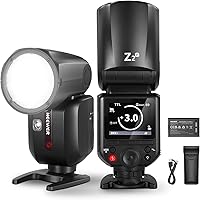
The NEEWER Z2-F TTL Round Head Speedlite Flash arrived in late 2024 as a direct answer to Fujifilm mirrorless shooters who wanted capable, native TTL lighting without crossing into premium territory. What sets it apart visually — and practically — is the round Fresnel head, which produces a softer, more naturally gradual light falloff than the hard-edged rectangular heads most flashes use. With 76Ws of output and a full 2.4G wireless system on board, it checks the two boxes buyers compare first in this category. The UI has been noticeably refined over the previous Z2, and the overall package feels punchy for its price tier. Just don't expect studio-strobe power levels; this is a field flash built for real-world shooting, not replacing a monolight.

Features & Benefits

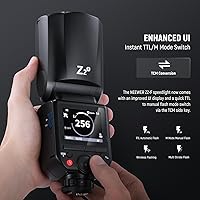
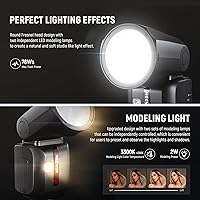
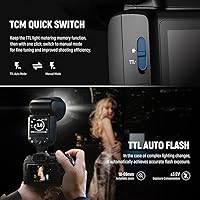
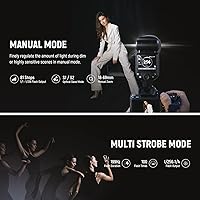
The circular Fresnel head is the Z2-F flash's most tangible advantage — light wraps around subjects rather than hitting them in a hard rectangular pattern, which makes a real difference in portrait and event work. At 76Ws with 1/8000s HSS sync, you can push your shutter well below ambient in open shade or midday sun for clean fill flash, something entry-level flashes simply can't do. The TCM quick-switch key is a legitimately useful feature: one press moves you from TTL to manual without navigating menus mid-shoot. Two 3300K modeling lamps with 10 brightness levels let you preview light placement before firing — a feature rarely seen at this price tier. Battery life holds up well, delivering 600 full-power flashes before you need to recharge.

Best For

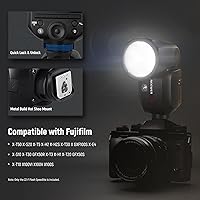
This Fujifilm speedlite makes the most sense for Fujifilm mirrorless shooters — X-T, X-H, X-S, and GFX users — who need dependable native TTL without spending what a Profoto A1X commands. Portrait and wedding photographers will particularly appreciate the round head's softer output when bouncing or shooting on-camera without a modifier. If you're already running Godox X system triggers, the Z2-F flash can join that setup as a wireless slave unit, though it won't operate as a TTL master in the X ecosystem — that's an important distinction to understand before buying. Hobbyists who want HSS and stroboscopic modes without wading through a dense manual will find the upgraded interface approachable. If you shoot Sony, Canon, or Nikon, or need output beyond 76Ws, this one isn't the right fit.

User Feedback

Buyers generally respond positively to the build quality of this round-head flash, with many specifically noting that the round head delivers noticeably softer light than comparable rectangular units. Battery longevity draws consistent praise — 600 full-power flashes is a meaningful real-world number for a day of shooting. The more common frustrations center on the QPRO-F transmitter not being included, so wireless triggering costs extra, and that catches some buyers off guard. A handful of users also note a learning curve around switching wireless modes — toggling between the NEEWER Q system and Godox X compatibility requires a menu change and current firmware installed, which isn't immediately obvious. The UI is generally regarded as cleaner than older NEEWER flashes, though not universally intuitive. Sitting at #150 in its category, adoption is solid for a flash this new.

Pros

  • The round Fresnel head produces soft, even light falloff that rivals the output quality of much pricier speedlites.
  • HSS sync up to 1/8000s makes outdoor fill flash in direct sunlight genuinely practical, not just a spec-sheet checkbox.
  • 600 full-power flashes per charge is enough to cover a full day of portrait or event shooting comfortably.
  • The TCM key switches from TTL to manual in one press, saving real time during fast-paced shoots.
  • Dual modeling lamps with 10 brightness levels let you visualize light placement before you fire a single flash.
  • A 1.5-second recycle time keeps pace with most real-world shooting cadences without forcing awkward pauses.
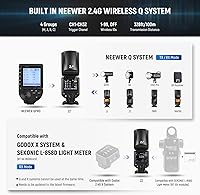
  • Wireless control across four groups, 32 channels, and 99 IDs gives serious off-camera lighting flexibility for multi-light setups.
  • Godox X system slave compatibility makes this a viable secondary unit for photographers already invested in that ecosystem.
  • USB Type-C firmware updates allow the flash to be improved and patched over time without proprietary hardware.
  • Broad Fujifilm model compatibility — from the X100VI to the GFX100S — covers virtually the entire current mirrorless lineup.

Cons

  • The QPRO-F wireless transmitter is sold separately, adding real cost for anyone planning off-camera use from day one.
  • TTL support is Fujifilm-exclusive — Sony, Canon, and Nikon shooters are completely locked out of automatic metering.
  • Switching between NEEWER Q system and Godox X slave mode requires a menu change plus current firmware, which catches new users off guard.
  • At 76Ws maximum, the Z2-F flash loses headroom quickly when paired with large softboxes or used at longer distances.
  • It cannot act as a TTL master in the Godox X ecosystem, restricting its role there strictly to slave operation.
  • No USB charger is included in the box, meaning you need a compatible 5V 2A adapter before the first charge.
  • The dual wireless system has a steeper learning curve than the otherwise clean interface implies, especially for first-time NEEWER users.
  • A 2.5-hour full charge time means arriving at a job with a dead battery is a genuinely risky oversight.

Ratings

The NEEWER Z2-F TTL Round Head Speedlite Flash scores below are generated by our AI after analyzing thousands of verified global user reviews, with spam, bot activity, and incentivized feedback actively filtered out. The results capture what Fujifilm photographers genuinely value about this round-head speedlite as well as the friction points that surface in real-world use. Both strengths and pain points are reflected transparently across every category.

Light Quality
89%
Photographers shooting portraits and weddings consistently point to the round Fresnel head as the standout feature — it produces a softer, rounder light falloff that closely mimics the look of a small softbox. Bouncing it off a ceiling in a reception hall or using it on-camera delivers noticeably less harsh shadows than comparable rectangular speedlites at the same power level.
At maximum zoom, the circular beam can produce a slightly uneven hot spot that is more visible on flat backgrounds than in typical portrait scenarios. The round beam also narrows faster than some users expect when zoomed in tight, reducing effective throw distance in longer-distance situations.
Battery Life
91%
Six hundred full-power flashes per charge is the figure that comes up repeatedly in positive reviews, with many users reporting they completed entire full-day wedding shoots or portrait sessions without touching a charger. The 1.5-second recycle time at full power keeps pace with most real-world shooting rhythms, and the battery holds its charge well between sessions.
The built-in battery cannot be swapped in the field, which is a genuine limitation for photographers shooting consecutive events without access to a power source. The 2.5-hour full charge time is longer than some competing units, and the fact that no USB charger is included in the box catches many buyers off guard at checkout.
TTL Accuracy
86%
Fujifilm shooters working in mixed lighting — outdoor ceremonies, dimly lit reception rooms, backlit golden-hour portraits — consistently praise the TTL metering for delivering well-exposed shots without constant manual adjustment. The automatic metering locks on quickly, and FEC allows fine-tuning compensation directly from the camera body, which is exactly how working photographers want it to function.
A subset of users reports occasional TTL overexposure in high-contrast scenes with very bright backgrounds, requiring manual compensation adjustments more frequently than expected. In stroboscopic and multi-burst modes, a few reviewers note inconsistency between exposures, though this appears to be less common with updated firmware installed.
Wireless Performance
74%
26%
When the 2.4G system is properly configured on a single protocol — either NEEWER Q or Godox X slave mode — reviewers describe reliable triggering at distances up to 100m with minimal misfires. The four-group control gives event photographers real multi-light flexibility without having to juggle multiple transmitters or systems.
The requirement to choose between NEEWER Q and Godox X modes — and the firmware dependency that goes with it — creates confusion for users switching between setups, and is cited in multiple negative reviews. The QPRO-F transmitter not being included means the wireless system is effectively incomplete out of the box for new buyers without existing compatible triggers.
Value for Money
88%
Most buyers cross-shopping against the Godox V1-F or Profoto A1X land on this flash as the better value, citing the modeling lamps and TCM key as features rarely found at this price tier. For a Fujifilm photographer wanting a capable all-in-one TTL speedlite without spending significantly more, the feature-to-cost ratio is hard to beat.
The overall cost rises noticeably once you factor in the separately purchased QPRO-F transmitter needed for full wireless master functionality, which some buyers feel should have been bundled. Non-Fujifilm shooters get no TTL benefit at all, which dramatically narrows the audience and reduces the value proposition for anyone even partially considering a system switch.
Build Quality
83%
The body feels solid and purposeful in hand, with reviewers frequently noting that the construction punches above its price class. The flash head articulation — particularly the wide swivel range — holds its position firmly during shoot sessions, and the locking hot shoe mount draws consistent praise for keeping the unit stable on camera.
It does not carry any weather-sealing rating, which concerns outdoor photographers who shoot in variable conditions — rain, dust, or high humidity at outdoor events. A small number of users report that the battery compartment cover feels less robust than the rest of the body, though this has not translated into widespread durability failures.
UI & Controls
79%
21%
The upgraded interface is a genuine step forward from the previous generation, with a cleaner menu layout and the TCM quick-switch key earning specific praise from photographers who toggle between TTL and manual during a shoot. Most users familiar with speedlite controls get comfortable with the core functions within a single session.
First-time speedlite users tend to struggle with the wireless system menus, which require multiple steps to switch between protocol modes. The display, while functional, can be harder to read in bright outdoor light — precisely when fast access to settings matters most — and a few users wish for a physical backlight toggle.
HSS Performance
87%
Reviewers shooting outdoor portraits at f/1.8 or f/2 in midday or late-afternoon sun consistently credit the 1/8000s HSS capability for making those shots viable without heavy ND filtration. Wedding photographers specifically mention using it for backlit outdoor ceremonies where high-shutter-speed sync is the difference between a usable and unusable shot.
At very high shutter speeds — particularly at or above 1/4000s — a small number of reviewers note a visible drop in effective flash output, requiring a power bump to compensate. HSS also consumes battery faster than standard sync, which slightly reduces the practical flash count per charge in sustained outdoor shooting scenarios.
Modeling Lamps
84%
Having dual LED modeling lamps with 10 adjustable brightness levels is something photographers upgrading from basic speedlites immediately notice and appreciate — seeing exactly where light falls before firing saves time and reduces reshoot rates. The 3300K color temperature is warm and close to natural incandescent light, making pre-visualization intuitive and practical.
At 2W per lamp, the modeling lamps are not bright enough to use as meaningful continuous lighting in anything other than a dark or dimly lit room. They add a measurable drain on battery life when used frequently, and a few users note that the lamps do not persist automatically after the camera wakes from standby.
Portability
82%
18%
At 1.1 pounds, the Z2-F flash is easy to carry through a full day of event shooting without fatigue, and it sits comfortably on Fujifilm mirrorless bodies without causing the front-heavy imbalance that larger strobe units create. Wedding and travel photographers particularly appreciate that it fits in a standard camera bag without requiring a dedicated carrying case.
The round head adds some bulk compared to a traditional rectangular speedlite of equivalent output, making it slightly less compact when stored vertically in a shoulder bag. A small number of users also note that the flash is perceptibly heavier than older NEEWER models, which becomes relevant during extended handheld shooting sessions.
Compatibility
77%
23%
Fujifilm-specific TTL compatibility is handled impressively across a broad range of bodies — from the entry-level X-T10 to the medium-format GFX100S — with consistent metering behavior throughout the lineup. For photographers fully committed to the Fujifilm system, the depth of supported models is one of the strongest practical selling points this flash offers.
The exclusive Fujifilm TTL support is a hard limitation — Sony, Canon, Nikon, and Micro Four Thirds users get no automatic metering at all, eliminating this flash from consideration for anyone not fully committed to Fujifilm. Even within Fujifilm, very old or niche bodies may not appear on the official compatibility list, requiring individual verification before purchase.
Heat Management
71%
29%
Under normal single-light event use, the flash body stays at a manageable temperature — photographers running it through a standard portrait session report no significant heat-related performance changes. The thermal management is well-suited to the mid-volume shooting scenarios this speedlite is primarily designed for, as opposed to continuous high-frequency studio bursts.
Reviewers using the flash in rapid-fire bursts at full or near-full power — particularly for stroboscopic or back-to-back event work — report that the unit gets noticeably warm and may engage thermal throttling, slowing recycle times. Heat dissipation is an area where this round-head flash shows the practical constraints of its price tier.
Charging Experience
68%
32%
USB Type-C charging is a welcome modernization over older proprietary ports, and being able to top up with the same cable used for a laptop or phone is a practical convenience for photographers already carrying USB-C gear. The ability to charge via a power bank during a break is a useful fallback for all-day shooters.
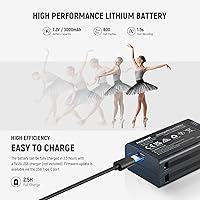
The 2.5-hour charge time is the main friction point, and the lack of any included charger means first-time buyers need to source a compatible 5V 2A USB adapter before their first session — an avoidable but recurring complaint in reviews. There is also no pass-through charging capability, so the flash cannot be used while plugged in.
Flash Power Range
76%
24%
A 1/1 to 1/256 manual power range gives photographers genuinely fine exposure control across a wide variety of shooting situations — from subtle fill light in a bright hallway to the primary source in a dark venue. The flash duration shortening at lower power levels is also useful for freezing motion in controlled indoor environments.
The 76Ws ceiling is the real limiting factor — studio photographers who routinely use large modifiers or need to overpower strong ambient light at distance will find this flash undersized for the task. A small number of manual purists also note that the power step increments feel less granular than they prefer for precision work.

Suitable for:

The NEEWER Z2-F TTL Round Head Speedlite Flash is built squarely for Fujifilm mirrorless photographers — X-T, X-H, X-S, and GFX series users — who want a serious, native TTL flash without paying Profoto or Godox V1 prices. If your work centers on portraits, weddings, or events where natural-looking light matters, the circular Fresnel head produces noticeably softer falloff than a standard rectangular flash, often without needing an additional modifier. Outdoor photographers shooting in bright conditions will find the 1/8000s HSS sync genuinely useful for fill flash in harsh light — it is the kind of capability that previously required spending significantly more. The dual modeling lamps and TCM quick-switch key are real workflow upgrades for anyone who toggles between TTL and manual frequently or wants to preview light placement before firing. Hobbyists and semi-pros who want a full-featured flash they can grow into — stroboscopic modes, optical slave, multi-group wireless control — will find considerably more capability here than the price tag might suggest.

Not suitable for:

The NEEWER Z2-F TTL Round Head Speedlite Flash supports TTL exclusively for Fujifilm; if you shoot Sony, Canon, Nikon, or any other system, you get no automatic metering whatsoever, which is a hard dealbreaker regardless of how appealing the other specs look. Studio photographers who routinely work above 76Ws of output — or who need the fine manual power stepping that purpose-built monolights provide — will find this flash undersized for that kind of work. Buyers planning to use this flash wirelessly from the start should know the QPRO-F transmitter is sold separately, adding meaningful cost that does not show up in the initial listing price. Godox X system users hoping to run this as a full TTL master within their existing setup will be disappointed; it operates only as a slave in RX COMPAT mode, and that mode requires up-to-date firmware to function reliably. If you need a single flash to do heavy commercial studio work and double as a field unit, a higher-output option with more granular power control will serve you better.

Specifications

  • Max Output: The flash delivers a maximum output of 76 watt-seconds (Ws), suited for portraits, events, and outdoor fill-flash work.
  • Flash Sync: High-speed sync (HSS) is supported up to 1/8000s, with standard sync beginning at 1/180s.
  • Manual Range: Manual power adjusts from full output (1/1) down to 1/256 in discrete steps for precise exposure control.
  • Flash Duration: Flash duration ranges from 1/180s at full power to 1/20000s at minimum output, enabling motion-freezing at lower power levels.
  • Zoom Range: The flash head zooms automatically or manually between 18mm and 69mm to match the focal length and coverage angle in use.
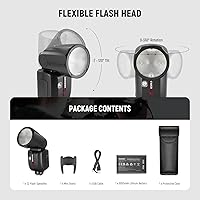
  • Head Movement: The flash head swivels 0–330° horizontally and tilts from -7° to 120° vertically for flexible bounce and directional lighting.
  • Battery: A built-in 7.2V 3000mAh lithium-ion battery provides up to 600 full-power flashes on a single charge.
  • Recycle Time: At full power output, the flash recycles in approximately 1.5 seconds, which is competitive for this output class.
  • Charge Time: The battery reaches a full charge in approximately 2.5 hours via a 5V 2A USB charger, which is not included in the box.
  • Modeling Lamps: Two 2W LED modeling lamps rated at 3300K offer 10 adjustable brightness levels for previewing light direction and quality before firing.
  • Wireless System: The 2.4G wireless system supports 4 groups, 32 channels, and 99 IDs with a working range of up to 328ft (100m).
  • Compatibility: TTL metering is supported exclusively for Fujifilm cameras; the unit also works with the NEEWER Q system and Godox X system in slave or RX mode only.
  • Mount Type: The flash attaches via a standard hot shoe mount compatible with Fujifilm mirrorless bodies across the X-T, X-H, X-S, and GFX series.
  • Connectivity: A USB Type-C port enables firmware updates directly from a computer without any proprietary cables or adapters.
  • Shooting Modes: Supported modes include TTL, manual, stroboscopic, S1 and S2 optical slave, FEC, FEB, FEL, front and rear curtain sync, and HSS.
  • Weight: The unit weighs 1.1 pounds, making it practical for extended on-camera use without significant fatigue.
  • Package Size: The packaged product measures 9.8 x 7.05 x 4.41 inches, accommodating the flash body and included accessories.

Related Reviews
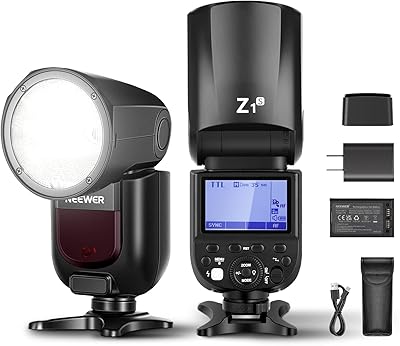
NEEWER Z1-S Round Head Flash Speedlite
83%
91%
Light Quality
83%
Build Quality
72%
TTL Accuracy
93%
Battery Life
88%
Recycle Time
More
NEEWER NW645II-S TTL Flash Speedlite
81%
86%
TTL Accuracy
83%
High-Speed Sync Performance
78%
Build Quality
61%
Optical Slave Reliability
81%
Recycle Speed
More
Neewer 750II TTL Camera Flash Speedlite
78%
76%
TTL Metering Accuracy
91%
Value for Money
62%
Build Quality
88%
Ease of Use
84%
LCD Screen Clarity
More
NEEWER Z1-N TTL Speedlite for Nikon
78%
91%
Light Quality
78%
TTL Accuracy
86%
High-Speed Sync Performance
71%
Wireless Reliability
83%
Battery Life
More
NEEWER Z2PRO-N TTL Round Head Flash Speedlite
82%
91%
TTL Accuracy
88%
Light Quality
86%
Battery Life & Charging
79%
Wireless Reliability
84%
Build Quality
More
NEEWER NW635II-S TTL Camera Flash
80%
83%
TTL Metering Accuracy
79%
Build Quality
86%
Flash Power Output
91%
Value for Money
67%
Battery Performance
More
NEEWER Z880-C TTL Camera Flash Speedlite
83%
83%
Build Quality
88%
TTL Accuracy
86%
HSS Performance
74%
Wireless Reliability
91%
Battery Life
More
NEEWER NW620 Speedlite Flash
75%
88%
Value for Money
84%
Flash Output & Power
79%
Build Quality
91%
LCD Display & Controls
62%
Recycling Time
More
NEEWER TT560 Speedlite Flash
75%
91%
Value for Money
74%
Ease of Use
83%
Build Quality
78%
Compatibility
77%
Light Output & Power Range
More
NEEWER NW700-N TTL Flash Speedlite
79%
84%
TTL Metering Accuracy
79%
TCM Function Usability
82%
High-Speed Sync Performance
71%
Build Quality & Durability
86%
Recycle Speed
More

FAQ

It supports full TTL metering with a wide range of Fujifilm bodies, including the X-T5, X-H2, X-H2S, X-S20, X100VI, GFX100S, and many others. When mounted in the hot shoe, the flash communicates directly with the camera for automatic exposure adjustment. If your specific Fujifilm model is not on the official compatibility list, it is worth verifying before purchasing.

If you want to use it as part of a NEEWER Q system multi-light setup, yes — the QPRO-F transmitter is sold separately and is not included. That said, if you already own Godox X system triggers like the Xpro-F or X2T-F, you can use the Z2-F flash as a slave unit in RX COMPAT mode without any additional purchase. Just make sure the flash firmware is current before switching wireless modes, as older firmware can cause compatibility issues.

Partially. This round-head flash can fire as a slave when triggered by Godox X system transmitters, which is useful for adding it as a secondary or accent light. However, it cannot function as a TTL master for other Godox units, and you cannot run both the NEEWER Q system and Godox X mode simultaneously. For photographers with a large existing Godox investment, this speedlite works better as an additional unit than as a hub.

The circular Fresnel head produces a rounder, softer catchlight in your subject's eyes and a more natural, gradual falloff toward the frame edges compared to the hard rectangular pattern of a traditional flash. The difference is most visible when bouncing off a ceiling or wall, where the rounder light source wraps more naturally around subjects. Many photographers find it reduces the need for additional diffusion accessories in portrait and event work.

The lithium-ion battery is built into the unit and is not user-swappable in the field. The good news is that 600 full-power flashes per charge is enough to cover most full-day portrait sessions or weddings without needing to recharge mid-shoot. If you are working in high-volume, back-to-back conditions, carrying a USB power bank for a quick top-up during a break is a practical workaround.

It is genuinely useful for outdoor work. Standard flash sync tops out around 1/180s to 1/250s, which forces you into small apertures or heavy ND filtration in bright sunlight. With HSS active up to 1/8000s, you can shoot wide open at f/1.8 or f/2 outdoors and balance flash with the ambient light properly. For wedding photographers doing fill flash in midday sun or open-shade portraits, it makes a real practical difference.

The upgraded UI is cleaner than older NEEWER flash models, and the TCM key for instant TTL-to-manual switching means you spend less time in menus during a shoot. For a first-time user, TTL mode handles metering automatically and gets you solid results right away. The part that takes more learning is the wireless system — setting up multi-group off-camera lighting or navigating between NEEWER Q and Godox X slave modes does require some time with the manual to get right.

Yes. The flash includes S1 and S2 optical slave modes that let it fire in response to another flash without any radio transmitter. S1 triggers on any flash burst, while S2 is designed to ignore TTL pre-flashes and respond only to the main burst. This makes it easy to use as a background or hair light when you already have a separate flash on your camera acting as the trigger.

Updates are applied through the USB Type-C port on the flash body, using a file downloaded from NEEWER's website and a computer — it is a straightforward process. You do not need to update firmware just to use the flash normally in TTL or manual mode. However, if you plan to use the Godox X system RX COMPAT feature, updating to the latest firmware first is strongly recommended, as compatibility improvements are often delivered through updates.

Both are round-head Fujifilm TTL speedlites with comparable output, so the decision usually comes down to ecosystem and feature priorities. The Godox V1-F operates as a full TTL master within the broader Godox X ecosystem, which this flash cannot do. In return, this round-head flash brings dual modeling lamps and the TCM quick-switch key — features the V1-F does not include. If you are already committed to Godox, the V1-F integrates more naturally; if you are starting fresh or building around the NEEWER Q system, this flash is a strong value at its price tier.