Overview

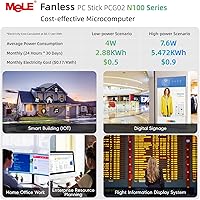
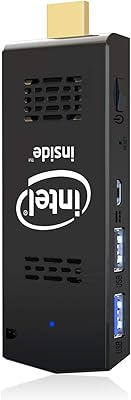
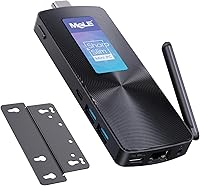
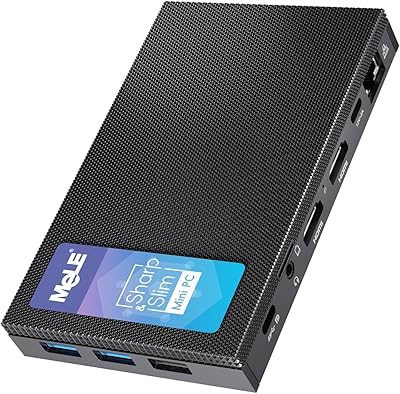
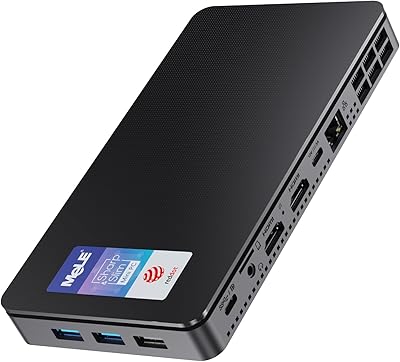
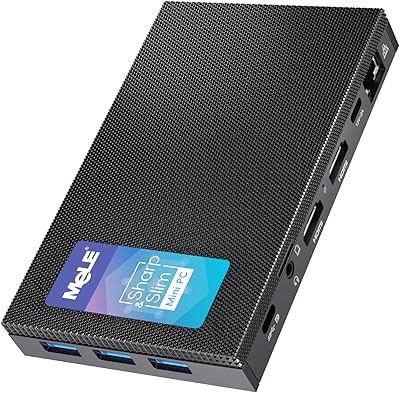
The MeLE PCG02 Fanless Mini PC Stick 8GB/128GB is a compact Windows 11 Pro computer that fits in a jacket pocket yet handles real work. Launched in early 2025, it occupies an interesting middle ground in the mini PC market — capable enough for business use, small enough to toss in a bag. What sets this stick PC apart from most competitors at this size is the combination of Gigabit Ethernet and a full-function USB-C port, both typically absent from cheaper sticks. The fanless passive cooling keeps things completely silent, though the surface gets noticeably warm during sustained use — a known, IEC-certified tradeoff, not a defect.
Features & Benefits

The Intel N100 processor is a genuine step up from the aging J4125 chips that powered earlier stick PCs — quad-core performance at up to 3.4GHz makes a real difference for browser-heavy workflows and light office tasks. Paired with 8GB of LPDDR4, the PCG02 handles multiple open applications without constant swapping. Storage is 128GB eMMC, adequate for most deployments but slower than NVMe, so heavy file writers should plan on a Micro SD card for overflow. The full-function USB-C supports 4K output at 60Hz alongside power delivery, which is impressive at this size. BIOS tools like Wake on LAN and PXE boot round out a surprisingly enterprise-ready feature set.

Best For

This fanless mini PC is a natural fit for anyone needing silent, always-on computing — think retail kiosks, lobby displays, or industrial monitoring stations where a spinning fan would be a liability. IT teams will appreciate Wake on LAN and PXE boot for remote management without touching the hardware. Home theater users get a genuinely quiet PC to hide behind a TV, pairing wirelessly via Bluetooth 5.1. Frequent travelers benefit from the compact form factor and a full Windows environment on demand. It is less ideal for content creators or developers who need fast local storage throughput or sustained heavy CPU performance.

User Feedback

Owners of the PCG02 consistently praise its near-silent operation and the N100 performance for everyday tasks — a clear step up from older stick PCs many had used before. Gigabit Ethernet and USB-C display output are called out as reliable and genuinely useful in real deployments. The surface heat draws regular attention: buyers report it gets hot to the touch during extended use, but most note no stability issues, and temperatures fall within IEC safety standards. Some users flag that eMMC write speeds bottleneck file-heavy tasks. A few mention friction with Windows 11 Pro activation out of the box. Overall, the value-for-size ratio is viewed positively for the intended use cases.

Pros

  • Completely silent operation makes this stick PC ideal for noise-sensitive environments like meeting rooms or home theaters.
  • The Intel N100 processor delivers a meaningful performance bump over older J4125-based sticks for everyday productivity.
  • Gigabit Ethernet is a rare inclusion at this form factor and adds real reliability for wired network deployments.
  • Full-function USB-C supports 4K output at 60Hz, power delivery, and high-speed data — unusually capable for a stick PC.
  • Enterprise BIOS features like Wake on LAN and PXE boot make remote management genuinely practical.
  • Two USB-A ports running at 10Gbps handle most peripheral setups without needing a hub.
  • Windows 11 Pro is included out of the box, with Linux compatibility for those who want an alternative OS.
  • The Kensington lock slot is a thoughtful addition for kiosk and commercial deployments where physical security matters.
  • Micro SD expansion up to 2TB gives users a practical path to more storage without replacing the unit.
  • Compact enough to carry in a jacket pocket, making it a legitimate travel computer for Windows-dependent workflows.

Cons

  • eMMC storage is noticeably slower than NVMe, which bottlenecks file-heavy tasks and large application installs.
  • The chassis surface reaches 55°C to 70°C under sustained load — warm enough to be uncomfortable if handled during heavy use.
  • RAM is soldered and fixed at 8GB with no upgrade path available.
  • Some buyers have reported friction with Windows 11 Pro activation straight out of the box.
  • Wi-Fi tops out at Wi-Fi 5, which may feel limiting compared to newer mini PCs shipping with Wi-Fi 6 or 6E.
  • The Bluetooth version is inconsistently documented across listing materials, creating uncertainty for buyers who rely on that spec.
  • Single-channel memory architecture limits performance headroom compared to dual-channel configurations at a similar price.
  • No internal storage upgrade path exists — the Micro SD slot is the only expansion option, and it runs at USB 2.0 speeds.

Ratings

The scores below for the MeLE PCG02 Fanless Mini PC Stick 8GB/128GB were generated by our AI review engine after analyzing verified global buyer feedback, with spam, bot activity, and incentivized reviews actively filtered out. Every category reflects the honest spread of real-world experiences — strengths and frustrations alike — so you get a clear picture before committing to a purchase.
Fanless Cooling
83%
Silent operation is the single most praised characteristic across user feedback — buyers deploying this stick PC in meeting rooms, home theaters, and retail kiosks consistently note the complete absence of fan noise as a genuine quality-of-life win. For 24/7 unattended deployments, passive cooling also removes one more mechanical failure point.
The chassis surface gets noticeably hot under sustained load, regularly reaching temperatures that are uncomfortable to hold. While this is within IEC safety standards and expected from passive cooling, buyers who did not anticipate it sometimes find it alarming, and enclosed mounting locations can compound the heat buildup.
Processing Performance
76%
24%
The N100 is a clear generational improvement over the older J4125 chips, and users switching from previous-generation stick PCs notice it immediately in everyday tasks. Web browsing, video calls, and light document work all feel responsive, and the processor handles 4K video playback through hardware decoding without breaking a sweat.
Sustained multi-threaded workloads push the N100 to its limits fairly quickly, especially without active cooling to sustain boost clocks. Users who pile on too many browser tabs or run background sync tasks alongside productivity apps report occasional sluggishness that disrupts workflow.
Connectivity Options
91%
Having both Gigabit Ethernet and dual-band Wi-Fi 5 in a stick-form PC is genuinely unusual, and buyers in network-sensitive environments — digital signage, thin clients, industrial monitoring — highlight wired reliability as a key differentiator. The full-function USB-C adding 4K video, 10Gbps data, and power delivery in a single port is praised as a smart design decision.
Wi-Fi tops out at Wi-Fi 5, which is starting to feel dated given how many competitors at this price tier now ship with Wi-Fi 6. For most home and office users this will not matter, but buyers in dense wireless environments may notice the ceiling during peak network usage.
Storage Speed
54%
46%
The 128GB eMMC handles typical OS and application loads adequately, and day-to-day operations like opening apps or booting Windows are not dramatically slow. For light deployments running a browser-based kiosk or a fixed signage application, the storage is more than sufficient.
eMMC write speeds are substantially slower than NVMe, and buyers who work with large files, run database-heavy software, or frequently install and update large applications feel the bottleneck clearly. The Micro SD expansion slot also runs over a USB 2.0 interface, which means secondary storage is even slower — not a great fallback for performance-sensitive overflow.
Build & Portability
88%
The physical form factor draws consistent praise — buyers are genuinely impressed that a full Windows PC with this many ports fits into a package you can slip into a shirt pocket. The external Wi-Fi antenna is a thoughtful touch that improves wireless signal without making the unit awkward to carry.
The chassis feels plasticky to some buyers, and a few note that port placement can make cable management messy when multiple peripherals are attached simultaneously. At 14.4 ounces, it is heavier than you might expect for its size, though this is partly a result of the heat-dissipating chassis mass.
Display Output
86%
The ability to push 4K at 60Hz via the USB-C DisplayPort output from a stick PC surprises many buyers positively. Dual-display setups using HDMI and USB-C simultaneously work reliably, and users running signage or presentation displays report clean, stable output without flickering or compatibility headaches.
There is only one HDMI port and one video-capable USB-C, so triple-display setups are off the table entirely. Some buyers using older monitors have also encountered initial handshake delays when booting, though these tend to resolve without lasting issues.
RAM Adequacy
69%
31%
For the intended use cases — productivity, web browsing, signage, and thin-client work — 8GB of LPDDR4 provides enough headroom to run Windows 11 Pro comfortably alongside a handful of open applications. Most buyers in commercial deployments report no memory-related slowdowns during normal operation.
Single-channel memory architecture is a real performance limiter compared to dual-channel setups at similar price points, reducing available memory bandwidth for graphics and processor tasks. RAM is soldered and non-upgradeable, so buyers who need more headroom in the future have no recourse other than replacing the unit entirely.
BIOS & Remote Management
89%
IT professionals and system administrators are notably enthusiastic about the BIOS feature set — Wake on LAN, PXE boot, Auto Power On, and RTC Wake are all enterprise-grade tools that simply do not appear in most competing stick PCs. Remote deployment without physical intervention becomes genuinely practical.
Accessing and configuring these features requires BIOS familiarity that non-technical buyers may lack, and documentation guiding new users through setup is thin. A few IT buyers also noted that WoL requires specific network configuration on the infrastructure side, which is expected but not always flagged clearly during setup.
Windows 11 Pro Setup
67%
33%
Windows 11 Pro is a meaningful inclusion over Home — buyers in business and commercial environments benefit from features like Remote Desktop, BitLocker, and Group Policy without paying extra for an OS upgrade. The pre-installation saves time in volume deployments.
A recurring complaint across buyer feedback involves friction during the Windows 11 Pro activation process, with some units requiring additional manual steps before activation completes successfully. This is frustrating for buyers expecting a truly out-of-the-box ready experience, particularly for non-technical users or bulk deployers.
Value for Money
78%
22%
Buyers evaluating the PCG02 against other fanless mini PCs and stick computers at comparable price points generally rate the value positively, particularly given the Gigabit Ethernet, full-function USB-C, and enterprise BIOS features that competitors often omit. For specific use cases it is designed for, the cost feels justified.
For general consumers comparing it against budget mini PCs with NVMe storage and faster RAM, the value equation looks less favorable. Buyers who do not specifically need the fanless design or commercial BIOS features may find similar or better raw performance elsewhere for the same outlay.
Peripheral Compatibility
82%
18%
The two USB-A ports at 10Gbps each cover most standard peripheral setups — keyboard, mouse, and a USB hub or external drive — without needing an additional hub for basic configurations. Bluetooth 5.1 adds reliable wireless peripheral support alongside the wired options.
With only two USB-A ports, buyers who need to connect more than two USB peripherals directly will need a hub, which adds desk clutter and negates some of the form factor appeal. Bluetooth version documentation inconsistencies in MeLE's own materials have caused minor confusion among buyers researching compatibility before purchase.
Thermal Management
61%
39%
The passive cooling design succeeds at its primary goal — maintaining system stability under the workloads this device is designed for, including 24/7 digital signage and light productivity tasks. Long-term stability reports from commercial users suggest the thermal solution does not degrade performance over extended operation.
Surface temperatures between 55°C and 70°C under sustained load are high enough to concern buyers who were not expecting it, and the device should not be placed in poorly ventilated enclosures or stacked with other heat-generating hardware. Deployments in warm ambient environments like industrial settings should account for additional thermal headroom.
Linux Compatibility
71%
29%
The hardware platform officially supports Linux and Ubuntu, and tech-savvy buyers who want to run a stripped-down Linux deployment for IoT or server tasks appreciate having that option confirmed. Several users report successful installs with minimal driver friction on popular distributions.
Linux support is not officially documented in detail, and driver availability for Wi-Fi and Bluetooth adapters can vary meaningfully between distributions. Buyers planning a Linux-first deployment should research community compatibility reports for their specific distro before purchasing rather than relying on the broad compatibility claim alone.
Physical Security
84%
The Kensington lock slot is a small but meaningful addition that commercial buyers in public-facing or shared-access environments specifically call out as a deciding factor. For retail kiosks, lobby displays, or school environments, physical device security is a genuine requirement that many competing stick PCs simply skip.
The lock slot only addresses physical removal of the device itself — it does not provide any additional software-level security beyond what Windows 11 Pro offers natively. In high-security environments, buyers will still need to configure BitLocker, BIOS passwords, and other software protections independently.

Suitable for:

The MeLE PCG02 Fanless Mini PC Stick 8GB/128GB is purpose-built for buyers who need a silent, low-maintenance Windows computer in a constrained space. IT professionals will find the Wake on LAN, PXE boot, and Auto Power On features genuinely useful for managing remote or unattended deployments without physical access. Digital signage operators and kiosk managers benefit from 24/7 fanless reliability, dust resistance, and the Kensington lock slot that keeps the hardware physically secured in public or commercial environments. Home theater enthusiasts who want a full Windows machine hidden behind a TV — without fan noise interrupting quiet scenes — will appreciate the completely passive design paired with 4K-capable USB-C output. Travelers and remote workers who need a real Windows environment on demand, not a ChromeOS workaround, will find this stick PC easy to carry and quick to set up anywhere there is a display.

Not suitable for:

The MeLE PCG02 Fanless Mini PC Stick 8GB/128GB is not the right tool for users with demanding computational needs. The N100 processor handles office tasks and web browsing confidently, but anyone running video editing software, compiling large codebases, or using locally-hosted AI tools will hit a ceiling quickly. The 128GB eMMC storage is a real constraint for heavy users — eMMC write speeds are significantly slower than NVMe, so bulk file transfers, large application installs, and database workloads will feel sluggish. Users who are sensitive to device temperatures should also know the chassis runs noticeably warm under load; while this is within IEC safety standards, it is not suitable for environments where surface heat could pose a handling concern. Finally, buyers expecting a traditional desktop replacement with easy internal upgrade paths will be disappointed — RAM and storage are fixed, and expandability is limited to a Micro SD card slot.
Specifications

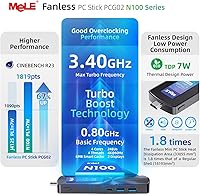
  • Processor: Intel N100 quad-core (Alder Lake) running up to 3.4GHz with a 6MB cache, built on a 10nm efficiency architecture.
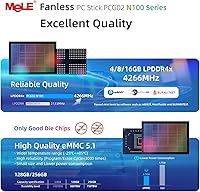
  • RAM: 8GB LPDDR4 in a single-channel configuration, soldered to the board with no upgrade path.
  • Storage: 128GB eMMC 5.1 internal storage with a theoretical read speed of up to 400MB/s, slower than NVMe alternatives.
  • Storage Expansion: One Micro SD card slot (UHS-I, USB 2.0 interface) supporting cards up to 2TB capacity.
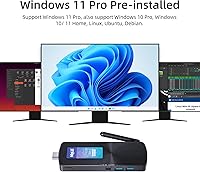
  • Operating System: Windows 11 Pro pre-installed; also compatible with Linux and Ubuntu distributions.
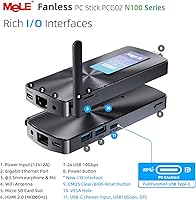
  • Video Output: HDMI 2.0 port plus a full-function USB-C port supporting DisplayPort 1.4, enabling up to 4096x2160 resolution at 60Hz.
  • USB Ports: Two USB-A ports (USB 3.2 Gen 2, 10Gbps each) and one full-function USB-C port (USB 3.2 Gen 2, DP1.4, PD 3.0).
  • Networking: Dual-band Wi-Fi 5 (802.11ac, 2.4GHz and 5GHz with MU-MIMO) plus one Gigabit Ethernet (RJ45) port for wired connections.
  • Bluetooth: Bluetooth 5.1 for connecting wireless peripherals including keyboards, mice, and audio devices.
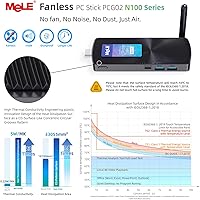
  • Cooling System: Fully passive fanless design with no moving parts, resulting in silent operation but a surface temperature range of 55°C to 70°C under load.
  • BIOS Features: Supports Wake on LAN, PXE boot, iPXE boot, Auto Power On, and RTC Wake for unattended and remote deployment scenarios.
  • Security: Kensington lock slot built into the chassis for physical security in commercial, kiosk, or public-facing installations.
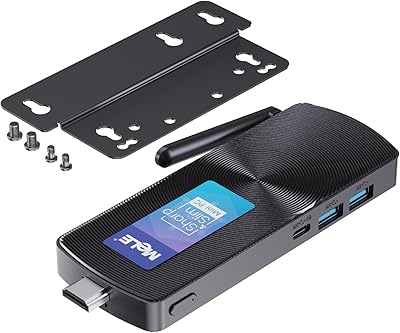
  • Power Input: Powered via a dedicated DC-in USB-C port accepting 12V to 20V input at 12V/2A; this port is for power only and is separate from the data USB-C port.
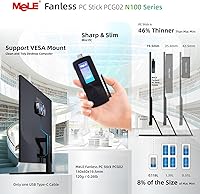
  • Form Factor: Stick PC measuring 6.61 x 3.39 x 2.52 inches, compact enough to mount behind a display or carry in a bag.
  • Weight: The unit weighs 14.4 ounces including the external Wi-Fi antenna and associated accessories in the package.
  • Graphics: Intel UHD Graphics integrated into the N100 processor, sufficient for 4K display output and light media playback.
  • Safety Certification: Surface operating temperatures comply with IEC 62368-1:2018 international safety standards for audio/video and IT equipment.
  • Linux Support: The hardware platform is listed as compatible with Linux and x86-based operating systems in addition to the pre-installed Windows environment.

Related Reviews
MeLE PCG02 N100 Mini PC Stick
76%
94%
Silent Operation
93%
Power Efficiency
88%
Display Output
46%
RAM & Multitasking
76%
Value for Money
More
AIOEXPC S7 J4125 8GB 128GB PC Stick
76%
72%
Everyday Performance
94%
Portability
88%
Setup Experience
91%
Connectivity
74%
Thermal Management
More
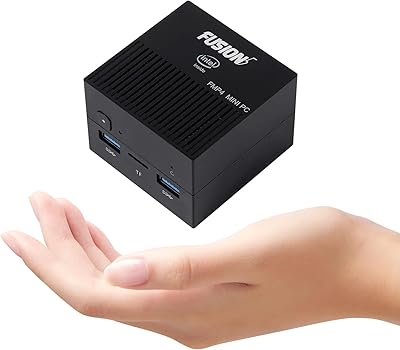
Fusion5 FMP4 Mini PC
70%
94%
Portability
78%
Value for Money
63%
Everyday Performance
47%
Storage Speed
88%
Connectivity
More
AKLWY Mini PC Stick 4GB/128GB Computer
74%
93%
Portability
78%
Value for Money
47%
Performance
84%
Setup & Ease of Use
71%
Build Quality
More
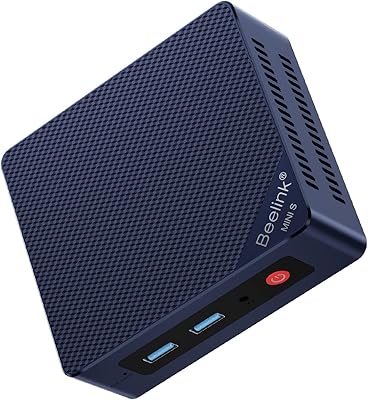
Beelink Mini S12 Mini PC
78%
88%
Value for Money
82%
Performance for Daily Tasks
79%
Build Quality & Design
91%
Dual Monitor Support
84%
Thermal Management & Noise
More
OASLOA T9PRO 8GB 256GB Mini PC
70%
83%
Value for Money
41%
Out-of-Box Experience
67%
Processing Performance
88%
Multi-Monitor Support
74%
Build Quality
More
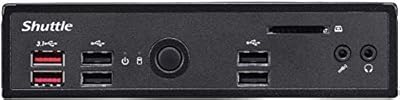
Shuttle DS10U5 Fanless Mini Barebone PC
80%
91%
Build Quality
83%
Fanless Passive Cooling
88%
Display Output Versatility
93%
Memory Expandability
89%
Connectivity & Port Selection
More
MeLE Mini PC Quieter 4C, 16GB RAM, 512GB SSD
87%
85%
Performance
90%
Build Quality
88%
Display Quality
93%
Energy Efficiency
92%
Noise Level
More
MeLE Quieter3C Mini PC N5105 16GB/512GB
80%
97%
Noise Level
83%
Build Quality & Design
71%
Thermal Management
74%
Everyday Performance
68%
Memory & Storage Configuration
More
MeLE Overclock 4C Mini PC, 32GB RAM, 512GB Storage
89%
89%
Performance
91%
Build Quality
96%
Portability
90%
Display Support
88%
Connectivity
More

FAQ

It does run warm — that is expected with any fanless design. Under sustained load, the chassis surface can reach between 55°C and 70°C, which is noticeably hot to the touch. That said, it stays within IEC 62368-1 safety standards, and most users report no throttling or stability issues during normal productivity tasks. If you are mounting it behind a display or in an enclosure, just make sure there is some airflow around it.

Yes, for most standard office tasks it holds up well. The N100 handles web browsing, Microsoft 365 apps, video conferencing, and light multitasking without complaint. Where it starts to feel limited is when you pile on too many browser tabs simultaneously or run more demanding background processes — 8GB of single-channel RAM is sufficient but not generous.

The internal eMMC is soldered in and cannot be replaced or upgraded. Your only expansion option is the Micro SD card slot, which supports cards up to 2TB. Keep in mind the slot runs over a USB 2.0 interface, so write speeds to the card will be much slower than the internal storage — fine for media files or archiving, not ideal for running apps directly from the card.

Yes. The HDMI 2.0 port and the full-function USB-C port can drive two displays simultaneously. The USB-C output supports DisplayPort 1.4 and can push up to 4K at 60Hz, so you can run a dual-monitor setup with at least one high-resolution display in the mix.

The USB-C port marked with a DisplayPort symbol supports three protocols in one connector: DisplayPort 1.4 for video output, USB 3.2 Gen 2 for 10Gbps data transfer, and Power Delivery 3.0 so it can also charge compatible devices. It is genuinely versatile. The second USB-C port on the device is a DC power input only and does not carry data or video.

Setup is reasonably straightforward — plug it into an HDMI port, connect power via the DC USB-C port, attach a keyboard and mouse, and boot into Windows 11 Pro. The main friction point some users have encountered is the Windows 11 Pro activation process, which occasionally requires additional steps. If you are deploying multiple units for a business, it is worth testing one unit through activation before rolling out a full batch.

Wake on LAN is supported in the BIOS alongside PXE and iPXE boot options, which is genuinely uncommon for a stick-form PC. IT users managing remote deployments report it functions as expected. You will need to enable it in BIOS settings and ensure your network infrastructure supports the feature — the device does not handle WoL configuration automatically out of the box.

The hardware platform officially supports Linux and Ubuntu in addition to Windows, so it is not locked to the pre-installed OS. That said, driver support can vary depending on the distribution you choose, particularly for Wi-Fi and Bluetooth. If you are planning a Linux deployment, it is worth checking community forums for your specific distro before committing.

Yes, the Gigabit Ethernet port is built directly into the body of this stick PC, which makes it unusual in this category. Most competing stick PCs rely entirely on Wi-Fi. The wired port uses a standard RJ45 connector and delivers full gigabit speeds, which is a meaningful advantage for network-dependent applications like digital signage, thin clients, or any scenario where Wi-Fi reliability is a concern.

It is a reasonable lightweight option for Plex if your library relies on direct play rather than heavy transcoding. The N100 handles hardware-accelerated decoding for common formats well enough, but real-time transcoding of high-bitrate 4K content will push it to its limits. For a modest home media setup with mostly pre-optimized files, it works fine. If you need to transcode frequently or run other services alongside Plex, you might want something with a more powerful chip.