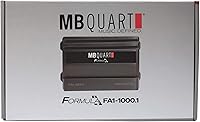
Overview

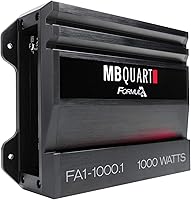
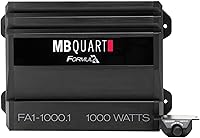
The MB Quart FA1-1000.1 Mono Car Amplifier sits in a competitive mid-range bracket where serious bass builds live — not entry-level throwaway gear, but not the kind of flagship money most daily drivers want to spend either. MB Quart has been building car audio equipment under German engineering standards for decades, and that heritage shows in how they approach the Q1 Class SQ design: rather than chasing raw wattage numbers, they prioritize cleaner power through FLUID-FET output devices that smooth out the harshness typical of cheaper Class D amps. The chassis measures 10.25 x 9.75 x 2 inches and weighs under six pounds, making routing and mounting considerably easier than bulkier monoblocks. Just set expectations correctly — this is a single-channel mono amp, optimized for powering one subwoofer well.

Features & Benefits

The MOSFET power supply inside the FA1-1000.1 draws power efficiently enough that you won't notice significant alternator strain, even at higher listening volumes — a real consideration if your vehicle already runs close to electrical capacity. The on-board variable electronic crossover is one of this mono amplifier's more practical advantages; it lets you tune the low-pass frequency precisely rather than relying on an external unit or guessing at settings. The hi-level input with DC Signal Sense is a standout for anyone upgrading from a factory head unit, since it eliminates the need to run a dedicated remote turn-on wire entirely. Being 1-ohm stable broadens your subwoofer pairing options considerably, and the included wired bass remote adds convenient level control without touching the stereo.

Best For

This MB Quart amp makes the most sense for builders putting together a single subwoofer system who need dependable mono power without overcomplicating the install. It's particularly well-suited for truck and SUV builds where space under the seat or in a compact enclosure is tight — the low-profile chassis fits where chunkier amps simply won't. Anyone upgrading from a factory stereo will appreciate not having to fish a remote wire through the firewall, since the signal-sense circuit handles that automatically. DVC subwoofer owners running a 1-ohm or 2-ohm load will get the most out of the power headroom here. It also works well as a meaningful step up for someone who has outgrown a budget amp and wants more hands-on control over their bass tuning.

User Feedback

Buyers generally respond well to how the FA1-1000.1 handles real-world installation — particularly the signal-sense feature, which removes a common friction point for OEM head unit upgrades. Crossover flexibility draws consistent praise from more experienced installers who want precise tuning rather than fixed presets. On the critical side, some reviewers in the car audio community raise the familiar question of rated versus actual RMS output, noting that real-world numbers often land modestly below the labeled spec — worth factoring in when matching the amp to a subwoofer. Thermal performance appears adequate for average sessions, though a handful of users report the amp running noticeably warm under sustained high-volume use. Longer-term build quality feedback leans positive overall.

Pros

  • Signal-sense turn-on eliminates the need for a remote wire, making factory head unit installs noticeably cleaner and faster.
  • The on-board variable crossover gives real tuning flexibility without requiring a separate processor or DSP unit.
  • 1-ohm stability broadens subwoofer pairing options, including lower-impedance DVC wiring configurations.
  • Compact 10.25 x 9.75 x 2-inch footprint fits under seats and in tight enclosures where bulkier amps cannot.
  • MOSFET power supply draws efficiently, reducing strain on the vehicle electrical system at moderate listening levels.
  • Included wired bass remote lets the driver adjust low-end output on the fly without touching the stereo.
  • FLUID-FET output devices produce noticeably smoother bass reproduction compared to generic Class D designs at this price point.
  • LED protection indicator is a practical diagnostic tool for catching clipping or thermal issues before they cause damage.
  • MB Quart’s long-standing reputation in car audio means parts support and brand accountability are more reliable than lesser-known alternatives.
  • At its price tier, the FA1-1000.1 offers a level of crossover and input flexibility typically found on more expensive amplifiers.

Cons

  • Real-world RMS output often falls short of the 1000-watt peak label — budget your subwoofer pairing accordingly.
  • The amp runs noticeably warm under sustained high-volume listening, which may concern buyers in warm climates or sealed enclosures.
  • No built-in subsonic filter means you may need external processing to protect ported subwoofer setups from over-excursion.
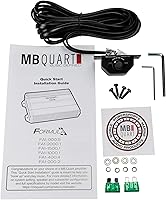
  • Wiring documentation included in the box is minimal, which can frustrate less experienced installers during initial setup.
  • The bass remote cable is on the shorter side, limiting mounting options depending on your vehicle’s dash layout.
  • No onboard display for crossover frequency settings means dialing in your tune is done by feel rather than precision readout.
  • At heavier loads and longer listening sessions, thermal throttling has been reported, which can affect consistent output levels.
  • This mono amplifier offers no upgrade path for adding full-range channels later — a separate amp will be required if your system grows.

Ratings

The scores below reflect AI-driven analysis of verified global buyer reviews for the MB Quart FA1-1000.1 Mono Car Amplifier, with spam, bot-generated, and incentivized feedback actively filtered out before scoring. Each category captures both the genuine strengths and the honest frustrations that real owners report after living with this amplifier in their daily builds. Nothing is inflated — where the amp earns praise, the scores reflect it, and where it falls short, that is reflected too.

Installation Ease
88%
The signal-sense turn-on feature is consistently cited as a major installation win, particularly by buyers working with factory head units who want to avoid running a dedicated remote wire through the firewall. Most owners with moderate DIY experience report completing the install in an afternoon without professional help.
The included documentation is sparse, and first-time amp installers frequently report needing to supplement it with online guides or forum posts to understand wiring gauge requirements and crossover adjustment ranges. A more thorough printed manual would reduce setup friction meaningfully.
Bass Output Quality
81%
19%
Buyers consistently note that the low-end reproduction feels tighter and better-controlled than what they experienced with similarly priced amplifiers, especially when the on-board crossover is tuned carefully to match the subwoofer enclosure type. Daily commuters report satisfying punch without the muddy, bloated character common in budget mono amps.
At sustained higher volumes, some users detect a slight softening in transient impact, which points to the amplifier approaching its real-world power ceiling rather than the labeled peak figure. Those expecting competition-level output at this price will likely be disappointed once the system is fully tuned.
Power Accuracy
62%
38%
For listeners running moderate volumes in trucks and SUVs, the actual delivered power is more than sufficient to drive a properly matched subwoofer with authority. Buyers who enter the purchase with realistic RMS expectations rather than fixating on the peak wattage label generally come away satisfied.
The gap between the marketed 1000-watt figure and actual continuous RMS output is a recurring complaint in user feedback, with several technically minded buyers pointing to dyno results that land well below the label. This spec inflation is a genuine issue that shapes buyer trust, especially for those matching the amp to a subwoofer with a specific minimum power requirement.
Thermal Performance
67%
33%
During typical daily listening sessions at moderate-to-high volume, the FA1-1000.1 maintains stable operation without triggering the protection circuit, and the LED indicator gives users visible confidence that the amp is running within safe parameters. Owners who install it in ventilated locations report no issues through regular use.
Extended high-volume listening — particularly in sealed or poorly ventilated mounting locations — pushes the chassis temperature noticeably higher than competing amps in this class, according to multiple buyer reports. A handful of users in warmer climates note that the protection circuit trips more frequently during summer months when ambient temperatures inside the vehicle are already elevated.
Crossover Flexibility
84%
The variable electronic crossover is one of the more practical on-board tuning tools at this price point, allowing experienced installers to fine-tune the low-pass frequency without bolting on an external processor. Buyers pairing this mono amplifier with a variety of sealed and ported enclosures report being able to dial in a usable sound without much trial and error.
The crossover adjustment is analog and lacks any frequency readout, so precise targeting of a specific Hz value requires a multimeter or real-time measurement tool rather than simply reading a label. Newcomers to car audio often find themselves guessing at settings rather than tuning with confidence.
Build Quality
76%
24%
The chassis feels solid for its weight class, and the terminal connections accept heavier gauge wiring without the wobble or resistance sometimes found on budget amplifiers. Longer-term owners — those past the one-year mark — report no significant degradation in connection quality or casing integrity.
At a close look, the finish and internal component layout do not match what you see on amplifiers in the next price bracket, and a small number of buyers report cosmetic imperfections out of the box. It reads clearly as a mid-range product rather than a premium one, which is fair at the price but worth noting for buyers who care about appearance in visible installations.
Value for Money
79%
21%
Relative to competing mono amplifiers at a similar price, the combination of hi-level inputs, signal-sense turn-on, variable crossover, and a bass remote represents a strong feature-to-cost ratio that few direct competitors match in the same package. Buyers stepping up from true budget amps feel a noticeable improvement in bass clarity that justifies the spend.
When stacked against the wattage claims of competing products at the same price, more analytically minded buyers feel the real-world output does not differentiate the FA1-1000.1 enough to make it a clear leader on pure power-per-dollar metrics. The value proposition is strongest when you factor in the installation convenience features rather than judging by output figures alone.
Compatibility
86%
1-ohm stability opens the amp up to a wide range of DVC subwoofer wiring schemes, and the combination of RCA and hi-level inputs means it integrates cleanly with virtually any head unit on the market, factory or aftermarket. Truck and SUV owners in particular report it working first-time with minimal compatibility issues across a range of subwoofer brands.
As a strictly mono amplifier, it is inherently incompatible with any build requiring full-range speaker amplification from a single unit, which narrows its appeal for buyers hoping to simplify their system to one amp. There is no bridging function or multichannel output path, so system expansion will always require an additional amplifier.
Bass Remote Usability
71%
29%
Having a physical bass remote included in the box — rather than sold as an add-on — is a practical convenience that buyers genuinely appreciate, especially when the head unit lacks independent subwoofer level control. The knob itself is responsive and allows quick adjustments without pulling over or fumbling with the stereo.
The cable length on the remote is a consistent limitation, restricting mounting placement options depending on where the amplifier is installed relative to the driver's seat. Several buyers in larger vehicles, particularly full-size trucks with longer under-seat-to-dash runs, report the cable being too short to mount the remote in a convenient location without an extension.
Protection Circuitry
78%
22%
The LED protection indicator is a functional diagnostic tool that gives installers and everyday users immediate visual feedback when the amp enters a fault state, making it easier to identify whether an issue is thermal, electrical, or related to impedance mismatch. Buyers report the circuit responding quickly to genuine fault conditions rather than triggering false positives under normal use.
The protection system does not communicate the specific fault type — it simply signals that protection has engaged — which leaves users guessing whether they are dealing with a thermal event, a short circuit, or a clipping condition without additional diagnostic tools. A multi-color or multi-blink LED scheme would significantly improve troubleshooting speed.
Footprint & Form Factor
89%
At just over 10 inches long and 2 inches tall, this MB Quart amp fits comfortably under factory seats in most mid-size and full-size trucks and SUVs — a layout that significantly simplifies cable management and keeps the amplifier out of cargo or passenger space. The sub-6-pound weight makes single-person mounting straightforward.
Compact cars and vehicles with very shallow under-seat clearance may still find the 2-inch height a tight fit depending on seat rail configuration, and the surface-mount-only design means rack or flush-mount installations are not possible without custom fabrication. Buyers should measure their mounting location carefully before assuming it will fit.
Signal Sense Reliability
82%
18%
For the majority of users running OEM head units, the DC Signal Sense feature works reliably and eliminates one of the more tedious steps in a factory upgrade install. Buyers report it correctly detecting audio signal and powering the amp on and off cleanly in everyday use without phantom turn-ons or delayed response.
A minority of users report the signal-sense circuit triggering inconsistently with certain head units, particularly when audio is paused for extended periods or when the signal level from the OEM stereo is unusually low. In those cases, toggling the feature off and running a traditional remote wire resolves the issue, but it adds a step that undermines the convenience the feature is designed to provide.
Longevity & Reliability
74%
26%
The bulk of long-term ownership feedback — users past the 12 to 18 month mark — describes the amplifier continuing to perform without notable degradation in output or connection quality, suggesting the build holds up adequately under typical daily driving conditions. MB Quart's brand history provides some additional confidence in post-purchase support compared to no-name alternatives.
There are isolated but non-trivial reports of unit failures within the first year, particularly among buyers who pushed the amplifier consistently at high volumes without adequate ventilation. Without a widely publicized warranty service experience to fall back on, buyers in those situations report frustration navigating the resolution process.

Suitable for:

The MB Quart FA1-1000.1 Mono Car Amplifier is a strong fit for car audio enthusiasts who are serious about bass but working within a realistic budget — specifically those building around a single subwoofer and wanting dependable, tunable power without the complexity of a multi-channel setup. Truck and SUV owners will find the compact chassis particularly practical, since it slides into tight spaces under seats or in shallow enclosures where larger monoblocks simply won't cooperate. The hi-level input with signal-sense turn-on is a genuine advantage for anyone upgrading from a factory head unit, removing the need to run a dedicated remote wire and cutting install time considerably. Buyers pairing this amp with a dual voice coil subwoofer wired to 1 or 2 ohms will extract the most from the available power headroom. It also suits someone stepping up from a budget amp who wants more hands-on frequency control through the on-board crossover rather than relying on external processing.

Not suitable for:

The MB Quart FA1-1000.1 Mono Car Amplifier is not the right choice for anyone planning to run multiple speakers or a full-range system — it is strictly a mono amplifier, and trying to repurpose it beyond subwoofer duty would be the wrong tool for the job. Audiophiles who demand laboratory-verified RMS output numbers should approach the rated 1000-watt figure with healthy skepticism; real-world dyno results in the car audio community frequently land below labeled specs at this price tier, and if your subwoofer requires a guaranteed minimum power floor, you may find yourself underdriving it. Buyers who listen at sustained high volumes for extended periods should also be aware that thermal performance under heavy load has been a concern for some users — this amp works well for typical listening sessions, but it is not designed for competition-level punishment. If your build requires bridging two channels or powering a more complex speaker layout, you will need a different amplifier entirely.

Specifications

  • Configuration: Single mono channel amplifier operating in Class SQ (Q1) mode, designed exclusively for subwoofer duty.
  • Peak Output: Rated at 1000 watts peak power; real-world RMS output will be lower and should be verified against your subwoofer's continuous power handling.
  • Impedance: Stable down to 1 ohm, allowing compatibility with dual voice coil subwoofers wired to low-impedance configurations.
  • Power Supply: MOSFET-based power supply designed to deliver efficient current without placing excessive load on the vehicle's charging system.
  • Output Devices: Uses FLUID-FET transistor technology to reduce harmonic distortion and produce smoother bass reproduction compared to standard Class D output stages.
  • Crossover: On-board variable electronic low-pass crossover allows frequency tailoring directly on the amplifier without requiring an external processor.
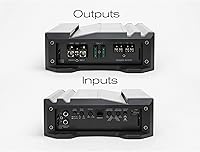
  • Inputs: Accepts both RCA line-level inputs and hi-level speaker-wire inputs for direct integration with factory or aftermarket head units.
  • Remote Turn-On: DC Signal Sense circuit detects an incoming audio signal and powers the amplifier on automatically, eliminating the need for a dedicated remote turn-on wire.
  • Bass Remote: Includes a wired bass level remote control that mounts within reach of the driver for real-time low-frequency adjustment.
  • Protection: LED system protection indicator illuminates to alert the user to fault conditions including thermal shutdown, clipping, or short-circuit events.
  • Dimensions: Physical footprint measures 10.25 x 9.75 x 2 inches, making it well-suited for under-seat or shallow-enclosure mounting locations.
  • Weight: Unit weighs 5.95 pounds, light enough for one-person installation without requiring additional support hardware during mounting.
  • Mounting Type: Designed for surface mounting using standard hardware; no rack-mount provisions are included.
  • Operating Voltage: Compatible with standard 12V vehicle electrical systems, with a functional range of approximately 9 to 16 volts DC.
  • Brand Origin: MB Quart is a German-heritage audio brand with a history spanning several decades across home, car, and marine audio product lines.

Related Reviews
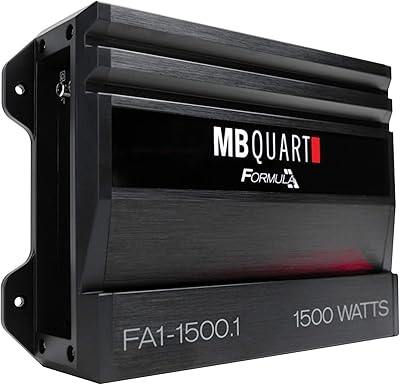
MB Quart FA1-1500.1 Mono Channel Car Audio Amplifier
84%
91%
Sound Quality
88%
Power Delivery
87%
Durability & Build Quality
85%
Ease of Setup & Installation
65%
Thermals (Heat Management)
More
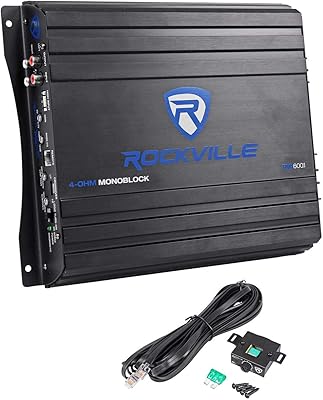
Rockville RVA600.1 Mono Car Amplifier
74%
83%
Value for Money
74%
Sound Quality
88%
Ease of Installation
52%
Power Accuracy
67%
Build Quality
More
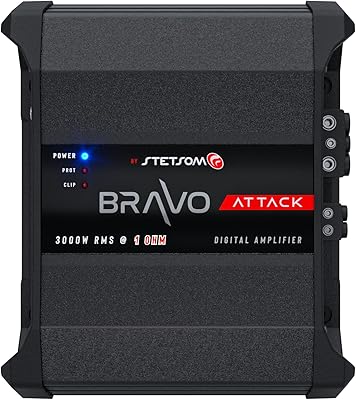
Stetsom Bravo Attack 3000.1 Mono Car Amplifier
86%
92%
Power Output
84%
Thermal Performance
88%
Ease of Installation
85%
Sound Quality
90%
Bass Control
More
Stinger MT-1500.1 Monoblock Car Amplifier
74%
83%
Bass Output Performance
57%
Rated vs Real-World Power
74%
Build Quality
62%
Heat Management
88%
Ease of Installation
More
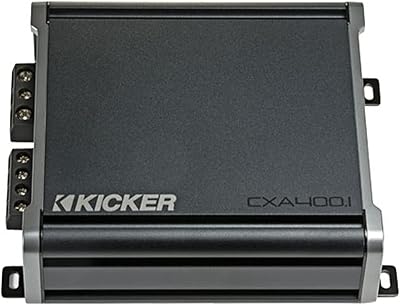
Kicker CXA400.1 Mono Car Amplifier
79%
86%
Sound Clarity
71%
Power Output Accuracy
91%
Installation Ease
67%
Build Quality
78%
Thermal Performance
More
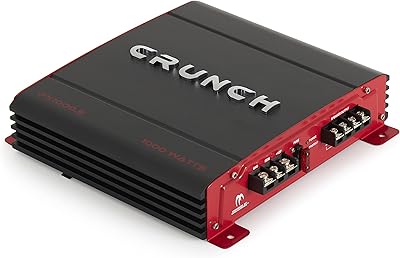
Crunch PX-1000.2 2-Channel Car Amplifier
72%
88%
Value for Money
76%
Sound Quality
83%
Ease of Installation
67%
Power Output
72%
Thermal Management
More
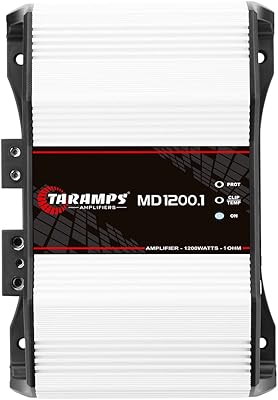
Taramp's MD 1200.1 1-Channel 1200W RMS Car Audio Amplifier
86%
93%
Power Output
89%
Sound Quality
91%
Installation Ease
85%
Build Quality
65%
Thermal Performance
More
Rockville dB15 Mono Car Amplifier
73%
83%
Value for Money
78%
Bass Output
86%
Ease of Installation
61%
Thermal Management
58%
Power Accuracy
More
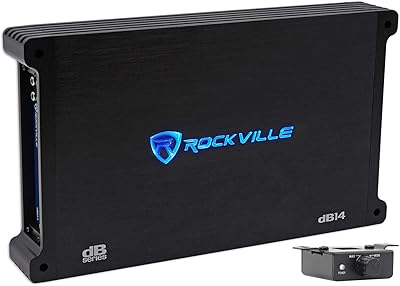
Rockville dB14 Mono Class-D Car Amplifier
74%
83%
Value for Money
78%
Power Accuracy
67%
Build Quality
54%
Long-Term Reliability
86%
Ease of Installation
More
Rockville dBcomp4 3000W Mono Car Amplifier
85%
94%
Power Output
91%
Bass Performance
87%
Ease of Installation
89%
Build Quality
67%
Thermal Management
More

FAQ

It works with factory head units without modification. The hi-level input accepts speaker-wire output directly from your OEM stereo, and the DC Signal Sense circuit turns the amp on automatically when it detects audio signal, so you do not need to run a remote turn-on wire at all. That combination makes it one of the more installer-friendly options at this price point for OEM upgrade builds.

That is a peak figure, and the actual continuous RMS output will be meaningfully lower. This is standard practice across the car audio industry at this price tier, not something unique to this amplifier. When matching it to a subwoofer, focus on RMS power handling rather than peak, and expect real-world output to land somewhere in the 500 to 700 watt range depending on impedance load and voltage conditions.

For an amplifier in this power range, 4-gauge wiring is the commonly recommended minimum for both power and ground runs. If your power cable run from the battery is longer than 15 feet, stepping up to 2-gauge is worth considering to avoid voltage drop under load. Always fuse the power wire within 18 inches of the battery connection.

No — the MB Quart FA1-1000.1 Mono Car Amplifier is strictly a single-channel mono amplifier, which means it outputs one signal channel intended for a subwoofer or subwoofer array. Running full-range speakers off a mono amplifier with a low-pass crossover would produce only low frequencies and would not be appropriate. You would need a separate multichannel amplifier for door speakers.

Thermal performance is adequate for typical daily listening, but the FA1-1000.1 has been reported by some users to run warm during extended high-volume sessions. Make sure the installation location has reasonable airflow and is not sealed inside a fully enclosed space with no ventilation. If the amp does overheat, the LED protection circuit will trigger a thermal shutdown to protect the unit before any damage occurs.

It works best with a single subwoofer rated to handle 500 to 700 watts RMS continuously, wired to a 1-ohm or 2-ohm load to take advantage of the amp's lower-impedance stability. Dual voice coil subwoofers wired in parallel to 2 ohms are a common and reliable pairing. Avoid wiring configurations that drop below 1 ohm, as the amplifier is not rated for sub-1-ohm operation.

If you have run power and ground cables and connected RCA inputs before, this amp should not present major challenges. The signal-sense feature simplifies the turn-on wiring considerably. The included documentation is fairly minimal, so referencing a wiring diagram online or using a third-party installation guide is recommended for less experienced installers.

The included wired bass remote plugs directly into the amplifier and allows you to turn the subwoofer level up or down from the driver's seat. The remote cable is on the shorter side, so where you can mount it depends heavily on where the amp is installed relative to your dash or center console. Planning your cable routing before installation will save time and help you find a practical mounting spot within comfortable reach.

For a straightforward single-subwoofer build, the on-board variable crossover handles the basics well and most users will not need an external processor. However, if you want precise control over phase alignment, time correction, or multi-band EQ, a dedicated DSP will still give you capabilities this amp cannot replicate on its own. For typical street builds focused on bass output and tunable low-pass filtering, the built-in crossover is genuinely sufficient.

There is no dedicated subsonic filter on this amplifier, which is worth noting if you are running a ported or bandpass enclosure where infrasonic frequencies can over-excite the driver. In that case, an external subsonic filter or a head unit with built-in subsonic control is advisable. For sealed enclosure builds, this is generally less of a concern due to the natural roll-off characteristics of a sealed box.

Where to Buy