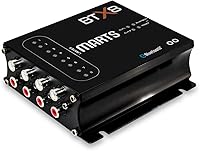
Marts Digital BTX8-DSP 8-Channel Bluetooth DSP Processor




Overview
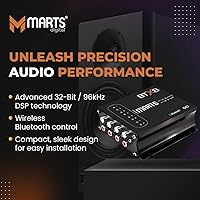
The Marts Digital BTX8-DSP 8-Channel Bluetooth DSP Processor is a signal processor — not an amplifier — built for audio enthusiasts who want active, precise control over how sound is routed and shaped across multiple speakers. Think of it as the brain of a complex speaker system: it takes audio in, applies your chosen EQ curves and crossover points, then sends clean, tuned signals out to your amplifiers. What sets this signal controller apart at its price tier is Bluetooth smartphone control, sparing you a dedicated wired remote. Processing at 32-bit, 96kHz, it targets a level of audio fidelity that punches above budget territory. The audience is clear: car audio builders, home theater integrators, and semi-pro installers who need real flexibility.
Features & Benefits
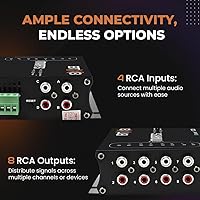
The BTX8-DSP offers 8 RCA outputs paired with 4 RCA inputs, giving you enough routing flexibility for full active setups — separate amplifier channels for tweeters, midrange drivers, and subwoofers without compromise. On the tuning side, you get a 31-band input equalizer plus 8 parametric EQ bands per output channel, which is a meaningful amount of control for dialing in speaker response in real rooms or car cabins. Crossover filter types include Linkwitz-Riley, Butterworth, and Bessel, with slopes ranging from 6 to 48 dB per octave — options that rival dedicated processors costing considerably more. Three memory presets let you save different tuning profiles, handy if you swap between listening preferences or share the system with someone else.
Best For
This DSP processor makes the most sense for active car audio builds where you're running separate amplifier channels for different driver types and need a central unit to manage crossover points and levels. It's also a practical pick for home theater setups where the receiver lacks built-in DSP flexibility, or where you're feeding multiple power amplifiers from a single preamp source. Installers who dislike proprietary wired remotes will appreciate the Bluetooth control approach. That said, if you're a complete beginner with no experience reading frequency plots or adjusting parametric EQ, expect a steep learning curve. This is a tool for people who already have a clear vision of their system architecture before they start.
User Feedback
With around 73 ratings, the review pool for this signal controller is still relatively modest, so it's worth approaching the feedback with some measured caution. That said, a consistent pattern does emerge: buyers who already understand DSP systems tend to come away satisfied, particularly praising the app-based control and the depth of the crossover filter options. On the flip side, a recurring concern involves the companion app — some users report occasional connectivity hiccups or find the interface less intuitive than expected. Documentation quality also draws complaints, with several buyers noting the setup guide assumes more prior knowledge than many users actually have. Build quality, for the price, lands in an acceptable range for most reviewers.
Pros
- Eight output channels allow fully active speaker builds with independent amplifier control per driver type.
- Bluetooth smartphone control removes the need for a wired remote module entirely.
- Parametric EQ per output channel gives experienced tuners surgical control over speaker response.
- Linkwitz-Riley, Butterworth, and Bessel crossover types cover virtually every practical filtering scenario.
- 32-bit, 96kHz processing delivers a clean, transparent signal chain that does not bottleneck quality amplifiers.
- Three memory presets let users store and switch between distinct tuning profiles quickly.
- Compact footprint fits neatly into car trunks, equipment racks, or tight installation spaces.
- Channel gain range of minus 33 to plus 9 dB handles mismatched speaker sensitivities without compromise.
- Filter slopes up to 48 dB per octave enable sharp, precise driver handoffs in active crossover builds.
Cons
- The companion app has reported connectivity drops on certain Android devices with no wired fallback option.
- Included documentation is widely considered inadequate for the complexity of the product.
- No integrated mounting ears or rack-mount bracket makes clean physical installation harder than it should be.
- Factory OEM head unit users may need additional upstream hardware for compatible signal input.
- Only three memory presets limits flexibility for users managing multiple system configurations.
- App interface lacks a preset naming function, making profile management unnecessarily confusing.
- Rear panel connector labeling is small and can cause wiring errors during initial setup.
- The asymmetric gain range offers more attenuation headroom than boost, which can frustrate low-sensitivity driver builds.
- No digital input option limits compatibility for source components with optical or coaxial outputs.
Ratings
The scores below were generated by AI after analyzing verified buyer reviews for the Marts Digital BTX8-DSP 8-Channel Bluetooth DSP Processor from multiple global sources, with spam, bot-submitted, and incentivized feedback actively filtered out. This signal controller sits in a competitive mid-range segment where expectations around tuning depth and app reliability run high, and the scores reflect both where it genuinely delivers and where real buyers have run into frustration. Nothing has been softened — the strengths and the pain points are represented as honestly as the data allows.
Signal Routing Flexibility
EQ & Tuning Depth
Crossover Filter Quality
Bluetooth App Control
Build Quality & Fit
Documentation & Setup Guidance
Value for Money
App Interface & Usability
Processing Fidelity
Memory Preset Functionality
Compatibility with Source Units
Installation Footprint
Channel Gain Control Range
Suitable for:
The Marts Digital BTX8-DSP 8-Channel Bluetooth DSP Processor is built for people who already have a clear picture of what they want their audio system to do — and need the right tool to execute it. Car audio enthusiasts running active speaker configurations, where separate amplifier channels drive tweeters, midrange drivers, and subwoofers independently, will find the eight output channels and professional-grade crossover filter options genuinely useful rather than overkill. Home theater builders who are bypassing a traditional AV receiver in favor of a dedicated amplifier stack will appreciate having a central signal controller that handles distribution, EQ, and crossover duties in one compact box. Installers who prefer Bluetooth-based tuning — being able to walk around a room or sit in the back seat while adjusting levels — will find the wireless control approach a real practical advantage over wired remotes. This signal controller also makes strong sense for anyone upgrading from a passive crossover setup who wants to move into fully active territory without spending on flagship-tier processors.
Not suitable for:
The BTX8-DSP is genuinely the wrong choice for buyers who expect to unbox it, plug it in, and have it sound good without any configuration work — this is a precision tuning tool, not a plug-and-play device. Anyone unfamiliar with parametric EQ, crossover slopes, or basic acoustic measurement concepts will likely find the setup process frustrating rather than rewarding, especially given that the included documentation is widely criticized for being thin and insufficiently instructive. Buyers relying heavily on Bluetooth app control should also approach with realistic expectations: the companion app has known stability issues on some Android devices, and there is no wired fallback control option if connectivity becomes a recurring problem. If your source is a factory OEM head unit with non-standard output voltage, you may need additional upstream hardware before this signal controller can be used cleanly, which adds cost and complexity the product listing does not flag upfront. Casual listeners or those building simple two-channel systems will find the feature depth here unnecessary — there are simpler, cheaper options better matched to modest setups.
Specifications
- Output Channels: The unit provides 8 RCA outputs, allowing independent signal routing to up to 8 separate amplifier channels or speaker zones.
- Input Channels: Four RCA inputs accept analog audio signals from head units, preamp outputs, or other line-level sources.
- Bit Depth: Audio is processed at 32-bit resolution, providing a wide dynamic range and low quantization noise throughout the signal chain.
- Sample Rate: The processor operates at a 96kHz sample rate, comfortably exceeding the 20Hz–20kHz range of human hearing.
- Input EQ Bands: A 31-band graphic equalizer is applied globally at the input stage for broad frequency shaping before signal distribution.
- Output EQ Bands: Each of the 8 output channels features 8 independent parametric EQ bands, enabling precise per-channel speaker correction.
- Crossover Types: Supported crossover filter algorithms include Linkwitz-Riley, Butterworth, and Bessel, each suited to different acoustic alignment goals.
- Filter Slopes: Crossover attenuation slopes are selectable at 6, 12, 18, 24, 36, and 48 dB per octave for flexible driver integration.
- Output Q Factor: The output Q factor is adjustable from 0.6 to 9.9, controlling the bandwidth of each parametric EQ adjustment.
- Channel Gain Range: Individual output channel gain can be set anywhere from minus 33 dB to plus 9 dB to balance mismatched speaker sensitivities.
- General Gain Range: The master general gain control spans from minus 53 dB to 0 dB for overall system level management.
- Input Gain Range: Input gain is adjustable from minus 12 dB to plus 12 dB to match varying source output levels cleanly.
- Cut-off Frequency: Crossover and filter cut-off frequencies are configurable across the full audible range from 20Hz to 20kHz.
- Memory Presets: Three onboard presets allow users to save and recall distinct EQ and crossover configurations without re-entering settings manually.
- Control Method: The unit is controlled wirelessly via a Bluetooth-connected smartphone app, with no wired remote controller required or included.
- Connector Type: All inputs and outputs use standard RCA connectors, compatible with the vast majority of aftermarket head units and amplifiers.
- Dimensions: The processor measures 6.69 inches long by 5.71 inches wide by 2.64 inches tall, suitable for compact installation spaces.
- Weight: The unit weighs 1.01 pounds, making it easy to mount in a vehicle trunk or equipment shelf without structural concerns.
- Color: The BTX8-DSP is finished in black, consistent with standard car audio and rack-mount equipment aesthetics.
- Product Class: This is a DSP signal processor and crossover controller — it does not contain an internal amplifier and does not drive speakers directly.
Related Reviews
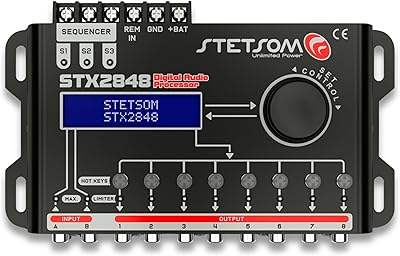
Stetsom STX 2848 8-Channel DSP Crossover Equalizer
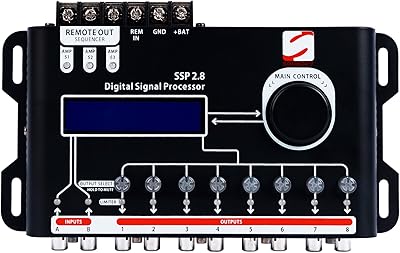
Soundfy SSP 2.8 Digital Signal Processor
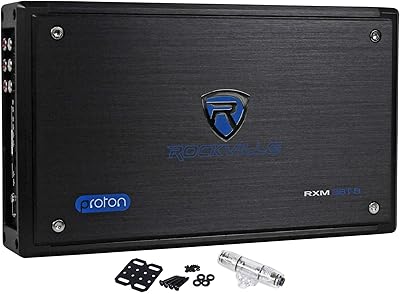
Rockville RXM8BTB 8-Channel Bluetooth Car Amplifier
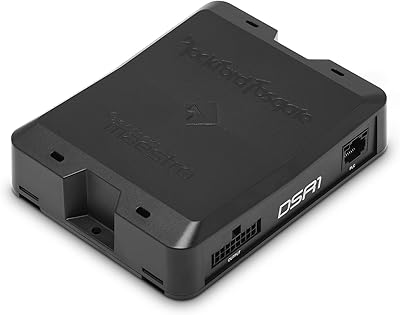
Rockford Fosgate DSR1 8-Channel Signal Processor
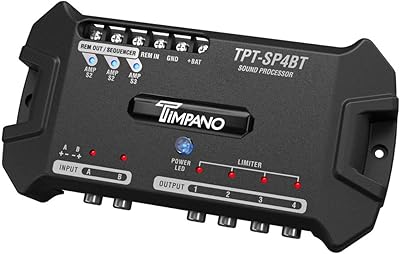
Timpano TPT-SP4BT Bluetooth DSP Car Audio Processor
Night Owl 8-Channel 4K Security Camera System
Rockville Rock Party 8 Dual 8″ Bluetooth Speaker
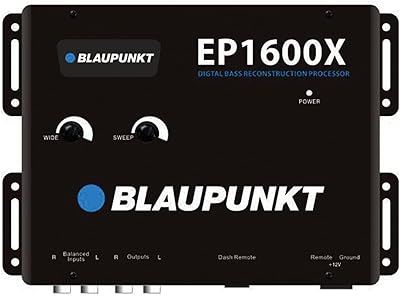
Blaupunkt EP1600X Digital Bass Processor
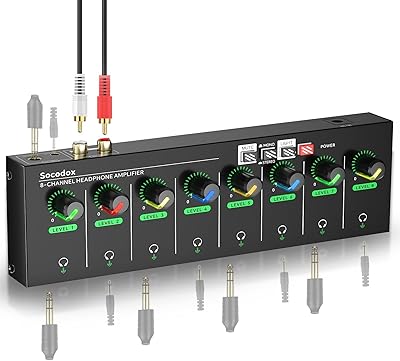
Socodox 8-Channel Headphone Amplifier