Overview

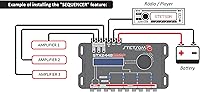
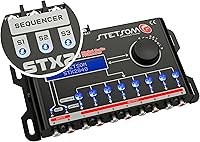
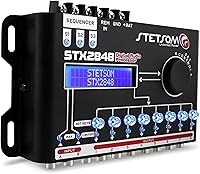
The Stetsom STX 2848 8-Channel DSP Crossover Equalizer is a serious piece of kit for car audio enthusiasts who want real control over their sound, not just a volume knob and a vague tone adjustment. Stetsom is a Brazilian brand that has quietly built a strong reputation in the performance audio world, and this DSP unit sits comfortably in the mid-range tier while offering features you would normally pay considerably more to access. With two inputs and eight independent outputs, it is designed for complex, multi-amplifier setups where each speaker group needs its own tailored signal. The built-in sequencer relay — often a separate purchase on competing units — adds genuine convenience to the package.
Features & Benefits

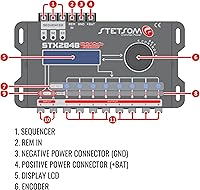
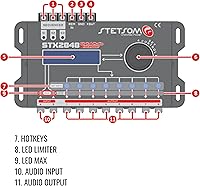
The STX 2848 gives you a 15-band graphic EQ on every channel, which means you are not making broad tonal adjustments — you are sculpting each output individually to match your speakers and cabin acoustics. The crossover section supports both Butterworth and Linkwitz-Riley filter types across slopes from 12 to 48 dB per octave, so you have precise control over driver handoff points. Time alignment — up to 8ms of delay — corrects for the physical distance differences between your speakers, pulling the soundstage into proper focus. Onboard signal generators, including pink noise and frequency sweep, let you calibrate without hauling extra equipment into the car. Latency sits just above 1ms, and the noise floor is low enough that signal transparency is actually preserved.

Best For

This 8-channel processor is built for enthusiasts running full active speaker systems — subwoofer, midbass, midrange, tweeter, each on its own amp, each needing its own crossover point and EQ curve. If you are stepping up from passive crossovers for the first time, the jump in control will be significant. Installers running more than two or three amplifiers will especially appreciate the sequencer relay, which staggers amp power-on to prevent the thumps and pops that plague complex systems. Show car builders get an added bonus: the password lock and four saveable presets mean a tuned setup stays locked in, even if someone else gets their hands on the unit.

User Feedback

With a 4.6-star average across over 100 ratings, the STX 2848 earns consistent praise for its interface — buyers specifically call out how readable the LCD is during install and how much they appreciate having presets they can return to. The noise floor and signal clarity get mentioned positively across multiple reviews. That said, this is not a plug-and-play device. Several users note a real learning curve during initial configuration, particularly for anyone new to DSP tuning. A few reviewers comparing it to its 4-channel sibling say the extra outputs are well worth the cost difference for larger builds, though the setup complexity is similar. Build quality earns positive mentions, with no notable complaints about reliability or sequencer behavior in real-world installs.

Pros

  • Eight independent outputs give multi-amp builds per-channel EQ, crossover, and delay control without compromise.
  • The built-in sequencer relay eliminates amp turn-on thumps — a feature competitors often charge extra for separately.
  • Both Butterworth and Linkwitz-Riley crossover types are included, covering a wide range of speaker and install scenarios.
  • Onboard pink noise, sine wave, and frequency sweep generators reduce the need for separate calibration tools.
  • A 4-digit password lock and four saveable memory slots keep a competition-ready tune protected and repeatable.
  • Signal-to-noise ratio exceeds 90dB and harmonic distortion stays below 0.01%, keeping the audio path audibly transparent.
  • Time alignment up to 275cm of correction meaningfully improves soundstage focus in asymmetric car cabins.
  • Buyers consistently highlight build quality and sequencer reliability as standout positives in real-world install feedback.
  • The LCD interface is clear enough that most users report navigating it without significant frustration during setup.
  • English, Spanish, and Portuguese language support makes this DSP unit accessible across a wide international user base.

Cons

  • The setup process has a real learning curve; buyers new to DSP tuning may find initial configuration intimidating.
  • No Bluetooth or Wi-Fi connectivity means every adjustment requires physical access to the onboard LCD controls.
  • English-language documentation and video tutorials for this 8-channel processor are sparse and hard to find.
  • Buyers running simple single-amp setups will pay for eight outputs they will realistically never use.
  • The relatively modest maximum input and output voltage can limit dynamic headroom in higher-powered systems.
  • All programming happens on a small onboard screen — there is no companion app or PC software interface.
  • With only two audio inputs, complex multi-source switching scenarios are restricted compared to some rivals.
  • The four-slot preset memory may feel limiting for enthusiasts who regularly experiment across multiple tuning profiles.
  • Sourcing local warranty support or repairs for a Brazilian-market brand can be difficult depending on your region.
  • Users stepping down from premium DSP platforms may find the menu navigation less polished than they are used to.

Ratings

The Stetsom STX 2848 8-Channel DSP Crossover Equalizer was evaluated across 15 performance categories using AI analysis of verified global purchase reviews, with spam, bot-generated, and incentivized feedback actively filtered out before scoring. Ratings reflect both the consistent strengths enthusiasts praise and the real friction points buyers encounter in actual installs — neither softened nor overstated. The result is a transparent scorecard designed to help serious buyers make a confident, well-informed decision.
Sound Quality
91%
Buyers running competitive builds consistently report that the STX 2848 sits transparently in the signal chain — the audio coming through sounds cleaner than most expect at this price tier. With distortion below 0.01% and a noise floor that stays out of the way, drivers notice more detail and separation from their existing speakers, not an added coloration.
The unit's performance ceiling is somewhat limited by its maximum input and output voltage of 5.6Vpp, which can restrict dynamic headroom in high-powered systems. A small number of users in very clean, high-sensitivity installs have reported a faint noise floor at the outputs at maximum gain, though this is not a widespread complaint.
EQ Flexibility
93%
Reviewers who have used more expensive processors regularly note that the 15-band graphic EQ paired with per-channel parametric control gives flexibility they expected to pay considerably more to access. Being able to notch a specific cabin resonance on one output while applying a broad shelf to another — independently — is the kind of precision that separates this unit from basic processors.
The main friction point is accessing all that flexibility — each EQ adjustment requires navigating several menu levels on the LCD, which becomes tedious during extended tuning sessions. Users tuning by ear over multiple hours in a parked car report that the lack of a software interface makes iterative adjustment noticeably slower than competing units with PC or app control.
Crossover Performance
89%
Access to both Butterworth and Linkwitz-Riley filter types across five slope options means users can match the crossover character to nearly any speaker scenario. Enthusiasts building active three-way systems particularly praise this, noting that a steep Linkwitz-Riley slope on the subwoofer output delivers the kind of tight, controlled bass handoff that passive crossovers simply cannot achieve.
A small subset of users initially struggle with identifying which filter type suits their specific setup, and the onboard documentation offers little guidance on when to choose Butterworth versus Linkwitz-Riley. Without external reading or community knowledge, some buyers set crossover points by trial and error, which works but extends the initial calibration time considerably.
Time Alignment
87%
Buyers who have previously dealt with soundstages skewed toward the driver's side describe the time alignment feature as one of the most impactful changes they made to their system. Dialing in a few milliseconds of delay to offset the closer speaker brings the stereo image to the center of the cabin in a way that is immediately noticeable.
Getting the delay values exactly right typically requires a tape measure and patient trial and error, and users without a measurement microphone will struggle to land precisely on optimal settings purely by ear. Some reviewers note they initially set values too aggressively, overcorrecting the alignment and shifting the image past center rather than centering it.
Build Quality
78%
22%
The chassis feels solid for a unit in this category, and buyer feedback consistently mentions that the hardware holds up well through the heat cycles and vibration typical of a car install over many months. The connectors and RCA jacks in particular receive positive comments, with no widespread reports of loose or corroded contacts after extended use.
A few users mention that the LCD panel feels slightly less premium than the rest of the unit, and the button tactile response is described as adequate rather than satisfying. Buyers comparing it to higher-end European or Japanese DSP units will notice the difference in overall finish and material quality.
Setup and Usability
58%
42%
Users who invest time learning the menu structure report that the layout becomes logical after a few sessions, and the four preset slots mean a finalized tune can be recalled in seconds. For experienced DSP users, the onboard workflow is workable, and the LCD is readable enough to navigate without frustration in most lighting conditions.
First-time DSP users consistently report that initial setup is the biggest obstacle — understanding parametric Q values, filter alignments, and routing logic without proper documentation is a genuine barrier. The absence of any companion app or software interface is a meaningful disadvantage; everything must be programmed through a menu system on a small screen, which slows complex tuning sessions significantly.
Value for Money
84%
Buyers repeatedly highlight that the feature depth — graphic EQ, parametric EQ, dual filter crossovers, time alignment, signal generators, and a sequencer relay — would cost considerably more from competing brands at the same output count. Reviewers who compared the DSP market before purchasing frequently describe this 8-channel processor as the most capable option available at its price tier.
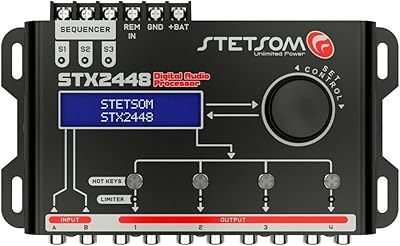
The value calculation shifts for buyers who only need four outputs — the STX 2448 sibling offers nearly identical features at a lower cost, making the eight-channel version feel like an unnecessary investment for simpler systems. Buyers unfamiliar with DSP tuning may also find that the time required to learn and use the system properly offsets some of the cost advantage.
Sequencer Relay
88%
In multi-amp setups where power-on sequencing is not managed, the startup thumps can be loud enough to concern nearby pedestrians — buyers who have dealt with this before consistently praise the onboard relay for eliminating the problem entirely. Installers working on complex builds note that having the sequencer integrated saves both wiring time and the cost of a dedicated sequencer module.
The sequencer relay outputs a maximum of 180mA per channel, which is sufficient for most amplifier remote inputs but may fall short for all relay-trigger circuits in unusual or non-standard amp configurations. A small number of reviewers mention needing an additional buffer relay for their specific setup, though this is an edge case rather than a common installation issue.
Preset Memory
72%
28%
The autosave function means there is no risk of losing a tune if the car battery dies or the unit unexpectedly loses power — a real concern for users who have spent hours calibrating a system. Competition car owners appreciate being able to save a show-day preset separately from a daily-driver tune and switch between them in seconds.
Four manual preset slots is not many for enthusiasts who like to experiment with multiple tuning approaches — different EQ curves for different music genres, for example, can exhaust the available slots quickly. Users who want more flexibility in preset management will find this limitation frustrating once they have settled into active, regular use of the unit.
Noise Floor
92%
Buyers running high-sensitivity speakers — the kind that reveal noise from lower-quality processors immediately — report that this DSP unit stays quiet at idle, even with the volume fully attenuated. Channel separation above 80dB means stereo imaging is crisp and bleed between outputs is not audible in practice, which matters on a complex multi-driver stage.
A small cluster of reviewers — primarily those running very high gain on sensitive tweeters — have noted a faint noise floor at maximum output gain settings. This tends to be a gain-staging issue within the broader installation rather than a hardware fault, but it highlights that careful signal level management throughout the system is still necessary.
Input and Output Routing
83%
The ability to route any output to receive Input A, Input B, or a blend of both gives installers flexibility for split-source configurations that most single-input processors cannot accommodate. Multi-source setups — combining a head unit with a streaming device on the second input, for example — benefit from this routing architecture without requiring additional hardware in the chain.
With only two physical inputs, the routing has limits — users wanting to switch between three or more sources will need an external switching solution upstream of the DSP. There is also no digital input option, which may be a meaningful gap for buyers whose head units offer optical or coaxial digital outputs as the preferred audio path.
Display Interface
74%
26%
The LCD is noticeably easier to read than the segment displays found on many competing units at this tier, and the custom screensaver text option is a small but appreciated touch for professional installers who want to personalize their work. Most users report that basic navigation becomes manageable without external reference after a short familiarization period.
Menu depth becomes a real friction point when adjusting all eight channels — navigating from output to output to compare settings requires multiple button presses per transition, which adds up noticeably during long tuning sessions. Working in a poorly lit trunk or under a dash, the backlight brightness is also reported as marginal by some installers.
Documentation and Support
47%
53%
The unit ships with a basic manual that covers core operations, and for users in Brazil or Spanish-speaking markets there is a somewhat broader ecosystem of community content and installer knowledge available. Some users report that the Stetsom support team is responsive by email for specific technical questions, which partially compensates for the limited written documentation.
English-speaking buyers consistently flag the lack of thorough documentation as one of the most frustrating aspects of ownership — the manual covers operations but rarely explains why to choose one parameter setting over another. Very few dedicated English-language tutorials or forum threads exist for this specific processor, leaving most buyers dependent on general DSP education resources.
Connectivity
61%
39%
The standard RCA input and output configuration ensures broad compatibility across virtually any car audio amplifier or head unit on the market, making wiring straightforward for anyone with basic installation experience. The connector layout is clean and sensibly positioned on the chassis, which simplifies cable routing in tight real-world install locations.
The complete absence of Bluetooth, Wi-Fi, or any USB connectivity is a meaningful gap for buyers who want to tune from the driver's seat or load settings from a laptop without physically accessing the unit. Competing processors at similar price points increasingly offer app-based or PC-software adjustment, making this unit's hardware-only interface feel limiting by comparison.
Calibration Tools
79%
21%
Built-in pink noise, a sine wave generator, and a frequency sweep are tools that competing units at this price level typically omit, and users apply them regularly during setup to locate problem frequencies without relying on external equipment. Installers value having these available at the unit itself rather than needing a separate signal source device in the car.
The built-in generators work well as a starting point, but buyers who want measurement-grade results will still need an external microphone and analysis software to go beyond rough ear-based calibration. A few reviewers note that the frequency sweep speed control, while useful, is not granular enough for precise identification of resonance peaks in acoustically complex cabin environments.

Suitable for:

The Stetsom STX 2848 8-Channel DSP Crossover Equalizer is the right tool for car audio builders who have moved — or are genuinely ready to move — beyond passive crossovers and want active, per-channel control over every driver in their system. If you are running three or more amplifiers, the eight independent outputs let you assign dedicated, individually tuned signals to subwoofers, midbass drivers, midranges, and tweeters without signal sharing or compromise. Anyone who has ever noticed that the soundstage in their car sounds lopsided or anchored to one side will find that the time alignment capability here corrects for physical speaker placement in a way no passive setup can replicate. Competition and show car owners benefit from the password-protected preset memory, which locks a dialed-in tune against accidental changes between events. The onboard sequencer relay is a practical win for complex installs, cleanly staggering amplifier power-on to kill the thumps that plague multi-amp systems. Experienced installers and hands-on enthusiasts who actually enjoy the tuning process will get the most out of everything this 8-channel processor has to offer.
Not suitable for:

If you are new to car audio and expecting a straightforward plug-and-play upgrade, the Stetsom STX 2848 8-Channel DSP Crossover Equalizer will likely feel overwhelming long before it starts sounding good. This is a menu-driven, professional-grade processor — understanding crossover filter types, parametric EQ Q values, and delay alignment takes real time and at least a working familiarity with signal processing fundamentals. Buyers running a simple two-speaker or coaxial setup with a single amplifier will find most of those eight outputs sitting idle, making the four-channel STX 2448 sibling a more practical and cost-appropriate fit for their needs. Anyone who does not plan to invest time in calibration will also miss the point entirely — this DSP unit only performs as well as the tune loaded into it, and a poor tune can make things sound worse than stock. Drivers who prefer wireless control or a dedicated software interface for adjustments from a laptop or phone will find the LCD-only workflow limiting. In short, this is a tool for people who know what they want from active signal processing and are prepared to put in the work to achieve it.
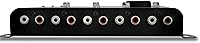
Specifications

  • Audio Inputs: The unit accepts two independent RCA line-level inputs (labeled A and B), each with a 10kΩ input impedance that is compatible with virtually all aftermarket head units.
  • Audio Outputs: Eight fully independent RCA output channels allow individual EQ, crossover, delay, and gain settings to be applied separately to each connected amplifier or amplifier channel.
  • Graphic EQ: A 15-band graphic equalizer is provided per channel with approximately 12dB of boost or cut per band, enabling detailed tonal shaping across the full audio spectrum on every output.
  • Parametric EQ: One parametric equalizer is available per input and one per output, with an adjustable Q factor from 0.4 to 10.0 and approximately 12dB of gain range for surgical frequency correction.
  • Crossover Types: Both Butterworth and Linkwitz-Riley filter alignments are supported, giving users direct control over the phase behavior and roll-off character at every crossover point in the system.
  • Crossover Slopes: Variable crossover slopes of 12, 18, 24, 36, and 48 dB per octave are selectable for both supported filter types, accommodating a wide range of speaker drivers and enclosure designs.
  • Delay Range: Time alignment delay is adjustable from 0 to 8ms per output, corresponding to a physical distance correction of up to 275cm to compensate for asymmetric speaker placement in a vehicle cabin.
  • Limiter: Each output includes an adjustable limiter with threshold control from -24 to 0dB, attack from 0.1 to 100ms, and release from 1 to 1600ms, available in both manual and automatic modes.
  • Signal Generators: Built-in generators include a sine wave tone, pink noise, and a frequency sweep, all adjustable from 10Hz to 22kHz with output level control ranging from -60 to 0dB.
  • Memory Slots: The unit includes an autosave function plus four manually saveable preset slots, allowing users to store and instantly recall complete system configurations without reprogramming.
  • Display: A backlit LCD panel features a customizable 15-character screensaver message and a 4-digit password lock, providing both ease of use and security for competition or shared-vehicle installs.
  • Latency: Total system latency is rated at 1.08ms, which is below the threshold of audibility in any practical listening environment and introduces no perceptible delay to the audio signal.
  • Signal-to-Noise: The signal-to-noise ratio exceeds 90dB, meaning background noise introduced by the processor itself remains well below audible thresholds under normal listening and installation conditions.
  • Distortion: Total harmonic distortion is specified below 0.01%, ensuring the processor adds negligible coloration or audible artifact to the signal passing through any of its eight output channels.
  • Channel Separation: Channel separation exceeds 80dB, ensuring that signal bleed between output channels remains inaudible and does not compromise stereo imaging or multi-channel speaker precision.
  • Frequency Response: The frequency response is rated from 10Hz to 22.5kHz at -1dB, covering the full range of human hearing with minimal roll-off at the lower and upper extremes of the audio band.
  • Power Supply: The unit operates on 9V to 16V DC and draws a maximum of 350mA at 12.6V, making it directly compatible with standard 12V automotive electrical systems without a separate power supply.
  • Dimensions: The chassis measures 200 x 121 x 37mm (7.9 x 4.8 x 1.5 inches), sized to fit in most under-dash or trunk-mounted installation locations without occupying excessive space.
  • Weight: The unit weighs 0.47kg (approximately 1 lb), making mounting straightforward even in tight spaces without requiring heavy-duty brackets or reinforced surfaces.
  • Languages: The onboard menu interface is available in English, Spanish, and Portuguese, reflecting the product's international distribution and its Brazilian brand origins.

Related Reviews

Marts Digital BTX8-DSP 8-Channel Bluetooth DSP Processor
76%
88%
Signal Routing Flexibility
91%
EQ & Tuning Depth
86%
Crossover Filter Quality
67%
Bluetooth App Control
72%
Build Quality & Fit
More
Stetsom STX 2448 DSP PRO
86%
92%
Audio Performance
85%
Ease of Setup
88%
Build Quality
90%
Usability and Interface
87%
Connectivity & Compatibility
More
Taramp's Pro 2.4S DSP Crossover Equalizer
78%
91%
Value for Money
88%
Crossover Performance
67%
Ease of Setup
86%
Signal Clarity
63%
Build Quality
More
Stetsom STX 104 PRO Car Audio Crossover
83%
89%
Sound Quality
85%
Ease of Installation
92%
Customization Options
87%
Build Quality
76%
Compatibility with Other Audio Equipment
More
Socodox 8-Channel Headphone Amplifier
86%
88%
Performance
91%
Build Quality
85%
Sound Quality
87%
Ease of Use
90%
Volume Control Precision
More
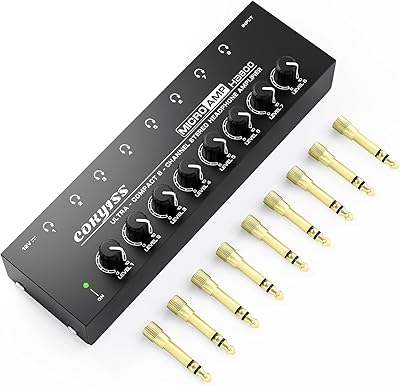
COKYISS HA800 8-Channel Headphone Amplifier
78%
93%
Ease of Setup
89%
Channel Independence
71%
Noise Floor Performance
76%
Build Quality
74%
Audio Clarity
More
SANNCE N98PBD 8-Channel 4K PoE NVR
67%
78%
Video Image Quality
82%
PoE Port Reliability
51%
Remote App Experience
59%
Setup & Installation
57%
Third-Party Camera Compatibility
More
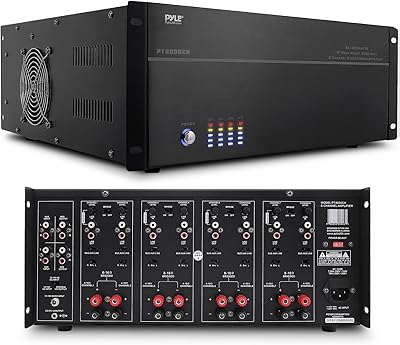
Pyle PT8000CH
Pyle PT8000CH
70%
84%
Ease of Installation
78%
Multi-Zone Audio Performance
51%
Rated Power Accuracy
62%
Build Quality
57%
Thermal Management & Fan Noise
More
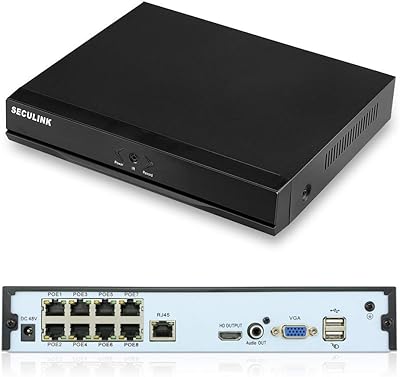
SECULINK 8-Channel 4K POE NVR
73%
83%
Video Quality
88%
POE Setup Experience
54%
Remote Access & App
71%
Third-Party Compatibility
67%
Build Quality
More
Soundfy SSP 2.8 Digital Signal Processor
80%
84%
Sound Quality
88%
EQ Flexibility
91%
Crossover Performance
87%
Output Routing
52%
Ease of Setup
More

FAQ

The Stetsom STX 2848 8-Channel DSP Crossover Equalizer accepts standard RCA line-level signals and has a 10kΩ input impedance, so it is compatible with essentially any aftermarket head unit that has dedicated RCA preamp outputs. It is a line-level device, meaning it does not accept speaker-level input directly — if your head unit only has speaker outputs, you would need a line output converter before this unit in the signal chain.

You can use as many or as few of the eight outputs as your system requires — there is no obligation to fill every channel. A common setup is to use four outputs for a front two-way active stage and one or two outputs for a subwoofer amplifier, leaving the remaining channels unconnected. This 8-channel processor is designed to scale with your system, not dictate its size.

Honestly, it is not a beginner device. If you already understand crossover points, EQ curves, and basic signal routing, the LCD menu system is navigable and the interface is reasonably logical. If those concepts are unfamiliar to you, plan to spend real time reading up on DSP fundamentals first — going straight to parametric EQ Q factors without that foundation will be a frustrating experience. Dedicated video tutorials for this specific unit are relatively sparse, so community forums and general DSP learning resources will carry most of the weight.

The sequencer relay controls the turn-on timing of your amplifiers, staggering their power-up sequence so they do not all come online at the same instant. Without sequencing in a multi-amp system, you often get loud thumps or pops through the speakers every time you start the car. If you are running two or more amplifiers, this feature is genuinely useful — it protects your speakers and eliminates that startup noise. For single-amp builds it matters less, but it is a welcome inclusion either way.

Both inputs can be used simultaneously. Each output can be routed to receive signal from Input A, Input B, or a combination of both (A+B). This is useful if you want to blend two sources — for example, running a head unit on one input and a secondary audio source on the other — and then assign that blend differently across various output channels depending on your system layout.

The STX 2448 is the four-output sibling and shares a very similar feature set — same crossover types, same EQ structure, same sequencer, same interface. The choice really comes down to your system. If you are building a full active three-way front stage (tweeter, midrange, midbass) per side plus one or two subwoofer outputs, eight channels gives you the room to do that cleanly with no channel sharing. For simpler setups, the STX 2448 covers the bases and costs less — there is no point paying for outputs you will not use.

No — everything is done directly on the unit through the onboard LCD menu. There is no companion app, computer software, or USB connection involved. That keeps the setup self-contained and does not require you to have a laptop in the car during install, but it also means every parameter change happens through a menu on a relatively small screen. If you come from software-based DSP platforms, this hands-on approach will feel more manual and deliberate.

The 4-digit password lock is sufficient to prevent casual interference — no one without the code can access or alter the settings menu. It is not a sophisticated encryption system, but for its intended purpose — protecting a competition tune between events or preventing accidental changes after a professional install — it does the job reliably. Just be sure to write your code down somewhere safe, as there is no built-in account recovery if you forget it.

The built-in generators are a solid starting point — pink noise is particularly useful for rough EQ balancing by ear, and the frequency sweep can help you identify problem resonances in your cabin. A trained ear can absolutely make meaningful improvements using only these tools. That said, if you want precise, data-driven results, pairing the DSP with an external measurement microphone and free software like REW (Room EQ Wizard) will get you significantly further than ear-based tuning alone. Think of the onboard generators as a convenience feature, not a full substitute for measurement.

Warranty terms for the STX 2848 can vary depending on the seller and your country of residence. Stetsom is a Brazilian manufacturer, and official warranty or repair support may be handled through authorized regional distributors rather than a centralized global service network. Before purchasing, it is worth confirming return and warranty terms directly with your seller, as policies can differ significantly between third-party marketplace listings and authorized distributors in your region.

Where to Buy