Overview

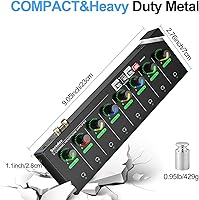
The Socodox 8-Channel Headphone Amplifier is a compact, metal-bodied unit designed to solve a very specific problem: getting audio into multiple sets of ears simultaneously without spending a lot of money. Socodox is a relatively new name — the brand launched this product in late 2024 — so a degree of buyer skepticism is completely fair. The unit positions itself against entry-level gear from Behringer and Rolls, and the comparison holds up better than you might expect. Powering it all is a dual op-amp design using NE5532 and JRC4580 chips — solid, well-understood components at this price tier. If you need 16 headphone outputs without breaking the bank, this channel distribution unit deserves attention.

Features & Benefits

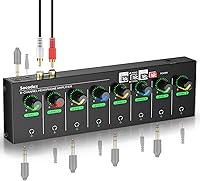
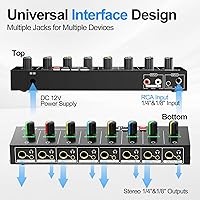
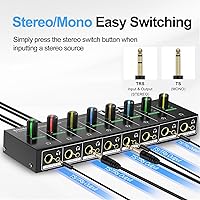
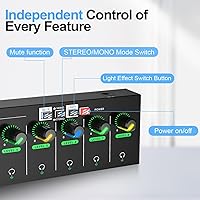
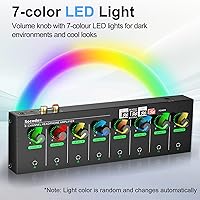
What makes this headphone amp genuinely practical is the combination of input options and per-listener control. On the input side, you get 1/4-inch TRS, 1/8-inch TRS, and RCA jacks, which means plugging in a mixer, audio interface, phone, or turntable all work without hunting for adapters. Each of the eight channels has its own volume knob, and the per-channel mute function is a quietly useful touch — silencing one listener mid-session without unplugging anything keeps things moving. A stereo/mono toggle gives you flexibility when feeding mono sources to a stereo mix. The RGB lighting on the knobs is a minor practical help in dim rooms, not a selling point. Rubber feet and an all-metal chassis keep it planted during use.

Best For

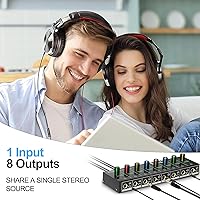
This multi-output amplifier is a natural fit for band rehearsal rooms, where five or six musicians all need headphone monitoring at the same time and nobody wants to manage a daisy-chain of splitters. It works equally well in a podcast studio with two or three co-hosts who each want their own feed at their own volume. Small recording studios can use it as a simple cue distribution solution when a dedicated headphone monitoring system is overkill. Language labs and classrooms that need synchronized audio for a group of students are another solid application. Streamers working with an on-site co-host or producer will find it a clean, low-fuss option — plug-and-play setup with no software required.

User Feedback

With a 4.3 out of 5 rating across roughly 150 reviews, user sentiment leans positive but isn't without caveats. Most buyers highlight the output count and value — getting 16 jacks at this price point with individual volume control is genuinely hard to find elsewhere. Setup gets consistent praise for being straightforward. Where things get more mixed is at higher gain levels: some users report a noticeable noise floor, which is typical of budget-tier op-amp designs and worth knowing if your headphones are particularly sensitive. A few buyers have questioned long-term knob durability and the included power supply quality. High-impedance headphones may also underwhelm, as driving demanding loads isn't this unit's strongest suit.

Pros

  • Sixteen headphone outputs across eight channels is genuinely rare at this price point.
  • Independent volume knobs per channel mean every listener sets their own level without affecting others.
  • Input flexibility is excellent — 1/4-inch TRS, 1/8-inch TRS, and RCA jacks cover nearly any source device.
  • The per-channel mute function is a practical time-saver during live sessions and rehearsals.
  • A stereo/mono toggle adds real flexibility for mixing and monitoring different source types.
  • All-metal housing feels solid and is more durable than the plastic shells common at this price tier.
  • Setup is straightforward with no software, drivers, or configuration required.
  • Anti-slip rubber feet keep this multi-output amplifier stable on desks and consoles during active use.
  • The compact footprint makes it easy to fit into crowded studio or rehearsal room setups.
  • Strong user satisfaction overall, with ease of use and output count consistently praised in reviews.

Cons

  • A noticeable noise floor appears at higher gain settings, which is a real concern for sensitive headphones.
  • Op-amp quality is adequate but not impressive — discerning listeners may find the sound slightly flat or colored.
  • Some users have reported doubts about the long-term durability of the volume knobs under frequent use.
  • The included power supply has drawn criticism for quality, and interference can occur near other electronics.
  • High-impedance headphones are likely to underperform, as the output power is not built for demanding loads.
  • Socodox is a very new brand with limited track record, which makes after-sale support an open question.
  • The power cable at 5.5 feet may be too short for certain rack or stage placements.
  • No built-in EQ or tone shaping means what comes in is exactly what goes out — fine for monitoring, limiting for mixing.
  • RGB lighting on the knobs, while harmless, adds no functional value for most professional use cases.
  • At only 151 ratings since late 2024, the long-term reliability data is still thin compared to established competitors.

Ratings

The scores below were generated by AI after analyzing verified buyer reviews for the Socodox 8-Channel Headphone Amplifier from multiple global sources, with spam, bot activity, and incentivized feedback actively filtered out. Each category reflects the real spread of user experience — not just the highlights — so both the genuine strengths and the recurring frustrations are honestly represented. Whether this multi-output amplifier earns a spot in your rehearsal room or falls short of your needs, these ratings are designed to give you a clear, unbiased picture before you buy.

Value for Money
88%
Most buyers come away feeling they got more than they paid for at this price tier. Getting 16 headphone outputs with individual volume controls, a metal chassis, and a mute function on each channel is genuinely difficult to match from established competitors without spending considerably more. For band rehearsals or small studio setups on a budget, the value proposition lands well.
A handful of buyers feel the value equation shifts if a knob fails early or the power supply causes interference, since replacement costs and hassle erode the initial savings. Those who need truly clean audio for professional work will find the limitations costly in a different sense — they end up buying a second, better unit anyway.
Audio Clarity
67%
33%
For rehearsal monitoring, casual listening distribution, and podcast cue mixes, the audio output is clean enough that most listeners won't have complaints. The NE5532 and JRC4580 op-amps are established chips that handle midrange frequencies with reasonable accuracy, and stereo imaging is preserved adequately at moderate gain levels.
Push the volume knobs past about 70 percent and a background hiss becomes noticeable, particularly with sensitive in-ear monitors or low-impedance headphones. Audiophiles and anyone doing critical listening or mixing decisions will find the sound floor too murky for reliable work, and the overall tonal character feels slightly flattened compared to mid-range dedicated headphone amps.
Output Count & Flexibility
91%
Sixteen simultaneous headphone outputs across eight independently controlled channels is the single biggest reason buyers choose this unit, and it delivers exactly what it promises. The combination of 1/4-inch and 1/8-inch output jacks on every channel means most headphones plug straight in with no adapter hunting, which saves real time during busy rehearsal or recording sessions.
The two outputs per channel share the same volume knob, so you cannot set two listeners on the same channel to different levels — they are locked together. For most multi-listener setups this is not a problem, but it is a constraint worth knowing about if you need truly granular per-listener control across all 16 jacks.
Ease of Setup
93%
Buyers consistently cite setup as one of the most satisfying parts of the experience — plug in the power adapter, connect a source, plug in headphones, and you are running in under two minutes. There are no drivers, apps, firmware updates, or pairing procedures of any kind, which makes it accessible to non-technical users like teachers, band leaders, and small studio owners who just want things to work.
The included user manual is minimal and reportedly thin on troubleshooting guidance, which can leave buyers guessing when something unexpected happens, such as hum from a shared power socket. A few users also noted that the input jack labeling on the unit is small and hard to read in dim environments during initial setup.
Build Quality
72%
28%
The all-metal chassis gives this channel distribution unit a noticeably more solid feel than plastic competitors at a similar price, and the rubber feet do a good job keeping it from sliding around on a mixing desk or rehearsal table. Out of the box, the unit presents well and feels more substantial than its price might suggest.
Longer-term durability is where confidence starts to drop. Several users have noted that the volume knobs feel slightly loose or develop a scratchy resistance with repeated daily use over several months. The power supply also draws criticism for feeling flimsy relative to the main unit, and a few buyers have had to replace it with a better third-party adapter.
Noise Floor
58%
42%
At low to moderate gain settings with standard consumer headphones, the noise floor stays in the background and rarely interferes with practical monitoring tasks. For band practice or podcast cue feeds where the source material is loud and dynamic, most listeners simply won't notice any residual hiss.
This is one of the more consistent complaints across reviews, and it is a real limitation rather than isolated user error. The hiss becomes clearly audible when volume is pushed high, when using sensitive IEMs, or when the unit shares a power circuit with computers or other electronics. It is a known trade-off of the op-amp spec at this price tier and not something firmware or cable changes will fully resolve.
Input Compatibility
86%
The three input types — 1/4-inch TRS, 1/8-inch TRS, and RCA — cover the vast majority of consumer and semi-professional audio sources without requiring extra adapters. This means users can connect a mixer, a smartphone, a laptop audio out, or a CD player without having to rummage through a cable box, which reviewers repeatedly call out as a practical convenience.
There is no XLR input, which means users feeding signal from a professional microphone preamp or broadcast console will need a converter. Bluetooth connectivity is also absent, which is expected at this price point but worth flagging for users hoping to feed audio wirelessly from a tablet or phone.
Per-Channel Mute
82%
18%
The per-channel mute function is a practical feature that gets mentioned positively across reviews from users in live and studio settings alike. Being able to cut a channel instantly during a recording take, a live cue feed, or a group lesson without physically unplugging anyone is a meaningful quality-of-life improvement over basic amplifiers that lack this control.
The mute switches are small and close together on the front panel, which can make them awkward to operate quickly without looking closely, particularly in a dimly lit environment. A few users noted the switches feel slightly thin and would benefit from a more tactile click to confirm activation.
Stereo/Mono Switch
77%
23%
Having a physical stereo-to-mono toggle is a feature that many competing units at this price omit entirely, and buyers who work with mono sources like single-microphone podcast feeds or mono instrument tracks genuinely appreciate the option. Switching modes is instant with no audio dropout in testing, which reviewers found reassuring.
There is no labeling on the switch itself indicating which position corresponds to stereo versus mono, which creates brief confusion for first-time users until they learn the orientation by trial and error. The switch also lacks any intermediate or balance control, so it is a binary choice rather than a flexible blend.
Power Supply Quality
54%
46%
The included DC 12V adapter is adequate for basic use and gets the unit running immediately out of the box without needing a separate purchase. The 5.5-foot cable provides enough reach for most desktop and small studio configurations where the power outlet is reasonably nearby.
The power supply is the most criticized component in the entire package. Multiple reviewers have reported audible hum introduced by the included adapter, and a notable number of buyers swapped it for a better-quality third-party 12V supply to resolve interference issues. The 5.5-foot cable length is also restrictive for rack or stage placements where the nearest outlet is further away.
High-Impedance Headphone Support
44%
56%
For standard consumer headphones in the 16 to 64-ohm range, this multi-output amplifier drives volume levels that are fully adequate and even slightly above average for the category. Users running budget headphones or standard monitoring earbuds will not encounter output level problems under normal conditions.
Buyers who own 250-ohm or 600-ohm studio headphones — common in recording environments — consistently report insufficient drive, with volume levels too low for comfortable monitoring even at maximum gain. This is a fundamental hardware limitation rather than a settings issue, and it makes this unit a poor match for professional studio headphone monitoring workflows.
RGB Lighting
69%
31%
The 7-color illumination on the volume knobs serves a genuinely practical function in dim rehearsal rooms or broadcast environments where seeing knob positions at a glance would otherwise require a flashlight. The dedicated on/off button for the lights is a thoughtful addition that lets users disable them entirely without any impact on audio performance.
For buyers coming from a professional audio background, the RGB lighting feels out of place on a functional monitoring tool and adds no sonic value whatsoever. A few reviewers noted mild concern about whether the LEDs contribute any electromagnetic interference at high brightness, though this has not been definitively confirmed in user reports.
Brand Reliability
61%
39%
Within its first year on the market, Socodox has accumulated a respectable 4.3-star average across a meaningful number of reviews, suggesting that the majority of buyers receive a functional unit that meets their expectations. There are no widespread reports of dead-on-arrival units or systematic product defects, which is a reasonable baseline of confidence for a new brand.
Socodox has virtually no established track record in the audio accessories market prior to late 2024, which makes it genuinely difficult to assess long-term reliability or warranty support. Buyers who have needed post-purchase assistance report that customer service response can be slow or unclear, which is a real risk consideration for anyone buying this unit for a critical or professional application.
Portability
79%
21%
At 15.2 ounces and with a slim profile of just over 9 inches long and roughly 1 inch tall, this headphone amp fits easily into a gear bag or backpack alongside cables and other accessories. Users who carry it between rehearsal locations or set it up temporarily for events find it no hassle to transport, especially given the metal build that protects it during transit.
Portability is somewhat undermined by the external power adapter requirement — there is no battery mode or USB power option, so you always need to locate a nearby outlet and manage an extra cable. For truly mobile setups or outdoor events without easy power access, that dependency is a practical constraint.

Suitable for:

The Socodox 8-Channel Headphone Amplifier is a strong fit for anyone who regularly needs to put audio into multiple sets of headphones at once without spending a lot of money. Band rehearsal spaces are the obvious sweet spot — when five or six musicians all need their own monitor mix and their own volume level, a simple headphone splitter just doesn't cut it, and this unit handles that scenario cleanly. Podcast producers running multi-guest sessions will appreciate being able to mute individual channels on the fly without pulling any plugs. Small home studios that need basic cue distribution but can't justify a rack-mounted solution will find the compact footprint and metal build more than adequate for the task. Educators running language labs or synchronized listening exercises will also get genuine value here, since the adapter-free output options and independent controls remove a lot of logistical friction.

Not suitable for:

Buyers expecting audiophile-grade transparency should look elsewhere — at this price tier, the NE5532 and JRC4580 op-amps are workable but not exceptional, and users with sensitive headphones may notice background hiss at higher gain settings. The Socodox 8-Channel Headphone Amplifier is also not the right tool for driving high-impedance, studio-grade headphones; it simply doesn't have the output power to push demanding loads with authority. Anyone relying on this for a professional live-sound environment with rigorous durability requirements should be cautious — the knobs and power supply have drawn enough user concern over time to warrant skepticism about long-term reliability. If you only need to distribute audio to two or three listeners, this unit is overkill, and a simpler passive splitter or a smaller amp would serve you better. Finally, buyers who want a well-established brand with documented customer support history may find Socodox's relative newness to the market an uncomfortable unknown.

Specifications

  • Input Channels: The unit provides 4 active input channels, each accepting audio from an external source such as a mixer, interface, or playback device.
  • Headphone Outputs: A total of 16 headphone output jacks are arranged as two outputs per channel, allowing up to 16 listeners to connect simultaneously.
  • Input Connectors: Three input jack types are supported: 1/4-inch TRS, 1/8-inch TRS, and RCA, covering the most common consumer and semi-professional audio sources.
  • Output Connectors: Headphone outputs accept both 1/4-inch and 1/8-inch TRS plugs, eliminating the need for adapters with most standard headphones.
  • Op-Amp Chipset: Signal amplification is handled by a dual op-amp configuration using NE5532 and JRC4580 integrated circuits, which are established components in budget-tier audio electronics.
  • Volume Control: Each of the 8 channels has a dedicated, independent rotary volume knob, allowing listeners to set their own preferred level without affecting others.
  • Mute Function: A per-channel mute switch allows any individual output to be silenced without physically disconnecting the headphone or interrupting other channels.
  • Stereo/Mono Mode: A physical toggle switch on the unit lets users switch between stereo and mono output modes to suit different monitoring or mixing scenarios.
  • RGB Lighting: The volume knobs feature 7-color RGB illumination, with a dedicated on/off button to disable the lighting when it is not needed.
  • Power Supply: The unit is powered by an included DC 12V external adapter with a 5.5 ft (approximately 1.68 m) cable; it does not operate on USB or battery power.
  • Housing Material: The outer chassis is constructed from metal, providing a more rigid and impact-resistant enclosure compared to plastic-bodied units in the same price range.
  • Stability Features: Anti-slip rubber feet are attached to the base of the unit to prevent it from shifting on desks, consoles, or flat surfaces during active use.
  • Unit Dimensions: The amplifier measures 9 x 2.76 x 1.1 inches, making it a slim, rack-friendly form factor suitable for tight desktop or studio setups.
  • Unit Weight: The amplifier weighs 15.2 ounces (approximately 431 g), keeping it lightweight enough for portable or temporary setups while still feeling substantial.
  • Package Dimensions: The retail package measures 12.48 x 4.25 x 2.56 inches and includes the amplifier unit, a DC 12V power adapter, and a printed user manual.
  • Manufacturer: This unit is manufactured by Socodox, an audio accessories brand that entered the market in late 2024.
  • Market Availability: The product was first listed for sale in September 2024 and is positioned in the entry-level to mid-range tier of the headphone distribution amplifier category.

Related Reviews
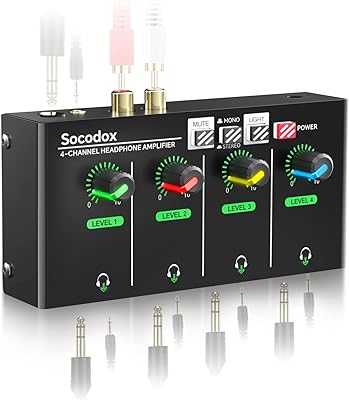
Socodox 4-Channel Headphone Amplifier
83%
91%
Multi-Headphone Support
74%
Sound Clarity
85%
Build Quality
93%
Independent Volume Control
88%
Connectivity Options
More
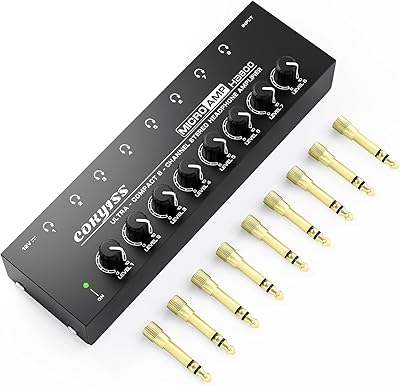
COKYISS HA800 8-Channel Headphone Amplifier

78%
93%
Ease of Setup
89%
Channel Independence
71%
Noise Floor Performance
76%
Build Quality
74%
Audio Clarity
More
STABCL S-800 8-Channel Headphone Amplifier
86%
89%
Performance
91%
Sound Quality
85%
Build Quality & Durability
88%
Portability
87%
Ease of Setup
More
Behringer HA8000 V2
Behringer HA8000 V2
79%
91%
Value for Money
88%
Output Power & Headroom
72%
Build Quality
74%
Noise Floor & Audio Clarity
61%
Fan Noise
More
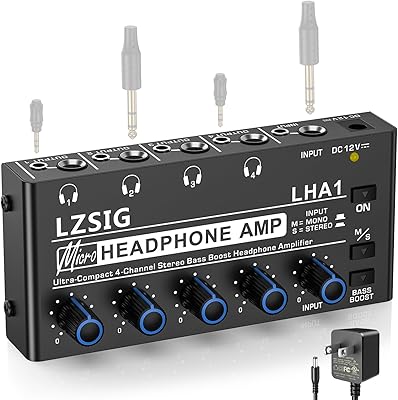
LZSIG LHA1 4-Channel Headphone Amplifier
82%
88%
Audio Clarity
84%
Build Quality
91%
Value for Money
93%
Ease of Setup
87%
Channel Independence
More
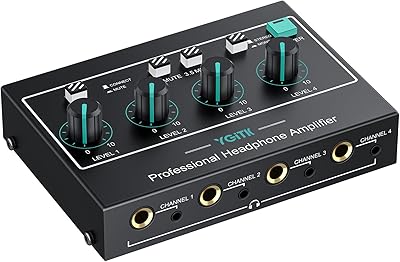
YGiTK KTYDAC152 4-Channel Headphone Amplifier
82%
91%
Value for Money
93%
Ease of Setup
94%
Per-Channel Volume Control
88%
Input Flexibility & Mixing
77%
Build Quality
More
Rockville RHPA4 4-Channel Headphone Amplifier
80%
94%
Ease of Setup
88%
Value for Money
61%
Output Volume & Power
79%
Build Quality
91%
Channel Independence
More
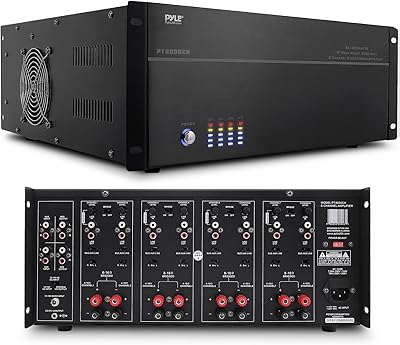
Pyle PT8000CH
Pyle PT8000CH
70%
84%
Ease of Installation
78%
Multi-Zone Audio Performance
51%
Rated Power Accuracy
62%
Build Quality
57%
Thermal Management & Fan Noise
More
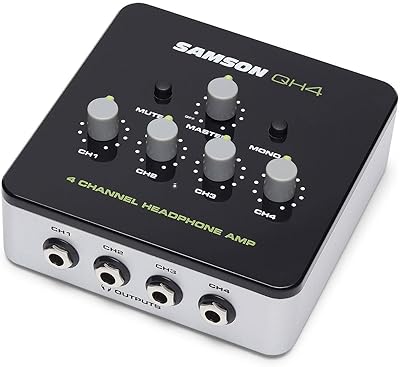
Samson QH4
Samson QH4
87%
88%
Audio Transparency
86%
Build Durability
92%
Value for Money
94%
Ease of Setup
83%
High Impedance Support
More
Neoteck NTK190us 4-Channel Headphone Amplifier
77%
88%
Build Quality
83%
Sound Clarity
86%
Value for Money
87%
Noise Floor
91%
Channel Independence
More

FAQ

Yes, the 1/8-inch TRS input jack handles the standard 3.5 mm stereo output found on most phones, tablets, and laptops. You will not need an adapter for that connection. Just keep in mind that the output level from a phone can be lower than a dedicated audio interface, so you may need to push the volume knobs higher, which can increase background noise slightly.

All 16 outputs are active simultaneously. Every jack on every channel carries the audio signal at all times, so you can have up to 16 listeners plugged in at once with no switching or selection required.

Probably not to a satisfying level. This multi-output amplifier is built for typical consumer and semi-pro headphones in the 16 to 64-ohm range. High-impedance headphones like 250-ohm or 600-ohm models require significantly more drive than budget op-amp designs can cleanly deliver, so you may find the output volume thin or the audio quality degraded at high gain.

At moderate gain levels, the noise floor is generally acceptable for casual monitoring or rehearsal use. However, several users have noted that hiss becomes more audible when channel volumes are pushed toward the upper range, which is a known limitation of NE5532 and JRC4580 op-amps at this price point. If your setup is noise-sensitive, keep gain levels moderate and ensure the unit is not sharing a power socket with other electronics.

Yes. There is a dedicated on/off button specifically for the lighting, so you can disable it entirely without affecting the audio functionality. The lights are completely independent of the volume and mute controls.

No software, drivers, or computer connection of any kind are required. This is a purely analog device — you plug in a power supply, connect your audio source, and it works immediately. There is no configuration, pairing, or setup beyond physical connections.

The all-metal housing is a genuine advantage here and holds up better than plastic alternatives at this price. The main durability concern flagged by users over time is the feel and longevity of the volume knobs under repeated heavy use. For occasional to regular rehearsal or studio use it should be fine, but buyers expecting daily high-intensity use in professional touring or broadcast environments should factor in that this is an entry-level product.

The unit has multiple input jacks, but mixing two live sources simultaneously is not a guaranteed clean result with this type of passive input design. It is best used with a single active source at a time. If you need to blend two sources, run them through a mixer first and then feed the mixed output into this channel distribution unit.

It can work in a live context, but with caveats. The compact size and rubber feet are helpful on a monitor board or side table, and the mute and volume controls are practical in a live setting. The main risk on stage is the power supply cable length of 5.5 feet, which may be restrictive depending on your setup, and the entry-level build quality means it is not rated for the kind of rough handling professional stage gear typically faces.

No headphones or audio cables are included. The box contains the amplifier unit, the DC 12V power adapter with its cable, and a printed user manual. You will need to supply your own headphones and any input cables required to connect your audio source.