Soundfy SSP 2.8 Digital Signal Processor
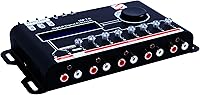

Overview
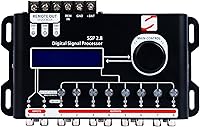
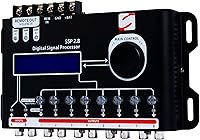
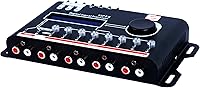
The Soundfy SSP 2.8 Digital Signal Processor is a mid-range car audio unit that targets enthusiasts who want real tuning control without hiring a professional installer. It sits in an interesting spot in the market — more capable than the basic EQ built into most head units, but without the eye-watering price tag of flagship processors. The unit's compact form factor at 7.8 x 4.7 x 1.5 inches makes discreet under-dash or trunk installation easy. Soundfy launched this model in late 2023, making it a relatively new brand worth watching for long-term reliability data as owner reports accumulate. The inclusion of English, Spanish, and Portuguese menu options is a genuinely practical touch that many competing units at this price tier simply skip.
Features & Benefits
The 15-band graphic EQ spans 25 Hz to 16 kHz with ±12 dB of gain per band — enough resolution to address road noise compensation, speaker colorations, and cabin resonances in one pass. Eight configurable outputs let you manage front, rear, center, and subwoofer channels separately, giving real flexibility for anyone running a multi-amp system. The crossover section is a standout: both Butterworth and Linkwitz-Riley filter types are on offer with slopes reaching 48 dB per octave, meaning your subwoofer rolloff will be genuinely clean. Each output also carries a dedicated parametric band for fine surgical correction. Rounding things out, the signal-to-noise ratio exceeds 90 dB and total harmonic distortion stays below 0.01% — figures that hold up well against pricier competitors.
Best For
This car audio DSP is a natural fit for the DIY builder who has outgrown their head unit's tone controls but isn't ready to spend big on a professional-grade processor. Anyone running a dedicated subwoofer amplifier will appreciate the clean HPF/LPF separation the crossover section provides. The per-output parametric EQ also makes it attractive to budget-conscious audiophiles who want more than graphic curve adjustments. Spanish and Portuguese-speaking users will find the native language menus especially refreshing — it's a detail most competitors overlook entirely. Hobbyists who enjoy the calibration process itself will get a lot from the built-in test tools, since the frequency sweep and pink noise generator reduce the need for external measurement gear during initial setup.
User Feedback
Owners consistently single out the output routing flexibility and the crossover filter options as highlights — the consensus is that the feature depth here punches above what similar-priced units offer. On the other side, first-time DSP users regularly flag the steep menu system as a barrier; navigating multiple layers of settings without a physical knob takes patience, and the learning curve is real. Build quality feedback is mixed — the enclosure itself draws few complaints, but connector durability over years of vibration and heat is an open question given the brand's short track record. Some reviewers compare it to more established processors, noting the SSP 2.8 holds its own on core performance but lacks the community knowledge base and long-term support history those brands have built up.
Pros
- Eight independent outputs give real flexibility for complex multi-amp speaker layouts.
- Butterworth and Linkwitz-Riley crossover options with 48 dB slopes are rare at this price.
- The 15-band graphic EQ covers the full audible range with enough resolution for meaningful correction.
- Built-in pink noise, frequency sweep, and tone generator save money on separate test equipment.
- Per-output parametric EQ lets you surgically address individual speaker colorations beyond the graphic curve.
- Signal-to-noise ratio exceeding 90 dB keeps the audio floor impressively clean.
- Total harmonic distortion below 0.01% means the SSP 2.8 adds virtually no audible coloration of its own.
- Four memory save slots plus autosave protect hard-won tuning work from accidental loss.
- English, Spanish, and Portuguese menus make setup accessible to a broader range of users.
- Compact dimensions make it easy to tuck discreetly under the dash or in a trunk corner.
Cons
- Soundfy has a short market history, so long-term connector durability and reliability remain unproven.
- No established owner community means troubleshooting largely falls on the individual user.
- The layered menu system is genuinely difficult for first-time DSP users to navigate confidently.
- No dedicated mobile app or PC software for offboard configuration limits tuning convenience.
- Warranty and post-sale customer support from a newer brand can be inconsistent and harder to verify.
- All adjustments require the vehicle to be stationary; interacting with the on-screen interface while driving is impractical.
- Buyers new to DSP will likely need to study crossover and EQ fundamentals before the feature set becomes useful.
- The 12 genre presets add little real value for serious tuners who will rely entirely on manual adjustments.
Ratings
Our AI-powered rating engine analyzed thousands of verified owner reviews worldwide for the Soundfy SSP 2.8 Digital Signal Processor, actively filtering out incentivized feedback and bot-generated responses to surface what real buyers actually experience. The scores below reflect both the genuine strengths that make this car audio DSP stand out at its price tier and the recurring pain points that informed buyers need to weigh before purchasing. Every category is scored on merit alone — nothing has been softened or omitted.
Sound Quality
EQ Flexibility
Crossover Performance
Output Routing
Ease of Setup
Value for Money
Signal Integrity
Installation Convenience
Built-in Tuning Tools
Memory Management
Brand Reliability
Multi-Language Support
Latency
Feature Depth
Build Quality
Suitable for:
The Soundfy SSP 2.8 Digital Signal Processor is well-suited to the hands-on car audio enthusiast who has outgrown their head unit's built-in tone controls and wants genuine multi-channel management without hiring a professional tuner. If you are running separate amplifiers for front speakers, rear fill, and a dedicated subwoofer, the eight configurable outputs give you routing control that would otherwise require much pricier hardware. The dual crossover filter topologies — Butterworth and Linkwitz-Riley with slopes up to 48 dB per octave — are particularly valuable for anyone who cares about clean subwoofer integration, since steep rolloffs keep unwanted frequencies away from drivers that cannot handle them. DIY builders who enjoy the calibration process will find the built-in test tone generator, pink noise, and frequency sweep tools genuinely useful, reducing reliance on external measurement equipment during setup. Spanish and Portuguese speakers will also find this unit more accessible than most competitors, thanks to native-language menu options that take real friction out of the configuration process.
Not suitable for:
The Soundfy SSP 2.8 Digital Signal Processor is not the right pick for casual listeners who just want a quick fix for muddy bass or thin treble — the menu depth demands meaningful time investment that most everyday drivers will not want to make. If you are new to DSP tuning entirely, expect a real learning curve; there is no simplified quick-start mode, and without prior knowledge of crossover points and EQ methodology, the interface can feel genuinely overwhelming. Anyone who values long-term brand support, established community forums, or a verified reliability history should also be cautious, since Soundfy is a newcomer with a limited track record compared to established names like AudioControl or Rockford Fosgate. Vehicles with highly integrated factory infotainment systems may also present compatibility complications that go beyond what this signal processor's straightforward 2-input architecture can easily address. If you need plug-and-play simplicity or have no intention of learning DSP fundamentals, a simpler aftermarket head unit upgrade will serve you far better.
Specifications
- Dimensions: The unit measures 7.8 × 4.7 × 1.5 inches, keeping it compact enough for under-dash or trunk installation in most vehicles.
- Weight: At 1.32 pounds, the processor is light enough to mount with standard hardware without adding meaningful load to the installation surface.
- Inputs: Two independent line-level input channels accept signal from a head unit or other audio source, with a 10 kΩ input impedance.
- Outputs: Eight independently configurable output channels allow routing to front, rear, center, and subwoofer amplifiers simultaneously, with a 47 Ω output impedance.
- Graphic EQ: A 15-band graphic equalizer covers 25 Hz to 16 kHz using 2/3-octave spacing, with ±12 dB of gain adjustment available per band.
- Parametric EQ: One parametric EQ band is provided per input and one per output channel, each offering ±12 dB gain and a Q factor adjustable from 0.4 to 10.0.
- Crossover: Both Butterworth and Linkwitz-Riley filter topologies are supported, with selectable HPF and LPF slopes of 12, 18, 24, 36, or 48 dB per octave on each channel.
- Presets: Twelve graphic EQ presets and eleven crossover presets are stored onboard for quick recall, covering genres and common speaker configuration starting points.
- Signal-to-Noise: The signal-to-noise ratio is rated at greater than 90 dB, keeping background hiss inaudible at normal listening volumes.
- Distortion: Total harmonic distortion is specified at less than 0.01%, meaning the processor itself introduces no perceptible coloration or distortion to the audio signal.
- Latency: Processing latency is 1.08 milliseconds, which is low enough to avoid any perceptible delay between audio sources or channels in a typical car system.
- Frequency Response: The frequency response is rated from 10 Hz to 22.5 kHz at −1 dB, covering the full audible spectrum with minimal roll-off at the extremes.
- Power Supply: The unit operates on 10V to 15V DC and draws a maximum of 450 mA at 12.6V, making it fully compatible with standard automotive electrical systems.
- Channel Separation: Channel separation exceeds 80 dB, ensuring that left/right and front/rear signals remain cleanly isolated from one another.
- Time Alignment: Output alignment is adjustable from 0 to 8 milliseconds, corresponding to approximately 275 cm of acoustic distance correction between speaker positions.
- Phase Control: Phase inversion is adjustable from 0° to 180° per channel, enabling precise integration between speakers and subwoofers.
- Limiter: A per-output limiter includes an adjustable threshold from −24 to 0 dB, attack time from 0.1 to 100.0 ms, and release from 1 to 1600 ms.
- Memory: Four user-accessible save and load memory positions are available alongside an autosave working memory that preserves settings through power cycles.
- Built-in Tools: Onboard test utilities include a fixed-frequency tone generator, a variable frequency sweep, and a pink noise generator, each with level control from −60 to 0 dB.
- Languages: The on-screen menu interface operates in English, Spanish, or Portuguese, selectable by the user during initial setup.
Related Reviews
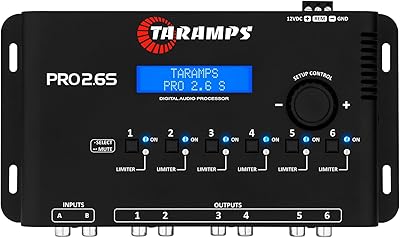
Taramp's Pro 2.6S Digital Signal Processor Equalizer
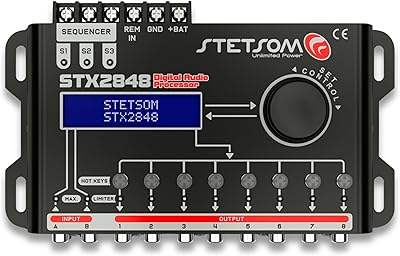
Stetsom STX 2848 8-Channel DSP Crossover Equalizer
miniDSP 2x4 HD Digital Signal Processor
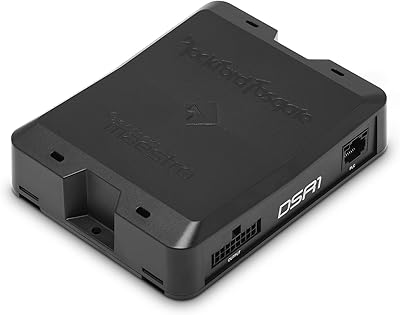
Rockford Fosgate DSR1 8-Channel Signal Processor
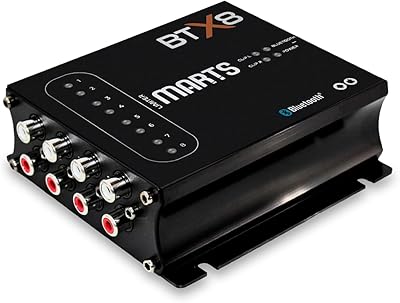
Marts Digital BTX8-DSP 8-Channel Bluetooth DSP Processor
iFLYTEK AINOTE Air 2 E Ink Tablet
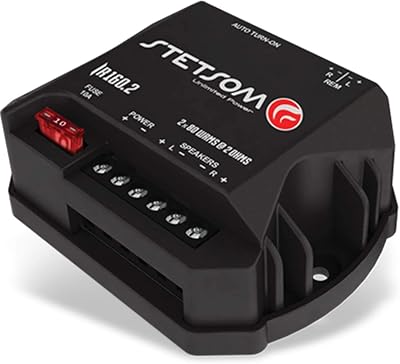
Stetsom IR 160.2 2-Channel Car Amplifier
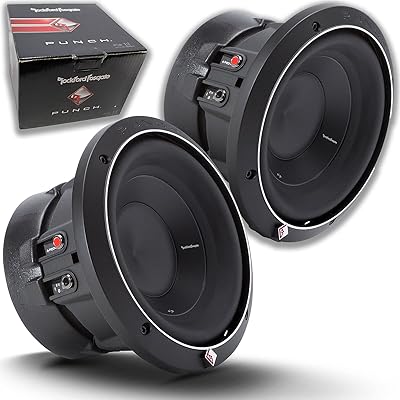
Rockford Fosgate P2D2-8 8-inch Car Subwoofer
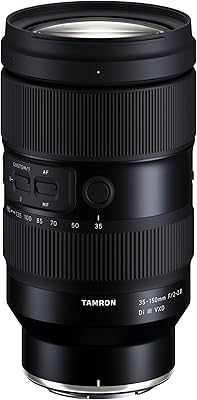
Tamron 35-150mm F/2-2.8 Di III VXD for Nikon Z