Overview

The Rockville RXM8BTB 8-Channel Bluetooth Car Amplifier is one of the more interesting options in the mid-range amp space — compact enough to tuck behind a seat, yet capable of driving a full 8-speaker layout in a car or on a boat. It sits in a price bracket where it squares off against upper-budget brands while reaching toward established names like Kicker and Rockford Fosgate. The built-in Bluetooth is a genuine convenience, letting you stream audio without reworking your head unit. One thing worth clarifying upfront: the 1500-watt figure is a peak rating. The verified RMS numbers — 65 watts per channel at 4 ohms — are what actually matter for real-world comparisons.
Features & Benefits

What makes this 8-channel amp worth considering is how much flexibility it packs into a chassis measuring just 6.7 by 11.5 inches. You can run it as a full 8-channel setup, collapse it to a 4-channel configuration, or build out a 4.2 system with dedicated sub control. The independent crossover controls on each channel group — switchable between full range, high-pass, and low-pass — give installers real tuning options rather than a one-size-fits-all filter. Class D topology keeps heat manageable. The white aluminum casing and marine-grade conformal coating mean this amp can handle salt spray and humidity, meeting ABYC marine standards without any modifications required.

Best For

The Rockville marine amplifier makes the most sense for a specific kind of buyer. If you're wiring up a boat with multiple speakers and need protection against moisture and salt air, this is a practical pick — just know that marine-grade means corrosion-resistant, not waterproof. It's also a strong fit for car audio builders who need 8 discrete channels in a tight space without spending premium-tier money. The onboard Bluetooth is particularly useful if your boat or vehicle lacks a modern head unit, since you can stream directly from a phone. Budget-conscious installers building out a 4.2 or multi-zone system will find the channel flexibility especially worthwhile.

User Feedback

Sitting at 3.8 stars across 60 ratings, this multi-channel car amp lands in solidly mixed but mostly positive territory. Buyers who install it correctly tend to be satisfied with the output, citing clean sound quality and solid build for the price tier. Marine users in particular have noted the casing holds up well after a season on the water. The friction points are real, though. Some buyers report Bluetooth pairing issues — occasional dropouts or reduced range — which frustrates anyone relying on wireless streaming as a primary feature. A few less experienced installers also found the channel configuration options confusing without prior amp setup knowledge. It rewards buyers who go in prepared.

Pros

  • Genuine 8-channel output in a compact chassis under 12 inches long makes complex installs far more manageable.
  • Dyno-certified RMS ratings give you honest, comparable power figures rather than inflated peak numbers.
  • ABYC-compliant marine-grade coating makes this 8-channel amp a rare dual-use option for both vehicles and boats.
  • Flexible channel configuration — 8, 6, 4, or 4.2 — adapts to a wide range of speaker layouts without extra hardware.
  • Built-in Bluetooth with auto-pairing lets you stream audio from a phone without touching your head unit.
  • Independent crossover controls per channel group provide real tuning control over highs, lows, and full-range outputs.
  • Class D topology keeps the amp running cool even during extended high-volume sessions in tight enclosures.
  • At under 4 pounds, the lightweight aluminum build makes mounting and repositioning genuinely easy.
  • Four-way protection circuitry guards against DC faults, shorts, thermal overload, and output overload simultaneously.
  • Signal-to-noise ratio above 100dB keeps background hiss low across all 8 channels.

Cons

  • Bluetooth pairing can be inconsistent, with some users reporting dropouts or limited effective range during use.
  • Per-channel RMS output of 65 watts at 4 ohms may leave buyers wanting more headroom for power-hungry speakers.
  • The 8-channel configuration options can overwhelm less experienced installers without prior multi-amp setup knowledge.
  • Marine-grade does not mean waterproof — direct water contact or fully exposed outdoor mounting will cause damage over time.
  • The 1500-watt peak figure is prominently marketed but largely irrelevant to real-world performance comparisons.
  • With a 3.8-star average across 60 ratings, buyer satisfaction is decent but not strong enough to call it a standout choice.
  • No speaker-level inputs means the Rockville RXM8BTB 8-Channel Bluetooth Car Amplifier requires RCA outputs from the source unit.
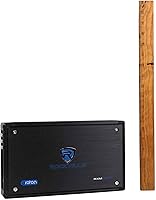
  • The white casing, while corrosion-resistant, may show grime or discoloration more visibly than dark-finished competitors.

Ratings

The scores below reflect an AI-driven analysis of verified buyer reviews for the Rockville RXM8BTB 8-Channel Bluetooth Car Amplifier, sourced globally and filtered to remove spam, incentivized responses, and bot activity. Every category is scored to honestly reflect what real users praised and where they ran into friction — nothing is inflated to flatter the product.

Value for Money
78%
22%
For a mid-range price, getting 8 independently controlled channels with dyno-certified RMS ratings and marine-grade construction is genuinely difficult to match. Buyers building multi-speaker boat or car setups consistently note they would have spent significantly more piecing together comparable functionality from separate components.
A handful of buyers felt the Bluetooth inconsistencies and per-channel power output placed it closer to budget territory than the pricing implies. When Bluetooth reliability is factored in, some users questioned whether the premium over cheaper 4-channel amps was fully justified for their specific setup.
Build Quality
82%
18%
The white aluminum alloy casing feels solid and purposeful rather than decorative, and marine users specifically noted the finish showed minimal corrosion or discoloration after a full boating season. The stainless steel RCA inputs and bolt-down terminals also drew praise for feeling more robust than expected at this price point.
A few buyers reported that some of the labeling on the controls faded or became harder to read after extended exposure to sun and heat, which is a minor but annoying issue in outdoor installs. The white finish, while durable, shows grime and UV yellowing over time in open-air environments.
Power Output
74%
26%
Users running moderate speaker loads — typical 4-ohm coaxials and components across a full car or pontoon setup — found the 65 watts per channel more than adequate for everyday listening levels with good headroom. Bridging channels for subwoofer duty at 190 watts per pair gave marine builders enough thump without a separate mono amp.
Buyers who misread the peak wattage as usable power were invariably disappointed when the amp didn't push the volume they expected from a 1500-watt label. Even those who understood RMS ratings noted 65 watts per channel starts to feel limiting when pushing efficient speakers in open-air environments like boats or off-road vehicles.
Bluetooth Performance
59%
41%
Auto-pairing works quickly on initial connection, and for straightforward in-car use — phone sitting in a cupholder or mounted on a dash — the connection held steadily for most users. The convenience of skipping a head unit upgrade entirely appealed strongly to boat owners who just wanted phone audio without rewiring.
Recurring complaints about signal dropouts and reduced effective range surfaced across multiple reviews, particularly in environments with wireless interference or when the phone was more than 10 to 15 feet away. For a feature prominently marketed on the product, the inconsistency is a real weak spot and the most common driver of lower-star ratings.
Channel Flexibility
87%
The ability to reconfigure between 8-channel, 4-channel, and 4.2 layouts without additional hardware is the kind of practical flexibility that experienced installers genuinely appreciate — it means one amp can serve very different system designs depending on the build. Users building phased systems or upgrading incrementally found this especially useful.
The configuration options, while powerful, come with a learning curve that frustrated less experienced buyers who expected plug-and-play simplicity. A few reviewers noted that the channel selector and crossover labels in the manual weren't always clear, leading to initial miswiring on their first attempt.
Marine Durability
76%
24%
Boat owners who mounted this amp in a protected cabin or under a console generally reported solid performance over a full season, with the conformal coating visibly doing its job against salt-air exposure. ABYC compliance gave professional marine installers confidence to specify it without concerns about standards violations.
The marine-grade claim creates an expectation that doesn't fully hold up when buyers mount the amp in exposed or semi-exposed locations. Direct splash or heavy condensation led to problems for a subset of marine users, suggesting the marketing could do more to set accurate expectations around what moisture resistance actually covers.
Installation Experience
67%
33%
For seasoned car audio installers, the wiring layout is logical and the labeled terminals are decently spaced for clean cable management. The compact footprint made routing power and RCA cables manageable even in cramped installations under seats or inside boat compartments.
Novice installers frequently flagged the lack of a clear, step-by-step wiring diagram for less common configurations like 4.2 mode. The requirement for RCA-only inputs also caught some buyers off guard who assumed speaker-level inputs would be included, leading to extra cost for a line output converter.
Thermal Management
81%
19%
Class D efficiency means the amp runs noticeably cooler than older-technology alternatives, and users who mounted it in tighter spaces — behind seats or under dashboards — rarely reported heat-related shutdowns during normal use. The aluminum heat sink dissipates warmth effectively during sustained moderate-volume listening.
Extended high-volume sessions in enclosed or poorly ventilated spaces did trigger the thermal protection cutoff for a small but notable number of users. The amp recovers fine once cooled, but installers need to factor airflow into mounting decisions more carefully than the compact size might suggest.
Audio Clarity
79%
21%
With a signal-to-noise ratio above 100dB and THD below 0.05%, background hiss is effectively inaudible during normal playback, which experienced listeners picked up on as a genuine quality indicator. Full-range channels sounded clean and well-defined at moderate gains without introducing harshness.
A small number of audiophile-leaning buyers felt the sonic character lacked the refinement of higher-tier amplifiers, particularly in the upper midrange under heavier loads. This is a minor concern in the context of the amp's intended market, but worth noting for buyers with high-resolution expectations.
Crossover & EQ Controls
73%
27%
The variable high-pass and low-pass filters covering 50Hz to 250Hz gave installers meaningful tuning latitude without needing an outboard processor, and the adjustable bass EQ at 45Hz was well-regarded for dialing in subwoofer blend. Having independent crossover control between the two channel groups is a feature more typically found at higher price points.
The crossover controls themselves are small and somewhat fiddly to adjust precisely once the amp is mounted in a tight location. Some users noted the bass EQ, while useful, had a slightly aggressive boost character that required careful tuning to avoid muddying the low-midrange.
Compact Form Factor
88%
At under 12 inches long and barely 2 inches tall, this multi-channel car amp genuinely fits in locations where a full-size 8-channel unit simply wouldn't — behind rear seats, inside console compartments, and under marine helm panels. The lightweight aluminum body made single-person mounting straightforward in most scenarios.
The compact layout does mean terminal access is a bit tight when working with thicker gauge power cables, and a few installers noted the chassis flexed slightly more than expected during torquing down the power terminals. These are minor ergonomic gripes rather than durability concerns.
Protection Circuitry
83%
The four-way protection system covering DC faults, shorts, thermal overload, and output overload gave buyers meaningful peace of mind, particularly in marine environments where wiring conditions can be less controlled. Several reviewers noted the amp recovered cleanly from protection shutdowns without any sign of lasting damage.
The protection circuit tripped earlier than expected for a small number of users running the amp at 2-ohm loads in warm conditions, suggesting the thermal threshold is set conservatively. While safe, this can feel frustrating when the amp cuts out during a session that doesn't feel particularly demanding.
RCA & Connectivity
77%
23%
Stainless steel RCA inputs added a reassuring sense of quality on connection points that often corrode or loosen on budget amps, and the RCA line output allowed easy daisy-chaining to a separate mono amp for users who wanted a dedicated subwoofer channel beyond the bridged pairs. Input sensitivity from 150mV to 6V covered most head unit configurations without adjustment issues.
The absence of speaker-level inputs remains a real gap for buyers trying to integrate with factory head units, and no wireless or digital input option beyond Bluetooth limits connectivity for more advanced source setups. Buyers planning OEM integration should budget for a quality line output converter from the start.

Suitable for:

The Rockville RXM8BTB 8-Channel Bluetooth Car Amplifier is a strong match for anyone building out a multi-speaker audio system in a space-constrained environment — particularly boat owners who need corrosion-resistant hardware that meets ABYC marine standards. If you're running a full 8-speaker layout on a pontoon, ski boat, or center console and don't want to pay flagship prices for marine-rated amplification, this 8-channel amp hits a practical sweet spot. It's equally well-suited to car audio enthusiasts wiring complex installs — think multi-zone cabins or dedicated front, rear, and subwoofer channels — who need channel flexibility without filling up the trunk with multiple amps. Buyers who lack a modern head unit will appreciate the onboard Bluetooth, since it allows direct phone streaming without a receiver upgrade. Anyone who values dyno-certified RMS specs over inflated peak claims will also feel more confident in the honest power ratings this amp provides.
Not suitable for:

The Rockville RXM8BTB 8-Channel Bluetooth Car Amplifier is not the right call for buyers expecting truly waterproof construction — marine-grade conformal coating protects against salt spray and humidity, but direct water exposure will still cause damage, so open-air or fully exposed installations are a bad fit. Audiophiles chasing high-end fidelity or users powering demanding, high-impedance speaker setups may find the RMS output per channel — 65 watts at 4 ohms — underwhelming compared to dedicated 2- or 4-channel performance amps at a similar price. If Bluetooth is your primary use case and you need rock-solid wireless reliability over distance, the reported pairing inconsistencies from real-world users are a genuine concern worth weighing. Novice installers with no prior experience configuring multi-channel amps may also find the crossover options and channel routing confusing without guidance, so this multi-channel car amp rewards buyers who already know their way around an amp rack.
Specifications

  • Peak Power: The amp is rated at 1500 watts total system peak power, a figure best used for comparison against other budget-tier brands rather than as a real-world performance benchmark.
  • RMS Output: Dyno-certified RMS output is 65 watts per channel across all 8 channels at 4 ohms, or 95 watts per channel at 2 ohms under less than 1% THD.
  • Bridged RMS: When bridged to 4 channels, the amp delivers 190 watts per channel at 4 ohms, suitable for driving higher-demand speakers or subwoofers.
  • Channel Count: Supports 8 fully independent channels, reconfigurable to 6-channel, 4-channel, or a 4.2 system with dedicated subwoofer outputs.
  • Topology: Uses a Texas Instruments Digital Class D audio topology paired with a high-speed MosFET power supply for efficient, low-heat operation.
  • Bluetooth: Built-in Bluetooth with auto-pairing allows wireless audio streaming directly from a smartphone or other Bluetooth-enabled source device.
  • Frequency Response: The amplifier covers a frequency range of 10Hz to 40kHz, accommodating both deep bass reproduction and high-frequency speaker output.
  • Signal-to-Noise: Signal-to-noise ratio exceeds 100dB, keeping background noise and hiss at a low level across all 8 channels during normal operation.
  • Distortion: Minimum total harmonic distortion is rated below 0.05%, indicating clean amplification at rated RMS power levels.
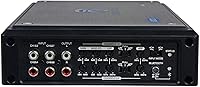
  • Crossover Filters: Each channel group has independent, selectable crossover modes — full range, high-pass, or low-pass — with variable filter points from 50Hz to 250Hz at 12dB per octave.
  • Bass EQ: A fully adjustable bass equalization control allows up to 12dB of boost centered at 45Hz for enhanced low-frequency output.
  • Fuse Rating: The amp carries an 80A fuse rating, which should be factored into your vehicle or marine wiring plan when sizing power cables and inline fuses.
  • Protection: Four-way protection circuitry monitors for DC faults, short circuits, thermal overload, and output overload, shutting the amp down safely if any threshold is exceeded.
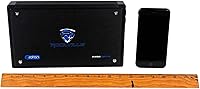
  • Dimensions: Physical dimensions are 6.7″ wide by 11.5″ long by 2″ tall, making it one of the more compact options available in the 8-channel amp category.
  • Weight: The unit weighs 3.88 pounds, light enough for straightforward single-person mounting in most vehicle or marine enclosure locations.
  • Casing Material: The enclosure is constructed from non-corrosive white aluminum alloy with a high-gloss finish and salt-water resistant paint and silk-screen printing.
  • Marine Rating: Conforms to American Boat and Yacht Council (ABYC) marine electronics standards, with conformal-coated circuit boards that resist salt spray and moisture-induced corrosion.
  • Input Sensitivity: Input voltage range spans 150mV to 6V, compatible with both low-level RCA outputs from head units and higher-voltage line outputs.
  • Input Impedance: Input impedance is rated at 22K ohms, standard for RCA line-level connections from most aftermarket and OEM source units.
  • Damping Factor: Damping factor exceeds 200 at 100Hz, indicating good control over speaker cone movement and tighter bass response during playback.

Related Reviews
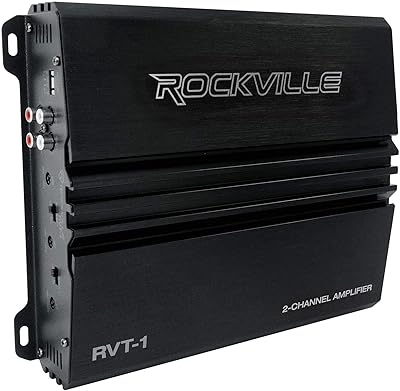
Rockville RVF-2 4-Channel Car Amplifier
84%
88%
Audio Quality
91%
Power Output
85%
Build Quality
72%
Thermals (Heat Management)
80%
Installation Ease
More
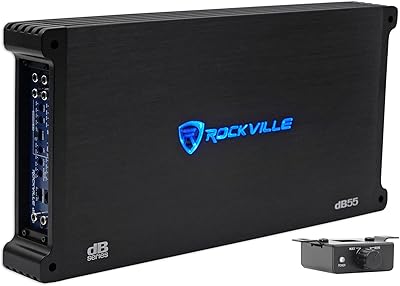
Rockville dB55 5-Channel Car Amplifier
75%
91%
Value for Money
83%
Sound Quality at Moderate Volumes
78%
Bass Output & Subwoofer Performance
62%
Power Accuracy & Transparency
58%
Thermal Management & Heat
More
Rockville dB25 2800W 2-Channel Car Amplifier
86%
94%
Power Output
89%
Sound Quality
85%
Ease of Installation
91%
Bass Control
82%
Durability
More
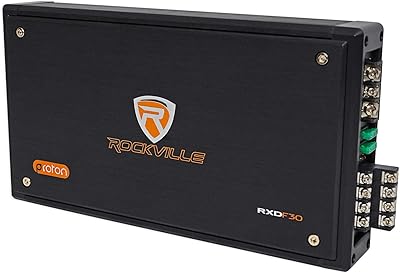
Rockville RVT-1 2-Channel Car Amplifier
68%
83%
Value for Money
67%
Power Output
58%
Build Quality
61%
Thermal Management
72%
Audio Clarity
More
Rockville KRYPTON F2 3200W 4-Channel Car Amplifier
84%
94%
Power Output
89%
Sound Clarity
76%
Ease of Installation
88%
Build Quality
90%
Efficiency (Power Handling)
More
Rockville RXH-F5 5-Channel Car Amplifier
74%
88%
Value for Money
74%
Power Accuracy
83%
Installation Ease
79%
Sound Quality
68%
Subwoofer Performance
More
Rockville RXA-F1 1600W 4-Channel Car Amplifier
82%
88%
Sound Quality
93%
Power Output
84%
Ease of Installation
92%
Value for Money
79%
Durability
More
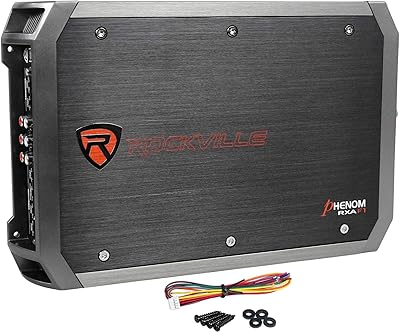
Rockville RXA-T1 1500W 2-Channel Car Amplifier
85%
88%
Audio Performance
92%
Bass Response
85%
Build Quality
89%
Compactness/Size
80%
Ease of Installation
More
Rockville RXD-T2 2-Channel Car Amplifier
79%
91%
Power Accuracy
83%
Build Quality
67%
Thermal Management
88%
Ease of Installation
84%
Crossover & EQ Controls
More
Rockville RXA-F2 2400W 4-Channel Car Amplifier
85%
94%
Power Output
89%
Sound Clarity
88%
Ease of Installation
90%
Bass Performance
85%
Compatibility with Factory Systems
More

FAQ

That figure is a peak power rating, which represents the maximum power the amp can theoretically handle in a momentary burst under ideal conditions. The number that matters for real-world comparisons is the RMS output — 65 watts per channel at 4 ohms, verified through dyno testing. When you're shopping amps, always compare RMS to RMS, not peak to RMS.

It's genuinely built for both. The circuit boards are conformal-coated to resist salt spray and moisture, and the amp meets ABYC marine electronics standards, which is a meaningful certification for marine use. Just keep in mind that marine-grade is not the same as waterproof — you'll want to mount it somewhere protected from direct water contact, not exposed on an open deck.

Yes, it uses RCA line-level inputs, so your source unit needs RCA preamp outputs to connect directly. If your factory head unit doesn't have RCA outputs, you'd need a line output converter between the speaker wires and the amp's inputs.

It works well for many buyers, especially for straightforward phone streaming in a car or on a boat. That said, some users have reported occasional pairing hiccups or shorter-than-expected wireless range. If Bluetooth is your primary reason for buying this amp — rather than a convenience bonus — it's worth keeping that in mind before committing.

You can absolutely run subs. In a 4.2 configuration, you can bridge pairs of channels to get 190 watts each at 4 ohms for your subwoofers while the remaining channels handle full-range speakers. The onboard low-pass filter is adjustable from 50Hz to 250Hz, giving you decent control over the crossover point for the sub channels.

It's more involved than wiring a basic 2-channel amp, mainly because of the channel routing options and the independent crossover controls for each channel group. If you're comfortable reading a wiring diagram and understand the basics of gains, crossovers, and RCA connections, you'll be fine. If this is your first amp install, it's worth watching a few tutorials before you start or having a shop do the initial setup.

Class D amplifiers are significantly more efficient than older Class AB designs, so this multi-channel car amp runs noticeably cooler under load. The aluminum heat sink helps dissipate what heat is generated. It does have thermal protection built in, so if it ever gets too warm — usually due to poor ventilation in the mounting location — it will shut itself off rather than sustain damage.

Each channel is stable down to 2 ohms, where the RMS output increases to 95 watts per channel. Running at 2 ohms draws more current and generates more heat, so make sure your mounting location has decent airflow if you're going that route.

No, this amp uses RCA inputs only. If you're integrating it with a factory head unit that has no RCA outputs, you'll need an external line output converter, which is a separate and inexpensive add-on that taps into the factory speaker wires and converts the signal.

With an 80A fuse rating, a 4-gauge power wire is typically the right starting point for a single run from the battery. If you're running longer cable distances — say, more than 15 feet — bumping up to 2-gauge is a reasonable precaution to minimize voltage drop and keep the amp performing at its rated output.

Where to Buy