Overview

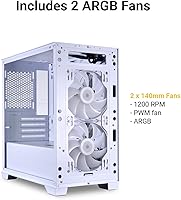
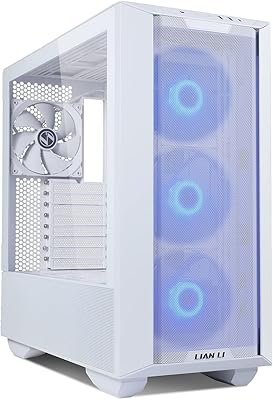
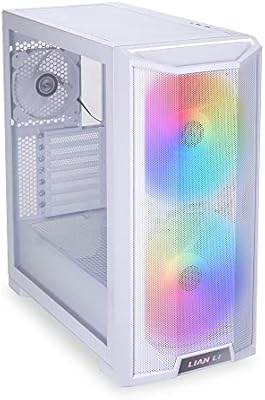
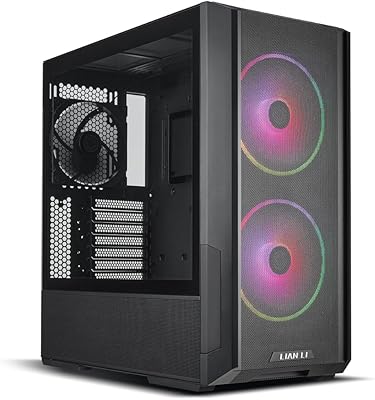
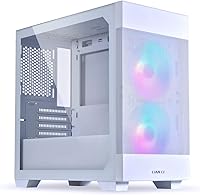
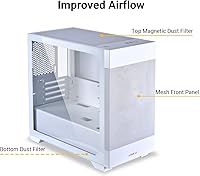
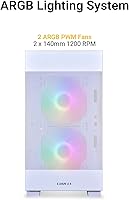
The Lian Li LANCOOL 205M Mesh Mid-Tower Case makes a compelling argument for going smaller without giving up airflow. Lian Li built this around a steel mesh front panel paired with magnetic dust filters on both the top and bottom — a practical combination that keeps internals cleaner over months of use, not just on day one. Two 140mm ARGB PWM fans come pre-installed, so you're not immediately shopping for extras after unboxing. Add a 4mm tempered glass side panel, and this compact mid-tower genuinely holds its own against similarly priced options from Fractal Design and Corsair on both looks and substance.
Features & Benefits

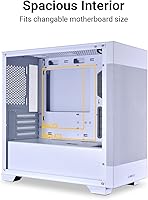
What stands out about the LANCOOL 205M Mesh isn't any single spec — it's how well the details work together. The front mesh pulls in serious airflow, and because the dust filters are magnetic, cleaning them takes seconds rather than a screwdriver. The included ARGB fans connect directly to your motherboard header, so lighting sync just works without a separate controller. GPU clearance stretches to 375mm, which is more than enough for current high-end cards in a chassis this size. Cable routing behind the motherboard tray is genuinely spacious, and the drive bay flexibility — mixing SSDs and a traditional hard drive — keeps older storage useful.

Best For

This mATX case is a natural fit for builders downsizing from a full tower who refuse to compromise on thermal performance. If you're working with a Micro ATX or Mini-ITX board and want ARGB lighting out of the box, it removes a lot of the usual setup friction. Gamers who'd rather spend their budget on components than fans will appreciate what's already included. It also suits dorm rooms or home offices where desk space matters — the footprint is noticeably smaller than a standard mid-tower, yet cooler and GPU support remain competitive with larger enclosures in the same price range.

User Feedback

Owners consistently call out how easy the build process is — removable SSD brackets and a logical interior layout make assembly less frustrating than many rivals. Airflow gets strong marks across the board. That said, a few builders feel the side panel clips don't match the overall build quality; they work fine, but feel slightly flimsy compared to the rest of the chassis. The included fans can get audible at full speed, which is worth knowing if noise levels matter to you. The most common complaint, though, is the lack of a USB-C port on the front I/O — at this price point, that omission is starting to feel like a real gap.

Pros

  • Pre-installed ARGB fans connect directly to the motherboard, eliminating the need for a separate lighting controller.
  • Magnetic dust filters on the top and bottom make routine maintenance a quick, tool-free task.
  • Generous graphics card clearance means even large triple-fan GPUs fit without modifications.
  • The cable management channel behind the motherboard tray is spacious enough to keep builds genuinely tidy.
  • Compact external dimensions free up meaningful desk space compared to standard ATX mid-towers.
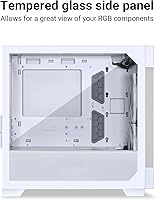
  • The 4mm tempered glass panel is thick and clear, giving RGB components a polished, finished look.
  • Flexible drive bay configuration supports a practical mix of SSDs and one legacy hard drive.
  • Liquid cooling up to 240mm is supported on both the front and top mounts, covering most AIO options.
  • Assembly is straightforward — removable brackets and a logical interior reduce build time noticeably.
  • The overall package delivers strong out-of-the-box value when factoring in included fans and filters.

Cons

  • No USB-C port on the front I/O panel is a notable omission at this price tier.
  • Side panel retention clips feel noticeably cheaper than the rest of the chassis construction.
  • Included fans become audible under sustained load, which matters in quiet workspaces.
  • Only four expansion slots limits any build that needs more than a standard GPU and sound card.
  • The open mesh front accelerates dust accumulation, requiring more frequent filter cleaning than enclosed designs.
  • No acoustic dampening anywhere in the chassis means fan and drive noise carries freely.
  • White exterior finish shows fingerprints and smudges prominently during and after the build process.
  • 360mm radiator support is completely absent, ruling out larger premium AIO kits.
  • The sparse instruction manual may leave first-time mATX builders needing outside guidance.
  • ATX motherboard incompatibility means existing full-size board owners must factor in a hardware upgrade cost.

Ratings

The Lian Li LANCOOL 205M Mesh Mid-Tower Case earns consistently strong marks across thousands of verified global purchases, and the scores below reflect an AI-driven analysis that actively filters out incentivized, bot-generated, and outlier reviews to surface what real builders actually experience. Strengths in airflow and build-day ease are well-documented, but genuine pain points — including front I/O limitations and fan noise at load — are weighted honestly and reflected in every category score.
Airflow Performance
93%
Builders running mid-range and high-end GPUs report noticeably lower component temperatures compared to cases with solid or partially obstructed front panels. The mesh front combined with the pre-installed 140mm fans creates strong intake pressure even before any additional fans are added, which resonates strongly with users in warmer climates or compact desk setups.
The airflow advantage does come with a trade-off: the open mesh design means ambient dust accumulates faster in dusty environments, and while the magnetic filters help, they need cleaning more frequently than users of sealed cases might expect.
Build Quality & Materials
81%
19%
The main chassis feels solid and rigid for a compact mid-tower — most builders note there is no flex when carrying or transporting it, and the steel construction gives it a reassuringly substantial weight. The tempered glass panel is thick and clear, making RGB builds look genuinely polished on a desk.
The side panel retention clips are the one area where the quality perception drops noticeably. Several experienced builders flagged them as feeling plasticky and less precise than the rest of the chassis, particularly when compared to tool-free panel systems on rival cases from Fractal Design.
Ease of Assembly
91%
Removable SSD mounting brackets and a logically organized interior make this one of the more approachable cases for first-time builders and veterans alike. Most users report completing a full build in well under two hours, and the cable routing channels are positioned exactly where you need them without requiring creative workarounds.
A small number of users found the motherboard standoff placement less clearly labeled than expected, which created brief confusion during initial assembly. The manual is functional but sparse — builders new to mATX form factors may want to supplement it with a video walkthrough.
Cable Management
88%
The space behind the motherboard tray is genuinely generous for a chassis this compact, and experienced builders frequently single it out as one of the better cable management implementations in this size class. Velcro tie points are well-placed, and most ATX power supplies fit neatly without forcing cables into awkward bends.
The front panel cable headers are positioned in a way that can feel tight if you are running a particularly thick 24-pin cable alongside other front I/O connections. It is manageable, but builders with stiffer modular cables may need to plan routing carefully before tightening everything down.
Included Fans & Lighting
84%
Shipping with two 140mm ARGB PWM fans already installed removes a common day-one expense, and the direct motherboard header connection means lighting sync works immediately without a separate hub or controller. The ARGB output looks vibrant through the tempered glass, especially in a darkened room.
At full PWM speed, the fans are audible — not alarmingly loud, but noticeable in a quiet room. Users who prioritize near-silent operation will likely want to configure a lower RPM curve in their BIOS or swap the fans entirely, which partially undermines the out-of-the-box convenience.
GPU & Component Clearance
89%
The maximum GPU length supported is well above what most current consumer graphics cards require, meaning even triple-fan flagship cards fit without modification. CPU cooler height allowance is similarly generous for a compact chassis, giving builders flexibility to use most 120mm and 140mm tower coolers without measuring twice.
While GPU length clearance is excellent, the case only supports four expansion slots total, which limits multi-GPU or high-card-count configurations — though for a typical mATX gaming build this is rarely a practical concern.
Dust Filtration
82%
18%
Magnetic dust filters on both the top and bottom panel are a practical inclusion that pays off over months of daily use. Removing and rinsing them takes under a minute, and the magnetic attachment means they seat firmly without warping or sagging over time.
There is no dedicated filter covering the rear exhaust, and the mesh front — while it does reduce ingress — is not as fine as some purpose-built dust filter meshes. Users in particularly dusty environments will still find debris accumulating on fan blades faster than in more enclosed designs.
Liquid Cooling Support
78%
22%
A 240mm radiator fits cleanly on both the front and top mounts, which gives builders a credible liquid cooling path without needing to upsize to a full mid-tower. The front radiator position is especially well-suited for push-pull configurations with slim 25mm radiators.
360mm radiator support is off the table entirely given the mATX-focused dimensions, which may disappoint builders already invested in larger AIO kits. Fitting a 240mm AIO in the front while also maintaining adequate storage and cable routing requires some planning.
Front I/O & Connectivity
62%
38%
Two USB 3.0 Type-A ports, audio in and out, and clearly labeled power and reset buttons cover the basics competently. The I/O panel placement on the top of the case is intuitive for desk use, and the port spacing is practical for simultaneously connected devices.
The absence of a USB-C port is the most cited complaint among recent buyers, and it is hard to dismiss at this price point — most competing cases in the same tier have added USB-C as standard. Builders with newer peripherals or smartphones will find themselves reaching for a hub or back-panel port more often than they would like.
Value for Money
86%
When you factor in the included ARGB fans, dust filters, and tempered glass panel, the total package represents solid value compared to barebones cases at similar prices. Builders who price out equivalent configurations from competitors often find this mATX case delivers more for the outlay.
The USB-C omission and the side panel clip quality do give pause when justifying the price against newer budget entrants that have updated their I/O. If those specific features matter to you, the value equation shifts enough to warrant comparison shopping.
Noise Levels
71%
29%
At moderate fan speeds the system runs quietly enough for everyday use and light gaming sessions. The chassis walls provide reasonable dampening, and users who set a conservative PWM curve in BIOS report the build staying nearly silent at idle.
Under sustained load the included fans spin up audibly, and there is no foam or acoustic lining anywhere in the chassis to soften that. Builders using this case for extended rendering or benchmark sessions in quiet workspaces will likely want aftermarket fans with a quieter noise profile.
Storage Flexibility
79%
21%
The configurable drive bay system accommodates a practical mix of SSDs and a legacy hard drive, which is genuinely useful for builders migrating storage from an older system. The removable brackets make swapping drives without fully disassembling the build straightforward.
Total drive capacity is on the modest side for a content creator or media storage workload. Builders who regularly work with large video libraries or game collections spanning multiple drives may find the storage options limiting within a year or two.
Aesthetic Design
87%
The Snow White colorway is clean and well-executed — the paint finish is even, and the white interior makes ARGB lighting pop more than it would in a standard black case. The overall silhouette is understated and modern without relying on aggressive styling that dates quickly.
White cases show smudges and fingerprints more readily during the build process, and the exterior finish can show scuffs if the case is moved or repositioned frequently. Touch-up options are limited compared to standard black chassis.
Compact Footprint
91%
The reduced dimensions compared to a standard ATX mid-tower make a meaningful difference on smaller desks and in dorm setups. Builders consistently report being surprised by how much internal space the case provides relative to its external footprint, which is a real-world win for space-constrained users.
The compact form factor does impose real limits — full-size ATX motherboards are simply not supported, and builders with existing ATX components considering a case upgrade will need to factor in a board swap, which changes the value calculation significantly.

Suitable for:

The Lian Li LANCOOL 205M Mesh Mid-Tower Case is a strong choice for anyone building around a Micro ATX or Mini-ITX motherboard who wants genuine airflow performance without the desk footprint of a full-size tower. It suits gamers and enthusiasts who care about aesthetics — the ARGB fans sync to the motherboard out of the box, and the tempered glass side panel makes a well-lit build look intentional rather than accidental. Builders downsizing from larger towers will appreciate that component clearances are more generous than the external dimensions suggest, accommodating long graphics cards and most tower CPU coolers without compromise. It is also a smart pick for students or home office users in tighter spaces, where a compact but capable machine needs to earn its place on a desk. Anyone who wants to skip the day-one fan shopping and get straight to building will find the included hardware genuinely useful rather than token.
Not suitable for:

The Lian Li LANCOOL 205M Mesh Mid-Tower Case is not the right choice for builders working with a full-size ATX motherboard — that is simply a hard incompatibility with no workaround. If you are running a workstation-style setup that demands multiple storage drives, the limited drive bay count will feel restrictive within a year or two, especially for video editors or anyone holding large local media libraries. Builders who have already invested in a 360mm AIO cooler will find it does not fit here, so if liquid cooling is central to your thermal strategy, the radiator support ceiling may be a dealbreaker. People who are particularly sensitive to system noise should also be cautious: the included fans are capable, but they get audible under sustained load, and the chassis has no acoustic dampening to compensate. Finally, if you rely heavily on USB-C for peripherals, phones, or external drives at your desk, the front I/O panel will frustrate you daily — this is a real gap at this price point that a few close competitors have already addressed.
Specifications

  • Form Factor: Micro ATX mid-tower chassis also supporting Mini-ITX motherboards, with four expansion slots total.
  • Dimensions: The case measures 210mm wide, 402.5mm deep, and 400mm tall, making it noticeably more compact than a standard ATX mid-tower.
  • Weight: Shipping weight is approximately 6 kg, reflecting the steel construction without feeling unnecessarily heavy for a case this size.
  • Side Panel: The left side panel is 4mm tempered glass, providing a clear, distortion-free view of internal components.
  • Chassis Material: The main body is constructed from SPCC steel at 0.6mm thickness, while the front panel uses slightly thicker 0.8mm SPCC steel.
  • Included Fans: Two 140mm ARGB PWM fans come pre-installed at the front, connecting directly to motherboard headers for speed and lighting control.
  • GPU Clearance: Maximum supported graphics card length is 375mm, accommodating virtually all current consumer triple-fan GPUs without modification.
  • CPU Clearance: CPU tower coolers up to 160mm tall are supported, covering the majority of high-performance air coolers on the market.
  • Radiator Support: A 240mm radiator can be mounted at both the front and top positions, enabling a range of dual-fan AIO liquid cooling configurations.
  • Fan Support: The front accepts two 120mm or two 140mm fans, the top supports two 120mm fans, and the rear fits one 120mm fan.
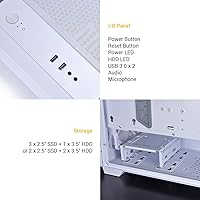
  • Drive Bays: The configurable bay system supports up to three 2.5-inch SSDs alongside one 3.5-inch HDD, or two 2.5-inch SSDs with two 3.5-inch HDDs.
  • Dust Filters: Magnetic dust filters are included at both the top and bottom of the chassis for easy removal and cleaning without tools.
  • PSU Support: The power supply mounts at the bottom and accommodates units up to 180mm in length, covering most standard and semi-modular ATX PSUs.
  • Front I/O: The top-mounted I/O panel includes two USB 3.0 Type-A ports, 3.5mm audio output and microphone input, a power button, reset button, power LED, and HDD LED.
  • Liquid Cooling: The case is both liquid cooling ready and liquid cooling capable, supporting sealed AIO systems up to 240mm on the front and top mounts.
  • Cable Management: A dedicated channel behind the motherboard tray provides extra clearance for routing and securing cables away from the main build area.
  • Expansion Slots: Four PCIe expansion slots are available, which is standard for Micro ATX builds and sufficient for a GPU plus one additional card.
  • Color Options: The Snow White variant features a white exterior paint finish with a matching white interior to maximize the visual impact of ARGB lighting.

Related Reviews

Lian Li Lancool III RGB White Mid-Tower Case
88%
94%
Cooling Performance
88%
Build Quality
92%
Design and Aesthetics
85%
Ease of Installation
91%
Airflow Optimization
More
Lian Li LANCOOL 215 X White Mid Tower Case
84%
89%
Cooling Performance
92%
Build Quality
88%
Aesthetic Appeal
75%
Cable Management
91%
Motherboard Compatibility
More
Lian Li LANCOOL 217
Lian Li LANCOOL 217
81%
91%
Airflow Performance
88%
Noise Levels
93%
Build Quality
94%
Aesthetic Design
86%
Cable Management
More
Lian Li O11 Vision Compact
80%
91%
Build Quality
94%
Aesthetic Design
89%
Back-Connect Motherboard Support
86%
Cooling Performance
74%
Cable Management
More
Lian Li LANCOOL 207 Digital Mid-Tower PC Case
81%
93%
Airflow Performance
91%
Build Quality
78%
LCD Screen Functionality
86%
Cable Management
89%
Fan Performance Out of the Box
More
SAMA V Mesh Mid Tower PC Case
86%
94%
Cooling Performance
88%
Build Quality
91%
Airflow Efficiency
89%
Ease of Maintenance
87%
Compatibility with Components
More
Lian Li LANCOOL 216 E-ATX PC Case
86%
94%
Cooling Performance
92%
Airflow Design
89%
Cable Management
85%
Ease of Installation
91%
GPU Compatibility
More
Cooler Master TD500 Mesh V2 ATX Mid-Tower Case
84%
91%
Cooling Performance
88%
Ease of Installation
84%
Build Quality
67%
Cable Management
92%
ARGB Lighting Customizability
More
Lian Li O11 Dynamic EVO XL Case
82%
93%
Build Quality
91%
Cooling Performance
88%
Cable Management
94%
Radiator & Liquid Cooling Support
89%
Motherboard Compatibility
More
Thermaltake Tower 600 Mid-Tower ATX Case
79%
91%
Build Quality
93%
Aesthetic Design
88%
Cable Management
94%
Cooling Capacity
71%
Installation Experience
More

FAQ

No — the Lian Li LANCOOL 205M Mesh Mid-Tower Case is designed exclusively for Micro ATX and Mini-ITX boards. If you are currently running a full ATX motherboard, you would need to factor in a board replacement, which changes the overall cost of switching to this chassis significantly.
Yes, in most cases you will be fine. The maximum GPU length supported is 375mm, and the majority of high-end triple-fan cards from both Nvidia and AMD fall within that limit. That said, always verify your specific card's length before ordering, since some ultra-beefy aftermarket coolers push close to or beyond that threshold.

The ARGB fans use standard 5V 3-pin ARGB headers, which are supported by motherboards from Asus, MSI, Gigabyte, and ASRock, among others. If your board has compatible headers, the lighting syncs automatically through your motherboard's software — no separate controller needed. Older boards without ARGB headers will still power the fans, but lighting control will be limited.

At moderate speeds they are fairly quiet and easy to live with. When the system pushes them to higher RPMs under sustained gaming or rendering workloads, they do become audible — not disruptive, but noticeable in a quiet room. Setting a custom fan curve in your BIOS to cap speeds unless temperatures demand it is the easiest fix.

Unfortunately, no. The front I/O offers two USB 3.0 Type-A ports and standard audio jacks, but USB-C is absent. For a case at this price point, that omission is a genuine gap — especially as more peripherals and phones rely on USB-C. If front USB-C access is important to your workflow, it is worth factoring this in before purchasing.

Yes, a 240mm radiator fits on both the front and top mounts, giving you flexibility depending on your airflow preferences. Most dual-fan AIO kits from Corsair, NZXT, and Arctic will work without issue. Just note that a 360mm radiator is not supported — the compact dimensions simply do not allow for it.

Very easy. Both the top and bottom filters attach magnetically, so you just pull them off, tap or rinse them under water, let them dry, and clip them back on. There are no screws or clips to wrestle with. Depending on your environment, a quick clean every few weeks keeps airflow and temperatures in check.

There is a reasonable amount — more than you would expect given the compact size. Most builders report being able to route and tie off cables cleanly without forcing anything. If you are using thick, non-modular PSU cables, it can get snug, but a fully modular power supply makes the job noticeably easier.

It lifts off with a few screws and is straightforward to remove when you need access. The panel clips that hold it in place get mixed reviews — they function reliably, but feel less solid than the rest of the chassis. As long as you handle the panel with reasonable care, it will not cause problems during a build or component swap.

It is genuinely one of the better options for that aesthetic at this price point. The white interior bounces ARGB light effectively, and the clear tempered glass makes the whole build visible from across a room. Just keep in mind that white cases show fingerprints and smudges more readily during the build process, so a microfiber cloth nearby is worth having.

Where to Buy