
Overview

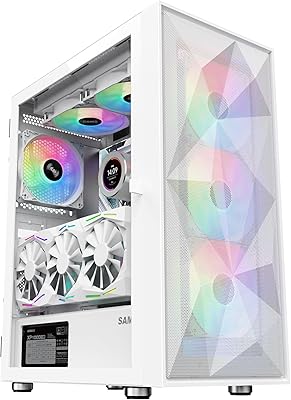
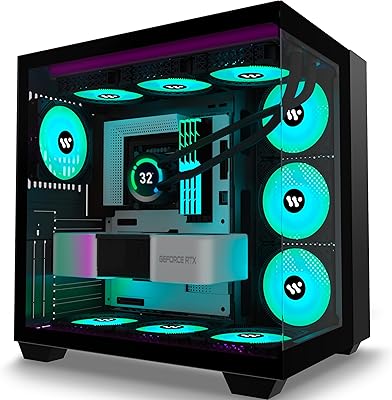
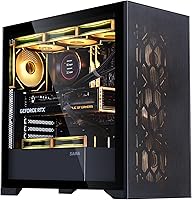
The SAMA V Mesh Mid Tower PC Case arrived in mid-2024 as the brand's clearest push into the value-focused airflow market — territory where names like Fractal and Montech already have loyal followings. SAMA has built a reputation for squeezing capable hardware into affordable cases, and this mid-tower delivers on that. The design leads with a full mesh front panel and a thick tempered glass side panel, giving it visual presence that competes above its price. There are ABS plastic accents alongside the steel frame, which is expected at this tier, so go in with realistic expectations about build feel — but on airflow and included hardware, it punches well for the money.

Features & Benefits

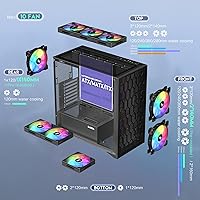
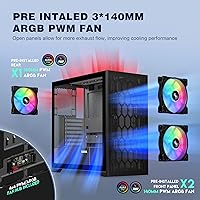
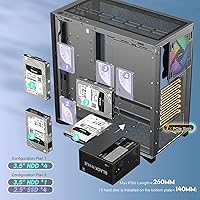
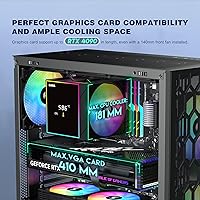
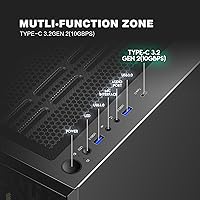
What stands out immediately is what ships in the box. Three 140mm ARGB fans come pre-installed — two as front intakes, one as a rear exhaust — which is unusual generosity for this price bracket, where single 120mm fans are common. The front mesh panel runs dual-layer and pairs with magnetic top and bottom dust filters, keeping maintenance straightforward. Inside, GPU clearance stretches to 410mm, making room for today's longer cards, and the top of the chassis accepts a 360mm liquid radiator without modification. A bottom-mount PSU bay keeps airflow paths cleaner, and the front I/O brings USB 3.0, Type-C, and audio — all where you'd expect them.

Best For

The V Mesh case is a natural fit for first-time builders who want real thermal performance without immediately budgeting for aftermarket fans. If you're pairing a power-hungry GPU — an RTX 4080 or 4090 — with a 360mm AIO cooler, the clearances here are generous enough to accommodate that without creative workarounds. The bottom-mount PSU bay makes cable routing less intimidating for newer builders. It also works well for anyone chasing a lit showcase build on a tight budget — the 4mm glass side panel keeps components visible, and the ARGB fans can sync with popular motherboard lighting systems like ASUS Aura or MSI Mystic Light.

User Feedback

With a 4.6-star average from over 60 buyers, early reception has been strong. Praise focuses on the included fans — most buyers did not expect 140mm units at this price — and multiple reviewers mention noticeably cooler temperatures after switching from an old solid-panel case. Assembly gets frequent positive remarks, suggesting the interior layout clicks logically into place. The main criticisms involve fit and finish: some plastic trim pieces feel lighter than the steel frame surrounding them, and a handful of users found the assembly guide sparse on detail. Fan noise under load comes up occasionally, though most report the 140mm fans run quietly at typical gaming speeds — sustained maximum RPM is less tested given the case's short market history.

Pros

  • Three 140mm ARGB fans come included — a genuinely unusual value at this price point.
  • The mesh front panel delivers real airflow improvement over closed-panel alternatives, with buyers reporting measurable temperature drops.
  • Magnetic dust filters on both the top and bottom make routine maintenance quick and tool-free.
  • GPU clearance of up to 410mm means even the largest current-generation cards fit without modification.
  • Top-mounted 360mm radiator support makes the V Mesh case liquid-cooling ready from day one.
  • The front I/O includes a USB Type-C port alongside USB 3.0 and audio, which keeps the build future-compatible.
  • A 4mm tempered glass side panel gives a clear, unobstructed view of internal components and lighting.
  • The bottom-mount PSU bay keeps power supply cables away from the main airflow path and simplifies routing.
  • Supports ATX, Micro-ATX, and Mini-ITX boards, giving builders room to change their platform later.
  • ARGB fans sync with mainstream motherboard lighting ecosystems, including ASUS Aura and MSI Mystic Light.

Cons

  • ABS plastic trim pieces feel noticeably lighter than the steel frame and can cheapen the overall impression.
  • The included assembly documentation is sparse, which may frustrate first-time builders during more complex steps.
  • Fan noise behavior at sustained maximum RPM is not yet well-tested, given the case launched only in mid-2024.
  • Panel fit and finish receives occasional criticism, with some buyers noting slight gaps or misalignment on trim parts.
  • SAMA is a lesser-known brand in Western markets, which may raise concerns about long-term parts availability and support.
  • No side panel ventilation on the non-glass side limits flexibility for unconventional component layouts.
  • The case weight of nearly 18 pounds makes transport or LAN party use less convenient than lighter alternatives.
  • Buyers wanting a minimalist, RGB-free aesthetic will find the pre-installed lighting difficult to fully suppress.

Ratings

The scores below for the SAMA V Mesh Mid Tower PC Case were generated by our AI engine after analyzing verified global buyer reviews, actively filtering out incentivized, bot-generated, and repeat submissions to surface authentic feedback. Each category reflects the honest distribution of praise and frustration found across real builder experiences — not a sanitized average. Where the case earns strong marks, it earns them; where it falls short, that is reflected just as transparently.

Airflow Performance
91%
Buyers consistently report a noticeable drop in CPU and GPU temperatures after switching to this mid-tower from older closed-panel cases. The dual-layer mesh front combined with three 140mm intake and exhaust fans creates a strong pressure differential that keeps even power-hungry RTX 40-series cards well-ventilated during extended gaming sessions.
A small number of users noted that without careful fan curve tuning in BIOS, default PWM behavior can leave temperatures higher than expected at idle. The mesh openness that aids airflow also means ambient dust accumulates faster than in semi-mesh designs, requiring more frequent filter cleaning.
Included Fans
88%
Three pre-installed 140mm ARGB PWM fans is a standout inclusion at this price point — most competing cases ship with two or three smaller 120mm units. Builders appreciate not needing to budget separately for a basic fan kit, and the PWM control gives reasonable flexibility for balancing noise against cooling.
Fan noise at sustained high RPM is a recurring concern, with some users finding the fans louder than expected during prolonged workloads or stress tests. The fans are capable but not audiophile-grade; builders who prioritize near-silent operation will likely want to replace them with premium alternatives over time.
Value for Money
86%
When you factor in the three included 140mm fans, the 360mm radiator compatibility, and the 410mm GPU clearance, the total hardware value packed into this SAMA chassis is difficult to match at a comparable price. Most buyers feel they are getting noticeably more than they paid for, particularly compared to similarly priced alternatives from Montech or Fractal.
The value equation is primarily driven by the fan bundle — strip that out mentally, and the case itself is a more average proposition for the money. Buyers who already own good fans and are paying purely for the enclosure may feel the shell alone does not justify the price as convincingly.
Build Quality
67%
33%
The steel frame feels solid and does not flex during assembly, which inspires reasonable confidence when routing cables or seating heavy components. The 4mm tempered glass panel in particular feels robust and sits flush when properly secured, which is not always a given at this price tier.
ABS plastic trim pieces — particularly around the front panel edges and top filter frame — feel noticeably cheaper than the steel structure they border. Several buyers coming from Fractal Design or be quiet! cases commented on the tactile quality gap, and a handful reported minor panel misalignment straight out of the box.
Ease of Assembly
83%
The interior layout is genuinely spacious and well-organized, with cable routing holes positioned logically behind the motherboard tray. Most builders — including first-timers — found the physical process of seating components, routing cables, and fitting the PSU straightforward once they had everything in front of them.
The included instruction manual is thin on detail, which causes friction specifically around fan hub wiring and front panel header identification. Experienced builders will work around this, but newcomers who rely on printed guides rather than online tutorials may find themselves confused at key steps.
Cable Management
81%
19%
The bottom-mount PSU shroud keeps the bulk of power supply cabling hidden and away from the primary airflow channel, which makes the interior look cleaner after a build is completed. Tie-down points and routing channels behind the motherboard tray are adequate for keeping things organized without needing aftermarket cable combs.
The clearance between the back panel and the rear of the motherboard tray is tighter than premium cases, making it harder to close the side panel cleanly when cable bundles are thick. Builders with modular PSUs and many cable runs report having to compress cables firmly to get the panel to seat fully.
ARGB Lighting
74%
26%
The three ARGB fans produce a consistent and visible glow through the tempered glass panel, and the standard 5V 3-pin connectors mean they integrate cleanly with ASUS Aura Sync, MSI Mystic Light, and Gigabyte RGB Fusion without adapters. The front-facing fans in particular make for a visually strong showcase build.
The lighting effect is pleasant but not exceptional — the fans produce a uniform ring pattern rather than the addressable per-LED effects seen on premium units from Lian Li or Corsair. Users who want precise lighting customization or complex effects will find the included fans limiting without a separate controller.
Dust Filtration
79%
21%
Magnetic filters on both the top and bottom of the chassis pull off in seconds without any tools, making routine dust cleaning genuinely painless. Buyers who have owned cases with screw-fixed or slide-out filters specifically call out how much easier maintenance feels with this design.
The front mesh panel itself does not have a removable filter layer — the dual-layer mesh acts as filtration but cannot be detached for washing. In dusty environments, some users found fine particulates still accumulated inside the case faster than they expected, requiring interior wipe-downs between filter cleans.
Thermal Headroom
84%
The combination of front mesh intake, 360mm top radiator support, and a rear 140mm exhaust gives this mid-tower more thermal headroom than its price suggests. Builders running high-core-count CPUs on AIOs alongside RTX 4080-class GPUs report comfortable sustained temperatures during long gaming and rendering sessions.
Without additional side or bottom fan mounts, builds that rely entirely on air cooling with dense, tall CPU coolers may find airflow paths less optimal. The case is clearly engineered with liquid cooling in mind for demanding setups, and air-only configurations with high-TDP chips may not hit the same thermal results.
GPU Compatibility
89%
A 410mm GPU clearance is generous and future-resistant, covering every current consumer card including the longest triple-fan RTX 4090 variants available on the market. Builders appreciate not needing to check clearance twice or remove drive cages to accommodate modern graphics cards.
There is no adjustable GPU support bracket included in the box, which means very heavy flagship cards may develop a visible sag over time without a third-party brace. This is a minor but real consideration for anyone installing a dense, triple-slot card that sits in the case long-term.
Front I/O Utility
77%
23%
Having both a USB 3.0 port and a USB Type-C port on the front panel keeps the case feeling current without requiring a motherboard header adapter for the Type-C connection on most modern boards. The placement is practical — centrally located and easy to reach without leaning around the case.
The total port count is modest: two ports total on the front means users who frequently plug in multiple drives or peripherals at once will find themselves reaching for the rear I/O more often than they would like. There are no additional USB-A expansion options without an internal hub.
Noise Isolation
58%
42%
At moderate fan speeds during typical gaming loads, the V Mesh case is acceptably quiet, and the larger 140mm fan diameter helps keep rotational speeds — and therefore noise — lower than 120mm alternatives moving the same volume of air.
Mesh cases are inherently poor at isolating sound compared to solid-panel designs, and this one is no exception. There is no acoustic dampening material anywhere inside the chassis, so coil whine, fan hum, and drive vibration transmit directly outward — something buyers sensitive to system noise should factor in carefully.
Radiator Support
87%
Top-mounted 360mm radiator support is a practical inclusion that removes a common upgrade barrier for new builders who start with air cooling and plan to switch to an AIO later. The mounting points are well-positioned and do not interfere with tall memory modules on most ATX boards.
Front radiator mounting is limited compared to some competitors — while the front bay technically accepts radiators, the layout is optimized for fans rather than thick radiator and fan sandwich configurations. Builders planning aggressive front-mounted liquid cooling setups may find clearance tighter than expected.
Long-term Durability
63%
37%
The steel chassis core shows no structural concerns in early buyer reports, and the tempered glass panel has not drawn complaints about cracking or edge chipping under normal handling. For a case that is going to sit stationary on a desk, the fundamental structure appears sound.
The ABS plastic accents — particularly the front panel trim and top filter frame — are the biggest durability unknowns. Given the product only launched in mid-2024, there is limited data on how these pieces hold up to repeated removal and reattachment over a multi-year period, which leaves some uncertainty for long-term reliability.

Suitable for:

The SAMA V Mesh Mid Tower PC Case is a strong match for budget-conscious builders who refuse to compromise on thermal performance or aesthetics. If you are putting together your first gaming rig and want a case that arrives ready to cool without an immediate fan upgrade, the three pre-installed 140mm units are a genuine head start. It is equally well-suited to builders housing power-hungry modern GPUs, since the 410mm clearance handles today's longest cards without creative bracket work or shelf removal. Anyone planning to run an all-in-one liquid cooler will appreciate that a 360mm radiator fits up top right out of the box. The spacious interior, bottom-mount PSU bay, and thoughtful cable routing channels also make this mid-tower forgiving for builders who are still developing their cable management skills.

Not suitable for:

The SAMA V Mesh Mid Tower PC Case will likely disappoint buyers who place a high premium on build quality and premium material feel. Several parts of the chassis rely on ABS plastic rather than steel, and anyone coming from a Fractal Design or be quiet! case will notice the difference in tactile quality immediately. If you need a compact form factor or have limited desk space, this case will feel oversized — it is a full mid-tower and does not trim any dimensions. Buyers chasing near-silent operation should also look elsewhere; while the 140mm fans are reasonable at moderate speeds, sustained load noise levels are not well-documented yet given the product's short time on the market. Finally, if you are building a workstation rather than a gaming PC and have no interest in RGB lighting, there are cleaner, simpler options at a comparable price.

Specifications

  • Form Factor: Mid Tower chassis compatible with ATX, Micro-ATX, and Mini-ITX motherboards.
  • Dimensions: The case measures 9.25 x 16.93 x 16.93 inches (L x W x H).
  • Weight: Shipping weight comes in at 17.71 pounds, which is typical for a steel-framed mid-tower.
  • Materials: Primary structure is steel with ABS plastic accents on trim panels and a 4mm tempered glass side panel.
  • Included Fans: Three 140mm ARGB PWM fans are pre-installed: two at the front as intake and one at the rear as exhaust.
  • Fan Expansion: The front of the case can accommodate up to three 140mm fans, three 120mm fans, or two 160mm fans.
  • Radiator Support: A 360mm radiator can be mounted at the top of the chassis without any modification to the case.
  • GPU Clearance: Graphics cards up to 410mm in length are supported, covering current long-format RTX 40-series cards.
  • Expansion Slots: Seven expansion slots are available for multi-GPU setups, capture cards, or other PCIe accessories.
  • Front Panel: The front panel uses a dual-layer mesh design paired with magnetic dust filters at both the top and bottom of the chassis.
  • Side Panel: A 4mm thick tempered glass panel on the left side provides a clear view of internal components.
  • PSU Mounting: The power supply mounts at the bottom of the case behind a shroud, keeping cables out of the main airflow path.
  • Front I/O: Front connectivity includes one USB 3.0 port, one USB Type-C port, HD audio jacks, and LED and power controls.
  • Lighting: All three pre-installed fans feature ARGB lighting compatible with major motherboard sync ecosystems.
  • Color: Available in an all-black finish covering both the steel frame and plastic trim components.
  • CPU Cooler Height: Based on standard interior dimensions for this chassis class, CPU cooler height clearance is approximately 165mm to 170mm.

Related Reviews
SAMA V60 Mid Tower PC Case
80%
93%
Out-of-Box Cooling Value
78%
Airflow Performance
91%
AIO & Radiator Flexibility
88%
Tempered Glass & Aesthetics
71%
Build Quality & Materials
More
SAMA S40 Mid Tower ATX PC Case
79%
88%
Airflow Performance
83%
Included Fan Quality
79%
Build Quality & Finish
92%
GPU Compatibility
61%
Cable Management
More
SAMA NEVIEW 4503 Mid Tower PC Case
76%
91%
Value for Money
78%
Build Quality
83%
Airflow Performance
76%
ARGB Lighting
82%
Hardware Compatibility
More
SAMA 3509 ATX Mid Tower PC Case
74%
88%
Value for Money
74%
Build Quality
81%
Airflow & Cooling Performance
67%
Pre-installed Fan Quality
86%
Tempered Glass Panel
More
Vetroo AL800 Mid Tower ATX PC Case
76%
78%
Build Quality
84%
Tempered Glass Panel
76%
Airflow Performance
61%
Fan Included & Expandability
69%
Cable Management
More
AMANSON H9 Mid-Tower ATX Gaming PC Case
76%
88%
Value for Money
81%
Airflow Performance
67%
Pre-Installed Fan Quality
63%
Build Quality
79%
Tempered Glass Panels
More
Zalman S2 ATX Mid-Tower PC Case
76%
88%
Airflow Performance
63%
Build Quality
91%
Value for Money
86%
Ease of Assembly
84%
Cooling Expandability
More
Zalman S3 ATX Mid-Tower PC Case
74%
83%
Value for Money
71%
Build Quality
58%
Airflow & Cooling Performance
86%
Ease of Assembly
67%
Acrylic Side Panel
More
ANSAITE W9 Mid-Tower ATX PC Case
77%
88%
Value for Money
91%
RGB & Lighting Performance
74%
Airflow & Cooling Capacity
63%
Build Quality & Materials
84%
Cable Management
More
Zalman S4 Mid-Tower ATX PC Case
75%
72%
Build Quality
88%
Value for Money
91%
Ease of Assembly
67%
Airflow Performance
63%
Cable Management
More

FAQ

The three included 140mm fans are genuinely capable and not just placeholder units. Most builders find them sufficient for a standard gaming build right out of the box. If you are running extreme overclocks or a high-TDP chip, adding a fourth fan is an option, but it is not a requirement for the average build.

Yes, GPU clearance extends to 410mm, which covers even the longest RTX 4090 models currently on the market. Just double-check your specific card's length before ordering, since some custom triple-fan 4090s push close to that limit.

Yes, the top of the chassis is designed to accept a 360mm radiator without cutting, drilling, or bracket swaps. This is one of the more practical features of the V Mesh case, especially given its price range.

The fans use a standard ARGB 5V 3-pin connector, which is compatible with ASUS Aura Sync, MSI Mystic Light, Gigabyte RGB Fusion, and similar motherboard lighting systems. Just connect the fan hub to your motherboard header and control everything from your usual software.

At typical gaming speeds, the 140mm fans run quietly enough that most users do not notice them over other system noise. At full RPM the case is louder, but because the fans are 140mm rather than 120mm, they move more air at lower rotational speeds, which generally keeps noise down during everyday use. Long-term data on sustained max-load noise is still limited since this is a relatively new product.

The assembly documentation is on the sparse side, which some builders find frustrating, particularly around fan hub wiring and front panel connectors. That said, the interior layout is fairly intuitive once you have the case in front of you. First-time builders may want to keep a build tutorial open on a second screen just in case.

The top and bottom filters are magnetic, so they pull off without any tools. Just pop them off, tap them out or rinse them under water, let them dry, and snap them back on. It takes under two minutes and means you can keep the inside clean without disassembling anything.

Yes, Micro-ATX and Mini-ITX boards are both supported alongside full ATX. The interior space will feel roomier with a smaller board, which can actually make cable management easier. The expansion slot count and cooling capacity remain the same regardless of which board size you use.

Both target a similar buyer, but this mid-tower ships with larger 140mm fans versus the 120mm units common in that price bracket, which is a meaningful thermal advantage. The Montech Air 903 has a slight edge in overall build finish and brand recognition in Western markets, but the included fan value here is genuinely harder to match for the same money.

Yes, the panel uses a standard tool-free latch mechanism found on most modern mid-towers — no screwdriver needed for regular access. It sits securely during normal use but swings open quickly when you need to get inside, which makes upgrades and cable tidying much less of a chore.