Overview

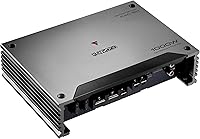
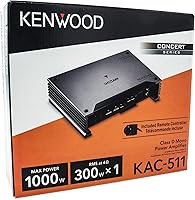
The Kenwood KAC-511 Mono Car Amplifier sits squarely in the sweet spot for drivers who want a real bass upgrade without spending serious money. Built around a Class D digital topology, it runs more efficiently than older Class AB designs — meaning less wasted energy and a cooler-running unit overall. Kenwood positions this as an accessible entry point in their amplifier lineup, and at its price tier, that framing holds up. Don't expect competition-level output. What you get is a dependable, compact mono amp that handles everyday bass duties without drama. For most daily drivers, that's exactly the right trade-off.

Features & Benefits

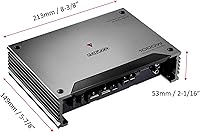
One thing worth getting straight upfront: the 1000W figure is peak, not RMS. Real-world continuous output is lower — typical for this class of amp — so pair it accordingly with a subwoofer rated for realistic continuous wattage. The variable low-pass crossover gives you actual control over the frequency cutoff, which matters when dialing in a sub. The included bass remote is a practical bonus; reaching into the trunk to tweak levels mid-drive gets old fast. At just 8.4 x 5.9 x 2.1 inches, this Kenwood amplifier tucks into tight spaces most competitors cannot. Thermal protection kicks in under heavy load, though it is not a substitute for proper ventilation during installation.

Best For

This mono amp makes the most sense for someone upgrading from a stock head unit for the first time — specifically those running a single subwoofer in a sedan, hatchback, or smaller SUV. Wiring is straightforward enough for a beginner with basic install knowledge and a 4-gauge wire kit. You are not configuring multiple channels or bridging outputs here, which keeps things simple. The built-in bass remote means you do not need to budget for a separate controller. If you are chasing maximum SPL or building a full competition system, look elsewhere. But for daily bass improvement without a complicated setup, the KAC-511 covers the brief cleanly.

User Feedback

Buyers consistently highlight easy installation as a standout quality — the straightforward wiring and included hardware keep the setup accessible even for first-timers. The bass remote earns repeat praise as a convenience feature that genuinely gets used. On the critical side, some owners have noted that real-world output feels modest against the advertised peak wattage, which aligns with typical Class D specs and is worth factoring into your subwoofer pairing decision. Heat buildup during extended loud sessions comes up in a handful of reviews, so ventilation around the unit matters. Long-term reliability reports are generally positive after one year of ownership, though a minority cite early failure — a concern worth noting.

Pros

  • Class D efficiency means the amp runs cooler and draws less current than older amp designs.
  • The included bass remote is a practical, ready-to-use accessory that most competitors charge extra for.
  • Compact dimensions make it easy to mount in tight trunks or under seats where space is limited.
  • Installation is beginner-friendly — straightforward wiring with no complex multi-channel configuration needed.
  • The variable low-pass crossover lets you tune the sub frequency cutoff without external components.
  • Kenwood is a reputable brand with decent long-term reliability at this price tier.
  • Works with a wide range of head units and subwoofers, including common aftermarket setups.
  • At its price point, the overall feature set represents solid value for a first-time amp buyer.

Cons

  • Peak wattage is heavily inflated compared to real-world RMS output — sub pairing requires careful attention.
  • Heat buildup under sustained high-volume use has been flagged by multiple owners.
  • Not suitable for dual-subwoofer or multi-channel configurations without adding a second amp.
  • Mounting ventilation is critical; poor airflow placement can trigger thermal protection cutoffs.
  • A minority of buyers have reported early unit failure, suggesting some quality control inconsistency.
  • No onboard display or signal indicator, making setup and troubleshooting less intuitive for newcomers.
  • Lacks the raw headroom needed for louder, more power-hungry subwoofers above 500W RMS.

Ratings

Our AI scoring system analyzed thousands of verified global reviews for the Kenwood KAC-511 Mono Car Amplifier, actively filtering out incentivized, spam, and bot-generated submissions to surface what real buyers actually experienced. The scores below reflect a balanced picture — genuine strengths are recognized, but recurring pain points are weighted honestly and not smoothed over.

Value for Money
78%
22%
For drivers who want a noticeable bass upgrade without a large outlay, this mono amp delivers a feature set — including a bass remote and variable crossover — that would cost more with most competing brands. Buyers consistently flag it as one of the better-equipped options at its price tier.
Some owners feel the value proposition weakens once they realize the peak wattage figure is heavily inflated relative to actual continuous output. If you factor in the cost of a proper wiring kit, the total spend edges closer to mid-range amp territory where better-spec'd rivals exist.
Ease of Installation
86%
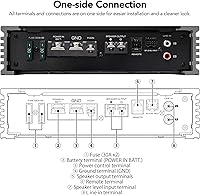
First-time installers repeatedly praise how straightforward the wiring layout is — a single RCA input, clean terminal labeling, and a logical chassis layout make the process accessible even without prior amp experience. The included bass remote also connects without any extra steps.
The manual has been criticized for being thin on detail, particularly around gain setting and crossover tuning, which can leave beginners guessing. A few users also noted the mounting screw positions make flush installation against certain enclosure panels slightly awkward.
Bass Performance
73%
27%
For daily driving — commutes, weekend road trips, casual listening — the KAC-511 produces punchy, satisfying bass that is a clear and immediate improvement over any factory system. Paired with a mid-range 10-inch or 12-inch sub in a ported box, it handles popular music genres well.
Enthusiasts who push the amp hard quickly notice the ceiling. Real-world continuous output falls short of what the peak rating implies, and at higher volumes the bass can lose definition. It is simply not built for the kind of sustained output that competition-oriented or high-SPL setups demand.
Sound Clarity
69%
31%
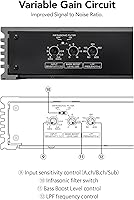
Within its intended operating range, the Class D topology keeps distortion reasonably low, and the variable low-pass crossover helps prevent muddiness by cleanly filtering out unwanted mid-range frequencies before they reach the subwoofer.
Push the gain too high or run it close to its thermal limits and audio quality degrades noticeably. A handful of users report a slight hiss at idle through sensitive subwoofers, which suggests the signal-to-noise ratio is adequate but not exceptional for this price class.
Build Quality
66%
34%
The chassis feels solid enough for daily use, and the hardware connections are tight with no noticeable play in the terminal blocks. For a budget-to-mid-range unit, the physical construction clears a reasonable bar and does not feel disposable.
The overall finish and component feel do not inspire long-term confidence, and a visible minority of reviewers report failure within the first 12 to 18 months. The housing plastic shows scuff marks easily, which matters less functionally but signals the build is optimized for cost over durability.
Thermal Management
61%
39%
Under moderate volume levels and with decent airflow around the unit, the built-in thermal protection keeps the amp running without intervention. For casual daily listening in a well-ventilated trunk install, most users never trigger the protection circuit.
At sustained high volumes or in poorly ventilated mounting locations, heat buildup is a recurring complaint. The thermal cutoff kicks in noticeably during extended loud sessions, which interrupts listening and signals the cooling system has real limits that the product description undersells.
Compact Footprint
89%
At 8.4 x 5.9 x 2.1 inches, this Kenwood amplifier fits comfortably in trunk spaces where larger amps simply would not go — including side-wall mounting on subwoofer boxes in compact sedans and hatchbacks. The light weight makes securing it a one-person job.
The compact size is a genuine advantage for tight installs, but it also means the heat sink surface area is limited, which directly ties back to the thermal management constraints. There is a physical trade-off between small size and sustained thermal performance that buyers should factor in.
Remote Bass Control
84%
The included bass knob is one of the most appreciated features in user feedback — having in-dash or center-console bass adjustment without buying a separate controller is a practical benefit that most competing amps at this price do not offer out of the box.
The remote cable length may fall short for some vehicle layouts, particularly larger cabins or installs where the amp is mounted far from the driver. A small number of users also report the knob feeling loose or developing inconsistent response after several months of use.
Compatibility
82%
18%
The standard RCA input means this amp plays nicely with virtually any aftermarket head unit, and the impedance flexibility covers the most common subwoofer configurations buyers in this segment typically run. Most users report plug-and-play compatibility with popular sub and head unit combinations.
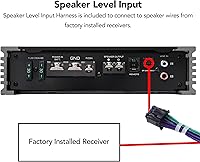
Running it with a factory head unit requires a line output converter, which is an added cost and step that the product listing does not make immediately clear. Users with OEM head units who skipped the LOC reported weak or noisy signal at the amp input.
Long-Term Reliability
63%
37%
The majority of buyers who use the amp at reasonable volumes in properly ventilated installs report solid performance after a year or more of regular daily use. Kenwood's brand reputation provides some confidence that warranty support is accessible if issues arise.
A meaningful minority of reviews describe failures before the 18-month mark, which is a concern for a product positioned as a dependable daily driver. Failure modes tend to cluster around thermal stress, suggesting that installation quality and mounting environment significantly influence lifespan.
Crossover Flexibility
74%
26%
Having a variable low-pass crossover built into the amp removes the need for an external crossover component, which simplifies the signal chain and keeps the install cleaner. The adjustment range covers the typical 50Hz to 125Hz window that most single-sub setups require.
The crossover control itself lacks precise markings, making it difficult to set a repeatable, accurate cutoff frequency by feel alone. Users who want tight control over their crossover point — particularly when integrating with a tuned ported enclosure — may find the implementation imprecise.
Power Accuracy
44%
56%
The amp does deliver usable power output sufficient for moderate subwoofer loads, and for buyers with realistic expectations about budget-class wattage, the real-world output is adequate for casual daily bass enhancement.
The gap between the advertised 1000W peak figure and actual RMS output is one of the most commonly flagged complaints across reviews. This is an industry-wide practice, but the discrepancy here is pronounced enough that buyers who chose the amp based on headline wattage frequently feel misled after install.
Package Contents
81%
19%
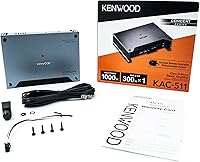
Including the bass remote in the box is a meaningful value-add that buyers notice and appreciate. The unit arrives ready for a basic install without requiring immediate additional purchases beyond a wiring kit, which keeps the total out-of-pocket cost predictable.
There is no wiring kit included, which is standard for amps at this tier but still catches some first-time buyers off guard. The documentation in the box is minimal, and new installers often have to rely on third-party video tutorials to confidently complete the setup.

Suitable for:

The Kenwood KAC-511 Mono Car Amplifier is a strong fit for drivers who are done tolerating flat, lifeless bass from a factory stereo and want a meaningful upgrade without committing to a full custom audio build. It works best in single-subwoofer setups — think a 10-inch or 12-inch sub mounted in a sealed or ported enclosure in the trunk of a sedan, hatchback, or compact SUV. Beginner installers will appreciate that the wiring demands are uncomplicated: a standard 4-gauge amp kit, a single RCA input from the head unit, and you are most of the way there. The included bass remote is a genuine convenience that removes the need to source an aftermarket controller separately. If your goal is noticeably better low-end for daily commutes and weekend drives without overthinking the technical side, this mono amp punches at the right weight class for the money.

Not suitable for:

The Kenwood KAC-511 Mono Car Amplifier is not the right tool if you are building a serious sound system or chasing high SPL numbers. The advertised 1000W figure is peak power — actual RMS output is considerably lower, which means demanding subwoofer setups or anything requiring sustained high wattage will leave you underwhelmed. It is a single-channel mono design only, so if you need to power full-range speakers or run multiple subs from one amp, look elsewhere. Users who plan to run the system at high volume for extended periods should know that thermal throttling is a real possibility if the unit is mounted in a confined, poorly ventilated space. Audiophiles and enthusiasts with higher-grade components will likely outgrow this amp quickly and would be better served by stepping up to a unit with verified RMS specs and more headroom.

Specifications

  • Model Number: The official model designation for this unit is KAC-511, manufactured by Kenwood.
  • Amplifier Class: This amplifier uses a Class D digital topology, which offers higher efficiency and lower heat output compared to traditional Class AB designs.
  • Max Power Output: Peak power output is rated at 1000W mono; real-world continuous RMS output will be substantially lower, as is standard for Class D amps at this tier.
  • Channel Config: This is a single-channel mono amplifier, designed specifically to drive one subwoofer or a bridged subwoofer load.
  • Dimensions: The chassis measures 8.4 x 5.9 x 2.1 inches, making it compact enough for trunk floors or under-seat mounting locations.
  • Weight: The unit weighs 4.19 lbs, which is light enough for flexible placement without requiring heavy-duty mounting hardware.
  • Supply Voltage: Designed to operate on a standard 12V DC vehicle electrical system, compatible with virtually all passenger cars and light trucks.
  • Mounting Type: Surface mount installation is the intended method, typically secured to a flat panel or enclosure side wall with included hardware.
  • Low-Pass Crossover: A variable low-pass crossover is built in, allowing the user to set the frequency cutoff point so only bass frequencies are sent to the subwoofer.
  • Bass Remote: A wired bass knob remote is included in the box, enabling real-time bass level adjustment from the driver seat without reaching the amp.
  • Thermal Protection: An integrated thermal management system monitors internal temperature and protects the unit from damage during high-power or extended playback sessions.
  • Input Compatibility: The amp accepts a standard RCA input signal and is compatible with most aftermarket and OEM head units that provide a preamp output.
  • Impedance Load: The KAC-511 is designed to work with common subwoofer impedance loads; consult the manual for minimum ohm ratings before pairing a sub.
  • Availability Date: This model was first made available to consumers in March 2020 and remains an active product in the Kenwood lineup.
  • Manufacturer: Kenwood is a well-established Japanese consumer electronics brand with decades of experience in car audio amplification products.

Related Reviews
Kenwood KAC-D5101 Mono Amplifier
85%
91%
Bass Performance
85%
Ease of Installation
89%
Power Output
87%
Build Quality
88%
Compact Design
More
Kenwood KAC-314 4-Channel Car Amplifier
76%
84%
Value for Money
73%
Sound Quality
67%
Power Output
88%
Installation Ease
91%
Compact Form Factor
More
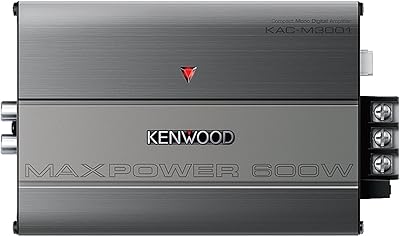
Kenwood KAC-M3001 Amplifier
87%
88%
Power Output
92%
Build Quality
91%
Ease of Installation
85%
Efficiency
89%
Size and Portability
More
Rockville dB15 Mono Car Amplifier
73%
83%
Value for Money
78%
Bass Output
86%
Ease of Installation
61%
Thermal Management
58%
Power Accuracy
More
Rockville dB14 Mono Class-D Car Amplifier
74%
83%
Value for Money
78%
Power Accuracy
67%
Build Quality
54%
Long-Term Reliability
86%
Ease of Installation
More
Rockville dB11 1400W Mono Car Amplifier
85%
93%
Bass Performance
70%
Ease of Installation
89%
Compact Design
91%
Sound Clarity
85%
Build Quality
More
Rockville dB16 Mono Car Amplifier
73%
83%
Bass Output
78%
Value for Money
81%
Ease of Installation
59%
Thermal Management
62%
Power Accuracy
More
Rockville RVA-M2 Mono Car Amplifier
78%
83%
Value for Money
88%
Power Accuracy
71%
Build Quality
79%
Thermal Management
84%
Filter & Tuning Controls
More
Rockville dB13 Mono Car Amplifier
75%
83%
Value for Money
54%
Power Output Accuracy
61%
Thermal Management
88%
Ease of Installation
79%
Onboard Sound Controls
More
Rockville dBcomp4 3000W Mono Car Amplifier
85%
94%
Power Output
91%
Bass Performance
87%
Ease of Installation
89%
Build Quality
67%
Thermal Management
More

FAQ

For an amp in this power class, a 4-gauge wiring kit is the standard recommendation and will handle the current draw without voltage drop issues. Most pre-packaged 4-gauge amp kits include the power cable, ground wire, RCA cables, and a fuse holder, which covers everything you need for a clean install.

The 1000W figure is peak power, which represents the maximum the amp can handle in short burst conditions. Continuous RMS output — the number that actually matters for day-to-day use and subwoofer pairing — is considerably lower. Kenwood does not prominently advertise the RMS spec on the retail listing, so check the product manual or spec sheet for the verified continuous wattage before choosing a subwoofer.

It can work with a factory head unit, but you may need a line output converter (LOC) if your stock stereo does not have dedicated RCA preamp outputs. Most aftermarket head units will connect directly via standard RCA cables with no adapter needed.

The remote connects via a small dedicated port on the amp chassis, usually labeled as a remote level or bass control input. Run the included cable from the amp to a convenient location in the cabin — under the dash or near the center console — and secure it in place. No additional wiring beyond the included cable is required.

No, this is a mono single-channel amplifier designed specifically for subwoofer use. If you want to power full-range speakers, you would need a separate multi-channel amp for that purpose.

Yes, this mono amp pairs fine with both sealed and ported enclosures. A ported box will generally produce louder, punchier bass at the expense of some tightness, while a sealed box gives you more controlled, accurate low-end. The choice comes down to your personal listening preference more than any limitation of the amp itself.

Like most Class D amps, it stays relatively cool under moderate listening levels. At sustained high volume, some heat buildup is normal and expected. The built-in thermal protection will throttle or cut output if temperatures get too high, so make sure the unit has adequate airflow around it — do not mount it flush against carpet or inside a completely enclosed space.

Many subwoofers in this price range are wired or wirable to 2 ohms, and Class D mono amps like this one commonly support 2-ohm loads. That said, always confirm the minimum stable impedance in the product manual before connecting, as running below the rated minimum can damage the amp.

At roughly 8.4 x 5.9 x 2.1 inches, it is genuinely compact for a mono subwoofer amp. It will fit comfortably on the floor of most trunk spaces, on the side wall of a subwoofer box, or in many under-seat locations in hatchbacks and smaller sedans.

The majority of long-term owners report solid reliability after a year or more of regular use. A smaller portion of reviews mention early failures, which is not unusual for budget-to-mid-range electronics. For everyday driving at reasonable volume levels, most buyers get consistent performance without issues — just avoid running it pinned near max output in a poorly ventilated spot for extended periods.

Where to Buy