Overview

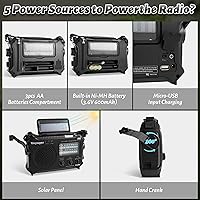
The Kaito KA500 Emergency Weather Radio has been a staple in the preparedness community since Kaito — a brand building reliable emergency radios since the early 2000s — first introduced it. What sets this emergency radio apart isn't any single feature; it's the sheer number of ways it can stay powered when everything else goes dark. Six independent power sources put it in rare company at its price tier, sitting comfortably between bare-bones budget units and expensive professional gear. For anyone who has sat through a hurricane or a multi-day blackout wondering how to get updates, multi-power redundancy isn't a luxury — it's the whole point.

Features & Benefits

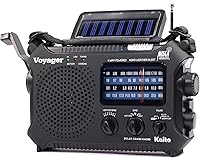
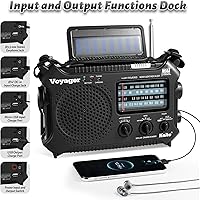
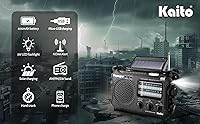
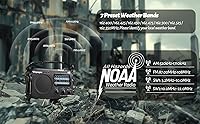
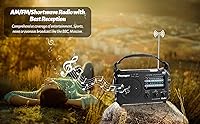
The KA500 pulls in AM, FM, shortwave, and all seven NOAA weather channels, and the PEAS alert system means it can sound an alarm during severe weather bulletins even if the volume is low. The built-in USB output is a quiet hero: when the grid is down and your phone battery is fading, this hand-crank weather radio can give it a charge. Extend the 14.5-inch telescopic antenna, watch the LED signal strength indicator, and you can dial in stations with real precision. The lighting suite — reading lamp, LED flashlight, and a red SOS beacon light — rounds out what amounts to a compact survival toolkit inside a water-resistant shell.

Best For

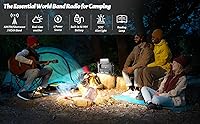
This emergency radio fits most naturally into the hands of anyone who takes preparedness seriously — households assembling go-bags, campers and overlanders who spend nights far from cell service, and people in regions where severe weather is a seasonal reality. Seniors and non-tech users tend to respond well to it because there is no subscription, no app, and no complicated setup: tune, crank, and listen. It is also a solid pick for anyone who lived through an extended outage and promised themselves they would be better equipped next time. One important caveat: the NOAA alert function covers USA and Canada only, so international travelers should not factor it into their plans.

User Feedback

With a 4.5-star average drawn from over 13,000 ratings, the KA500 has earned its reputation through years of real-world use, not just launch-day enthusiasm. Owners consistently praise the speaker volume and clarity and the peace of mind that comes from having so many power fallbacks. The honest criticism? The hand crank is slow — most experienced users treat it as a last resort rather than a routine charging method, which is a fair and realistic expectation to set. Some reviewers note that shortwave reception varies depending on location and antenna positioning. There are also scattered long-term reports of the NiMH battery pack losing capacity after a few years, though that issue is common across rechargeable devices in this class.

Pros

  • Six independent power sources mean the KA500 almost never leaves you without options, even in prolonged outages.
  • Full NOAA weather band coverage with PEAS alerts can wake you up to severe weather warnings automatically.
  • The built-in USB output is a practical lifesaver when your phone battery dies and the grid is down.
  • A loud, clear built-in speaker performs well even outdoors, where tinny audio is a common complaint on budget radios.
  • The combined lighting suite — reading lamp, flashlight, and SOS beacon — reduces how much gear you need to pack separately.
  • At its price point, the breadth of features is genuinely hard to match from competing brands.
  • Water-resistant and impact-resistant housing means it holds up to the kind of rough handling emergency scenarios actually involve.
  • The LED signal strength indicator takes the guesswork out of antenna positioning, which most radios in this class skip entirely.
  • Over 13,000 ratings averaging 4.5 stars signals durable, long-term satisfaction rather than a short burst of launch-day hype.
  • Compact dimensions and a weight just over a pound make it easy to store in a go-bag without sacrificing space.

Cons

  • The hand crank charges the battery very slowly — treating it as a primary power source will leave you disappointed.
  • NiMH battery pack capacity tends to degrade noticeably after a few years, and replacements add to the total cost of ownership.
  • Shortwave reception can be inconsistent depending on your geographic location and how carefully you position the antenna.
  • The wall power adapter is sold separately, which feels like an oversight given how often buyers will use AC power at home.
  • The retro aesthetic appeals to some but may feel dated to buyers who prefer modern industrial design.
  • No digital display or preset station memory means manually retuning every time you power it on, which gets tedious.
  • Solar charging is useful in direct sunlight but impractically slow in cloudy conditions or indoors near a window.
  • The USB output charges devices, but output is slow by modern standards and unsuitable for larger tablets or newer fast-charge phones.

Ratings

The Kaito KA500 Emergency Weather Radio earned its scores through AI analysis of thousands of verified global buyer reviews, with spam, bot-generated, and incentivized feedback actively filtered out. Ratings reflect the full picture — what this hand-crank weather radio genuinely excels at and where real owners have run into frustration. Every category below is scored to surface the honest trade-offs that matter most when making a buying decision.

Power Versatility
93%
Six independent power sources is the feature buyers mention most when recommending this emergency radio to friends and family. Knowing you can switch between solar, crank, AA batteries, a rechargeable pack, USB input, or a wall adapter means the device almost never goes dark — a reassurance that becomes very real during multi-day outages.
While the breadth of options is impressive, not all six are equally practical. Solar charges slowly in anything less than direct sunlight, and the hand crank is more of a last-resort lifeline than a convenient daily method, which surprises buyers who expected faster results.
NOAA Weather Alerts
91%
The PEAS alert system performs reliably, waking users to severe weather broadcasts even when the radio is sitting quietly in a corner at low volume. For households in storm-prone regions, this is the single most valuable function — and it works exactly as advertised across all seven NOAA channels.
Coverage is strictly limited to the United States and Canada, which has frustrated international buyers and travelers who did not realize the limitation before purchasing. There is no workaround; outside North America, the automated alert system simply does not operate.
Build Quality
78%
22%
The ABS housing feels noticeably more solid than cheaper emergency radios in the same category, and long-term owners consistently report units surviving years of storage, occasional drops, and outdoor use without cracking or degrading. The water resistance holds up well against rain and splashes.
It does not feel like premium hardware up close — the dials and buttons have some play in them, and the retro plastic aesthetic can read as dated compared to more modern competitors. A few reviewers noted that the telescopic antenna feels slightly fragile if handled carelessly.
Audio Quality
84%
The built-in speaker is consistently praised for its volume and clarity, especially relative to the unit's size. Buyers camping outdoors note they can hear weather broadcasts clearly even with moderate wind noise, which is a practical edge over smaller, tinnier emergency radios.
Bass response is limited and at maximum volume some distortion creeps in, particularly on AM stations with strong local signals. It is a mono speaker by design, so anyone expecting rich sound quality for casual music listening will find it functional but not satisfying.
Hand Crank Efficiency
47%
53%
The crank works as a genuine emergency fallback — if every other power source is exhausted, a few minutes of cranking will get you enough juice to catch a weather bulletin or make a short phone call. That is genuinely useful when nothing else is available.
Charging via crank is slow to the point that many owners describe it as frustrating in practice. Multiple minutes of sustained cranking typically yield only a few minutes of use, and trying to charge a smartphone this way is nearly futile. Buyers who expect the crank to be a primary power method are regularly disappointed.
Reception & Tuning
76%
24%
The LED signal strength indicator is a thoughtful touch that helps users dial in stations without guesswork, and when the 14.5-inch telescopic antenna is properly extended and oriented, AM and FM reception is clear and stable even in rural areas with weak signals.
Shortwave performance is inconsistent — location, antenna positioning, and local interference all affect results noticeably. Buyers in urban areas sometimes report FM interference, and shortwave sensitivity falls short of what a dedicated shortwave receiver would deliver at a similar price point.
USB Charging Output
68%
32%
Having a 5V USB output port on an emergency radio is genuinely useful, and multiple reviewers have credited it with keeping a phone alive long enough to contact family after a disaster. It works with smartphones, GPS units, and small cameras without any additional accessories.
The output is slow by modern standards — nowhere near fast-charge speeds — and it struggles to keep up with the power draw of larger or newer smartphones during active use. Buyers expecting it to replace a quality power bank will be underwhelmed.
Lighting Suite
82%
18%
Having three distinct lighting modes — a reading lamp, a directional flashlight, and an SOS beacon — in one compact device is a real advantage when assembling a go-bag. Buyers who have used it during blackouts mention the reading lamp in particular as more useful than expected for navigating a dark home.
The flashlight beam is adequate but not powerful enough to replace a dedicated torch for trail navigation or extended outdoor use. LED brightness is not adjustable, so the reading lamp can feel either too dim for focused tasks or unnecessarily bright in a dark tent.
Ease of Use
89%
Physical controls, no apps, no Wi-Fi setup, and no subscription requirements make this one of the most accessible emergency radios available. Seniors and first-time buyers in particular consistently rate setup and daily operation as intuitive, with a short learning curve even for users unfamiliar with shortwave or multi-band radios.
The lack of digital preset memory means manually retuning every time the radio is powered on, which regular listeners find tedious. The owner's manual has also drawn complaints for being sparse on troubleshooting guidance, leaving some buyers uncertain about optimizing shortwave reception.
Portability
86%
At 1.25 pounds and compact enough to fit inside a standard go-bag, the KA500 hits a practical size-to-feature ratio that few competitors match. Hikers and campers specifically value that it consolidates radio, lighting, and emergency charging into a form factor that does not dominate pack space.
It is not truly pocket-sized, and the telescopic antenna adds fragility to an otherwise rugged package when the radio is being carried or stored in a crowded bag. Users who want something truly ultralight for minimalist camping setups may find it slightly bulky.
Battery Longevity
61%
39%
When fully charged via AC adapter or USB input, the internal NiMH pack provides a reasonable number of hours of radio playback, and the AA battery fallback extends that considerably. For short-term emergencies lasting a few days, most users report having adequate power available.
The NiMH pack is the most frequently cited long-term disappointment — capacity degrades visibly after a few years of regular use, and some owners report significant reduction in runtime within two to three years. Replacement packs are available but not prominently stocked, making the process more involved than it should be.
Value for Money
88%
Across more than 13,000 ratings, buyers consistently describe the KA500 as one of the best-value emergency radios at its price tier, citing the combination of multi-band reception, six power sources, USB output, and lighting as genuinely difficult to replicate without spending significantly more.
The value equation depends on your expectations — if you factor in the eventual NiMH battery replacement cost and the separately sold AC adapter, the all-in cost is a bit higher than the initial price suggests. Budget buyers may also find more stripped-down alternatives available for less.
Solar Performance
58%
42%
In strong, direct sunlight the solar panel contributes meaningfully to battery maintenance, and several preparedness-focused buyers specifically appreciate being able to set the radio in a sunny window during fair weather to keep it topped off passively.
Cloud cover or indirect light reduces solar input to near zero, and even in ideal conditions full charging via solar alone takes a very long time. Buyers in northern climates or those who store their radio indoors find the solar panel largely symbolic rather than functional in practice.
Durability Over Time
74%
26%
Many reviewers who have owned the KA500 for three to five years report it still functioning reliably, with the housing holding up well and the core radio functions remaining solid. It is clearly built to last through years of storage and occasional hard use.
Longer-term owners point to the NiMH battery degradation and occasional mechanical loosening of the tuning dial as the most common wear issues. The unit ages reasonably well overall, but it is not immune to the kind of gradual deterioration that affects most consumer electronics after several years.

Suitable for:

The Kaito KA500 Emergency Weather Radio was built for people who take preparedness seriously and want a single device that covers communication, weather alerts, and basic lighting without depending on a working power grid. Households in hurricane corridors, tornado alleys, or wildfire-prone regions will get the most out of it — particularly those assembling go-bags or stocking a shelter with supplies that need to work years from now without maintenance. Campers, hikers, and overlanders also find it a natural fit: it is compact enough to pack, rugged enough to handle outdoor conditions, and useful enough to replace several single-purpose items. Seniors and non-tech users tend to appreciate the straightforward physical controls and the fact that there are no accounts, subscriptions, or apps involved. If you have already lived through one extended blackout and want to be better prepared for the next one, this emergency radio checks most of the boxes without requiring a large investment.

Not suitable for:

The Kaito KA500 Emergency Weather Radio is not the right tool for every situation, and being clear about that saves frustration later. Buyers outside the United States and Canada will get no value from the NOAA weather alert function — that system simply does not operate elsewhere, so international users or frequent travelers abroad should factor that in before purchasing. Shortwave enthusiasts who prioritize signal sensitivity and fine-tuning precision may find the KA500 adequate but not exceptional; a dedicated shortwave receiver will outperform it in that specific discipline. Anyone expecting to rely primarily on the hand crank for regular, sustained power should recalibrate those expectations — the crank is a genuine emergency fallback, not an efficient daily charging method. Long-term buyers should also be aware that the NiMH battery pack will likely degrade over several years of use, eventually requiring replacement, which adds a modest ownership cost down the line.

Specifications

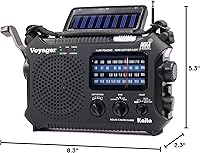
  • Dimensions: The unit measures 8.3″ long by 2.3″ wide by 5.3″ tall, making it compact enough to fit inside most go-bags.
  • Weight: At 1.25 pounds, the KA500 is light enough to carry on extended outdoor trips without adding meaningful burden.
  • Power Sources: Six independent power methods are supported: solar panel, hand crank dynamo, 3 AA batteries, built-in NiMH rechargeable pack, 5V USB input, and AC/DC wall adapter input.
  • Radio Bands: Receives AM, FM, 2-band shortwave, and all 7 pre-programmed NOAA weather channels for comprehensive domestic and international coverage.
  • Alert System: Equipped with PEAS (Public Emergency Alert System) support for automatic severe weather notifications across USA and Canada.
  • USB Output: A standard 5V DC USB output port allows the unit to charge mobile devices including smartphones, GPS units, and MP3 players during outages.
  • Antenna: A telescopic antenna extends up to 14.5″ and is paired with an LED signal strength indicator for accurate manual tuning.
  • Lighting: Includes a 5-LED reading lamp, a forward-facing LED flashlight, and a red LED SOS beacon light for emergency signaling.
  • Housing Material: Constructed from impact-resistant and water-resistant ABS plastic, suitable for both indoor storage and outdoor field use.
  • Battery Type: Uses a built-in NiMH rechargeable battery pack that is described as replaceable, supplemented by 3 AA batteries as a separate backup option.
  • Speaker: Features a built-in mono speaker tuned for loud, clear audio reproduction, which users note performs well even in outdoor environments.
  • Design Style: Styled in a retro form factor with physical tuning controls and a black finish, prioritizing function and durability over modern aesthetics.
  • Manufacturer: Designed and sold under the Kaito brand, manufactured by Hisonic International, Inc., a company with a long history in portable emergency radio products.
  • Model Number: The official model designation is KA500BLK, corresponding to the black color variant of the KA500 series.
  • Connectivity: Offers USB connectivity for both power input (charging the internal battery) and power output (charging external devices).

Related Reviews
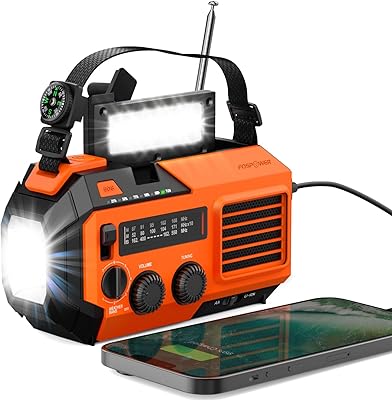
Roxicosly CR1009Ultra 12000mAh Emergency Weather Radio
74%
88%
Battery Life
91%
Charging Versatility
86%
NOAA Alert Performance
58%
Hand Crank Durability
44%
Solar Charging Speed
More
QAUYYW Emergency Weather Radio XSY330
86%
89%
Battery Life
85%
Ease of Use
92%
Portability
75%
Radio Reception
88%
Build Quality
More
TFTDOUP Emergency Weather Alert Radio
86%
88%
Overall Performance
85%
Battery Life
90%
Charging Options
80%
Ease of Use
87%
Build Quality
More
OnLyee CR1030 Emergency Weather Radio
76%
88%
Power Source Redundancy
83%
Hand Crank Durability
61%
Solar Charging Performance
79%
NOAA Reception Quality
67%
Battery Capacity & Phone Charging
More
Sttfaishen F20 Emergency Hand Crank Weather Radio
72%
82%
NOAA Alert Reception
54%
Battery Capacity & Honesty
61%
Hand Crank Usability
57%
Solar Charging Performance
83%
USB-C Charging Speed
More
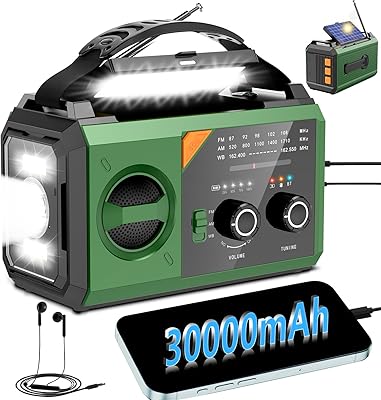
FosPower A6 5200mAh Emergency Weather Radio
77%
91%
NOAA Reception
84%
Build Quality
67%
Power Bank Utility
53%
Hand Crank Efficiency
49%
Solar Charging
More
RAOUOEN 30000mAh Emergency Weather Radio
85%
89%
Battery Life & Charging
91%
Performance in Emergencies
75%
Portability & Weight
84%
Sound Quality & Reception
87%
Ease of Use
More
Lanshanchu XG-098 Emergency Weather Radio
86%
95%
Battery Life & Charging Options
92%
NOAA Alert Accuracy
89%
Radio Reception Quality
88%
Portability & Size
90%
LED Flashlight & SOS Function
More
MangePagar MA-091 4000mAh Emergency Weather Radio
75%
88%
Value for Money
82%
NOAA Reception Quality
84%
Battery Capacity & Runtime
61%
Hand Crank Charging
57%
Solar Charging Performance
More
Midland ER210 Emergency Weather Radio
75%
91%
NOAA Reception Quality
83%
Power Source Versatility
78%
Battery Life
89%
Ease of Use
67%
Flashlight Performance
More

FAQ

Yes, the PEAS alert function is designed to trigger an audible alarm even when the volume is turned down, as long as the radio is powered on and set to a NOAA weather channel. Think of it like a smoke detector for severe weather — it monitors in the background so you do not have to.

Realistically, a long time. Cranking for several minutes typically yields only a few minutes of playback, so most owners use the hand crank strictly as a last resort when no other power source is available. For regular home use, plugging in via USB or the AC adapter is far more practical.

No. The NOAA weather alert system, including the PEAS function on the Kaito KA500 Emergency Weather Radio, only operates within the United States and Canada. The radio will still receive AM, FM, and shortwave stations internationally, but the automated emergency alert feature will not function outside North America.

You can, using the built-in 5V USB output port. That said, the output is standard 5V and relatively slow by current smartphone standards — do not expect fast-charging speeds. It is best thought of as a trickle-charge option during emergencies rather than a replacement for a dedicated power bank.

The housing is made from water-resistant and impact-resistant ABS plastic, so it can handle splashes, rain, and the occasional drop without issue. It is not submersible or waterproof in any rated sense, so do not submerge it or leave it sitting in standing water.

It works best in direct outdoor sunlight. Charging through glass indoors is possible but noticeably slower due to UV filtering in most window glass. On overcast days, solar output drops significantly regardless of whether you are indoors or outdoors.

The product listing notes that 3 AA batteries are required, and some listings indicate they are included — but this has varied over time. It is worth keeping a set on hand just in case, since AA batteries are one of the six power fallbacks and worth having available immediately.

Yes, the built-in NiMH pack is described as replaceable. Several long-term owners have noted the pack loses capacity after a few years of regular use, which is normal for NiMH chemistry. Replacement packs compatible with the KA500 are available from third-party sellers, though Kaito does not prominently sell them through official retail channels.

For occasional international listening and emergency broadcasts, the shortwave reception is adequate. For serious shortwave enthusiasts who want to pull in weak or distant signals with consistency, it will feel limited. Reception quality also varies depending on your location and how carefully you extend and orient the telescopic antenna.

It is actually one of the better options for that profile. The controls are physical dials and buttons — no apps, no Wi-Fi setup, no accounts required. Tune to a NOAA channel, leave it powered on, and it will alert you if severe weather is incoming. Seniors and first-time emergency radio buyers consistently rate the ease of use as one of the KA500s strongest qualities.

Where to Buy