Overview

The Joemnwart 3000W 24V Pure Sine Wave Inverter entered the market in late 2024 as a mid-range option aimed at RV owners, truck drivers, and off-grid users who need dependable AC power without spending on a top-tier brand. It delivers 3000W continuous power with a 6000W surge capacity — numbers that look solid on paper. With 107 ratings averaging 4.3 stars, there is enough data to draw some meaningful conclusions, though the sample is still relatively small for a product this new. Joemnwart is not a household name in the inverter world, so real-world performance matters more here than brand recognition alone.
Features & Benefits

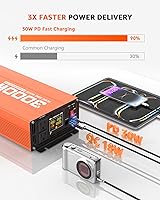
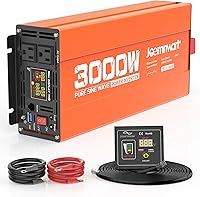
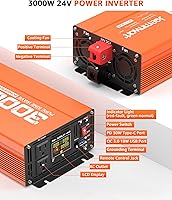
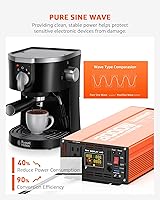
What sets this 24V inverter apart from cheaper modified sine wave alternatives is the quality of its output. Pure sine wave power matters when you are running a CPAP machine overnight, charging a laptop, or driving any device with a motor — modified sine wave can cause buzzing, heat buildup, or outright damage over time. The unit pairs dual AC outlets with two USB ports, including QC3.0 and PD 30W for fast charging across multiple devices. A six-layer safety system covers overload, overheating, short circuit, and reverse polarity. The fan only activates above 45°C or at higher load levels, so it runs quietly during everyday light use.

Best For

This pure sine wave unit is a strong candidate for RV travelers who want to run a coffee maker, small microwave, or medical device without dragging along a gas generator. Truck drivers with a 24V electrical system will find it a practical fit for in-cab appliances or personal electronics. It also suits off-grid solar setups where a clean sine wave is non-negotiable for load-sensitive equipment. That said, be upfront about who this is not for: if your vehicle runs on a 12V system, this unit simply will not work, and anyone needing 240V output for international appliances should look elsewhere.

User Feedback

Across its 107 reviews, this power inverter holds a 4.3-star average — solid, though worth contextualizing given how recently it launched. Buyers frequently highlight easy installation and note that the power output feels genuinely clean, with no audible buzzing or interference on connected devices. The quiet fan behavior draws particular praise from RV users. On the other side, a handful of reviewers question whether the unit truly sustains its rated wattage under prolonged heavy load, and a few mention wanting faster customer support responses. For a newer brand, early reception is largely encouraging — but the review pool needs another year before anyone can draw firm long-term reliability conclusions.

Pros

  • Pure sine wave output is safe for sensitive devices like CPAP machines, laptops, and variable-speed appliances.
  • The 6000W surge capacity handles motor-driven appliances like refrigerators and power tools at startup.
  • Dual USB ports with QC3.0 and PD 30W mean you can fast-charge phones and tablets alongside AC devices.
  • The fan stays off during light loads, keeping noise levels low for sleeping areas or quiet cab environments.
  • Aluminum casing dissipates heat effectively and holds up better than plastic housings in rugged or mobile use.
  • Six-layer safety protection — including reverse polarity and short circuit safeguards — reduces risk during installation and daily use.
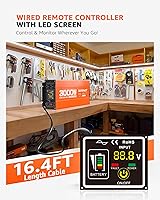
  • Wired remote control is a genuine convenience for users who mount the inverter out of easy reach.
  • The package includes battery cables, grounding wire, spare fuses, and a wrench, so most users can get set up without a separate hardware run.
  • At its price point, getting 3000W of pure sine wave output with fast-charging USB ports represents strong value for budget-conscious buyers.
  • Early user feedback consistently praises clean power output and straightforward installation.

Cons

  • Joemnwart is a newer brand with a limited long-term reliability track record, which adds some uncertainty for risk-averse buyers.
  • Only 107 reviews are available so far, making it harder to identify patterns in durability or failure rates over time.
  • Some reviewers question whether the unit truly sustains its full rated output under continuous heavy load, which is worth investigating for demanding applications.
  • Customer support responsiveness has been flagged as inconsistent by a portion of early buyers.
  • The 24V input requirement immediately disqualifies this inverter for the majority of standard 12V vehicle setups.
  • At 11.43 pounds and nearly 20 inches long, this is not a compact unit and may be awkward to mount in tighter spaces.
  • The 12-month warranty is on the shorter end compared to some established inverter brands that offer two or more years.
  • No USB-C output port is included — the PD 30W port is USB-A, which may disappoint users with newer devices that rely on USB-C cables.

Ratings

Our AI scoring system analyzed verified buyer reviews for the Joemnwart 3000W 24V Pure Sine Wave Inverter sourced from multiple global marketplaces, actively filtering out incentivized, bot-generated, and repetitive low-quality feedback to ensure only genuine ownership experiences shape the scores. Each category below reflects both what real users have praised and the friction points they have run into during actual day-to-day use. Scores are benchmarked against comparable inverters in the same power and price class, so they represent relative performance rather than an idealized standard.
Waveform Quality
88%
Buyers running CPAP machines, audio equipment, and sensitive chargers consistently report zero interference or buzzing, which is exactly the point of pure sine wave output. In RV and off-grid contexts where grid-quality power is critical, this unit holds up well against inverters that cost significantly more.
A handful of users noted minor fluctuations under loads approaching the upper capacity limit, though this is not uncommon in this price class. The unit does not publish a total harmonic distortion percentage, making it difficult to independently benchmark waveform precision against a stated spec.
Power Output Accuracy
74%
26%
For everyday loads — laptops, televisions, coffee makers, and small appliances — the inverter handles tasks without complaint, and the 6000W peak rating provides real headroom when motor-driven devices need a startup surge. Most buyers in typical use cases report no unpleasant surprises from the power delivery.
Sustained output near the 3000W ceiling is where some reviewers express doubt, with a recurring thread questioning whether the unit holds its rating under prolonged heavy demand. Without third-party testing data available, buyers planning to push close to capacity regularly are taking some degree of risk on that claim.
Build Quality
72%
28%
The aluminum alloy casing is a genuine step above plastic-housed competitors at this price, providing better heat transfer and resistance to the knocks and vibrations common in truck cabs or RV storage bays. Most buyers report the unit feels solid and well-assembled straight out of the box.
A portion of reviews flag concerns about long-term build quality, particularly around connector points and internal components that have not yet been stress-tested across multiple years of continuous use. As a newer brand with limited long-term feedback, durability beyond the first year remains a genuinely open question.
Value for Money
83%
Getting 3000W of pure sine wave output paired with dual fast-charging USB ports, a wired remote, and a six-protection safety system at this price point is a genuinely competitive offer compared to similarly specified units from better-known brands. For budget-conscious buyers who have done their research, the spec-to-dollar ratio is difficult to argue with.
The value proposition depends heavily on the unit performing as advertised over time, which is still uncertain given how recently it launched. If real-world sustained wattage falls consistently short of 3000W or reliability degrades after the first year, the initial savings start to look less compelling against the cost of an early replacement.
Noise Level
86%
The temperature-triggered fan is one of the most consistently praised design choices in buyer feedback — during light to moderate use, the inverter stays completely silent, which RV users and anyone operating near a sleeping area find genuinely useful. The fan-off behavior under low load is reliable and well-executed.
Under heavier loads or in warmer ambient conditions, the fan does spin up and can be audible in quiet environments, with some buyers finding it louder than anticipated at full speed. Mounting the unit in a partially enclosed compartment without adequate airflow can amplify perceived fan noise during sustained high-demand sessions.
Thermal Management
81%
19%
The combination of aluminum casing and an auto-activating cooling fan keeps this power inverter running within safe temperature ranges under most real-world conditions. Users running sustained medium loads in warm climates report no unexpected shutdowns or overheating warnings, suggesting the thermal design is reasonably well-calibrated for its intended applications.
In high-ambient-temperature environments — a sun-baked storage compartment in summer, for instance — a few users report the fan cycling more aggressively or the unit entering thermal protection mode earlier than expected. Adequate ventilation around the unit is not optional; it is essential to maintaining rated performance under heat stress.
Safety Protection
84%
The six-layer protection system addresses the most common failure modes in real-world DC-to-AC power conversion, and buyers who made wiring errors during installation specifically credit the reverse polarity protection with saving the unit from damage. That kind of practical safety margin matters in mobile or DIY installation contexts.
Some users would prefer audible fault alarms or more granular error codes on the LED display to quickly identify which protection has triggered during a shutdown. Diagnosing whether a cutout was caused by overload versus overheating currently requires some guesswork, which adds friction during troubleshooting in the field.
USB Charging Performance
78%
22%
The dual USB configuration — a QC3.0 port and a 30W PD port — charges modern phones and tablets quickly alongside whatever is running through the AC outlets. For truck drivers who need devices topped up during a shift, having fast charging built directly into the inverter removes the need for a separate wall adapter.
The PD port uses a USB-A connector rather than USB-C, meaning users with newer devices that rely on USB-C cables will need a separate adapter to take advantage of the faster charging speed. This omission feels like a missed opportunity given how standard USB-C has become across phones, tablets, and laptops.
Ease of Installation
87%
Buyers across experience levels consistently describe the installation process as manageable, especially given the included battery cables, grounding wire, wrench, spare fuses, and a clearly written manual. The wired remote also makes it straightforward to tuck the unit into a remote location while maintaining accessible on-and-off control.
At nearly 20 inches long and over 11 pounds, this 24V inverter requires deliberate mounting planning — you cannot simply set it on a shelf and expect it to stay put in a moving vehicle. A few buyers also noted the battery cables could be longer for installations where the battery bank is not immediately adjacent to the mounting point.
Remote Control & Display
76%
24%
The wired remote is a practical inclusion that truck and RV users find immediately useful — switching the inverter on or off from a bunk or the driver's seat without physically reaching the unit adds up to real daily convenience. The LED display provides clear at-a-glance status information in dim or bright conditions.
Being wired rather than wireless, the remote adds a cable to manage in already tight installations and limits placement flexibility based on cable length. The LED display handles basic status indicators but does not show real-time wattage draw or input battery voltage, which many experienced off-grid users actively want to monitor during operation.
Brand Reliability & Support
61%
39%
Joemnwart offers a 12-month warranty and appears reachable for standard setup questions, with a portion of early buyers reporting satisfactory support interactions during the initial ownership period. For users with straightforward inquiries, the brand has demonstrated a basic willingness to engage during the warranty window.
With less than a year on the market, Joemnwart has no meaningful long-term reliability history for buyers to evaluate before committing. A recurring pattern in reviews also mentions slower-than-expected customer support responses for more complex technical issues, which is a real concern for anyone depending on this unit in remote or time-sensitive situations.
Long-term Durability
67%
33%
Early indications from buyers who have used this pure sine wave unit through several months of regular RV or truck operation are generally positive, with no widespread reports of premature failure during the initial ownership period. The aluminum construction and thermal design suggest the unit was engineered with longevity as an intention.
The product simply has not been on the market long enough to provide meaningful multi-year durability data, and that gap is a legitimate concern for buyers making a long-term investment in off-grid or vehicle power infrastructure. Waiting another 12 to 18 months for the review pool to grow would offer a much clearer reliability picture.
Package Contents
82%
18%
The included accessories — battery cables, grounding wire, five spare fuses, a wrench, and a wired remote — cover most of what a standard installation requires without an additional hardware run. Having replacement fuses in the box from day one is a practical detail that experienced inverter users will appreciate immediately.
Battery cable length may fall short for installations where the inverter is mounted farther from the battery bank, and some buyers have needed to source longer cables separately after the fact. A USB-C cable or adapter in the box would also have better complemented the 30W PD port given the current charging accessory landscape.

Suitable for:

The Joemnwart 3000W 24V Pure Sine Wave Inverter is a practical fit for anyone who already runs a 24V battery system and needs clean, stable AC power on the go or off the grid. RV owners are perhaps the most obvious match — whether that means powering a CPAP machine through the night, running a small microwave at a campsite, or keeping a mini fridge humming without firing up a noisy generator. Long-haul truck drivers with dual-battery setups will also find real value here, since the wired remote and LED display make operation straightforward from inside a cab. Off-grid solar users who prioritize pure sine wave output for load-sensitive equipment — think variable-speed tools, audio gear, or any device with a switching power supply — will appreciate the waveform quality this unit delivers. It also makes a reasonable home backup inverter for short outages, provided a 24V battery bank is already part of your setup.
Not suitable for:

This pure sine wave unit is a poor match for drivers or vehicle owners whose electrical system runs on 12V — and that covers the majority of standard passenger cars and smaller trucks, so check your setup before ordering. Anyone who needs 240V output for international appliances or specialized equipment will also need to look elsewhere, since this inverter outputs 110V to 120V AC only. Buyers who require a well-established brand with a long track record of documented field reliability may feel uneasy here — Joemnwart is still a relatively new name, and 107 reviews, while encouraging, is not the same as thousands of verified long-term users. If your power demands frequently push toward the 3000W ceiling for extended periods, the uncertainty around sustained wattage performance under continuous heavy load is worth factoring in. Finally, this is not the right choice for anyone who needs a plug-and-play solution without any wiring — proper battery cable connections and basic electrical knowledge are expected.

Specifications

  • Continuous Power: This inverter delivers a sustained 3000W of continuous AC output under normal operating conditions.
  • Peak Surge Power: It handles surge loads of up to 6000W for brief periods, covering the startup draw of motor-driven appliances.
  • Input Voltage: The unit requires a 24V DC input, making it compatible with 24V battery banks and dual-battery truck systems.
  • Output Voltage: AC output is rated at 110V to 120V, matching the standard household voltage used across the United States.
  • Waveform Type: The inverter produces a pure sine wave, which replicates grid-quality AC power suitable for sensitive and variable-speed electronics.
  • AC Outlets: Two standard US-style three-prong AC outlets are built into the unit for powering household appliances and devices.
  • USB Ports: Two USB-A ports are included: one QC3.0 rated at 18W and one Power Delivery port rated at 30W.
  • Efficiency: The inverter achieves up to 90% conversion efficiency from DC input to AC output under optimal load conditions.
  • Fan Activation: The internal cooling fan activates automatically when internal temperature exceeds 45°C or load efficiency exceeds 50%, and stays off otherwise.
  • Casing Material: The outer shell is constructed from aluminum alloy, which aids heat dissipation and adds structural durability for mobile installations.
  • Safety Protection: Six layers of protection are built in, covering overvoltage, undervoltage, overload, overheating, short circuit, and reverse polarity.
  • Dimensions: The unit measures 19.3 × 8.5 × 5.6 inches, which should be accounted for when planning mounting locations in tight spaces.
  • Weight: At 11.43 pounds, this power inverter is substantial enough to require secure mounting rather than loose placement.
  • Package Contents: The box includes the inverter, two battery cables, one wired remote control, one grounding wire, five replacement fuses, a wrench, and a user manual.
  • Warranty: Joemnwart provides a 12-month warranty covering manufacturing defects, backed by their customer service team.
  • Market Availability: The unit was first made available in September 2024, making it a relatively recent addition to the power inverter market.

Related Reviews

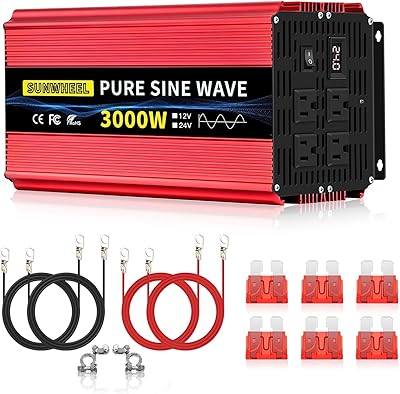
SUNWHEEL 3000W 24V Pure Sine Wave Inverter

78%
88%
Output Power Quality
83%
Value for Money
86%
Ease of Installation
81%
Surge Handling
79%
Noise Level
More
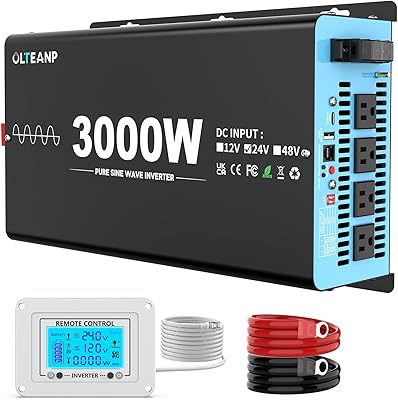
OLTEANP TK-3 3000W Pure Sine Wave Inverter
78%
92%
Power Output Quality
88%
Lithium Battery Compatibility
74%
Build Quality
61%
Fan Noise
86%
LCD Display & Usability
More
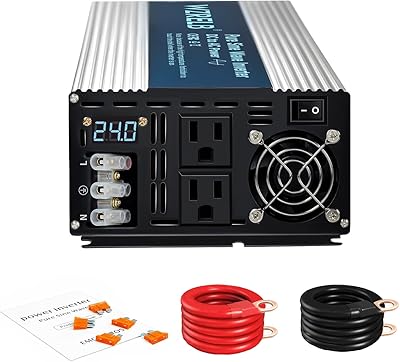
WZRELB 3000W 24V Pure Sine Wave Inverter
76%
91%
Output Power Quality
84%
Build Quality
78%
Thermal Management
61%
Fan Noise
66%
Voltage Display Accuracy
More
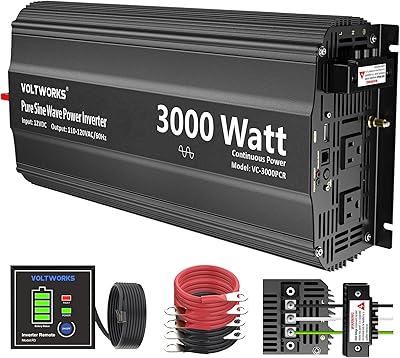
VOLTWORKS VS-3000PCR 3000W Pure Sine Wave Inverter
79%
83%
Output Power Accuracy
91%
Output Signal Quality
88%
Cooling & Noise Level
79%
Build Quality & Housing
86%
Installation Ease
More
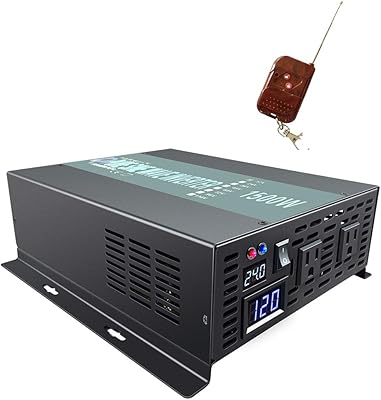
WZRELB 1500W 24V Pure Sine Wave Inverter
73%
88%
Output Power Quality
61%
Reliability & Longevity
84%
Cooling & Noise
82%
Ease of Installation
71%
Remote Control Function
More
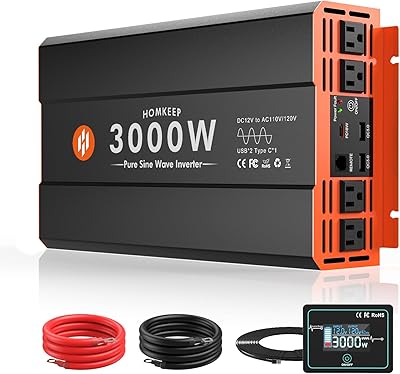
Homkeep 3000W Pure Sine Wave Power Inverter
88%
93%
Power Performance
88%
Ease of Use
90%
Build Quality
85%
Noise Level
91%
Safety Features
More
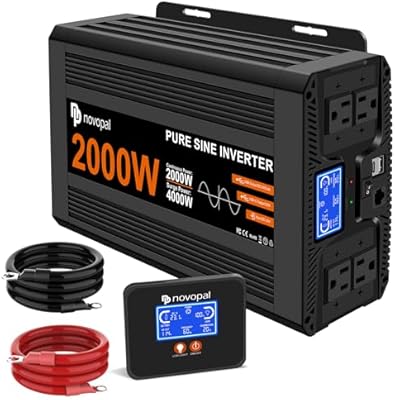
Novopal 2000W 24V Pure Sine Wave Inverter
79%
88%
Power Output Quality
83%
Build Quality
79%
Value for Money
74%
Ease of Installation
81%
Remote Control Functionality
More
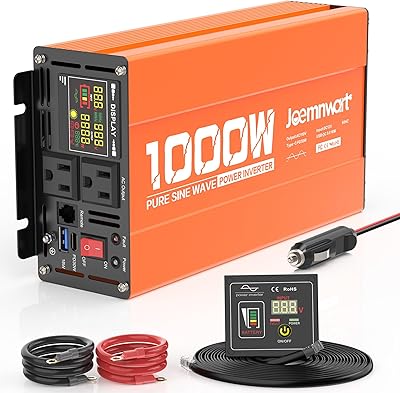
Joemnwart 1000W Pure Sine Wave Power Inverter
79%
88%
Power Output Quality
79%
Build Quality
84%
USB Charging Performance
86%
Safety Protection System
82%
Noise Level
More
LiTime 3000W Pure Sine Wave Inverter Charger
76%
83%
Power Output Accuracy
91%
Sine Wave Quality
79%
UPS Performance
87%
Charging Versatility
74%
Build Quality
More
Joemnwart 1000W Pure Sine Wave Power Inverter
78%
88%
Power Output Quality
76%
Build Quality
91%
USB Charging Speed
84%
Ease of Setup
67%
Noise Level
More

FAQ

It depends on your vehicle's battery system voltage. This inverter requires a 24V DC input, which is common in larger trucks, heavy-duty rigs, and some RV setups — but most standard passenger vehicles and light trucks run on 12V systems. Check your battery bank or consult your vehicle manual before ordering.

Yes, pure sine wave output is specifically what CPAP machines need. Modified sine wave inverters can interfere with CPAP motors and void warranties on some models, but a pure sine wave unit like this one delivers the same waveform quality as wall power, so your machine should run exactly as it would at home.

Yes, but not directly to panels — you connect it to the 24V battery bank that your solar panels charge. The inverter draws from the batteries and converts that stored DC power into usable AC output. Just make sure your battery bank is sized appropriately for the loads you plan to run.

Modified sine wave inverters are cheaper but produce a choppy, stepped waveform that some devices struggle with. You may notice buzzing from audio equipment, heat buildup in some motors, or outright incompatibility with medical devices and certain chargers. Pure sine wave output is a smooth, continuous waveform that virtually every AC device is designed to accept without issue.

During light to moderate loads, the fan does not run at all — it only kicks in when internal temperature climbs above 45°C or when the unit is running above 50% of its capacity. Most users running everyday electronics report that the inverter is very quiet during typical use, which is a meaningful advantage in sleeping areas or quiet cab environments.

A standard compact microwave (around 700W to 1000W) is within the continuous power budget, so that should be fine. A small window air conditioner is trickier — the startup surge can spike well above 3000W, and while the 6000W peak rating is meant to handle that, sustained cooling loads near capacity for extended periods may stress any inverter at this price point. It is worth testing carefully rather than assuming it will hold indefinitely.

Most buyers report a straightforward installation process. The package includes battery cables, a grounding wire, and a wrench, so you have the basics covered. You connect the inverter directly to your 24V battery bank using the provided cables, attach the grounding wire to the chassis, and run the wired remote to a convenient location. Basic electrical comfort helps, but it is not an advanced install by any measure.

The wired remote allows you to switch the inverter on or off from a distance, which is particularly useful when the unit is mounted in a storage bay, under a bunk, or in another hard-to-reach location. It does not give you real-time load monitoring — that information is displayed on the LED panel on the unit itself.

That entirely depends on your battery capacity and what you are running. As a rough guide, a 200Ah 24V battery bank powering a 500W load would give you roughly 8 to 9 hours before the batteries are drained — though you should avoid discharging most battery types below 50% to protect their lifespan. For heavier loads close to 3000W, runtime drops sharply, and a larger or lithium battery bank becomes important.

Joemnwart is a newer entrant to the inverter market, and transparency on that point matters. With around 107 reviews averaging 4.3 stars, early feedback is largely positive — buyers mention clean output and easy setup — but the review pool is still relatively small compared to brands that have been around for years. If you are risk-averse or relying on this inverter for critical medical equipment in remote areas, a more established brand with a longer track record might offer more peace of mind. For most everyday off-grid or RV use cases, the early signs are encouraging.