Overview

The Jensen JEP-650R NOAA Emergency Weather Radio is the kind of device you hope you never need but will be genuinely glad you have when a storm knocks out the power. Built around a multi-power design, it runs on AA batteries, solar energy, a hand-crank dynamo, or USB input — so you're not left stranded if one source fails. Beyond weather alerts, this emergency radio also pulls in standard AM/FM stations, and it throws in a built-in LED flashlight and a USB charging port for good measure. It's an entry-level tool, honest about what it is — practical backup gear, not a high-end communications device.
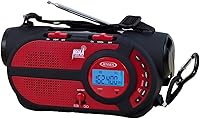
Features & Benefits

The NOAA weather band is the centerpiece here — tune in and you'll get direct broadcasts from the National Weather Service covering severe storm alerts, tornado warnings, and emergency bulletins. The AM/FM side is reliable enough for casual listening, though reception can vary depending on your location. What really stands out is the redundancy in power options: batteries, solar, hand-crank, and USB all work together so no single failure leaves you dark. The 2000mAh power bank won't fully recharge a modern smartphone, but it can deliver a meaningful partial charge when you need it most. At under 1.6 lbs, tossing this hand-crank radio into a go-bag takes almost no thought.

Best For

This hand-crank radio makes the most sense for people building a basic emergency kit without wanting to spend a lot. If you live in a hurricane corridor, tornado alley, or a wildfire-prone region, having it on a shelf — already charged and ready — is a reasonable precaution. Campers and hikers will appreciate its light footprint as a backup when cell service disappears. It's also a thoughtful, genuinely useful gift for an elderly parent or a college student living alone. Renters who can't install dedicated weather stations will find this kind of self-contained unit a practical, low-commitment fit for their situation.

User Feedback

Owners of the Jensen weather radio generally come away satisfied, particularly given its accessible price point — common praise focuses on how easy it is to get running straight out of the box. The multiple charging options earn consistent appreciation; people like knowing they have a fallback. That said, the hand-crank draws honest criticism: sustained cranking yields only a modest power gain, and the solar panel struggles in overcast conditions — exactly when you'd need it most. A few buyers report that AM/FM sensitivity drops in rural or low-signal areas. Durability feedback skews positive for occasional emergency use, but this isn't built to survive rough daily field conditions.

Pros

  • NOAA weather band delivers real-time emergency alerts directly from the National Weather Service.
  • Four independent power sources mean you are unlikely to be completely stranded without a way to run it.
  • Lightweight at under 1.6 lbs, so it fits easily into a go-bag or emergency bin without taking up meaningful space.
  • The built-in LED flashlight adds genuine utility during blackouts without needing a separate device.
  • Setup is straightforward — most users have it running within minutes of opening the box.
  • The USB charging port can deliver a useful partial charge to a phone when no other power is available.
  • Solid value for the price tier, especially for buyers assembling a first emergency preparedness kit.
  • Available in two color options, a small but appreciated detail for households that color-code their gear.

Cons

  • Hand-crank charging is slow and tiring — sustained effort yields only a modest power gain.
  • The solar panel struggles to generate meaningful charge in overcast or low-light conditions, exactly when storms hit.
  • AM/FM reception sensitivity drops noticeably in rural areas or locations with poor signal coverage.
  • The 2000mAh power bank provides only a partial smartphone charge, not enough for extended outage communication.
  • Build quality is suited for occasional emergency use only — not designed to withstand drops or rough field conditions.
  • Spare part availability is limited to a 90-day window, which is short for a safety-category device.
  • Requires 3 AA batteries that are not included, adding a small but immediate extra cost at setup.
  • Battery life in real-world use may fall short of what the specs suggest, based on user reports.

Ratings

Our AI rating system analyzed thousands of verified global purchases of the Jensen JEP-650R NOAA Emergency Weather Radio, actively filtering out incentivized, bot-generated, and spam reviews to surface what real buyers consistently experienced. The scores below reflect both the genuine strengths that earned this hand-crank radio its loyal following and the recurring frustrations that kept it from scoring higher. Nothing has been softened — if a category underperforms, the score says so.

Value for Money
88%
Among budget-tier emergency radios, this one consistently earns high marks for delivering a meaningful feature set at an accessible price point. Buyers frequently note that getting NOAA alerts, a flashlight, a power bank, and four charging methods in one unit feels like a smart deal, especially when building a first emergency kit.
A small but vocal segment of buyers feels the long-term durability does not fully justify even the modest investment, particularly after experiencing build issues within the first year. Expectations around the power bank capability also leave some feeling slightly misled once they realize 2000mAh only partially charges a modern phone.
NOAA Reception
83%
The core function holds up well — tuning into NOAA weather band channels is straightforward, and users in suburban and urban areas report clear, reliable reception of National Weather Service broadcasts. During actual storm events, several reviewers specifically noted the radio delivered alerts when their phones had already lost signal.
Reception in rural or geographically shielded areas can be inconsistent, with some users reporting signal drop-off or static on certain NOAA channels. The antenna, while functional, lacks the sensitivity of mid-range dedicated weather radios, which matters when you need a clean signal most.
Power Source Versatility
81%
19%
Having four independent power inputs is genuinely reassuring for emergency preparedness scenarios — if batteries run out, you still have solar, hand-crank, and USB as fallbacks. Buyers who have lived through extended outages appreciate this redundancy, even if no single alternative source is particularly fast or efficient.
The real-world effectiveness of the non-battery sources is limited: solar requires strong direct light, and the hand crank demands sustained physical effort for a modest payoff. Users who assumed any of these alternatives would serve as a reliable standalone option often come away disappointed after their first real test.
Hand-Crank Efficiency
51%
49%
The hand crank does technically work and provides a last-resort power option when every other source has been exhausted. For short bursts of emergency use — a few minutes of radio or a dim flashlight beam — it can bridge the gap in a pinch.
The efficiency is poor enough that it generates consistent criticism across buyer reviews. Several minutes of vigorous cranking yields only a marginal charge gain, and the mechanism itself feels flimsy under sustained use, raising questions about how many full emergency cycles it could realistically survive.
AM/FM Reception
67%
33%
In strong-signal environments, the AM/FM tuner performs competently for a radio at this tier, picking up local stations clearly enough for casual listening or news monitoring during a power outage. Urban users in particular tend to be satisfied with everyday performance.
Sensitivity falls off noticeably in rural areas, valleys, or buildings with thick walls, where stations that should be audible come through with static or not at all. The tuning mechanism can also feel imprecise, making it harder to lock onto weaker signals compared to more refined competing units.
Solar Charging
44%
56%
On paper, having a solar panel adds meaningful redundancy to the charging options, and in ideal outdoor conditions — direct summer sun over an extended period — it does contribute a slow but real trickle of power. For emergency kits stored in cars or taken camping, it adds incremental value.
The solar panel is undersized for meaningful real-world charging, and in overcast or stormy conditions — precisely when this radio is most needed — it contributes almost nothing. Multiple reviewers specifically flagged this as a feature that looks good on the spec sheet but underdelivers in practice.
Built-in Flashlight
74%
26%
The LED flashlight is consistently cited as a genuinely useful bonus — not spectacular, but bright enough to navigate a dark room, locate supplies, or read printed emergency materials during a blackout. It draws from the internal battery cleanly without draining it as fast as radio use.
Output is modest by any flashlight standard, and it is not suited for outdoor search tasks or illuminating large spaces. Buyers who expected a bright tactical-style beam were let down, though those with realistic expectations for a secondary utility feature tended to be satisfied.
Power Bank Output
58%
42%
Having any USB charging capability built into an emergency radio is a practical advantage, and users who needed a quick boost to make a single emergency call or send a text found the 2000mAh output genuinely useful in that narrow context. It works as described for small USB devices.
The 2000mAh capacity is simply insufficient for modern smartphones — at best, expect a 30 to 50 percent top-up on a typical handset, and less on larger-battery devices. Users who expected a full phone charge were consistently disappointed, and this remains one of the most commonly cited gaps between marketing impression and real-world result.
Ease of Setup
91%
Nearly universal praise surrounds how quickly this hand-crank radio can be unboxed and put into use — there is no complex configuration, no app pairing, and no manual required for basic operation. This simplicity is especially appreciated by buyers purchasing it as a gift for less tech-confident family members.
The lack of any setup complexity is largely by design, but it also means there are no advanced features to configure, which can feel limiting for more experienced users who want fine control over scanning, alert thresholds, or channel memory. What you see is what you get, operationally.
Portability
86%
At under 1.6 lbs and with a compact footprint, this emergency radio earns consistent praise from campers, hikers, and anyone assembling a lightweight go-bag. It does not feel like a burden to carry, and its size makes it easy to store in a drawer, closet shelf, or vehicle kit without consuming meaningful space.
The form factor, while portable, does not include a protective case or impact-resistant shell, so transport in a bag with other gear risks cosmetic and functional damage over time. There is no clip or carabiner attachment point either, limiting hands-free carrying options outdoors.
Build Quality
62%
38%
For occasional emergency use — grabbed during a storm, used for a few hours, then stored away — the construction holds up adequately. Most buyers who treat it as a backup device rather than daily-use hardware report no significant durability issues over a reasonable ownership period.
The plastic housing feels light and somewhat hollow, and the hand-crank mechanism in particular draws criticism for feeling fragile under repeated use. Several reviewers noted wear or looseness in moving parts after limited cycles, suggesting this unit is not engineered for rugged or frequent field deployment.
Audio Quality
63%
37%
For an emergency context — listening to weather alerts, news updates, or public safety announcements — the speaker output is clear enough to understand spoken content without difficulty. Volume levels are adequate for a quiet indoor environment or close listening outdoors.
Audio depth and fidelity are limited, which matters less for voice content but makes music listening noticeably flat. The single small speaker also struggles in noisy outdoor environments, where wind or background noise can easily overpower the output even at maximum volume.
Durability Over Time
59%
41%
Buyers who store the radio properly and use it only during actual emergencies tend to report satisfactory longevity — for a device that might be used a handful of times a year, it holds up reasonably well against that modest demand. Light-use owners rarely report early failure.
Users who have tested or used this hand-crank radio more regularly note signs of wear relatively quickly, particularly around the crank, tuning dial, and USB port. The 90-day spare part availability window from Jensen also provides little long-term reassurance for buyers thinking about multi-year reliability.

Suitable for:

The Jensen JEP-650R NOAA Emergency Weather Radio was built with a specific kind of buyer in mind: someone who wants a sensible safety net without overcomplicating or over-spending. It fits naturally into a household emergency kit — the type kept in a closet or under a bed, ready to grab if a hurricane warning comes in at midnight. Apartment dwellers and renters who cannot wire in a dedicated weather station will find this hand-crank radio especially practical, since it requires zero installation and runs entirely on its own power reserves. Campers, weekend hikers, and anyone who spends time in areas with spotty cell coverage will also appreciate having a self-contained unit that can pull in NOAA alerts and local AM/FM broadcasts without relying on a data connection. It also makes a genuinely thoughtful gift for elderly family members or college students living alone in storm-prone regions — people who need emergency readiness but won't research it themselves.

Not suitable for:

The Jensen JEP-650R NOAA Emergency Weather Radio is not the right fit for buyers who need a primary, high-reliability communication device or who plan to use it under demanding conditions. If you are a serious outdoors enthusiast, a prepper building a rugged go-kit, or someone who needs a radio that can take drops, moisture, and sustained field use, this unit is likely to disappoint — it is built to an accessible price point, and the construction reflects that. The hand-crank and solar charging options, while genuinely useful in a pinch, are not efficient enough to serve as your sole power strategy during a prolonged outage; you will still want a fresh set of AA batteries on hand. Buyers who need strong AM/FM reception in rural or low-signal areas may also find the tuner underwhelming. And if you are hoping the built-in power bank will fully recharge a modern smartphone, temper that expectation — 2000mAh gets you a partial charge at best, not a full top-up.

Specifications

  • Brand: Manufactured by Jensen, a consumer electronics brand with a long history in portable audio and communication devices.
  • Model: The model number is JEP-650R, designated as a Limited Edition variant in Jensen's emergency radio lineup.
  • Dimensions: The unit measures 8.5 x 4.84 x 3.54 inches, making it compact enough to fit in a standard emergency kit or backpack pocket.
  • Weight: At 1.52 pounds, this hand-crank radio is light enough to carry in a go-bag without adding meaningful load.
  • Power Sources: Supports four independent power inputs: 3 AA batteries, a built-in solar panel, a hand-crank dynamo, and USB charging input.
  • Battery Type: Requires 3 AA batteries (not included) for battery-powered operation; batteries are widely available and easy to stockpile.
  • Power Bank: Houses a 2000mAh internal battery that can output a partial USB charge to smartphones and small USB-powered devices.
  • Radio Bands: Receives AM, FM, and NOAA weather band broadcasts, covering emergency alert channels alongside standard radio stations.
  • Frequency Range: FM reception extends up to 108 MHz, covering the full standard FM broadcast spectrum used across North America.
  • Flashlight: Includes a built-in LED flashlight powered by the internal battery, suitable for close-range illumination during blackouts.
  • USB Output: Features a USB port that functions as a power bank output for charging phones or other small USB-compatible devices.
  • Connectivity: USB is the primary connectivity interface, used for both charging the internal battery and outputting power to external devices.
  • Color Options: Available in two color combinations: Red/Black and Blue/Black, allowing for easy visual identification in an emergency kit.
  • Spare Parts: Jensen offers spare part availability for a 90-day window from the date of purchase, which is limited relative to category norms.
  • Certifications: Supports NOAA Weather Radio All Hazards (NWR) reception, the official U.S. network for broadcasting emergency alerts and warnings.

Related Reviews
Leaton Emergency NOAA Weather Alert Radio
85%
88%
Battery Life & Charging Options
85%
Weather Alerts & Reception
90%
Build Quality & Durability
93%
Portability & Size
87%
Ease of Use
More
Midland ER210 Emergency Weather Radio
75%
91%
NOAA Reception Quality
83%
Power Source Versatility
78%
Battery Life
89%
Ease of Use
67%
Flashlight Performance
More
Eoxsmile CR1009Pro Emergency Weather Radio
79%
88%
Value for Money
91%
NOAA Weather Alert
67%
Battery Life
83%
Charging Versatility
74%
Build Quality
More
PPLEE 1009Pro-G NOAA Emergency Weather Radio
84%
94%
Power Options Versatility
88%
Build Quality and Durability
81%
Ease of Use
90%
Portability and Size
75%
Sound Quality (Radio Reception)
More
PPLEE CR1009 5000mAh Emergency Weather Radio
74%
88%
NOAA Reception Reliability
91%
Power Redundancy
83%
Battery Life
47%
Solar Charging Performance
44%
Hand Crank Efficiency
More
RAOUOEN 30000mAh Emergency Weather Radio
85%
89%
Battery Life & Charging
91%
Performance in Emergencies
75%
Portability & Weight
84%
Sound Quality & Reception
87%
Ease of Use
More
Sttfaishen F20 Emergency Hand Crank Weather Radio
72%
82%
NOAA Alert Reception
54%
Battery Capacity & Honesty
61%
Hand Crank Usability
57%
Solar Charging Performance
83%
USB-C Charging Speed
More
TFTDOUP Emergency Weather Alert Radio
86%
88%
Overall Performance
85%
Battery Life
90%
Charging Options
80%
Ease of Use
87%
Build Quality
More
FosPower A6 5200mAh Emergency Weather Radio
77%
91%
NOAA Reception
84%
Build Quality
67%
Power Bank Utility
53%
Hand Crank Efficiency
49%
Solar Charging
More
Audiocrazy AM FM NOAA Emergency Weather Radio
67%
83%
NOAA Reception
61%
Battery Life
58%
Build Quality
79%
Value for Money
62%
Bluetooth Performance
More

FAQ

No, it does not. You will need to supply 3 AA batteries yourself. It is worth keeping a spare set stored alongside the radio so it is always ready when you need it.

Honestly, it works — but slowly. A few minutes of steady cranking will give you enough power for a short burst of radio use or a dim flashlight, but do not expect it to meaningfully top up the internal battery on its own. Think of the hand crank as a last-resort option, not a primary charging method.

In practice, indoor solar charging is very limited. The panel needs direct or strong indirect sunlight to generate useful power, so a windowsill on a cloudy day is unlikely to do much. In a real emergency during a storm, the solar option is often the least reliable of the four power sources.

It can deliver a partial charge via the USB output port, but the 2000mAh internal capacity means you are looking at roughly 30 to 50 percent on most modern smartphones — not a full top-up. It is useful in a pinch, just not a substitute for a dedicated power bank.

The Jensen JEP-650R NOAA Emergency Weather Radio receives the standard NOAA Weather Radio All Hazards frequencies, which cover all seven designated weather band channels used by the National Weather Service across the U.S.

No, it is not rated for waterproofing or significant water resistance. Keep it protected from rain and moisture. It is designed for indoor emergency storage or sheltered outdoor use, not for use in wet field conditions.

It is decent for a unit in this category, but reception is location-dependent. Users in urban areas with strong signals generally report solid performance, while those in rural or low-signal zones notice more sensitivity issues. An extendable antenna helps, so make sure it is fully extended when tuning.

It is practical for close-range tasks like reading, navigating a dark room, or finding items in a kit, but it is not a high-lumen spotlight. Think of it as a functional utility light rather than a search-grade torch.

It holds up fine for occasional, careful outdoor use — tossed in a bag for a camping trip or kept in a car emergency kit. That said, it is not built to military or rugged outdoor standards, so repeated drops or exposure to harsh conditions will likely shorten its life.

You can, and some people do. The AM/FM tuner works for everyday listening, and running it on AA batteries makes that practical. Just keep in mind it was designed as emergency backup gear first, so the audio quality and ergonomics are functional rather than refined.

Where to Buy