Overview

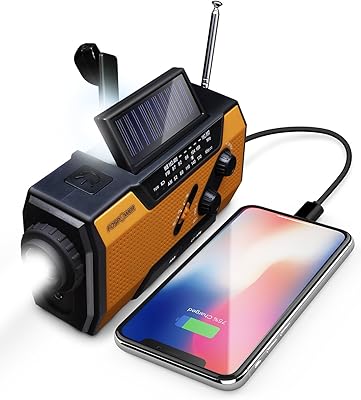
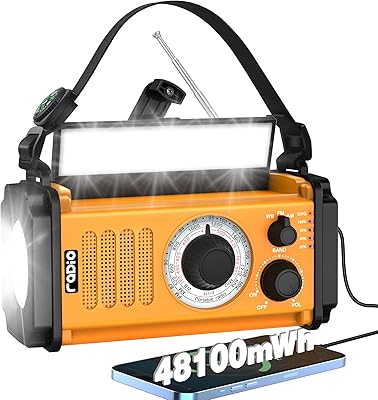
The Eoxsmile CR1009Pro Emergency Weather Radio is a compact, do-it-all survival device that bundles NOAA weather alerts, AM/FM/shortwave reception, and multiple charging options into one hand-sized unit. It's a step up from its predecessor, with a proper LCD screen and a noticeably larger battery — changes that genuinely matter when the power goes out. Eoxsmile is a budget-friendly brand, and this emergency radio reflects that positioning honestly: it's not trying to compete with professional-grade gear. Think of it as a solid entry point for casual preppers or households wanting a dependable backup device without overspending.
Features & Benefits

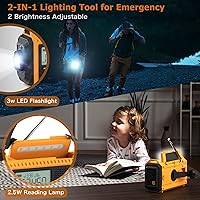
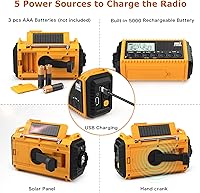
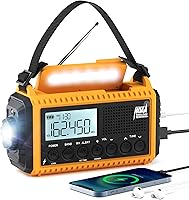
The CR1009Pro packs a lot into a small frame. Its 5000mAh battery supports five different charging methods — solar, hand crank, USB-C, wall adapter, and a AAA slot for true backup redundancy. The auto-scan NOAA alert system covers all seven weather band stations and wakes you with a loud siren and flashing light if a hazard warning arrives overnight. Two built-in lights — a bright side flashlight and a softer reading lamp — cover both long-range searching and close-up camp use. A USB output port lets you top up a phone in a pinch, which is a genuinely useful bonus during extended outages.

Best For

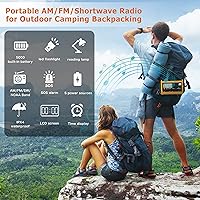
This hand crank weather radio makes the most sense for households in storm-prone regions — think hurricane corridors or tornado alley — where receiving emergency broadcasts without grid power is a real concern. It's also a practical companion for campers and hikers who'd rather carry one versatile tool than several separate gadgets. Older adults or anyone who prefers straightforward controls will appreciate the button-driven interface and readable screen. Budget-conscious buyers building a starter kit will find genuine utility here. And for rural users where cell coverage is patchy, the shortwave and AM bands can pull in signals FM simply cannot reach.

User Feedback

Buyers consistently praise the bright flashlight and the hassle-free NOAA setup, and build quality generally earns positive marks for the price. That said, a few honest caveats are worth knowing. Solar charging is painfully slow — treat it as an absolute last resort, not a practical day-to-day method. Manufacturer runtime figures are best-case estimates; real-world mixed use will land noticeably shorter. A handful of users found FM reception thin in weaker signal areas, even with the antenna fully extended. The hand crank works, but some buyers describe it as feeling slightly flimsy under repeated heavy use — worth keeping in mind.

Pros

  • Covers AM, FM, shortwave, and all seven NOAA weather band stations in one compact unit.
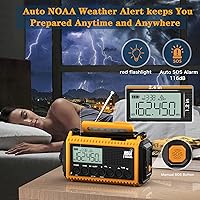
  • Auto-scan NOAA alert wakes you with a loud siren and flashing light, even overnight.
  • Five different charging methods mean you are rarely left with a dead device.
  • The built-in battery is large enough to squeeze in an emergency phone charge when needed.
  • Dual lighting — a long-range flashlight and a softer reading lamp — covers multiple real scenarios.
  • The 116dB SOS alarm with red strobe is a genuinely useful distress signal for outdoor emergencies.
  • LCD screen makes tuning and battery monitoring far easier than older analog-style radios.
  • IPX6 waterproof rating gives reasonable confidence in wet outdoor conditions.
  • Lightweight and compact enough to tuck into a go-bag without eating up space.
  • Button-driven controls and a lock function make it accessible for older or less tech-savvy users.

Cons

  • Solar charging is extremely slow — expect hours of direct sunlight for a modest battery gain.
  • Manufacturer runtime estimates are best-case figures; real mixed-use performance falls noticeably short.
  • FM reception can be weak or unreliable in low-signal areas, even with the antenna fully extended.
  • The hand crank feels somewhat flimsy and is not built for frequent or heavy-duty use.
  • No AC adapter included in the box — you need to supply your own 5V/2A charger.
  • Speaker audio quality is adequate for voice broadcasts but thin and tinny for music listening.
  • AAA battery backup requires three batteries that are also not included out of the box.
  • Backlight auto-shuts off after 15 seconds, which can be annoying during active nighttime use.

Ratings

Our AI rating engine analyzed thousands of verified global buyer reviews for the Eoxsmile CR1009Pro Emergency Weather Radio, actively filtering out incentivized, repeated, and bot-generated submissions to surface what real owners actually experience. The scores below reflect both where this hand crank weather radio genuinely earns its place in an emergency kit and where it falls short of its bolder claims. Strengths and pain points are weighted equally — nothing is glossed over.

Value for Money
88%
For the price bracket it occupies, this emergency radio delivers a remarkable breadth of features — NOAA alerts, multiple charging paths, dual lighting, and USB output — that would cost significantly more if purchased as separate devices. Buyers consistently describe it as a smart, low-risk starter purchase for household emergency preparedness.
A handful of buyers who pushed the radio hard over extended camping trips felt the overall construction didn't quite justify even modest long-term expectations, suggesting the value proposition is strongest for occasional or emergency use rather than daily wear.
NOAA Weather Alert
91%
The auto-scan weather alert is the standout feature for most buyers. It reliably wakes users with a loud siren and flashing indicator during overnight storm warnings, which is exactly the use case emergency radios exist for. Setup is straightforward and takes only a few minutes even for first-time users.
A small number of users in fringe geographic areas noted occasional missed or delayed alerts, though it is difficult to determine whether these were unit issues or local broadcast gaps. The alert system performs as advertised in well-covered regions.
Battery Life
67%
33%
The large built-in battery gives the CR1009Pro a meaningful runtime advantage over smaller competitors in its class. For standby weather monitoring over a multi-day power outage, it holds up reasonably well and gives users a real buffer before needing to recharge.
Manufacturer runtime figures are best-case estimates under controlled conditions, and real-world mixed use — radio on, occasional flashlight, phone charged once — drains the battery noticeably faster than advertised. Several buyers flagged the gap between claimed and actual battery performance as their biggest disappointment.
Charging Versatility
83%
Having five distinct ways to recharge one device is genuinely reassuring in an emergency scenario. USB-C and wall charging work exactly as expected, and the hand crank provides a credible backup when no power source is available, making this radio a sensible addition to any disaster preparedness kit.
Solar charging is the weakest link by a wide margin. The built-in panel is small and slow, requiring many hours of unobstructed direct sunlight to make a meaningful dent in the battery level — it is better thought of as a trickle supplement than a real charging method.
Build Quality
74%
26%
For a budget-tier emergency device, the physical construction holds up better than many buyers expect. The ABS housing feels solid in hand, the buttons are responsive, and the IPX6 waterproof rating provides practical confidence for outdoor use in rain or humid conditions.
The hand crank is the most frequently criticized component — several users describe it as feeling lightweight and slightly flimsy under repeated use. It functions reliably for occasional emergency cranking, but anyone expecting to use it regularly may notice it lacks the robustness of purpose-built survival gear.
FM/AM/SW Reception
69%
31%
In areas with decent signal coverage, AM and FM reception is clean and serviceable for picking up local emergency broadcasts and news. The shortwave capability adds genuine long-distance reach that most competitors at this price point omit entirely, which is a real differentiator for rural users.
FM reception in weak-signal environments is a recurring complaint — even with the telescopic antenna fully extended, fringe areas can produce noisy or unreliable tuning. The CR1009Pro is not a high-sensitivity radio, and buyers in rural or signal-shadowed locations should factor this in.
Flashlight Performance
86%
The side-mounted flashlight consistently earns praise for being genuinely bright and useful — not just a token LED tacked on for the spec sheet. Campers and users who experienced overnight power outages specifically called out the beam range as impressively long for a device this compact.
The two-brightness design is practical, but there is no strobe or low-power preservation mode for the flashlight specifically, which limits its versatility for signaling or extended battery-conserving use during prolonged outages.
Reading Lamp
78%
22%
The secondary reading lamp is a thoughtful addition that FM-only emergency radios typically skip. It casts a wide, soft light useful for navigating a dark room or campsite without the harshness of the main flashlight beam, and buyers with kids or elderly family members particularly appreciated it.
At maximum brightness it covers a decent area, but it is not quite bright enough to comfortably illuminate a full-size room for extended reading, making it better suited to close-up tasks or tent use than whole-room lighting during a blackout.
LCD Display & Controls
82%
18%
The digital LCD display is a meaningful upgrade over the analog tuner dials found on older emergency radio designs. Being able to see exact frequency, battery level, and alert status at a glance reduces guesswork, and the child lock function is a genuinely useful safety touch for family households.
The backlight auto-shutoff after 15 seconds of inactivity frustrates some users during active nighttime use, requiring repeated button presses to keep the screen lit. It is a sensible power-saving default but not user-adjustable, which feels like a missed opportunity.
SOS Alarm
84%
A 116-decibel alarm with a simultaneous red strobe is a legitimately loud and visible distress signal. Hikers and campers who tested it outdoors confirmed it carries well across open terrain, and having it accessible via a dedicated button rather than buried in a menu is a smart design choice.
The SOS button lacks a physical guard or cover, meaning accidental activation in a bag or pocket is possible. A few users reported triggering it unintentionally, which is more startling than harmful but points to a design refinement that would improve the overall experience.
Portability
87%
At under a pound and roughly the size of a thick paperback book, this hand crank weather radio fits comfortably in a backpack, a bedside drawer, or an emergency bin without occupying meaningful space. The included wrist strap and hang buckle add practical carry options for outdoor use.
It is slightly bulkier than the most minimalist pocket emergency radios on the market, so ultralight backpackers counting every ounce may find it a borderline choice compared to stripped-down alternatives that sacrifice features for weight savings.
Ease of Setup
89%
Out of the box, most users have the radio tuned, NOAA alert configured, and time set within ten minutes. The physical button layout is intuitive, and the manual is clear enough that less tech-comfortable users — including older adults and first-time emergency radio owners — consistently report no setup frustration.
The NOAA alert timer configuration could benefit from clearer labeling on the unit itself; a couple of buyers had to consult the manual more than once to correctly distinguish between the alert preset and the clock timer functions.
Phone Charging Utility
63%
37%
In a genuine power outage scenario, the USB output port is a practical lifeline — enough charge to make a few calls, send texts, or quickly look up emergency information. Buyers who used it during real outages were grateful it existed, even if they understood its limitations going in.
The charging output is slow by modern standards, and the internal battery depletes noticeably fast when powering another device. It is an emergency utility, not a travel power bank replacement, and users who expected meaningful device charging were often underwhelmed by throughput speed.
Audio Quality
58%
42%
For spoken-word content — emergency broadcasts, news, weather reports — the built-in speaker is perfectly adequate. Volume headroom is generous across its 16-level range, and the 3.5mm headphone jack lets users listen privately without disturbing others in shared spaces.
Music listening is where the audio falls short; the speaker sounds thin and compressed at higher volumes, with limited bass and a tendency to distort when pushed. This is an emergency radio first, and anyone hoping to use it casually for music enjoyment will be disappointed by the sound character.

Suitable for:

The Eoxsmile CR1009Pro Emergency Weather Radio is a strong fit for households in storm-prone regions — coastal areas facing hurricane seasons, tornado-alley states, or anywhere that routinely loses power during severe weather. If your emergency plan currently involves hoping your phone stays charged and the cell towers stay up, this radio fills that gap in a practical, affordable way. It also makes real sense for campers, hikers, and backpackers who want one compact tool handling communications, lighting, and even a bit of phone charging without stuffing a bag full of separate devices. Older adults and less tech-savvy users will appreciate the straightforward button layout and readable LCD screen — there is no fiddly app or complex menu to navigate. Rural residents who regularly deal with weak cell coverage will find the AM and shortwave bands especially useful for pulling in broadcasts that FM simply cannot reach.
Not suitable for:

The Eoxsmile CR1009Pro Emergency Weather Radio is not the right choice for buyers expecting professional-grade radio performance or rugged heavy-duty construction. If you are a serious ham radio operator, an emergency management professional, or someone who needs consistently sharp FM reception across a wide range of signal environments, this radio will frustrate you. The solar charging capability, while a nice-to-have, is impractically slow for anyone counting on it as a primary power source — if reliable off-grid recharging is a top priority, you will need a more capable solution or at minimum a proper solar panel setup. The hand crank, while functional, is not built for extended or aggressive use, so buyers in genuinely demanding survival scenarios may find it falls short over time. Finally, audiophiles or anyone wanting rich, clear sound for casual everyday listening should look elsewhere — this is a functional emergency tool, not a quality audio device.
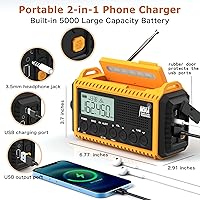
Specifications

  • Dimensions: The unit measures 6.77″ long by 3.7″ wide by 2.91″ tall, making it compact enough to fit in a standard backpack side pocket.
  • Weight: At just under 15 ounces, this emergency radio is light enough to carry on day hikes or store in a go-bag without adding meaningful bulk.
  • Built-in Battery: A 5000mAh rechargeable lithium battery is built into the unit and cannot be removed, serving as the primary power source.
  • Backup Power: A dedicated compartment accepts three AAA batteries as a true backup, independent of the internal rechargeable cell.
  • Charging Inputs: The radio recharges via USB-C cable, a 5V/2A wall adapter (sold separately), a fold-out solar panel, or the built-in hand crank.
  • Radio Bands: Supported bands include FM (87–108 MHz), AM (520–1710 kHz), shortwave (2.3–22 MHz), and all seven NOAA weather band channels.
  • Runtime Estimates: Under ideal conditions, the manufacturer rates FM playback at up to 30 hours, standby weather alert mode at up to 100 hours, and the reading lamp at up to 40 hours.
  • Flashlight Output: The side-mounted LED flashlight delivers up to 300 lumens at its higher setting, with an effective beam range of roughly 70 meters.
  • Reading Lamp: A secondary 2.5W LED reading lamp provides up to 300 lumens and is designed to illuminate an area of approximately 20 square meters.
  • SOS Alarm: A dedicated SOS button triggers a 116dB audible alarm paired with a red strobe light for emergency signaling.
  • Display: An LCD backlight screen shows current time, tuned frequency, battery level indicator, and active alert or lock status icons.
  • Waterproofing: The enclosure carries an IPX6 waterproof rating, meaning it can withstand strong water jets but should not be submerged.
  • Volume Control: Audio output is adjustable across 16 discrete levels, giving fine-grained control in both quiet and noisy environments.
  • Audio Output: A 3.5mm headphone jack allows private listening and is compatible with standard wired earphones.
  • USB Output: A built-in USB output port allows the radio to charge phones or small USB-powered devices directly from its internal battery.
  • Material: The housing is constructed from ABS plastic described by the manufacturer as dustproof and shatterproof in addition to its IPX6 water resistance.
  • Antenna: An extendable telescopic antenna is included to improve signal reception across FM, AM, shortwave, and weather band frequencies.
  • Warranty: Eoxsmile provides a one-year manufacturer warranty, with support accessible directly via email as stated in the product documentation.
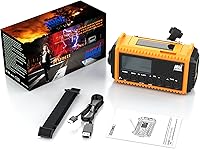
  • Included Items: Each unit ships with a USB-C charging cable, a hang buckle, a wrist hand strap, and a printed owner's manual.
  • Child Lock: A dedicated lock function disables the control buttons to prevent accidental changes to settings, particularly useful around young children.

Related Reviews
FosPower A6 5200mAh Emergency Weather Radio
77%
91%
NOAA Reception
84%
Build Quality
67%
Power Bank Utility
53%
Hand Crank Efficiency
49%
Solar Charging
More
QAUYYW Emergency Weather Radio XSY330
86%
89%
Battery Life
85%
Ease of Use
92%
Portability
75%
Radio Reception
88%
Build Quality
More
Roxicosly CR1009Ultra 12000mAh Emergency Weather Radio
74%
88%
Battery Life
91%
Charging Versatility
86%
NOAA Alert Performance
58%
Hand Crank Durability
44%
Solar Charging Speed
More
TFTDOUP Emergency Weather Alert Radio
86%
88%
Overall Performance
85%
Battery Life
90%
Charging Options
80%
Ease of Use
87%
Build Quality
More
RAOUOEN 30000mAh Emergency Weather Radio
85%
89%
Battery Life & Charging
91%
Performance in Emergencies
75%
Portability & Weight
84%
Sound Quality & Reception
87%
Ease of Use
More
Sttfaishen F20 Emergency Hand Crank Weather Radio
72%
82%
NOAA Alert Reception
54%
Battery Capacity & Honesty
61%
Hand Crank Usability
57%
Solar Charging Performance
83%
USB-C Charging Speed
More
OnLyee CR1030 Emergency Weather Radio
76%
88%
Power Source Redundancy
83%
Hand Crank Durability
61%
Solar Charging Performance
79%
NOAA Reception Quality
67%
Battery Capacity & Phone Charging
More
AXYEBI AB-US-107Y Emergency Weather Radio
75%
91%
Value for Money
82%
NOAA Signal Reception
88%
Flashlight Performance
63%
Build Quality & Durability
67%
Hand Crank Usability
More
Leaton Emergency NOAA Weather Alert Radio
85%
88%
Battery Life & Charging Options
85%
Weather Alerts & Reception
90%
Build Quality & Durability
93%
Portability & Size
87%
Ease of Use
More
MangePagar MA-091 4000mAh Emergency Weather Radio
75%
88%
Value for Money
82%
NOAA Reception Quality
84%
Battery Capacity & Runtime
61%
Hand Crank Charging
57%
Solar Charging Performance
More

FAQ

Once you configure the WX alert setting and set the monitoring timer, the radio handles it automatically. It scans all seven NOAA weather stations in the background and triggers the alarm on its own if a hazard alert is broadcast, even if the screen is off and you are asleep.

Honestly, treat solar as a backup-to-the-backup rather than a primary charging method. The panel is small, so recharging a depleted battery via sunlight alone would take an impractically long time — we are talking many hours of direct, unobstructed sunlight for a modest charge. For real-world reliability, USB-C or a wall adapter is the way to go, with hand crank as your emergency option.

Yes, the built-in USB output port can push a charge to your phone or other USB devices. Just keep expectations realistic — this is not a dedicated power bank, and the internal battery has limits. In an emergency it will likely get you enough charge for a few important calls or texts, which is exactly what it is there for.

The alarm is rated at 116 decibels, which is genuinely loud — comparable to a rock concert or a nearby chainsaw. Paired with the red strobe light, it is a solid distress signal for attracting attention in outdoor emergencies, though no alarm is guaranteed to be heard over strong wind or significant ambient noise.

Not at all. The controls are physical buttons with clear labeling, and the LCD screen gives you enough feedback to know what mode you are in. The NOAA alert setup takes a few button presses to configure, and the manual walks through it clearly. Most users have it ready to go within ten minutes of unboxing.

FM performance is decent in areas with reasonably strong signals, but it can struggle in genuinely weak coverage zones even with the antenna fully extended. If you live in a rural area and FM is your primary concern, it is worth knowing this limitation upfront. The AM and shortwave bands actually tend to perform more reliably over long distances and in fringe reception areas.

It works fine for occasional emergency use, which is exactly the scenario it is designed for. That said, some users have noted it feels a bit lightweight under the hand. If you were planning to hand-crank your way through daily listening sessions, it might show wear over time. For what it is — an emergency backup charging method — it does the job.

The radio charges via USB-C and requires a 5V/2A adapter, which is a very common standard. One is not included in the box, but any modern phone charger meeting that spec will work fine. A USB-C cable is included, so you just need to supply the plug.

Yes, standard AAA batteries fit the backup compartment, and rechargeable NiMH AAAs will work there too. Keep in mind that rechargeable AAAs have a slightly lower voltage than alkaline ones, so runtime may be marginally shorter, but they are a practical and eco-friendly choice for stocking your emergency kit.

The LCD backlight is set to switch off automatically after 15 seconds of no button activity, which is a sensible default for preserving battery life. You can wake it back up with any button press. If you are actively using the radio, the screen stays on, but during overnight monitoring the backlight stays off most of the time, keeping power draw low.