Overview

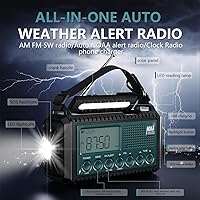
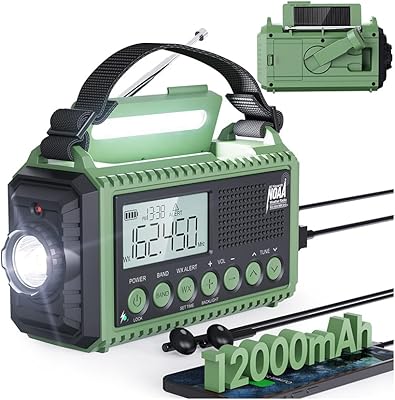
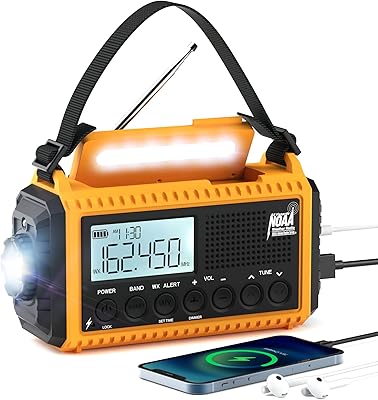
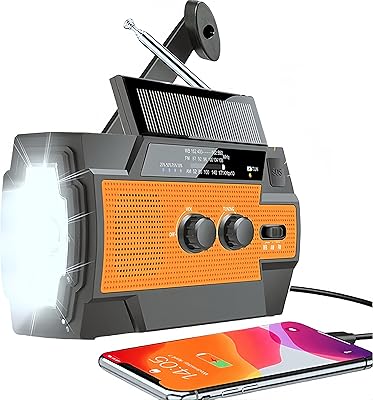
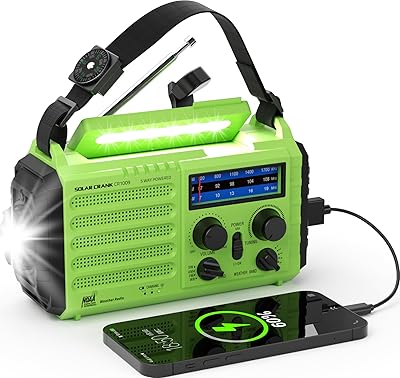
The PPLEE P-1009Pro Emergency Weather Radio is less a radio and more a compact emergency hub that happens to receive broadcasts. About the size of a thick paperback and weighing just a pound, it fits comfortably in a go-bag or on a nightstand without taking up much space. What makes it stand out at this price point is the five independent power sources — solar, hand crank, USB input, internal 5000mAh battery, and three AAA cells — so you are rarely left without options during a prolonged outage. On the market since late 2020, it has accumulated a substantial real-world review base, which makes it easier to separate the genuine strengths from the marketing claims.
Features & Benefits

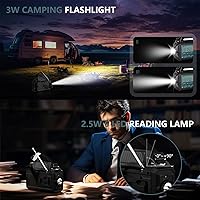
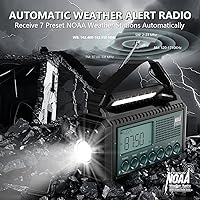
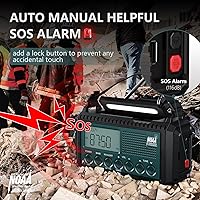
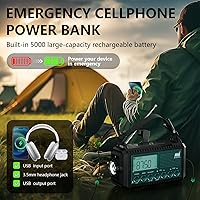
The feature that genuinely sets this survival radio apart from a standard portable receiver is the auto NOAA weather alert. Set it up once, and the unit will wake itself, broadcast the warning, and flash its red light — all without you touching it. The 5000mAh internal battery can also push power out through a USB port, so you can top off a phone during a blackout, though how much charge you actually get depends on your device and how depleted the radio is. There is a 3W flashlight for navigating a dark house, a softer reading lamp for extended use, and an SOS alarm that combines a loud sound with a Morse-code strobe — useful if you ever need to signal for help.

Best For

This emergency weather radio makes the most sense for people who live in regions regularly hit by hurricanes, tornadoes, or heavy winter storms — situations where power and cell service can disappear for days. It also travels well for camping, since it covers lighting, communication, and basic phone charging in a single pound of gear. If you tend to forget to check the forecast before a storm rolls in, the auto-alert function alone justifies keeping one charged on a shelf. It also makes a surprisingly thoughtful gift for elderly parents or anyone who has recently moved into their first home, since it is intuitive to use and covers multiple emergency scenarios without requiring any technical background.

User Feedback

Buyers consistently highlight two things: ease of setup and the auto-alert system, which tends to work reliably even for people who are not particularly tech-savvy. The speaker volume draws genuine praise. On the critical side, the solar panel is slow — think trickle charge in direct sunlight, not rapid recovery — so treat it as a backup to your backup rather than a primary source. The hand crank is similarly limited; fine for generating a few minutes of radio use, but not something you want to rely on for extended listening. Shortwave reception is workable but nothing remarkable. A few buyers have noted the build feels better suited to indoor emergency storage than daily rough handling, which is a fair assessment of what this unit actually is.

Pros

  • Auto NOAA alert activates the radio and flashlight on its own the moment a weather warning is issued.
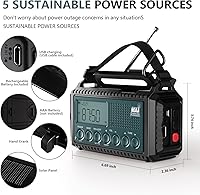
  • Five independent power inputs mean you are unlikely to be caught with a completely dead unit in a real emergency.
  • The built-in reading lamp is a practical addition that most competing radios at this price point skip entirely.
  • At roughly one pound, this survival radio is light enough to keep in a go-bag without a second thought.
  • The large LCD screen shows battery level and current time, so you always know your power status at a glance.
  • Digital tuning with auto-scan makes finding an active station fast and frustration-free, even under stress.
  • The SOS alarm is genuinely loud and doubles as a Morse-code strobe, adding real rescue signaling capability.
  • A 3.5mm headphone jack lets you monitor weather alerts at night without disturbing others in the household.
  • Initial setup is simple enough for non-technical users, including older adults, to handle without assistance.
  • The included carabiner and braid belt make it easy to attach to a bag without sourcing extra hardware.

Cons

  • Solar charging is a trickle at best; in cloudy or indirect light conditions, it barely registers as meaningful input.
  • Sustained hand cranking is tiring and slow, making it a true last-resort fallback rather than a practical power method.
  • Shortwave reception is mediocre compared to dedicated shortwave receivers available at a similar price point.
  • The 5000mAh battery capacity sounds generous but may realistically deliver only a partial phone charge depending on your device.
  • Build quality is adequate for indoor shelf storage but reveals its budget-tier origins under any real outdoor stress.
  • The micro USB charging port feels outdated now that USB-C has become the standard across most modern devices.
  • There are no saved presets for local NOAA frequencies, which can be a minor but real inconvenience after a reset.
  • Several buyers have noted the hand crank mechanism feels flimsy and raises durability concerns with repeated or forceful use.

Ratings

The PPLEE P-1009Pro Emergency Weather Radio has been scored by our AI after analyzing thousands of verified buyer reviews from global markets, with spam, incentivized, and bot-generated feedback actively filtered out before any scoring was applied. The ratings below reflect the genuine strengths that keep buyers recommending this survival radio alongside the honest frustrations that surface once it is put to real use. Both standout performers and underdelivering features are transparently represented so you can make a fully informed decision before buying.
Auto NOAA Alert
88%
The auto-alert function is the most consistently praised aspect of this unit. Buyers in hurricane-prone and tornado-watch regions report that the self-activation worked reliably when tested, giving them peace of mind without having to leave the radio on around the clock. For the set-and-forget crowd, it genuinely delivers.
A small number of buyers noted that the initial alert configuration requires patience to get right, and without reading the manual carefully it is easy to miss a step that leaves the feature inactive. There is no audible confirmation when alert mode is successfully armed, which adds uncertainty.
Value for Money
84%
At this price tier, covering NOAA alerts, five power inputs, dual lighting, and phone charging in one compact device is genuinely hard to replicate by buying separate items. Buyers who discovered this unit while building an emergency kit frequently cite the feature-to-cost ratio as the primary reason they chose it over more expensive single-function alternatives.
The value equation holds best for buyers who primarily need this unit for home emergency storage. Those expecting build quality or charging performance equivalent to more expensive dedicated radios have reported disappointment, particularly with the solar panel and hand crank, both of which underdeliver relative to what the feature list suggests.
Build Quality
67%
33%
For shelf storage and indoor emergency use, the physical construction is entirely adequate. The buttons have a reasonably solid feel, and the unit holds up well when handled with normal care, which is what the majority of buyers actually do with a device they hope to never urgently need.
The plastic housing shows its budget-tier origins under any real physical stress, and the hand crank mechanism in particular has drawn repeated complaints about feeling flimsy when cranked with force. Buyers who plan to pack this radio in a hiking bag and subject it to daily bumps and drops should temper their expectations.
Battery Performance
79%
21%
The 5000mAh internal battery provides solid standby endurance when the unit is used primarily for radio listening or kept in alert mode. In real household outage scenarios, buyers report the battery lasting well through a typical multi-hour storm event without needing a recharge mid-crisis.
Running the flashlight and radio simultaneously drains the battery noticeably faster, and some buyers have found the actual runtime falls short of expectations when multiple features are used at once. The capacity rating reflects storage potential, not a guarantee of specific hours of combined multi-feature use.
Solar Charging
41%
59%
In sustained direct sunlight, the solar panel does contribute a trickle of power over several hours, which is better than nothing during a prolonged grid outage with no USB power available. For buyers in very sunny climates who store the unit on a window ledge, it can serve as a slow passive maintenance charge.
The solar panel performance is genuinely poor by most practical measures. In real-world conditions including partly cloudy skies or indoor placement near a window, the charge rate is nearly imperceptible. Buyers who purchased this unit hoping solar would be a reliable emergency charging method have been consistently disappointed.
Hand Crank Efficiency
53%
47%
The hand crank does deliver power in short bursts, and in a true last-resort scenario with every other charging option exhausted, the ability to generate even a few minutes of radio use from human effort alone is a meaningful safety net. Most emergency scenarios only require brief, intermittent listening.
Sustained cranking is both tiring and inefficient, with many buyers reporting that several minutes of effort yields only a minute or two of listening time. The crank mechanism raises durability concerns among buyers who have tested it repeatedly, with some noting it feels unlikely to survive prolonged or forceful use.
AM/FM Reception
76%
24%
AM and FM reception is solid for a device in this category, handling most local and regional stations reliably in typical suburban and rural settings. The digital tuner and auto-scan function make finding and locking onto a station fast, which buyers appreciate during the chaos of an actual storm.
Reception quality drops noticeably in areas with poor signal coverage or when the unit is used in a basement or interior room with minimal antenna line-of-sight. Extending the adjustable antenna helps, but buyers in low-signal areas report that even at full extension, performance can be inconsistent on weaker AM stations.
Shortwave Reception
58%
42%
Strong shortwave stations come in clearly enough for practical use, and buyers who want to tune into major international broadcasts during an extended grid outage will get what they need. The digital tuning also makes navigating the shortwave spectrum less cumbersome than analog dial alternatives at this price point.
Weak and distant shortwave signals are difficult to hold, and some buyers have noted that audio on marginal shortwave channels is noisy and hard to follow. Dedicated shortwave listeners accustomed to quality receivers will find the performance underwhelming, and interference from the LCD electronics has been mentioned by a handful of users.
Speaker Volume
82%
18%
The speaker is consistently one of the most positively reviewed aspects of this emergency weather radio. Buyers frequently express genuine surprise at how loud it gets for a device this size, which matters when you need to hear a weather alert clearly over wind noise or household activity during a storm.
At higher volume levels, the speaker can introduce distortion on bass-heavy content, and audio fidelity is strictly functional rather than pleasant for extended music listening. It is tuned for speech intelligibility over sound quality, which is right for an emergency device but disappoints buyers hoping to use it casually for music.
Lighting Performance
81%
19%
The dual-mode lighting system earns consistent praise from buyers who have used it during a real power outage. The 3W flashlight handles navigation and task work effectively, while the softer reading lamp is genuinely useful for hours of ambient illumination without the eye strain of a direct focused beam.
Neither light mode is bright enough to illuminate a large room effectively, and buyers expecting the flashlight to match the output of a dedicated torch will find it modest. Extended lamp use accelerates battery drain more than buyers typically anticipate, which becomes a real concern during a multi-day outage.
Phone Charging
71%
29%
The USB output port works as advertised, and during a real blackout when a phone hits single-digit battery, being able to pull charge from the radio provides genuine reassurance that few buyers fully appreciate until they actually need it. It covers a gap that almost no other radio in this price tier addresses.
Buyers who expect a meaningful full phone charge are often let down, particularly if the radio's own battery is not near capacity when the outage hits. Charging speed is slow, and the output is better suited to keeping a phone alive in airplane mode than running it actively while refilling the battery.
Ease of Setup
89%
Out-of-box setup is fast and accessible even for buyers who are not comfortable with technology. The auto-alert configuration, clock setting, and radio scanning all follow logical button sequences, and buyers who gifted this unit to elderly relatives frequently report back that the recipients had it running independently within minutes.
The one area where setup falters is configuring the auto-alert correctly — the manual instructions are adequate but not particularly clear, and a misstep leaves the feature inactive without any obvious indicator. A few non-technical buyers needed to find video walkthroughs online to confirm the alert mode was properly engaged.
Portability
86%
At one pound and roughly the footprint of a thick paperback, this survival radio slips into a go-bag or emergency kit without demanding meaningful space or weight. The included carabiner and braid belt make it clippable to a bag strap or backpack loop without needing to source additional hardware.
The form factor, while compact, is not pocketable, and the extended antenna adds noticeable bulk when in use. Buyers assembling true ultralight backcountry kits may find the size-to-function trade-off less favorable compared to minimal single-function emergency radios that weigh considerably less overall.
Display & Interface
77%
23%
The LCD screen gives buyers useful at-a-glance information: current frequency, battery level, and time are all visible simultaneously without navigating a menu. During a power outage, buyers appreciate not having to guess how much battery remains before committing to extended flashlight or radio use.
Display brightness is fixed and can be difficult to read in strong direct sunlight, which is precisely when outdoor use is most likely. Button labeling is functional but not always intuitive, and the lack of a backlit keypad means navigating controls in complete darkness requires some tactile familiarity with the layout.
SOS Safety Features
83%
The SOS button delivers a legitimately loud alarm combined with a Morse-code strobe pattern, providing a real dual-channel signal useful in search-and-rescue scenarios. Buyers who have tested it report the alarm is jarring enough to be heard from a meaningful distance, adding genuine functional value beyond a simple buzzer.
The SOS button has no protective cover or guard, meaning it can be triggered accidentally if the unit is bumped or jostled in a bag. A handful of buyers reported being startled by unintentional SOS activations, particularly during travel or when the unit was loose and unsecured in a vehicle.

Suitable for:

The PPLEE P-1009Pro Emergency Weather Radio is best suited for homeowners in storm-prone regions who want a hands-off alert system they can configure once and trust to wake them when a NOAA warning is issued. If you live along the Gulf Coast, in Tornado Alley, or in areas that routinely lose power during winter ice storms, having a unit that activates itself without any action on your part is genuinely worth the asking price. Campers and day hikers who want to consolidate gear will also get solid value from it, since one device covers radio reception, dual-mode lighting, and emergency phone charging. It serves well as a thoughtful gift for elderly relatives or first-time homeowners who want basic preparedness without navigating a complicated setup. Budget-conscious preppers trying to cover multiple emergency functions with a single affordable device will find the feature-to-price ratio hard to argue with.
Not suitable for:

The PPLEE P-1009Pro Emergency Weather Radio is a poor fit for anyone expecting professional-grade radio reception or serious off-grid charging capability. If your primary goal is keeping devices powered through extended outages, be realistic: the 5000mAh internal battery is a useful reserve, but depending on your phone model and current charge level, you may get only a partial top-up, not a full rescue charge. Dedicated shortwave enthusiasts will find the reception functional but unimpressive next to purpose-built receivers in a comparable or slightly higher price range. Anyone planning multi-day backcountry trips who needs consistent power restoration should also look elsewhere, since the solar panel trickle-charges rather than meaningfully restores the battery, and the hand crank is an emergency supplement at best. If you need a device that can absorb drops, mud, and prolonged rough handling, the build quality here is better matched to shelf storage than field abuse.
Specifications

  • Brand: Manufactured and sold by PPLEE E-COMMERCE CO., LTD under the PPLEE brand name.
  • Model: The official model designation is P-1009Pro.
  • Dimensions: The unit measures 6.69″ long by 2.36″ wide by 3.74″ tall.
  • Weight: The complete unit, including the internal rechargeable battery, weighs 1 pound.
  • Internal Battery: A built-in 5000mAh rechargeable lithium battery serves as the primary power source and can also output charge to connected devices via the USB port.
  • Power Inputs: Five input methods are supported: a built-in solar panel, a hand crank generator, micro USB cable input, three AAA backup batteries, and the internal rechargeable battery.
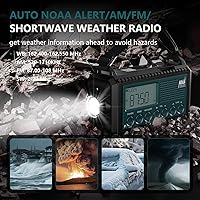
  • Radio Bands: The tuner covers AM, FM, shortwave (SW), and all seven official NOAA weather broadcast frequencies.
  • Tuning Type: Digital tuning is used across all bands, with a hold-to-auto-scan function that automatically finds the next active station.
  • Flashlight: An integrated 3W LED flashlight provides a focused beam for navigation and short-range signaling in the dark.
  • Reading Lamp: A separate 2.5W diffused lamp mode delivers softer, area-filling illumination suited for extended low-light use.
  • SOS Alarm: A dedicated SOS button triggers a loud audible alarm combined with a Morse-code pattern strobe light to signal for rescue.
  • USB Output: A USB output port allows the internal battery to charge phones and other small USB-powered devices during a power outage.
  • Headphone Jack: A standard 3.5mm headphone jack allows for private listening without disturbing others in the same space.
  • Display: A large LCD screen shows the current time, selected frequency, and remaining internal battery level simultaneously.
  • NOAA Auto Alert: When auto-alert mode is enabled, the unit self-activates, sounds an alarm, and flashes its red indicator light upon receiving an official NOAA weather warning broadcast.
  • In the Box: Included accessories are one micro USB charging cable, one braid belt with a carabiner clip, and one printed owner’s manual.

Related Reviews
PPLEE CR1009 5000mAh Emergency Weather Radio
74%
88%
NOAA Reception Reliability
91%
Power Redundancy
83%
Battery Life
47%
Solar Charging Performance
44%
Hand Crank Efficiency
More
RAOUOEN H27 30000mAh Emergency Weather Radio
68%
83%
Battery Capacity
81%
Value for Money
76%
Radio Reception
44%
Solar Charging
58%
Hand Crank Usability
More
Roxicosly CR1009Ultra 12000mAh Emergency Weather Radio
74%
88%
Battery Life
91%
Charging Versatility
86%
NOAA Alert Performance
58%
Hand Crank Durability
44%
Solar Charging Speed
More
TFTDOUP Emergency Weather Alert Radio
86%
88%
Overall Performance
85%
Battery Life
90%
Charging Options
80%
Ease of Use
87%
Build Quality
More
OnLyee CR1030 Emergency Weather Radio
76%
88%
Power Source Redundancy
83%
Hand Crank Durability
61%
Solar Charging Performance
79%
NOAA Reception Quality
67%
Battery Capacity & Phone Charging
More
QAUYYW Emergency Weather Radio XSY330
86%
89%
Battery Life
85%
Ease of Use
92%
Portability
75%
Radio Reception
88%
Build Quality
More
FosPower A6 5200mAh Emergency Weather Radio
77%
91%
NOAA Reception
84%
Build Quality
67%
Power Bank Utility
53%
Hand Crank Efficiency
49%
Solar Charging
More
Sttfaishen F20 Emergency Hand Crank Weather Radio
72%
82%
NOAA Alert Reception
54%
Battery Capacity & Honesty
61%
Hand Crank Usability
57%
Solar Charging Performance
83%
USB-C Charging Speed
More
FosPower Emergency Weather Radio A1
76%
88%
NOAA Reception Quality
74%
AM/FM Reception
58%
Hand Crank Charging
53%
Solar Panel Effectiveness
62%
Power Bank Output
More
Midland ER210 Emergency Weather Radio
75%
91%
NOAA Reception Quality
83%
Power Source Versatility
78%
Battery Life
89%
Ease of Use
67%
Flashlight Performance
More

FAQ

No, you do not need to leave it running. Once you enable the auto-alert mode during setup, the unit monitors NOAA frequencies in a low-power standby state and wakes itself up — turning on the speaker and flashing the red indicator light — when an official warning is broadcast for your area. It is worth doing a quick test after setup to confirm the feature is configured correctly before you actually need it.

Yes, but with realistic expectations. The USB output port draws from the 5000mAh internal battery, and how much usable charge you get depends on your phone’s battery size and how full the radio’s own battery is when you start. Think of it as an emergency top-up rather than a guaranteed full charge. The best habit is to keep the radio charged via USB in between storms so the battery is near capacity when you actually need it.

Honestly, it is slow enough that you should treat it as a trickle supplement rather than a meaningful primary charging source. In strong, direct sunlight it will add some power over several hours, but do not count on it to recover a depleted battery quickly. It is most useful during extended situations where even a slow gain is better than nothing.

A minute of steady cranking typically buys a few minutes of radio use at most, so the hand crank is genuinely a last-resort option rather than a practical daily power method. It is best used to catch a short weather update when every other power source has been exhausted, not for sustained listening sessions.

It works perfectly well as an everyday portable radio. The digital tuner covers AM, FM, and shortwave, and the headphone jack lets you listen privately at night without bothering anyone else. Keeping this survival radio in active everyday use also ensures the battery stays cycled and the unit is ready when a real emergency comes around.

It is a solid option for casual camping and car camping where you want one device to handle communication, lighting, and basic phone charging without packing separate gear. The included carabiner clip makes it easy to attach to a bag. For serious multi-day backcountry use or trips where the gear will face persistent moisture, drops, or rough handling, the build quality is more in line with a home emergency kit than a ruggedized field radio.

The 3W flashlight is a focused, bright beam — useful for navigating a dark house, checking a fuse box, or signaling if needed. The 2.5W reading lamp is a softer, more diffused light that covers a wider area without the harshness of the focused beam, making it far more comfortable for sitting and reading or working by during a prolonged outage.

Not at all. Three standard AAA batteries serve as a backup power source, which is one of the more practical design choices on this unit. If the internal battery is depleted and you have no way to recharge it, a fresh set of alkaline AAAs from a kitchen drawer will get the radio running immediately. It is worth keeping a spare set stored alongside the unit.

It is functional but not impressive by shortwave standards. You will be able to pull in strong international stations, but weak or distant signals may be difficult to lock in, and the audio quality on shortwave falls short of a purpose-built receiver. For AM and FM the reception is much more competitive for the price. If shortwave listening is your primary use case, a dedicated shortwave radio would serve you better.

It is genuinely one of the better emergency preparedness gifts for that scenario. The controls are clearly labeled, initial setup is minimal, and the auto-alert function means they do not need to actively monitor anything — the radio takes care of it for them. The clock and battery level on the LCD also give it everyday utility as a small bedside device, which means it is more likely to stay charged and ready rather than sitting forgotten in a closet.