Overview

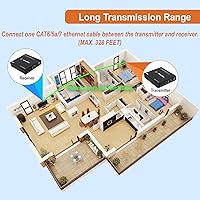
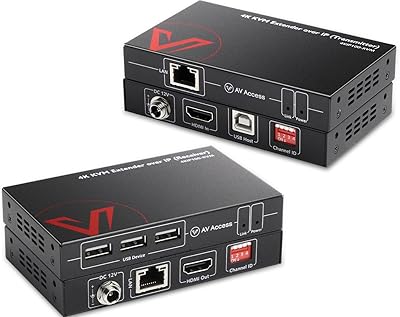
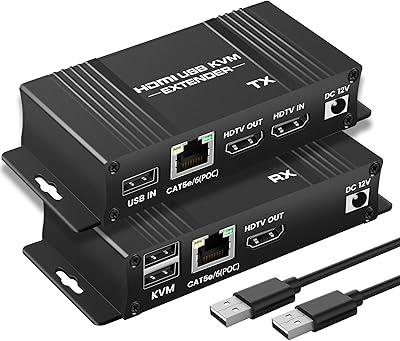
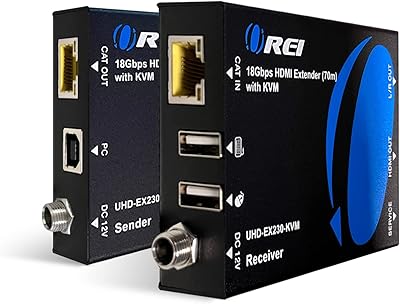
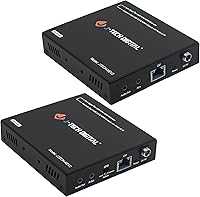
The J-Tech Digital JTECH-KVE2 KVM HDMI Extender solves a real problem that comes up constantly in offices, server rooms, and media installations: you need your display and input devices far from the actual computer. By running signals over ordinary Cat6 ethernet cable, this KVM extender can push 4K video and keyboard/mouse control up to 328 feet away — a distance that rules out almost every passive HDMI cable on the market. J-Tech Digital is a smaller, specialized AV brand with US-based customer support, which puts it in a different category than the generic no-name units flooding the lower end. Mid-range in price, it targets buyers who want reliable signal extension without enterprise-level costs.
Features & Benefits

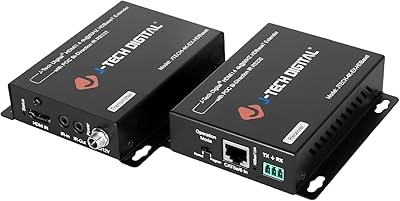
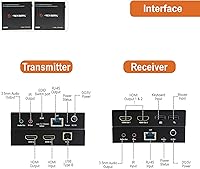
The most important thing to understand about the J-Tech extender unit before buying is what the USB side actually does. Those two USB ports on the receiver handle keyboard and mouse only — no storage drives, no webcams, no USB audio adapters. That said, for the use cases this device targets, that limitation rarely matters. On the video side, 4K at 30Hz works well for static content, document work, and presentations — just don't expect smooth playback of fast-moving video. Dual HDMI outputs on the receiver let you run two monitors at the remote end, while a local loop output on the transmitter keeps a display running at the source simultaneously. Audio extraction via 3.5mm jacks on both ends adds routing flexibility.

Best For

This HDMI-over-Cat6 solution fits a fairly specific buyer profile. IT managers routing a workstation signal across a warehouse floor, AV installers setting up digital signage installations where the PC needs to stay in a locked rack, or home theater enthusiasts who want a PC tucked away while the display sits across the room — these are the people who will get the most out of it. If you only need keyboard and mouse control at the remote end, the USB constraint stops being a drawback and just becomes the spec. Buyers who value US-based warranty support over the cheapest possible option will also find this a more trustworthy choice than anonymous alternatives.

User Feedback

Across 169 reviews, this KVM extender holds a 4.0-star average — solid, but the mix behind that number tells a more nuanced story. Buyers who praise it consistently highlight reliable signal quality at shorter runs and stress-free setup straight out of the box. Where things get rougher is at the distance limit: a handful of users report inconsistent performance when pushing close to 328 feet, and cable quality matters more than you might expect. The USB-keyboard-mouse-only restriction also trips up buyers who didn't read carefully. Support gets decent marks for responsiveness. With fewer than 200 reviews, this is a useful trend, not a definitive verdict — longer cable runs in particular introduce more variability.

Pros

  • Extends 4K video and keyboard/mouse control up to 328 feet over ordinary Cat6 cable.
  • Plug-and-play setup requires no driver installation — most users report being up and running in minutes.
  • Dual HDMI outputs on the receiver allow two monitors at the remote end simultaneously.
  • A local loop HDMI port on the transmitter keeps a source-side display active at the same time.
  • 3.5mm audio extraction on both units gives flexibility for third-party audio routing without adapters.
  • Lightweight and compact at just one pound, making installation and mounting straightforward.
  • US-based lifetime technical support is a genuine differentiator over no-name alternatives.
  • One-year manufacturer replacement warranty adds meaningful peace of mind for professional deployments.
  • Holds a 4.0-star average across nearly 170 reviews, with consistent praise for signal quality at moderate distances.
  • Works with widely available Cat6, Cat6a, or Cat7 cable — no proprietary or expensive cabling required.

Cons

  • USB ports on the receiver are limited strictly to keyboard and mouse — no storage, webcams, or USB audio devices.
  • 4K is capped at 30Hz, making it unsuitable for smooth video playback or any fast-moving visual content.
  • Some buyers report signal inconsistency when cable runs approach the 328-foot maximum.
  • Performance appears sensitive to cable quality — cheaper Cat6 runs can introduce reliability issues.
  • The USB limitation is not prominently communicated in marketing, leading to frustration for unprepared buyers.
  • No USB 3.0 support, which limits transfer speeds even for the peripheral types it does accept.
  • Lifetime support is US business-hours only, Monday through Friday, which may not suit international buyers or urgent overnight situations.
  • At this price tier, some competing units offer broader USB device compatibility worth comparing before committing.

Ratings

The scores below reflect our AI-driven analysis of verified global buyer reviews for the J-Tech Digital JTECH-KVE2 KVM HDMI Extender, with spam, bot-generated, and incentivized submissions actively filtered out before scoring. Each category is weighted against real-world usage patterns reported by IT professionals, AV installers, and home office users alike. Both the genuine strengths and the recurring frustrations are transparently reflected — no category has been inflated to flatter the product.

Signal Quality
83%
At cable runs under 200 feet, buyers consistently describe the picture as clean, stable, and artifact-free — exactly what you need for a permanent office workstation or digital signage display. The near-zero latency claim holds up well in practice for static desktop use, with no perceptible input lag during normal productivity tasks.
As runs approach the 328-foot ceiling, signal consistency becomes less predictable, with a notable minority of users reporting occasional dropouts or slight quality degradation. The 4K 30Hz ceiling also means fast-moving content can look less impressive than the resolution number implies.
Ease of Setup
91%
Plug-and-play installation is one of the most praised aspects across the review pool — most buyers report the unit working immediately after connecting the cables, with no driver downloads or configuration menus needed. IT staff and non-technical users alike appreciate that there is essentially no learning curve.
A small number of users ran into confusion around which HDMI port to use first, and the included documentation was flagged as sparse by a handful of buyers. Initial setup is simple, but troubleshooting without clearer printed guidance can be frustrating if something does not work right away.
USB Functionality
54%
46%
For users whose remote-end needs are limited strictly to a keyboard and mouse, the two USB 2.0 ports work reliably and without fuss. Response latency for keystrokes and mouse movement is minimal, making it a solid remote input solution for productivity workstations.
The hard limitation to keyboard and mouse only is the single most cited disappointment in negative reviews — buyers expecting to use USB storage, webcams, or USB audio devices at the remote end are left without options. This constraint is not prominently featured in the product marketing, which has caused genuine buyer frustration.
Video Resolution
76%
24%
For document work, spreadsheets, presentations, and static signage content, the 4K 30Hz output looks sharp and detailed on large displays. Users running dual-monitor setups at the remote end appreciate that both screens receive the same crisp signal without any perceptible quality difference between them.
The 30Hz refresh rate cap is a real-world limitation that shows up clearly with video playback or any animated content — motion looks noticeably choppier than on a native HDMI connection. Anyone expecting this to handle video editing previews or cinematic content smoothly will be disappointed.
Build Quality
78%
22%
The transmitter and receiver units feel solid and purposeful, with a construction quality that reads as appropriately mid-range — not flimsy, not over-engineered. Buyers who have used cheaper no-name alternatives consistently note that the J-Tech extender unit feels more durable and better finished.
The enclosures are plastic, and a few buyers in permanent rack-mount or behind-display installations noted they would prefer metal housings for added heat dissipation. There are no mounting holes or brackets included, which makes permanent installation slightly less tidy.
Cable Compatibility
69%
31%
Supporting Cat6, Cat6a, and Cat7 means buyers have genuine flexibility in cable choice, and the use of standard ethernet cable rather than proprietary cabling keeps long-run infrastructure costs reasonable. Most users already have compatible cable on hand or can source it locally without difficulty.
Performance appears meaningfully sensitive to cable quality — users who ran cheap or older Cat6 cable, particularly at longer distances, reported more inconsistency than those who used quality Cat6a or Cat7. The product works best when paired with well-made cabling, which adds a hidden cost variable some buyers do not anticipate.
Multi-Display Support
84%
The dual HDMI outputs on the receiver unit and the local loop output on the transmitter give this HDMI-over-Cat6 solution a genuinely useful three-display configuration that competitors at this price tier rarely match. IT managers setting up shared workstations or AV installers running dual signage panels find this flexibility particularly valuable.
There is no independent resolution control per HDMI output on the receiver — both ports mirror the same signal, so running two displays at different resolutions is not possible. For most use cases this is a non-issue, but it limits flexibility in more complex multi-screen environments.
Audio Extraction
72%
28%
Having a 3.5mm analog audio output on both the transmitter and receiver is a practical inclusion that allows audio to be routed independently of the displays — useful for conference room setups or installations where speakers are managed separately from monitors.
The 3.5mm extraction is analog only, which means buyers who need digital audio passthrough to an AV receiver or soundbar will need additional adapters. The audio quality itself is functional rather than audiophile-grade, and a few users noted slight background hiss when connecting to sensitive speaker systems.
Latency Performance
81%
19%
For typical PC desktop use — navigating applications, using office software, managing browser windows — the near-zero latency claim is backed up by buyer experience, with no perceptible delay between mouse movement and on-screen response. Remote desktop management and signage control feel as responsive as local operation for most users.
The latency performance is well-suited to office and productivity scenarios but is not tested or appropriate for gaming or interactive video applications. Buyers measuring latency with specialized tools have noted it is not literally zero, which matters in any timing-sensitive workflow.
Value for Money
77%
23%
For buyers whose use case fits squarely within its designed scope — office workstation extension, digital signage, or home theater PC routing — the price-to-performance ratio is considered fair by the majority of verified purchasers. The inclusion of US-based lifetime support adds tangible long-term value not found in cheaper alternatives.
Buyers who discover the USB limitation only after purchase feel the value proposition weakens considerably for their use case. At this price point, some competing units offer broader USB compatibility, which makes direct comparison shopping important before committing.
Long-Distance Reliability
63%
37%
At distances up to roughly 150 to 200 feet, the vast majority of buyers report stable and consistent performance with no signal management required after initial setup. For typical office or retail signage installations that fall within this range, reliability is rarely a complaint.
The picture changes notably as cable runs approach the advertised maximum, with a meaningful subset of users experiencing intermittent signal loss or reduced stability near 300 feet or beyond. Real-world results at the distance limit are variable enough that buyers planning long runs should treat 250 feet as a more conservative practical ceiling.
Warranty & Support
82%
18%
Lifetime technical support from a US-based team is a standout promise at this tier, and buyer feedback generally confirms that J-Tech Digital support staff are knowledgeable and responsive during business hours. The one-year replacement warranty also provides meaningful protection against early defects.
Support is only reachable Monday through Friday during Central Time business hours, which creates a gap for international buyers or anyone who runs into issues on a weekend. A handful of reviews mention slower-than-expected response times during peak periods, suggesting the support team may have capacity constraints.
Packaging & Documentation
61%
39%
The unit arrives well-protected and the box includes both transmitter and receiver, which is straightforward and clearly organized. Most buyers report that the physical packaging gives a professional first impression consistent with the product tier.
The included documentation is described as minimal by multiple buyers, with the quick-start guide lacking enough detail to cover less common installation scenarios. Users who hit any snag beyond the basic setup often have to reach out to support rather than being able to self-serve from the included materials.
Compatibility
68%
32%
The plug-and-play design means compatibility with standard Windows PC setups is broadly reliable, and HDCP 1.4 support covers most mainstream content protection requirements for business and signage use. Most common monitor brands work without any configuration adjustments.
Official compatibility is listed for PC only, leaving Mac and other platform users without a confirmed support path. A small number of reviews flag issues with specific monitor models or switcher configurations that required workarounds, suggesting edge-case compatibility is not fully predictable without testing.

Suitable for:

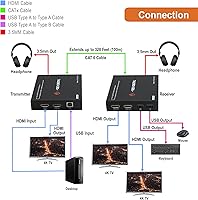
The J-Tech Digital JTECH-KVE2 KVM HDMI Extender is built for anyone who needs to physically separate a computer from its display and input devices over a serious distance. IT administrators managing workstations in large open-plan offices or warehouse environments will find this KVM extender especially practical, since it lets them keep the actual PC locked in a server room while staff work at a remote desk with a full keyboard, mouse, and monitor setup. Digital signage installers also benefit greatly here — the source PC can sit in a secured back-of-house location while the display runs up front, all without running proprietary cabling. Home theater enthusiasts who want a media PC hidden in a cabinet or closet while displaying on a large TV across the room are another natural fit. If your run is under 200 feet and your USB needs are limited to a keyboard and mouse, this HDMI-over-Cat6 solution is hard to argue with at its price point.
Not suitable for:

The J-Tech Digital JTECH-KVE2 KVM HDMI Extender is a poor choice for anyone expecting full USB functionality at the remote end. The two USB ports on the receiver are strictly limited to keyboard and mouse — plug in a USB drive, webcam, audio interface, or any other peripheral and you will get nothing. Gamers should also look elsewhere: 4K at 30Hz simply does not hold up for fast-moving content, and there is no high-refresh-rate support to speak of. If your cable run is pushing close to the advertised 328-foot maximum, real-world user reports suggest the reliability picture gets murkier, particularly with lower-grade Cat6 cable. Buyers on a tight budget who are tempted to cut corners on cabling should know that cable quality appears to have a meaningful impact on performance consistency. And anyone who needs to extend USB audio, touch displays, or storage devices remotely should look for a true full-USB KVM extender instead.
Specifications

  • Video Resolution: Supports 4K at 30Hz and 1080p full HD over the extension link.
  • HDMI Version: Uses HDMI 1.4, which covers 4K 30Hz and standard HD resolutions.
  • HDCP Support: Compatible with HDCP 1.4 for standard content protection compliance.
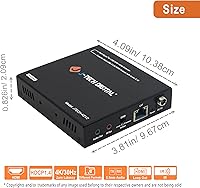
  • Max Distance: Extends signals up to 328 ft (100 meters) over Cat6, Cat6a, or Cat7 ethernet cable.
  • USB Ports: Two USB 2.0 ports on the receiver unit support keyboard and mouse devices only, operating at up to 480 Mbps.
  • HDMI Outputs: The receiver provides two HDMI output ports for connecting dual displays at the remote end.
  • Loop Output: A local loop HDMI output on the transmitter allows a monitor to remain active at the source location simultaneously.
  • Audio Output: Both the transmitter and receiver include a 3.5mm analog audio extraction port for routing audio to external speakers or processors.
  • Latency: The manufacturer rates latency as near-zero, making it suitable for standard PC desktop and productivity use.
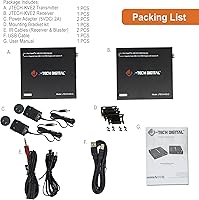
  • Cable Type: Requires Cat6, Cat6a, or Cat7 ethernet cable, sold separately, for the extension link between transmitter and receiver.
  • Driver Required: No software drivers are needed; the unit is fully plug-and-play on compatible systems.
  • Dimensions: The package measures 12.45 x 10 x 2.4 inches, housing both the transmitter and receiver units.
  • Weight: The complete package weighs approximately 1 pound.
  • Warranty: Covered by a one-year manufacturer replacement warranty from J-Tech Digital.
  • Tech Support: Free lifetime technical support is provided by a US-based team in Stafford, TX, available Monday through Friday, 9AM to 6PM CST.
  • Compatible Source: Designed for use with PC sources; compatibility with Mac or other platforms is not officially specified.
  • Model Number: Official model designation is JTECH-KVE2, manufactured by J-Tech Digital.

Related Reviews

J-Tech Digital WEX200V3 Wireless HDMI Extender
71%
71%
Signal Stability
86%
Setup & Installation
58%
Transmission Range
79%
Video Quality
47%
Latency
More
J-Tech Digital HDBaseT HDMI Extender
80%
91%
Signal Reliability at 1080p
67%
4K Performance
58%
Cable Quality Dependency
88%
HDCP 2.2 Compatibility
84%
Ease of Setup
More
J-Tech Digital JTECH-MV41A 4x1 HDMI Multi-Viewer
77%
88%
Display Mode Versatility
91%
Switching Performance
83%
4K Resolution Handling
74%
Audio Extraction
86%
Build Quality
More
AV Access HDEX80-KVM HDMI KVM Extender
82%
93%
Ease of Setup
84%
Video Signal Quality
88%
USB Peripheral Responsiveness
86%
Build Quality
89%
PoE Implementation
More
TESmart HKE12MMA20 HDMI KVM Extender
71%
78%
Signal Stability
74%
Video Quality
71%
Multipoint Topology Support
83%
Build Quality
63%
IR Pass-Through Reliability
More
VPFET HDMI KVM USB Extender 394ft/120M
84%
91%
Value for Money
88%
Ease of Setup
94%
Signal Stability
89%
Video Quality
75%
USB Compatibility
More
J-Tech Digital V638
J-Tech Digital V638
71%
83%
Ergonomic Comfort
61%
Build Quality
72%
Palm Rest Design
78%
Wireless Performance
81%
Battery Life
More
AV Access 4KIP100-KVM HDMI KVM Extender
76%
83%
Video Signal Quality
88%
Transmission Range
79%
USB Hub Functionality
61%
Network Compatibility & Setup
67%
DIP Switch Configuration
More
avedio links 164ft HDMI KVM USB Extender
86%
91%
Performance over Distance
88%
Setup Ease
92%
Video Quality
89%
USB Signal Stability
94%
Latency/Responsiveness
More
OREI EX-230PRO-KVM 4K HDMI KVM Extender
79%
86%
4K Picture Quality at Range
78%
Maximum Distance Reliability
61%
Cable Sensitivity
84%
Setup & Installation Ease
88%
HDCP & Streaming Compatibility
More

FAQ

No — and this is probably the most important thing to know before buying. The two USB ports on the receiver are strictly limited to keyboard and mouse input. Storage devices, webcams, USB audio interfaces, and other peripherals simply will not work through this extender. If you need full USB device support at the remote end, you will need a different product entirely.

The manufacturer specifies Cat6, Cat6a, or Cat7 for reliable operation at the full 328-foot range. Cat5e is not listed as a supported cable type, and based on user feedback, using lower-grade cabling tends to introduce signal inconsistency — especially at longer runs. Stick with quality Cat6 or better to avoid headaches.

For static and slow-moving content — think desktop applications, presentations, spreadsheets, or digital signage — the picture quality is generally reported as clean and sharp. Where it falls short is with fast-moving video content; 4K at 30Hz has an inherent motion smoothness ceiling, and this extender does not change that. It is not the right tool for watching sports or gaming at high refresh rates.

Yes. The receiver unit has two HDMI output ports, so you can run two displays simultaneously at the remote location. On top of that, the transmitter has a local loop HDMI output, meaning you can also keep a monitor active at the source end. That gives you a total of three displays across both units if needed.

No drivers or software are required. The J-Tech Digital JTECH-KVE2 KVM HDMI Extender is plug-and-play — connect your cables, power the units, and it should be recognized immediately by your system. Most buyers report getting up and running without needing to touch any settings.
This is where real-world results start to vary more noticeably. At shorter distances — generally under 200 feet — users report consistently solid performance. As you approach the upper end of the rated distance, some buyers have experienced intermittent signal issues, and cable quality appears to play a bigger role. Using a well-made Cat6a or Cat7 cable at long runs is a smart precaution.

The product is officially listed as compatible with PC sources, and J-Tech Digital does not specifically certify Mac compatibility. That said, since the video side is standard HDMI and the USB side only handles basic HID devices like keyboards and mice, there is a reasonable chance it would function on a Mac — but it is not guaranteed, and you would be outside the supported configuration if issues arose.

Both the transmitter and receiver have a 3.5mm headphone-style audio output port that pulls the audio signal out of the HDMI stream and makes it available as a standard analog audio signal. This is useful if you want to route sound to a speaker system or amplifier that does not accept HDMI audio. If your display handles audio fine on its own, you can simply ignore these ports.

J-Tech Digital offers free lifetime technical support through a US-based team in Stafford, Texas, available on weekdays during standard business hours. User reviews suggest support is reasonably responsive and knowledgeable, though after-hours or weekend help is not available. The one-year manufacturer replacement warranty also provides a meaningful safety net if a unit turns out to be defective.

It is actually one of the more natural use cases for this KVM extender. The PC can sit secured in a back office or equipment room while the display runs up front — and since you only need a keyboard and mouse at the remote end for occasional interaction, the USB limitation is a non-issue in a typical signage workflow. The dual HDMI receiver outputs are a bonus if you are driving more than one screen from a single source.