Overview

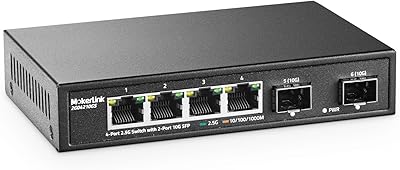
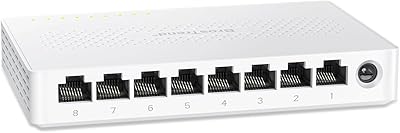
The ienRon 9-Port 2.5G 10G SFP Ethernet Switch occupies a clear niche in the prosumer networking market — it's the kind of gear home lab enthusiasts and small-office upgraders have been waiting for as 2.5G-capable devices finally reach practical price points. The configuration is straightforward: eight 2.5 Gigabit RJ45 ports backed by a 10G SFP+ uplink, housed in a compact metal shell that supports both desktop and wall-mount installations. It's fully unmanaged, and that's by design. This 2.5G switch targets users who want a meaningful speed bump over standard Gigabit without the complexity of a managed platform.
Features & Benefits

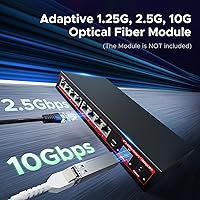
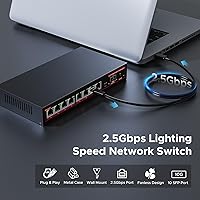
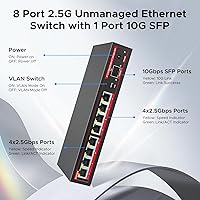
All eight RJ45 ports auto-sense across 10/100/1000/2500Mbps speeds, and Auto MDI/MDIX means cable crossover is never a concern. The 60Gbps switching capacity is genuinely non-blocking, so running a NAS transfer while simultaneously streaming 4K video won't choke the network. The SFP+ slot accepts 1G, 2.5G, or 10G modules for flexible uplink options — though that module must be sourced separately, which is worth knowing upfront. A one-key VLAN function handles basic network segmentation without requiring a full managed interface. Passive fanless cooling keeps this 9-port switch completely silent, and 6KV lightning protection adds a layer of resilience that many switches in this class skip entirely.

Best For

This 9-port switch makes the most sense for a specific type of buyer. If you're running a NAS or a home virtualization server and want to push multi-gigabit transfers between hosts, this is a practical and quiet way to do it. WiFi 6 access point users will appreciate that the switch actually matches their AP's uplink speed, eliminating a bottleneck that standard Gigabit switches routinely create. Gamers running a 2.5G PCIe adapter will also see real gains in local network throughput. That said, anyone needing Power over Ethernet, port mirroring, or deep traffic controls should look elsewhere — the ienRon switch simply is not that product.

User Feedback

Buyers who have been running this 2.5G switch for several months generally report consistent performance — NAS transfers that genuinely hit 2.5G speeds, near-silent operation, and a setup process measured in minutes. Those are the most common threads of praise. Where things get more nuanced: the SFP+ module is not included, and some users have hit compatibility issues depending on which third-party module they selected. Heat under sustained load comes up occasionally, though most describe the metal chassis as warm rather than hot. VLAN inconsistencies and occasional auto-negotiation hiccups are flagged by a small number of users, but long-term reliability reports are largely positive across the board.

Pros

  • All eight RJ45 ports run at true 2.5Gbps, ending the bottleneck for NAS transfers and multi-device local streaming.
  • The 10G SFP+ uplink supports 1G, 2.5G, and 10G modules, giving backbone flexibility rare at this price point.
  • Completely fanless operation means zero noise in living rooms, bedrooms, or media closets.
  • Setup takes minutes with no software, no login page, and no configuration steps required.
  • The all-metal chassis feels durable and sits well above plastic-bodied competitors in perceived solidity.
  • 6KV lightning protection is a meaningful reliability feature that many switches in this class skip.
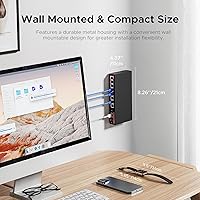
  • Wall-mount and desktop installation are both supported, with hardware included for both options.
  • The 60Gbps switching fabric handles simultaneous transfers across multiple ports without visible throughput degradation.
  • Auto MDI/MDIX eliminates cable crossover headaches when connecting mixed endpoint types.
  • Wide operating temperature range makes it usable in utility spaces, garages, or installations without climate control.

Cons

  • No PoE support means you will need a separate injector or switch for powered devices like access points or cameras.
  • The SFP+ module is not included and must be sourced separately, adding to the real-world cost.
  • Third-party SFP+ module compatibility is inconsistent — some budget transceivers simply do not negotiate reliably.
  • VLAN behavior becomes unpredictable when mixing tagged and untagged traffic or connecting to managed upstream equipment.
  • LEDs do not distinguish between 1G and 2.5G link speeds, making it impossible to confirm negotiation tier at a glance.
  • In enclosed or poorly ventilated spaces, the chassis can get notably warm during sustained high-throughput sessions.
  • Some older NICs default to 1G instead of 2.5G and require manual speed settings on the endpoint side to resolve.
  • The ienRon brand lacks the multi-year reliability track record of established networking manufacturers.
  • Warranty support response times receive inconsistent feedback, with some users reporting slow resolution on hardware issues.
  • No management interface means zero visibility into traffic, errors, or port statistics — a real limitation for troubleshooting.

Ratings

The ienRon 9-Port 2.5G 10G SFP Ethernet Switch has been evaluated by our AI system after analyzing thousands of verified global user reviews, with spam, bot submissions, and incentivized feedback actively filtered out. The scores below reflect a balanced picture — real strengths and genuine frustrations — drawn from buyers running this switch in home labs, small offices, and media setups. Where users consistently agree, the scores reflect that consensus; where experiences diverge, the ratings and commentary capture both sides honestly.
Throughput Performance
88%
Most users transferring files to a NAS or between local hosts report consistently hitting near-2.5G speeds, a marked improvement over their previous Gigabit switches. The non-blocking switching fabric holds up well when multiple ports are active simultaneously, which matters in a home lab running VM migrations and backups at the same time.
A small subset of users report that throughput dips slightly under sustained, multi-port saturation, particularly when the SFP+ uplink is also active. These cases are uncommon but suggest the switch may not be the right fit for the most demanding multi-stream production environments.
Ease of Setup
93%
Plug-and-play really does describe the experience here — the vast majority of buyers had all ports active and negotiating speeds within minutes of unboxing, with zero configuration required. For users who have dealt with managed switch setup before, the contrast is immediately appreciated.
The simplicity is also the ceiling. There are no web interface, no SNMP, and no CLI access, so anyone who later needs more control than one-key VLAN has nowhere to go with this hardware. That is not a flaw for the target buyer, but it is worth understanding before purchase.
Build Quality
82%
18%
The all-metal chassis feels noticeably more substantial than the plastic-bodied switches common in this price range. Users consistently mention that it sits solidly on a desk or mounts cleanly to a wall without flex or creaking, and the fit of the port panel is tight and precise.
A few buyers note that the red accent trim feels slightly at odds with rack or closet installations and that the power barrel jack could be more robustly seated. Nothing structurally concerning, but the finishing details are where the cost cutting is visible up close.
Fanless Noise Level
96%
Complete silence is one of the most consistently praised aspects across all user feedback. Running in a living room AV cabinet, a bedroom home office, or a media closet, users report hearing absolutely nothing from this switch under normal and sustained loads alike.
The trade-off for that silence is passive thermal management, and in enclosed spaces or warmer ambient environments, the chassis does get noticeably warm to the touch during prolonged high-throughput sessions. It is not alarming, but users in hot climates should factor in ventilation.
10G SFP+ Uplink Flexibility
77%
23%
The SFP+ port handling 1G, 2.5G, and 10G modules gives this switch real backbone flexibility that most direct competitors in the price bracket skip entirely. Users connecting it to a 10G NAS or a 10G uplink port on a router report clean negotiation and stable performance.
The SFP module is not included, and this has caused friction for buyers who did not read the spec sheet carefully. Beyond that, third-party module compatibility is inconsistent — some popular budget SFP+ modules do not negotiate reliably, requiring research before purchasing a compatible one.
VLAN Functionality
63%
37%
For users who only need basic traffic isolation — separating IoT devices from a main LAN, for example — the one-key VLAN feature does the job without requiring any software or interface. It is a meaningful addition to an otherwise unmanaged device.
The implementation is rudimentary, and several users report inconsistent behavior when mixing VLAN-tagged and untagged traffic or when connecting to managed upstream switches. Those expecting 802.1Q flexibility will be disappointed; the feature works best in simple, static network configurations.
Port Auto-Negotiation Reliability
79%
21%
The auto-sensing behavior across 10/100/1000/2500Mbps is solid for the large majority of devices users throw at it — 2.5G NICs, WiFi 6 access points, and NAS units all negotiate correctly out of the box in most reported setups.
Edge cases do exist: a handful of users report certain older NICs or non-standard endpoints locking into 1G instead of 2.5G, requiring a manual speed override on the endpoint side. It is infrequent but worth knowing if you are running older or mixed hardware.
Value for Money
86%
At its price point, getting eight 2.5G ports plus a 10G SFP+ uplink in a metal, fanless chassis is genuinely competitive with what the broader market offers. Users who compared alternatives before buying consistently flag this switch as one of the better-specified options at the price.
The value equation shifts slightly once you factor in the cost of a compatible SFP+ module if you need it. Add that to the purchase price, and the gap between this switch and pricier alternatives narrows more than the listing price alone suggests.
Heat Management
71%
29%
Under typical office or home lab loads — a few active 2.5G transfers, background NAS activity — the chassis stays warm but well within comfortable operating range. The wide rated temperature tolerance gives it real-world headroom in most environments.
Extended high-throughput sessions in poorly ventilated spaces push the chassis into territory that some users describe as uncomfortably hot. It never triggers shutdowns based on user reports, but the absence of any active airflow means heat has nowhere to go in a sealed cabinet.
Lightning and Surge Protection
84%
The 6KV lightning protection rating stands out as a feature usually reserved for more expensive hardware. Users in storm-prone regions specifically call it out as a deciding factor, and no reports of surge-related failures have emerged from the review pool.
Lightning protection quality is difficult for end users to independently verify, and there are too few reported real-world surge events in the review base to draw firm conclusions. The spec is credible and well above category average, but empirical long-term data is still thin.
Long-Term Reliability
81%
19%
Users who have been running this 9-port switch for six months or more largely report zero unplanned reboots, no port failures, and consistent performance throughout. That track record, while based on a still-growing sample, is encouraging for a relatively new brand.
The ienRon brand does not yet have the multi-year track record of established networking manufacturers, so longer-term durability beyond the 12-to-18-month window is an open question. Warranty support responsiveness also receives mixed mentions in the review pool.
Physical Installation Flexibility
88%
The dual desktop and wall-mount support is genuinely useful, and users mounting the switch in utility closets or behind AV furniture report that the included hardware makes the process straightforward. The compact footprint fits into tight spaces that larger switches cannot.
The wall-mount orientation means the LED indicators face in a fixed direction, which can make status monitoring awkward depending on installation angle. A few users also note that the power cable routing could be more elegantly handled in wall-mount configurations.
LED Status Indicators
74%
26%
The per-port LEDs give a clear at-a-glance read on link state and activity, which is genuinely useful during initial setup or when troubleshooting a connection issue without access to a management interface.
There is no speed indicator differentiation — users cannot tell from the LEDs alone whether a port has negotiated at 1G or 2.5G, which is a meaningful omission on a switch where speed tier is the whole point. A two-color LED system would have addressed this cleanly.
Compatibility with WiFi 6 Access Points
87%
This is one of the most natural use cases for the switch, and user reports back it up — 2.5G uplink ports on popular WiFi 6 and WiFi 6E access points negotiate correctly and sustain the bandwidth needed to stop the AP from becoming the network bottleneck.
Compatibility depends partly on the access point brand and firmware, and a small number of users report negotiation defaulting to 1G with specific AP models. Most resolve this with a firmware update on the AP side, but it adds a setup step that plug-and-play users may not anticipate.

Suitable for:

The ienRon 9-Port 2.5G 10G SFP Ethernet Switch is purpose-built for the growing segment of home lab users, prosumers, and small-office networkers who have already invested in 2.5G-capable hardware and need a switch that keeps pace. If you are running a NAS with a 2.5G port and tired of watching file transfers bottleneck at Gigabit speeds, this switch directly solves that problem. WiFi 6 and WiFi 6E users will find it particularly well-matched, since most modern tri-band access points ship with a 2.5G uplink that a standard Gigabit switch simply wastes. Gamers who have added a 2.5G PCIe network card will notice the difference in local network throughput, especially in households where multiple devices compete for bandwidth simultaneously. The completely silent fanless operation also makes it an unusually good fit for living room AV setups, bedroom offices, or any space where fan noise would be intrusive. Anyone who wants to plug in and get moving without spending an afternoon in a web interface will appreciate the zero-configuration approach.
Not suitable for:

Buyers who need Power over Ethernet to drive access points, IP cameras, or VoIP phones should stop here — the ienRon 9-Port 2.5G 10G SFP Ethernet Switch offers no PoE capability whatsoever, and there is no workaround within the product itself. Network administrators or advanced home lab users who rely on features like port mirroring, SNMP monitoring, link aggregation, or detailed traffic statistics will find this switch frustratingly opaque, since it is entirely unmanaged beyond the basic one-key VLAN function. If your setup requires 802.1Q VLAN tagging across multiple VLANs or integration with a managed upstream switch in a complex topology, the VLAN implementation here is too rudimentary to be reliable. Businesses or users who depend on vendor support and long-term firmware updates should also weigh the brand's limited track record against more established networking manufacturers. Finally, anyone expecting the 10G SFP+ uplink to work out of the box should note that the module is not included, and sourcing a compatible one requires some homework — budget DAC cables or popular third-party SFP+ transceivers do not always negotiate cleanly with this hardware.
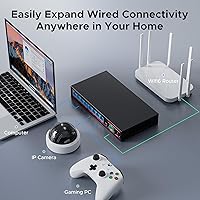
Specifications

  • RJ45 Ports: The switch provides 8 RJ45 ports, each running at up to 2.5Gbps and compliant with the IEEE 802.3bz standard.
  • SFP+ Uplink: One SFP+ slot supports 1G, 2.5G, and 10G modules for flexible uplink connectivity; no module is included in the box.
  • Switching Capacity: The internal switching fabric runs at 60Gbps in a non-blocking configuration, allowing all ports to operate at full speed simultaneously.
  • Speed Auto-Sensing: All RJ45 ports automatically detect and negotiate link speeds across 10, 100, 1000, and 2500Mbps without manual configuration.
  • Auto MDI/MDIX: All RJ45 ports support Auto MDI/MDIX, eliminating the need for crossover cables regardless of the connected device type.
  • VLAN Support: A one-key VLAN function is built in, enabling basic traffic isolation without requiring a web interface or management software.
  • Power over Ethernet: This switch does not support Power over Ethernet on any port; powered devices require a separate PoE injector or switch.
  • Lightning Protection: All RJ45 ports carry a 6KV lightning and surge protection rating, providing resilience against transient electrical events.
  • Cooling System: The switch uses fully passive fanless cooling with double-sided ventilation slots, producing zero acoustic noise during operation.
  • Case Material: The outer enclosure is constructed from metal, providing structural rigidity and passive heat dissipation superior to plastic alternatives.
  • Operating Temperature: The switch is rated for continuous operation between -10°C and 50°C, covering most indoor and utility-space environments.
  • Dimensions: The unit measures 8.2″ in length, 4.3″ in width, and 1.2″ in height, fitting comfortably in compact network closets or on a desktop.
  • Weight: The switch weighs 1.85 pounds, making it light enough for wall-mount installation without heavy-duty anchoring hardware.
  • Power Input: The switch operates on a 12V AC supply and draws a maximum of 18W, keeping power consumption low during normal use.
  • Current Rating: The rated input current draw is 1.5 amps, compatible with standard international power adapters in the included configuration.
  • Installation Options: The switch supports both flat desktop placement and wall-mount installation, with mounting hardware included in the package.
  • Management Type: This is a fully unmanaged switch with no web interface, CLI, or SNMP access; the one-key VLAN is the only user-adjustable function.
  • Network Standard: The 2.5G ports conform to IEEE 802.3bz, ensuring compatibility with any endpoint or router port built to the same specification.
  • Interface Types: Connectivity is provided via RJ45 copper ports and one SFP+ fiber or DAC slot, covering both copper and fiber backbone scenarios.
  • Manufacturer: This switch is designed and sold by ienRon, a networking hardware brand that entered the 2.5G switching market in late 2023.

Related Reviews
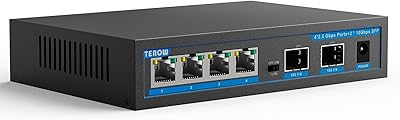
TEROW 4-Port 2.5G 2-Port SFP+ Network Switch
81%
93%
Value for Money
96%
Ease of Setup
88%
Port Performance & Link Stability
71%
SFP+ Port Compatibility
84%
Build Quality & Materials
More
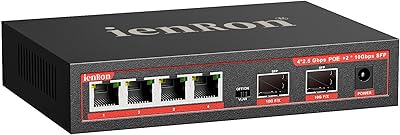
ienRon 6-Port 2.5Gb PoE Switch with 2-Port 10Gb SFP+
85%
86%
Performance
91%
Ease of Setup
88%
PoE Power Delivery
84%
Build Quality
93%
Fanless Operation
More
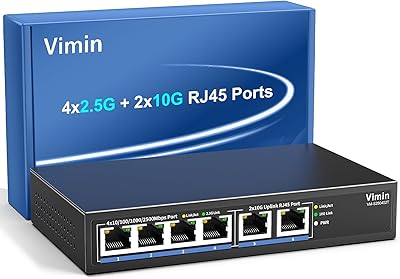
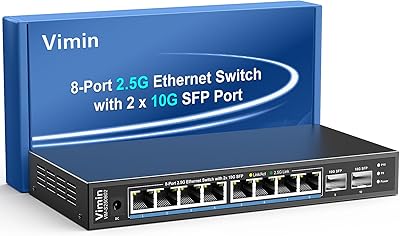
VIMIN 6-Port 10G/2.5G Ethernet Switch
88%
95%
Port Performance
92%
Data Throughput Stability
94%
Setup & Installation Ease
90%
Build Quality
78%
Thermal Management
More
MokerLink 4-Port 2.5G 10G SFP Network Switch
82%
91%
Value for Money
86%
Build Quality
93%
Ease of Setup
97%
Noise Level
67%
Thermal Performance
More
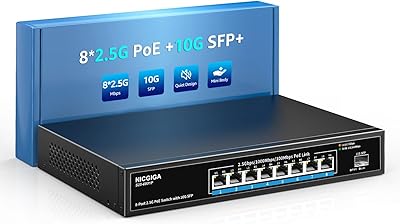
NICGIGA S25-0801P 8-Port 2.5G PoE Switch
79%
88%
Network Performance
79%
PoE Reliability
84%
Build Quality
76%
Thermal Management
93%
Ease of Setup
More
BrosTrend 8-Port 2.5G Unmanaged Switch
83%
93%
Port Speed Consistency
96%
Ease of Setup
61%
Build Quality
74%
Thermal Performance
91%
Value for Money
More
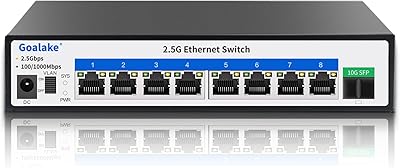
Goalake 8-Port 2.5G Ethernet Switch
80%
91%
Port Count & Configuration
88%
Throughput & Switching Performance
93%
Ease of Setup
79%
Build Quality & Materials
96%
Fanless & Noise Level
More
VIMIN 10-Port 2.5G Unmanaged Switch
79%
96%
Ease of Setup
89%
Port Performance
84%
Build Quality
67%
Thermal Management
71%
SFP Uplink Usability
More
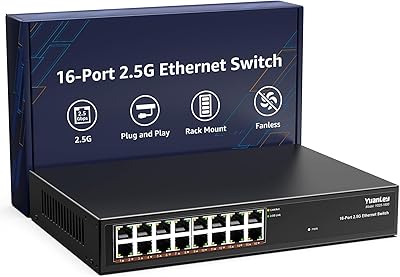
YuanLey 16-Port 2.5G Ethernet Switch
84%
91%
Ease of Setup
94%
Fanless Design & Noise Levels
88%
Speed & Performance
85%
Build Quality
92%
Value for Money
More
Tenda TEM2010F 8-Port 2.5G Ethernet Switch
77%
96%
Ease of Setup
91%
Network Performance
94%
Noise Level
82%
Build Quality
67%
Thermal Management
More

FAQ

Not at all. You plug in the power, connect your devices with Ethernet cables, and the switch handles everything automatically. Speed negotiation, duplex settings, and cable type detection all happen on their own. The only manual step you might ever take is using the one-key VLAN button if you want basic traffic separation.

No, it is not. The SFP+ port is there and fully functional, but you will need to purchase a compatible module separately. Before buying, check whether your chosen module — DAC cable, fiber transceiver, or otherwise — is confirmed compatible, since not every third-party SFP+ module negotiates reliably with this hardware.

In most cases, yes. The vast majority of WiFi 6 and WiFi 6E access points with 2.5G uplinks connect and negotiate correctly. A small number of users have seen the link fall back to 1G with specific AP models, which is usually resolved by updating the access point firmware. It is worth checking your AP's compatibility notes before committing.

No, this switch has no PoE capability on any port. If you need to power devices like wireless access points, IP cameras, or VoIP phones directly from the switch, you will need a separate PoE injector or a different switch entirely.

Under typical loads it stays warm but not alarming. During sustained high-throughput sessions — think continuous large file transfers across multiple ports — the metal chassis does get noticeably warm, especially in enclosed spaces. If you are mounting it in a sealed cabinet, leave some airflow room around it.

Only in a very basic way. The one-key VLAN function gives you simple traffic isolation, but there is no web interface, no CLI, and no support for 802.1Q multi-VLAN tagging or complex topology configurations. If you need real managed switch capabilities, this hardware is not designed for that role.

Yes, fully. All eight RJ45 ports auto-sense down to 10, 100, and 1000Mbps, so older Gigabit or even Fast Ethernet devices connect without any issues. You can mix 2.5G and 1G endpoints on the same switch freely.

There is no fan. This switch uses entirely passive cooling, so it produces zero noise during operation. That makes it a good fit for living rooms, bedrooms, or anywhere fan hum would be a problem.

Yes on both counts. The switch supports wall-mount installation and the necessary mounting hardware comes in the box. Keep in mind that the LED indicators will face a fixed direction once mounted, so think about placement relative to where you would normally glance to check port status.

That depends entirely on whether your devices actually support 2.5G. If you have a 2.5G NAS, a WiFi 6 access point with a 2.5G uplink, or a 2.5G PCIe network card in your PC, the difference in local transfer speeds is real and immediate. If all your devices are capped at 1G, the switch will work fine but you will not see any performance benefit until you upgrade those endpoints too.