


Overview

The Hisense 75U7K 75-inch Mini-LED QLED TV occupies a compelling spot in the mid-to-premium market — large enough to transform a living room, yet priced significantly below what Samsung or LG charge for comparable specs. The real differentiator is the Mini-LED backlighting, which clusters thousands of smaller LEDs into independently controlled dimming zones, delivering contrast that standard full-array sets simply can't match. Google TV rounds out the package as a capable smart platform for streaming households. Honest takeaway: this is a strong picture performer relative to its price, but shoppers expecting OLED-level black depth will find trade-offs worth knowing about.

Features & Benefits

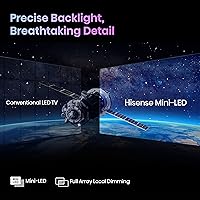
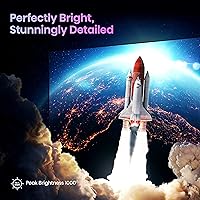
Full Array Local Dimming is where this set earns its keep. Unlike edge-lit panels that bleed light uniformly, the zone-based system lets dark scenes stay genuinely dark while bright highlights pop — not perfectly, but noticeably better than standard LED. The native 144Hz panel keeps fast motion clean; sports panning and action sequences hold together without obvious judder. At 1000 nits peak, HDR highlights land with real impact in a daylit room, though that figure is peak output rather than a sustained average. For gaming, Game Mode Pro pairs with two HDMI 2.1 ports and a wide VRR range, making the 75U7K a legitimate choice for PS5 and Xbox Series X owners.

Best For

This 75-inch QLED TV makes the most sense for a few specific types of buyers. Console and PC gamers get genuine value from the 144Hz native refresh, HDMI 2.1 bandwidth, and VRR support — the kind of spec combination that used to cost significantly more. Sports viewers will appreciate how fluid live broadcasts look at this refresh rate on a screen this size. Households with bright, sun-facing living rooms benefit from the peak brightness ceiling keeping HDR watchable even in glare. And if you're cutting cable and relying entirely on streaming apps, Google TV's broad library covers essentially every major platform. It's less ideal for dedicated home theater setups where black-level accuracy trumps everything else.

User Feedback

Owner sentiment around this Hisense Mini-LED set sits at a solid 4.3 stars, and reading through the reviews, the satisfaction is fairly consistent: buyers who prioritized picture quality per dollar tend to be the happiest. The most repeated praise centers on image quality for the price, gaming performance, and the sheer impact of a 75-inch screen. Where criticism shows up, it clusters around a few predictable areas — blooming in dark scenes when local dimming works hard, a so-so remote, and Google TV's habit of surfacing promoted content rows before your actual apps. Out-of-box calibration runs a bit warm; a quick manual adjustment typically fixes it. Long-term owners report solid build quality with no widespread reliability concerns.

Pros

  • Mini-LED Full Array Local Dimming delivers contrast that standard LED sets at this size simply cannot match.
  • Native 144Hz refresh rate keeps sports and fast action genuinely smooth, not just artificially processed.
  • Two HDMI 2.1 ports support 4K at 144Hz, making the 75U7K a capable long-term gaming display.
  • Peak brightness of 1000 nits keeps HDR highlights punchy even in sun-facing living rooms.
  • Wide VRR range (48–144Hz) reduces screen tearing across a broad range of frame rates.
  • Quantum Dot color coverage produces vivid, natural-looking HDR on well-mastered content.
  • Google TV provides access to virtually every major streaming platform without extra hardware.
  • At 75 inches, the sheer screen size creates an immersive viewing experience for groups.
  • Dolby Vision IQ adjusts HDR tone mapping based on ambient light, which actually works well in practice.
  • Owners consistently report solid build quality with no widespread long-term reliability concerns.

Cons

  • Blooming around bright objects in dark scenes is noticeable and cannot be fully tuned out.
  • Out-of-box color temperature runs warm; buyers who skip calibration may never see the panel at its best.
  • The included remote feels cheap relative to what competitors bundle at this price point.
  • Google TV promotes content rows aggressively, which clutters the home screen until you reorganize it.
  • 1000-nit brightness is a peak figure, not a sustained one — real-world average brightness is lower.
  • At nearly 90 pounds, wall-mounting this 75-inch QLED TV typically requires two people and a sturdy mount.
  • The 2.1-channel built-in audio is adequate but uninspiring; a soundbar will be a near-necessity for serious viewers.
  • Local dimming aggressiveness can cause some content to look crushed in shadow areas if not adjusted carefully.

Ratings

The scores below reflect an AI-driven analysis of thousands of verified global owner reviews for the Hisense 75U7K 75-inch Mini-LED QLED TV, with spam, bot-generated, and incentivized feedback actively filtered out before scoring. Each category is weighted against real usage patterns — from daily streaming to competitive gaming — so both the genuine strengths and the honest frustrations are represented without sugarcoating.

Picture Quality
88%
Owners consistently describe the image as punchy and detailed, particularly when watching HDR films or 4K streaming content in a moderately lit room. The Quantum Dot color layer gives skin tones and natural scenery a richness that most LED sets at this size simply don't deliver.
Dark scene performance is where opinions diverge — blooming around subtitles or bright objects in night sequences is a recurring complaint that even careful local dimming adjustments don't fully resolve. Reviewers upgrading from OLED panels tend to rate this category lower than first-time buyers.
Contrast & Local Dimming
79%
21%
The Full Array Local Dimming system produces genuinely deep blacks compared to edge-lit competitors, and most owners notice an immediate improvement during dark movie scenes. For mixed content like sports or action films with varied lighting, the zone control works well enough to keep bright and dark areas balanced.
Push the local dimming to its highest setting and blooming becomes obvious — halos appear around logos, HUD elements in games, and bright credits on dark backgrounds. Several reviewers noted that the middle dimming settings feel like the practical sweet spot, meaning the top-tier contrast performance is effectively locked behind a visible trade-off.
Brightness
83%
In a living room with afternoon sunlight streaming through windows, this 75-inch QLED TV holds its own better than most sets in its class — HDR highlights stay visible and color doesn't wash out. Owners in bright apartment settings repeatedly cite the brightness headroom as a deciding factor in their purchase.
The 1000-nit figure is a peak measurement, not what you see during a typical full-screen scene, and some buyers feel misled when everyday content doesn't match that ceiling. Sustained brightness during long, uniformly bright scenes is noticeably lower, which can affect the perceived impact of non-HDR content.
Gaming Performance
91%
PS5 and Xbox Series X owners are among the most enthusiastic reviewers — HDMI 2.1, VRR across a wide range, and Game Mode Pro combine to produce a responsive, tear-free experience that punches well above the price bracket. At 75 inches with 144Hz native refresh, fast-paced games like racing titles and shooters feel genuinely fluid.
Auto Low Latency Mode occasionally fails to trigger when switching between inputs, requiring a manual mode toggle that shouldn't be necessary at this tier. A small number of PC gamers also reported minor compatibility quirks at 4K 144Hz that required driver or settings adjustments to resolve.
Motion Handling
86%
Live sports in particular benefit from the 144Hz native panel — fast panning during football or basketball broadcasts stays coherent without the soap-opera effect that plagues over-processed motion on cheaper sets. Film content with motion smoothing turned off also holds up well, preserving cinematic cadence.
The default motion processing settings are too aggressive for most users, adding an artificial smoothness to cinematic content that many find off-putting. Getting to the right balance requires digging into the menu system, which is not intuitive for buyers less familiar with display settings.
Color Accuracy
77%
23%
In Cinema or Filmmaker mode, after a manual warm-up calibration, colors land in a natural and pleasing place — foliage, ocean shots, and complexion tones all read as convincing. HDR content on well-mastered streaming titles shows wide color volume that holds detail in both saturated reds and subtle pastels.
Out of the box, the default Vivid or Standard modes push saturation and color temperature into warm, oversaturated territory that looks punchy in a store but inaccurate at home. Buyers who skip manual calibration are effectively not seeing the panel at its true capability.
Smart TV Platform
74%
26%
Google TV covers every major streaming service without gaps, and voice search through Google Assistant is fast and accurate for finding content across platforms in one query. Chromecast built-in is a practical bonus for households that cast regularly from phones or tablets.
The home screen prioritizes promoted content rows above the user's own app library, which irritates a meaningful segment of owners who feel like they're navigating an ad before their own TV. The interface has improved over older Hisense software, but the sponsored content layout still feels like it serves the platform more than the viewer.
Value for Money
89%
This is consistently the highest-praised dimension in user reviews — buyers comparing the 75U7K to equivalently specced Samsung or LG models note that the gap in real-world picture performance rarely justifies the premium those brands command at 75 inches. For the combination of screen size, Mini-LED technology, and gaming specs, the price-to-performance ratio is hard to argue with.
A handful of reviewers who upgraded from higher-end flagship sets feel the value narrative breaks down in the details — especially in dark-room contrast and peak brightness sustain — and wish Hisense had been more conservative with its spec claims. The remote and software experience also feel budget-tier relative to the overall price paid.
Build Quality
81%
19%
The chassis and panel feel solid for a TV in this class, and long-term owners across multiple review platforms report no widespread panel degradation or hardware failures after 12-plus months of regular use. The bezel-less design looks clean and modern in most room setups.
The stand design draws occasional criticism for feeling less substantial than the TV it supports — some owners opt to wall-mount the set partly because the stand wobbles slightly on softer surfaces. The back panel plastic, while functional, has a budget feel that contrasts with the front's premium appearance.
Remote Control
58%
42%
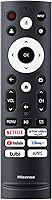
The remote covers all essential functions and includes a dedicated Google Assistant button, which is genuinely convenient for voice-based channel switching and app launching without navigating menus manually.
The physical construction is the most consistently criticized accessory complaint in user reviews — it feels lightweight and plasticky relative to what competitors ship at this price point. Button travel is shallow, and the layout takes time to learn, which frustrates buyers coming from more ergonomically refined remotes.
Audio Quality
62%
38%
For casual daytime viewing — morning news, sitcoms, background streaming — the built-in 2.1-channel system is loud enough to fill a medium-sized room without distortion at moderate volume levels. Dialogue clarity in talk-heavy content is reasonably clean.
Movie soundtracks and gaming audio quickly expose the system's limitations: bass is thin, dynamic range compresses under action sequences, and the overall sound stage feels narrow for a 75-inch screen. The majority of buyers who care about audio report adding a soundbar within the first month of ownership.
Setup & Installation
72%
28%
The initial Google TV onboarding is straightforward, and most streaming accounts can be restored from a Google profile without re-entering credentials manually, which speeds up first-day setup considerably. Stand assembly is tool-minimal and took most owners under 20 minutes.
At nearly 90 pounds, physically placing the TV is a two-person job without exception, and wall mounting requires a study surface and hardware that are not included. A few reviewers flagged confusing menu navigation during the first calibration pass, particularly for buyers not experienced with advanced picture settings.
HDR Performance
84%
Dolby Vision IQ content — particularly on Apple TV Plus and Netflix — looks genuinely impressive, with the tone mapping adjusting visibly and correctly when room lighting changes. Well-mastered 4K HDR titles show specular highlights and shadow detail simultaneously in a way that standard HDR10 sets at this price rarely manage.
HDR performance is content-dependent to a degree some buyers find frustrating — poorly mastered HDR streams occasionally look flat or over-brightened, and the set doesn't compensate as gracefully as higher-end processors do. Some owners also noted that switching between HDR formats mid-viewing session causes a brief black screen.
Connectivity
87%
Four HDMI ports, dual USB, Ethernet, Wi-Fi, and Bluetooth cover virtually every connection scenario a modern household faces — gamers, streamers, and cable subscribers can all plug in simultaneously without running out of ports. The two HDMI 2.1 ports being full-bandwidth is a meaningful differentiator at this price.
The physical port layout on the back panel is recessed in a way that makes cable management awkward, particularly for thicker HDMI cables used with gaming consoles. A few users also reported inconsistent Wi-Fi stability in environments with crowded 2.4GHz bands, though the Ethernet option resolves this entirely.

Suitable for:

The Hisense 75U7K 75-inch Mini-LED QLED TV is a strong match for buyers who want a large, high-performance screen without paying flagship prices. Gamers with a PS5 or Xbox Series X will get real mileage from the native 144Hz panel, two HDMI 2.1 ports, and wide VRR range — these aren't just spec checkboxes, they translate to noticeably smoother, more responsive gameplay at 4K. Sports fans also land squarely in the target audience, since the motion handling keeps fast-panning live action looking clean on a screen this size. If your living room gets significant daytime light, the peak brightness ceiling means HDR content remains watchable rather than washed out. Cord-cutters and streaming-first households will find Google TV covers every major app without needing an external stick or box. Anyone coming from a mid-range LED set a few years old will notice an immediate and meaningful upgrade in contrast and color depth.

Not suitable for:

Buyers who prioritize absolute black-level accuracy and cinematic shadow detail should look elsewhere — the Hisense 75U7K 75-inch Mini-LED QLED TV, like all Mini-LED sets, still produces measurable blooming around bright objects against dark backgrounds, and no amount of local dimming tuning eliminates it entirely. Dedicated home theater enthusiasts who watch a lot of content in a fully darkened room will likely find an OLED panel more satisfying, even at a higher price. Those who dislike tinkering with picture settings may be frustrated by the out-of-box calibration, which runs warm and benefits from manual adjustment. Buyers who expect a premium remote experience will find the included controller a bit plasticky and basic for a TV at this tier. Finally, anyone sensitive to software clutter should know that Google TV still surfaces promoted content rows prominently, which can feel intrusive before you settle into your preferred app layout.

Specifications

  • Screen Size: The panel measures 75 inches diagonally, providing a wide cinematic viewing area suited for living rooms and open-plan spaces.
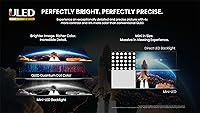
  • Display Technology: Uses Mini-LED QLED (ULED) backlighting with Quantum Dot color enhancement for improved contrast and color volume over standard LED panels.
  • Resolution: Native 4K UHD (3840 x 2160) resolution delivers sharp detail across streaming, gaming, and broadcast content.
  • Refresh Rate: The panel runs at a native 144Hz refresh rate with a 480 motion rate, reducing motion blur in fast-paced sports and gaming content.
  • Peak Brightness: Capable of reaching 1000 nits at peak output, which supports impactful HDR highlights, though sustained brightness during normal viewing is lower than this figure.
  • Local Dimming: Full Array Local Dimming uses independently controlled LED zones across the entire back panel to deepen blacks and improve contrast in dark scenes.
  • HDR Support: Compatible with Dolby Vision IQ, HDR10, and HLG formats, with Dolby Vision IQ dynamically adjusting tone mapping based on ambient room lighting.
  • Smart Platform: Runs Google TV, providing access to major streaming apps, Google Assistant voice search, and Chromecast built-in for casting from mobile devices.
  • Gaming Features: Game Mode Pro includes VRR support across a 48–144Hz range and Auto Low Latency Mode (ALLM) for reduced input lag when a compatible console is connected.
  • HDMI Ports: Equipped with four HDMI ports total, two of which are full-bandwidth HDMI 2.1 supporting 4K resolution at up to 144Hz for next-generation console and PC gaming.
  • USB Ports: Includes one USB 3.0 and one USB 2.0 port for connecting external storage drives or other peripheral devices.
  • Audio Output: Built-in 2.1-channel speaker system with 50W total output; adequate for casual viewing, though a soundbar is recommended for immersive audio.
  • Connectivity: Supports dual-band Wi-Fi, Bluetooth, Ethernet (wired LAN), HDMI, and USB for flexible wired and wireless device connections.
  • Voice Assistants: Compatible with both Google Assistant (built-in) and Amazon Alexa, allowing hands-free control and smart home device integration.
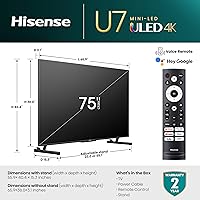
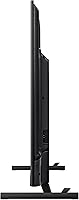
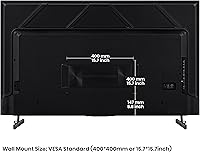
  • Dimensions: With the stand attached, the TV measures 65.9″ wide, 40.4″ tall, and 3.1″ deep; without the stand it sits significantly shallower for wall-mount installations.
  • Weight: The set weighs approximately 89.8 pounds with the stand, so wall mounting or positioning typically requires two people and appropriate hardware.
  • Power Draw: Rated at 260W during standard operation, with a 120V power requirement; energy consumption will vary based on brightness settings and content type.
  • Included Items: Ships with a power cable, remote control, TV stand with mounting hardware, and two AAA batteries for the remote.

Related Reviews
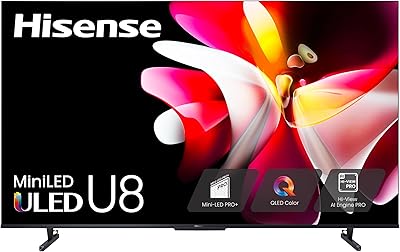
Hisense 75-Inch U8 Series Mini-LED ULED 4K TV
85%
94%
Display Quality
89%
Gaming Performance
85%
Smart Features
91%
Build Quality
71%
Sound Quality
More
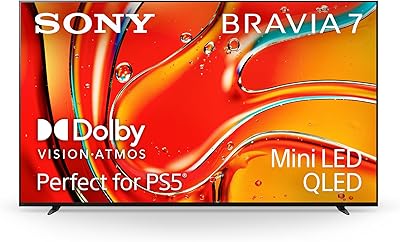
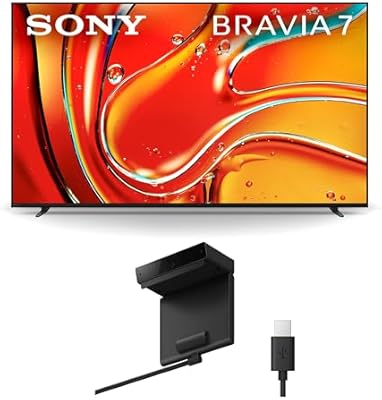
Sony BRAVIA 7 75-inch Mini LED TV
79%
91%
Picture Quality
88%
Gaming Performance
86%
HDR Performance
72%
Smart TV Experience
78%
Contrast & Black Levels
More
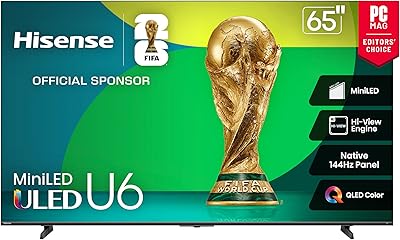
Hisense U6 65-inch Mini-LED 4K Smart TV
78%
84%
Picture Quality
91%
Gaming Performance
82%
HDR Performance
79%
Motion Handling
76%
Local Dimming & Contrast
More
Hisense 55U8N 55-Inch Mini-LED Smart TV
80%
91%
Picture Quality
83%
Contrast & Black Levels
93%
Brightness & HDR
94%
Gaming Performance
86%
Color Accuracy
More
LG QNED80 Series 75-Inch 4K Mini LED Smart TV
84%
91%
Picture Quality
88%
Gaming Performance
84%
Smart Features & Usability
79%
Sound Quality
93%
Build Quality
More
Sony BRAVIA 7 55-inch 4K QLED TV
77%
88%
Picture Quality
91%
Gaming Performance
86%
Brightness & HDR
84%
Color Accuracy
77%
Smart TV Experience
More
Hisense 85-inch U8QG Mini-LED Smart TV
81%
91%
Picture Quality
93%
Brightness & HDR Performance
84%
Contrast & Local Dimming
89%
Gaming Performance
86%
Motion Handling
More
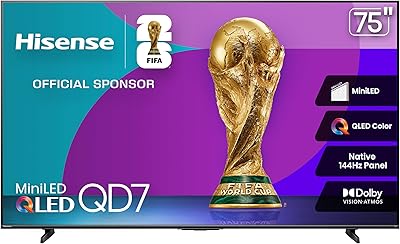
Hisense 75-inch QD7 Mini-LED 4K Smart TV
75%
83%
Picture Quality
81%
Gaming Performance
78%
Motion Handling
79%
HDR Experience
82%
Color Accuracy
More
TCL 85-Inch QM8 QLED Mini LED TV
76%
93%
Picture Brightness
76%
Contrast & Black Levels
84%
Color Accuracy
89%
Gaming Performance
78%
Motion Handling
More
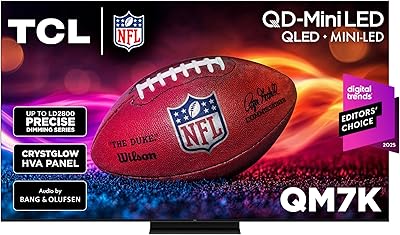
TCL 75-inch QM7K Mini LED QLED TV
80%
88%
Picture Quality
82%
Local Dimming Performance
91%
Gaming Performance
86%
Anti-Reflective Panel
71%
Smart TV Experience
More

FAQ

4K at 144Hz is available specifically on the two HDMI 2.1 ports. The other two HDMI ports are 2.0 and max out at 4K/60Hz, so if you want the highest refresh rate from a PC or a next-gen console, make sure you plug into one of those two HDMI 2.1 connections.

Blooming is a real trade-off on the 75U7K, and it's worth being upfront about that. In very dark scenes with small bright elements — subtitles, stars in space shots, street lights at night — you will see a faint halo of light around those objects. It's less severe than cheaper LED sets, but it is visible if you're watching in a fully darkened room. If dark-room accuracy is your top priority, an OLED panel would serve you better.

Yes, fully. Both consoles connect via the HDMI 2.1 ports and take advantage of VRR, ALLM, and 4K at up to 120Hz. The 75U7K also supports the higher 144Hz ceiling for PC gaming, though current consoles cap at 120Hz for now.

The default picture mode tends to run warm with oversaturated colors — it's calibrated to look vivid on a bright showroom floor, not in a home. Most owners find switching to Cinema or Filmmaker mode, then manually nudging the color temperature toward a cooler setting, makes a significant difference. Turning local dimming down one notch from maximum also reduces blooming noticeably without killing contrast.

Yes, though the experience is limited. All four HDMI inputs, both USB ports, and the antenna tuner work completely offline. You just won't have access to Google TV apps or streaming services, and over-the-air software updates won't download. For a basic cable box or Blu-ray setup, it works fine without a network connection.

Google TV on this set is generally responsive — app switching and navigation don't feel sluggish the way older Hisense software did. That said, the home screen does push promoted content and sponsored rows above your own apps, which takes some reorganizing to get the layout the way you want it. Once you've set up your personal row of favorite apps, daily use is pretty smooth.

Two people can manage it, but the 89.8-pound weight means you should plan carefully. Make sure your wall mount is rated for the weight and VESA pattern, and have one person hold the TV flush while the other attaches the bolts. It's not a one-person job under any circumstances.

The 2.1-channel 50W system is passable for casual news and sitcom watching, but it lacks bass depth and struggles with dynamic movie audio. If you're planning to use this 75-inch QLED TV for movies or gaming in a larger room, a soundbar will make a meaningful difference. It's not unlistenable out of the box, but most owners who care about audio end up adding one within a few weeks.

Better than most TVs in this category. The 1000-nit peak capability means HDR content stays punchy and readable in a room with natural light coming in from windows. It won't completely overpower direct sunlight the way some premium outdoor displays can, but for a typical bright living room, glare handling is noticeably better than what you'd get from a standard LED set.

Input lag drops significantly when Game Mode Pro is active — that's where you get the low-latency performance ideal for gaming. In the standard TV or Cinema picture modes, input lag is higher and more appropriate for passive viewing. The TV can detect connected gaming consoles automatically via ALLM and switch modes on its own, which is convenient so you don't have to toggle it manually every time.