Overview

The Hifonics ZD-1950.1D Mono Car Amplifier sits in a crowded but competitive middle tier of the car audio market, where buyers want real performance without paying flagship prices. As part of the Zeus Delta lineup, this mono amp steps noticeably above the no-name budget units you find at discount retailers — the nickel-plated chassis alone signals that Hifonics put some thought into durability. It is compact at just over 12 inches long, which matters when you are working around spare tires or shallow trunk floors. The mid-range price point sets a clear expectation: solid, dependable bass amplification without exotic features or audiophile-grade components.

Features & Benefits

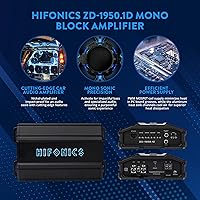
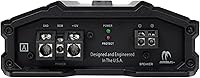
The Zeus Delta amplifier runs on a PWM MOSFET power supply, which keeps voltage delivery stable even when the music gets punishing — that consistency is what separates it from cheaper amps that clip and distort under load. At 1 ohm you are pulling nearly 1,950 watts, but the design also scales sensibly to 2 and 4 ohm loads if your subwoofer demands it. The DC Signal Sense auto turn-on is a genuinely useful feature for installs where running a remote wire is awkward, though it does require a clean DC signal from your head unit to trigger reliably. Angled RCA inputs and a molded terminal block make wiring less of a headache, and the LED protection indicators on the end panel give you a quick visual read on the amp's status.

Best For

This mono amp is a natural fit for anyone building a dedicated subwoofer stage without wanting to spend flagship money. If you are dropping a 12-inch or 15-inch sub into a hatchback or sedan trunk and need an amp that will not eat up the entire cargo area, the compact footprint makes placement straightforward. It is also a solid choice for DIY installers who would rather avoid the extra step of running a remote turn-on wire — the auto turn-on handles that without fuss, provided your source unit puts out a reliable DC signal. Users stepping up from entry-level amplifiers will find the headroom and stability a noticeable improvement, though anyone expecting competition-level output or ultra-precise tuning controls may want to look at pricier options.

User Feedback

Across nearly 100 reviews, the Zeus Delta amplifier holds a 4.1-star average — a score that reflects genuine satisfaction with occasional reservations. Most buyers are pleased with the power delivery, noting the amp drives their sub with authority and does not clip under moderate listening levels. Installation also gets consistent praise; the wiring layout is logical and the auto turn-on works reliably for most users. Where opinions divide is on heat — some owners running this Hifonics unit hard in warmer climates mention it gets uncomfortably warm, which is worth monitoring if trunk airflow is restricted. A handful of longer-term owners have raised questions about build longevity, and a few noted the wattage rating felt slightly optimistic under real-world conditions.

Pros

  • Stable power delivery via PWM MOSFET supply keeps bass tight and controlled even at higher volumes.
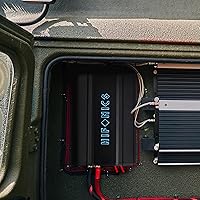
  • The compact 12.4-inch length fits easily in trunk builds where space is genuinely limited.
  • DC Signal Sense auto turn-on works reliably for most installs and skips the remote wire hassle entirely.
  • Angled RCA inputs make cable routing noticeably cleaner in cramped mounting locations.
  • LED indicators on the end panel let you spot overload or short-circuit issues at a glance.
  • The nickel-plated, impact-resistant chassis feels more substantial than comparable amps at this price point.
  • Scales well across 1, 2, and 4 ohm loads, giving flexibility when pairing with different subwoofers.
  • Bass remote is included in the box, which is a small but appreciated addition.
  • A 4.1-star average across nearly 100 real buyer reviews suggests consistent satisfaction for typical use cases.
  • Straightforward molded terminal block makes the initial wiring process less intimidating for DIY installers.

Cons

  • Heat management can become a real issue when the amp is pushed hard in an enclosed trunk with poor airflow.
  • Some buyers report the rated wattage feels optimistic compared to actual output under sustained real-world listening.
  • The auto turn-on feature depends on a clean DC signal; vehicles with noisy or weak head unit outputs may experience unreliable triggering.
  • A handful of longer-term owners have raised questions about how well the unit holds up beyond the first year of use.
  • No built-in parametric EQ or adjustable subsonic filter limits fine-tuning options for more demanding setups.
  • The external 100A fuse rating means you need to factor in proper fusing during install, which adds a small extra step.
  • At higher impedance loads the power output drops significantly, so pairing with a 4 ohm sub reduces the value proposition.
  • Customer support experiences reported by some buyers have been inconsistent when issues arise post-purchase.

Ratings

The Hifonics ZD-1950.1D Mono Car Amplifier has been evaluated by our AI rating engine after analyzing verified buyer reviews from global markets, with spam, bot-submitted, and incentivized feedback actively filtered out before scoring. The result is a transparent breakdown that reflects where this mono amp genuinely impresses and where real owners have run into frustration. Every score below — high or low — is grounded in patterns drawn from authentic user experiences.

Power Output
78%
22%
Most buyers find that this mono amp moves air with real authority, particularly when paired with a well-matched subwoofer at 1 or 2 ohms. For daily street listening and moderate bass setups, the output headroom feels generous compared to entry-level alternatives at a similar price.
A recurring theme in user feedback is that the peak wattage figure does not fully translate under sustained real-world conditions, which is an industry-wide issue but still catches some buyers off guard. Those expecting the rated number to hold consistently at high volume for extended sessions tend to be the most disappointed.
Heat Management
61%
39%
The aluminum heat sink does a credible job under moderate use, and buyers who mount the Zeus Delta amplifier in open or semi-ventilated locations report no serious thermal complaints during typical listening sessions. For casual daily use, the amp holds its temperature within acceptable limits.
Push this Hifonics unit hard in a sealed trunk during summer months and heat becomes a genuine concern — multiple owners flag thermal throttling or protection mode activation as a frustrating pattern. Installers who do not plan for adequate airflow around the chassis are the ones most likely to experience reliability issues.
Ease of Installation
86%
The angled RCA inputs and molded terminal block consistently earn praise from both first-time installers and experienced hands who appreciate a tidy, logical wiring layout. The DC Signal Sense auto turn-on is a particular highlight for anyone who has ever wrestled with running a remote wire through a firewall.
The auto turn-on feature has a meaningful caveat — it needs a stable, clean DC trigger signal to work reliably, and some head units do not deliver that consistently. A small but vocal group of buyers report the amp turning on randomly or failing to trigger at all, which usually requires troubleshooting the source signal rather than the amp itself.
Build Quality
74%
26%
The nickel-plated chassis gives a noticeably more premium first impression than the bare plastic housings common at this price tier, and the impact-resistant finish holds up well to the bumps and vibration of mobile environments. Buyers generally feel the external construction justifies the mid-range price.
While the exterior looks and feels solid, a subset of longer-term owners raise questions about internal component longevity after extended high-demand use. The confidence in build quality appears stronger in the first year of ownership than it does in multi-year assessments from more experienced users.
Value for Money
79%
21%
For buyers upgrading from a basic budget amp, the Zeus Delta amplifier represents a meaningful step up in both output quality and feature set without requiring a flagship investment. The inclusion of a bass remote in the box adds practical value that competing units at this price sometimes omit.
Buyers who compare real-world sustained output against the rated peak spec sometimes feel the value calculation is less favorable than it first appears. If your expectations are anchored to the maximum wattage figure, the effective cost-per-usable-watt ends up higher than the sticker price implies.
Bass Performance
82%
18%
Paired with a quality 12-inch or 15-inch subwoofer at a low impedance load, this mono amp delivers tight, controlled low-end reproduction that most listeners find satisfying for both music and bass-heavy tracks. The MOSFET power supply contributes to a stable, consistent signal that keeps bass from sounding loose or clipped at moderate volumes.
At 4 ohms the output drops considerably, and buyers who pair this amp with higher-impedance subs notice a tangible reduction in perceived impact. It is not a dealbreaker, but it does narrow the subwoofer compatibility range for those wanting full performance.
Thermal Protection
71%
29%
The onboard protection circuitry reliably catches overload and short-circuit events before damage occurs, and the LED indicators make it easy to identify when the amp has entered protection mode rather than leaving the owner guessing. Several users specifically credit this feature with saving their setup during wiring mistakes.
The protection system triggers relatively conservatively under heat stress, which some users interpret as the amp shutting down prematurely rather than continuing to push. In poorly ventilated installs, this means the protection circuit becomes a recurring inconvenience rather than a last-resort safeguard.
Diagnostic Indicators
83%
The LED status panel on the end plate is one of those small design decisions that experienced installers genuinely appreciate — a quick visual check tells you whether the amp is in protection, overloaded, or operating normally without needing a multimeter. For troubleshooting mid-install, it saves real time.
The indicator system is functional but basic, offering limited granularity about the nature of a fault beyond a general protection-mode signal. Advanced users looking for more descriptive diagnostic feedback will find it underwhelming compared to higher-end amplifiers with more detailed status reporting.
Compact Footprint
88%
At just over 12 inches in length, this mono amp fits comfortably in trunk builds where larger class-D amps would require awkward mounting compromises. Under-seat installations are possible in many vehicles, giving installers more flexibility in designing a clean, hidden setup.
The compact size does come with the thermal trade-off mentioned elsewhere — less chassis surface area means the heat sink has less room to dissipate heat at peak demand. Buyers should treat size and thermal performance as a linked variable rather than independent advantages.
RCA Input Quality
76%
24%
The angled RCA inputs are well-positioned for practical cable routing, and users report solid signal integrity with minimal noise or interference during normal operation. For a mono subwoofer application, the input stage handles source signals cleanly enough to satisfy most listeners.
A small number of users have noted occasional ground loop noise that required additional troubleshooting to resolve, suggesting the input stage is sensitive to wiring quality and vehicle grounding conditions. This is not unique to this amp class but worth flagging for less experienced installers.
Compatibility
77%
23%
The ability to load at 1, 2, or 4 ohms gives genuine flexibility when choosing a matched subwoofer, and most standard aftermarket head units pair with the auto turn-on system without issue. For typical street builds, compatibility hurdles are rare.
The DC Signal Sense turn-on method introduces a compatibility dependency that wired remote connections avoid entirely, and some OEM or budget head units simply do not output a reliable enough signal for consistent auto triggering. Buyers with factory head units or unconventional source hardware should verify compatibility before committing.
Long-Term Reliability
63%
37%
For buyers who install this Hifonics unit correctly, maintain reasonable listening levels, and ensure adequate ventilation, the amp performs without incident through the first year of ownership and beyond in many cases. Short to mid-term reliability in normal use conditions is generally satisfactory.
Patterns in longer-term reviews raise enough questions about component endurance under sustained high-demand use to temper enthusiasm about multi-year reliability. It is not a consistent failure pattern, but the uncertainty is reflected meaningfully enough in user feedback to score this category conservatively.
Packaging & Accessories
72%
28%
The inclusion of a bass remote control is a genuine plus that not every competing amp at this price provides, and the packaging is adequate for protecting the unit during shipping. First impressions out of the box are generally positive among buyers.
Beyond the bass remote, the accessory kit is minimal — no mounting hardware of note and no wiring kit, which means first-time buyers need to budget for additional components before the install is complete. For a mid-range product, a slightly more complete out-of-box experience would improve the overall value perception.

Suitable for:

The Hifonics ZD-1950.1D Mono Car Amplifier is purpose-built for the enthusiast who wants a serious subwoofer setup without committing to a high-end build budget. If you are working with a single sub in a compact trunk or hatchback, this mono amp delivers the kind of headroom that genuinely moves air without requiring a massive installation footprint. It is a strong match for DIY installers who want a straightforward wiring experience — the DC Signal Sense auto turn-on removes one of the more tedious steps in a typical amp install. Buyers stepping up from an entry-level unit will notice an immediate improvement in bass control and output stability, particularly at moderate to high volumes. The Zeus Delta amplifier also suits anyone who values visual feedback during troubleshooting, since the LED protection indicators make diagnosing problems faster than guessing by ear.

Not suitable for:

The Hifonics ZD-1950.1D Mono Car Amplifier is not the right tool for every car audio project, and it is worth being clear about where it falls short. Buyers chasing competition-level SPL numbers or expecting every watt of the rated output to translate directly into real-world performance may come away disappointed — like most amplifiers at this price tier, peak figures and sustained output under real load are different conversations. If your vehicle has poor trunk ventilation or you plan to run this Hifonics unit at high volume for extended periods in warm climates, heat buildup is a genuine concern that proper installation planning needs to address. Audiophiles who prioritize fine-grained tuning controls, such as parametric EQ or subsonic filter adjustment, will find the feature set fairly basic. Lastly, buyers who need to power a full multi-channel system should look elsewhere entirely, as this is strictly a single-channel mono design with no provisions for running door speakers or tweeters.

Specifications

  • Model Code: This amplifier carries the official model designation ZD-1950.1D within the Hifonics Zeus Delta series.
  • Configuration: Single-channel mono block design, purpose-built for driving one subwoofer or a dedicated bass load.
  • Max Power Output: Rated at 1,950 watts maximum power at a 1 ohm load under peak conditions.
  • Power at 2 Ohms: Delivers up to 975 watts RMS into a 2 ohm load for compatible subwoofer configurations.
  • Power at 4 Ohms: Outputs up to 450 watts into a 4 ohm load, suitable for higher-impedance subwoofer pairings.
  • Power Supply: Uses a PWM MOSFET switching power supply for stable and efficient voltage conversion during operation.
  • Fuse Rating: Requires an external 100A fuse, which must be sourced and installed separately as part of the wiring setup.
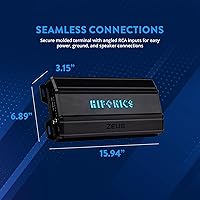
  • Dimensions: The amplifier measures 12.4 × 5.8 × 2.2 inches, keeping the footprint manageable for trunk and under-seat installs.
  • Heat Management: An integrated aluminum heat sink runs along the chassis to channel and dissipate thermal buildup during extended use.
  • Turn-On Method: Features DC Signal Sense auto turn-on, which detects a DC signal from the head unit and powers the amp without a dedicated remote wire.
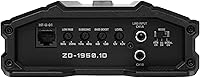
  • Inputs: Equipped with angled RCA inputs that allow cable entry at an angle, making routing easier in confined installation spaces.
  • Terminals: Uses a molded connection terminal block for power, ground, and speaker connections, providing a secure and organized wiring interface.
  • Protection System: Built-in circuitry guards against overload and speaker short-circuit conditions, with illuminated LED indicators on the end panel for real-time status feedback.
  • Finish: The chassis features a nickel-plated, impact-resistant exterior designed to withstand the physical demands of mobile installation environments.
  • Impedance Loads: Compatible with 1 ohm, 2 ohm, and 4 ohm subwoofer loads, giving flexibility when selecting a matching driver.
  • Channels: Operates as a single-channel amplifier only, with no provision for multi-channel or stereo speaker output.
  • Bass Remote: A bass level remote control is included in the package, allowing convenient gain adjustment from the driver seat.
  • Brand Family: Part of the Hifonics Zeus Delta lineup, positioned as a mid-tier performance series above the brand's entry-level offerings.

Related Reviews
Hifonics BXX1200.1D Mono Car Subwoofer Amplifier
79%
88%
Power Output Accuracy
91%
Thermal Management
86%
1-Ohm Stability
79%
Ease of Installation
74%
Build Quality
More
Hifonics BXX4000.1D Brutus 4000W RMS Mono Car Amplifier
86%
94%
Power Output
93%
Bass Performance
88%
Build Quality
86%
Ease of Installation
72%
Thermal Performance
More
Hifonics BG-1900.1D Brutus Gamma Mono Amplifier
76%
88%
Bass Output & Power Delivery
84%
Value for Money
67%
Thermal Management & Heat Tolerance
76%
Build Quality & Construction
86%
Ease of Installation
More
Hifonics ZD-750.4D 4-Channel Car Amplifier
74%
83%
Ease of Installation
77%
Sound Quality
68%
Power Output
71%
Thermal Management
74%
Build Quality
More
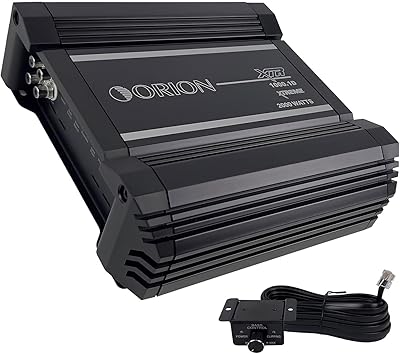
Orion XTR1000.1D Monoblock Class D Car Amplifier
79%
83%
Power Output Accuracy
88%
Bass Performance
61%
Thermal Management
79%
Build Quality
86%
Ease of Installation
More
Rockville dB15 Mono Car Amplifier
73%
83%
Value for Money
78%
Bass Output
86%
Ease of Installation
61%
Thermal Management
58%
Power Accuracy
More
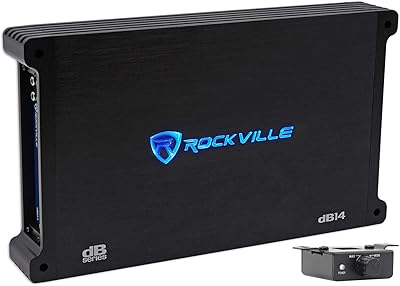
Rockville dB14 Mono Class-D Car Amplifier
74%
83%
Value for Money
78%
Power Accuracy
67%
Build Quality
54%
Long-Term Reliability
86%
Ease of Installation
More
Planet Audio AC4000.1D Monoblock Car Amplifier
77%
88%
Value for Money
79%
Power Output
82%
Thermal Management
67%
Build Quality
63%
Installation Experience
More
Rockville dBcomp5 Mono Car Amplifier
75%
88%
Verified Power Output
82%
Build Quality
91%
Onboard Tuning Flexibility
87%
1-Ohm Stability
79%
Remote Sub Control
More
Rockville dB11 Mono Class-D Car Amplifier
82%
91%
Value for Money
86%
Bass Output
88%
Ease of Installation
83%
Signal Clarity & THD
67%
Build Quality
More

FAQ

That is correct for most setups. The DC Signal Sense feature detects a signal from your head unit and triggers the amp automatically. That said, it does depend on a clean, consistent DC signal — some budget or aftermarket head units with noisy outputs can cause the amp to turn on and off erratically, so it is worth testing your setup before calling the install done.

It pairs well with single subwoofers in the 10-inch to 15-inch range, particularly those with lower impedance ratings where the amp can deliver more of its power. A quality 12-inch or 15-inch sub running at 1 or 2 ohms will let this Hifonics unit really stretch its legs. If your sub is rated at 4 ohms, you will still get usable output but significantly less of the amp's rated headroom.

It might, depending on the vehicle. At just over 12 inches long and about 2.2 inches tall, it is relatively compact for its power class, but under-seat clearance varies widely by car model. Measure your available depth and height carefully before committing to that mounting location, and make sure there is at least some airflow around the heat sink.

Like most high-wattage mono amps in this size range, it does generate noticeable heat under extended or heavy use. The aluminum heat sink manages thermals reasonably well in a ventilated space, but if you mount it in a sealed enclosure or a trunk with poor airflow and push it hard for long sessions, it will get warm. Installing it in an open or semi-open location makes a real difference in long-term reliability.

No — this is strictly a single-channel mono block amp, meaning it is designed exclusively for subwoofer duty. It cannot be split or bridged to run door speakers or tweeters. If you need a full system setup, you would pair this with a separate multichannel amp for your speakers.

Honestly, treat the 1,950-watt figure as a peak rating rather than a continuous output number, which is standard practice across the industry. Real-world RMS output at a stable 1 ohm load will be lower. That said, buyers generally find the amp performs with authority and does not feel underpowered relative to its price class — just go in with realistic expectations rather than expecting the peak number at all times.

Given the 100A external fuse requirement, a 4-gauge power and ground wire is the typical recommendation for this class of amplifier. Some installers prefer to step up to 1/0 gauge if the run from the battery is long or if the system will be pushed regularly at high output levels. Always keep the power wire fused as close to the battery as possible.

A bass remote is included in the box, which is a welcome detail since some competing amps at this price leave it out. It lets you adjust the subwoofer level from the driver seat without reaching back to the amp — useful for fine-tuning between different music types on the fly.

The LEDs on the end panel light up when the amp detects an overload condition or a speaker short circuit. In practice, this means if your sub stops producing sound, a quick glance at the panel tells you whether the amp has gone into protection mode rather than leaving you guessing. It is a simple feature but saves real time during diagnostics.

For most buyers, yes — the step up in power headroom and build quality is noticeable. If you have been running a 500-watt budget amp and felt like your sub was not reaching its potential, the Zeus Delta amplifier offers a meaningful improvement in dynamic range and low-end control. The jump to a dedicated MOSFET power supply also means less compression and more consistent output, which is something entry-level amps rarely deliver well.

Where to Buy