Overview

The Hifonics BG-1900.1D Brutus Gamma Mono Amplifier sits in an interesting spot — it's a dedicated subwoofer amp priced where serious bass builders shop when they don't want to stretch into boutique territory. Hifonics built the Brutus Gamma line for people who want real output without paying for a prestige badge. The Super D Class topology is worth understanding: it runs more efficiently than traditional Class AB designs, which translates to less heat generated per watt delivered. That efficiency affects how the amp behaves during extended listening sessions, not just on paper. The all-aluminum chassis reinforces that thermal advantage physically. Just know going in: this monoblock amp is designed for one job — powering subwoofers — and it doesn't try to be anything else.

Features & Benefits

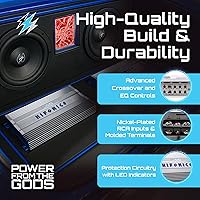
The power scaling on this car subwoofer amplifier is one of its most practical strengths. Running a dual-voice-coil sub wired to 2 ohms, you're pulling around 950 watts. Drop to a 1-ohm load and you hit the full rated output. That flexibility lets you match the amp to a wide range of subwoofer configurations without guesswork. The variable low-pass crossover is built in, so there's no external unit added to the signal chain. An onboard bass EQ gives you a boost option when the head unit falls short. The wired bass remote is a genuinely useful inclusion — adjusting levels from the driver's seat without touching the amp becomes second nature fast. Nickel-plated, angled connector terminals keep wiring cleaner and more corrosion-resistant over time.

Best For

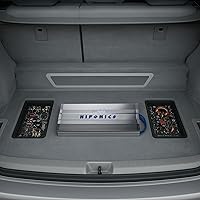
This monoblock amp is well suited for anyone building around a single high-power subwoofer — whether that's a ported enclosure chasing loud, full lows or a sealed box tuned for tighter, more controlled bass. Budget-conscious builders who want genuine output without stepping into premium amp pricing will find it competitive. Physically, it's not a compact unit, but at 12.75 by 8.25 inches it fits reasonably into most trunk amp racks without extensive custom work. The included remote knob adds real value for daily drivers where bass levels need quick adjustment between environments. If you're coming from a factory amp or a basic entry-level unit, the noticeable power jump will be immediately apparent on the right subwoofer pairing.

User Feedback

The Brutus Gamma carries a solid 4.4-star average, and working through buyer experiences, that rating holds up with some honest caveats. Most owners say bass output is strong for the price tier — the amp delivers noticeably more authority than budget alternatives they'd used before. The wiring layout earns consistent praise for being approachable, even for first-time installers. On the flip side, some users report the unit runs warm under sustained high-volume use, making proper ventilation in your install a real consideration rather than an afterthought. A smaller portion flagged long-term reliability questions beyond the first year, though that isn't the dominant trend. Buyers who correctly matched impedance to their subwoofer setup consistently report the highest satisfaction.

Pros

  • Scalable power output lets you match the amp to a wide range of subwoofer impedance configurations without extra hardware.
  • The built-in low-pass crossover removes the need for an external unit, keeping the signal chain clean and the install simpler.
  • Onboard bass EQ gives you a meaningful boost option when your head unit lacks output flexibility.
  • The wired bass remote is genuinely useful for daily driving — adjusting levels from the seat is a quality-of-life upgrade you notice every day.
  • Aluminum construction does real thermal work, not just cosmetic duty, helping the amp stay stable during extended sessions.
  • Illuminated protection indicators make diagnosing overload or speaker short issues straightforward rather than a guessing game.
  • Nickel-plated, angled connector terminals hold up well against corrosion and reduce cable stress at the port entry point.
  • For the mid-range price tier, the Brutus Gamma competes favorably against similarly priced monoblocks in real-world bass output.
  • At 4.4 stars across a broad buyer base, overall satisfaction is consistently strong for the category and price point.
  • First-time installers consistently praise the wiring layout as approachable and logically organized.

Cons

  • The amp runs noticeably warm under sustained high-volume use, making ventilation in your install a requirement, not a suggestion.
  • Long-term reliability beyond the first year has been questioned by a subset of buyers, which is worth factoring into your decision.
  • Rated wattage figures reflect ideal conditions — real-world output depends heavily on your electrical system's ability to supply clean, stable voltage.
  • At 12.75 inches long, it takes up a meaningful footprint in trunk installs and may not fit tighter custom amp rack builds.
  • No speaker-level input is mentioned in the spec sheet, which could complicate installs in vehicles without a low-level preamp output on the head unit.
  • The bass remote, while included, uses a basic cable connection that some users find feels less refined than remote knobs on higher-end competitors.
  • Super D Class efficiency is an advantage, but the amp still requires proper grounding and power wiring to perform as rated — shortcuts will hurt output noticeably.
  • Warranty and post-sale service experiences from Hifonics have been inconsistent based on buyer reports, which adds a small but real element of purchase risk.

Ratings

The scores below reflect AI-driven analysis of verified global buyer reviews for the Hifonics BG-1900.1D Brutus Gamma Mono Amplifier, with spam, bot-submitted, and incentivized feedback actively filtered out before scoring. Each category is evaluated honestly — strong performers are recognized, but real pain points are not softened or buried. What you see here is an accurate picture of where this monoblock amp earns its reputation and where it falls short.

Bass Output & Power Delivery
88%
Buyers consistently describe the low-end punch as the amp's standout trait — in real installs, it moves air confidently whether the sub is in a ported build tuned low or a sealed box chasing tight, accurate bass. The scalable impedance output means users who take the time to wire their sub correctly are rewarded with noticeably more output than competing amps at this price tier.
A portion of buyers found the rated peak figures optimistic under real vehicle electrical conditions, particularly in older cars with weaker charging systems. Without a healthy alternator and properly gauged wiring, output headroom shrinks and the amp doesn't hit its ceiling as cleanly as the spec sheet implies.
Value for Money
84%
For its price range, this monoblock amp delivers a level of wattage and feature set that routinely undercuts boutique-brand alternatives by a meaningful margin. Buyers upgrading from factory amps or basic budget units describe the performance jump as immediately obvious, which reinforces the sense of solid return on spend.
Buyers who treat the sticker price as an indicator of long-term durability sometimes find themselves reassessing that position after 18 months of heavy use. It's a fair deal at purchase, but it doesn't fully insulate against the longevity concerns that surface in longer-term ownership reports.
Thermal Management & Heat Tolerance
67%
33%
The aluminum chassis does meaningful passive cooling work during moderate sessions — users running the amp at reasonable volumes in ventilated installs report no significant heat issues in day-to-day commuting or even longer highway drives. The Super D Class topology genuinely helps keep thermal output lower than older Class AB designs at equivalent power levels.
Under sustained hard use — loud extended listening or repeated bass-heavy tracks back to back — the amp runs noticeably warm, and buyers who mounted it in poorly ventilated spaces report more frequent thermal protection events. Proper airflow clearance around the unit isn't optional at this output level; it's a real install requirement.
Build Quality & Construction
76%
24%
The aluminum enclosure feels solid and purposeful, and the nickel-plated connector terminals show more attention to material quality than typical at this price point. Most buyers describe the physical unit as looking and feeling like it belongs in a more expensive product, which helps justify the purchase at first inspection.
Some users note that internal construction quality doesn't fully match the exterior impression — a handful of longer-term owners have flagged component-level reliability concerns that suggest cost-cutting inside the chassis. It's a well-presented amp, but it's not engineered to the same tolerance as premium-tier competitors.
Ease of Installation
86%
The angled, clearly labeled connector ports are one of the most consistently praised aspects of this car subwoofer amplifier — first-time installers specifically call out how intuitive the wiring layout is compared to other amps they've tried. The logical terminal arrangement reduces the chance of wiring mistakes during a DIY install, which matters when you're working in a trunk without a second set of hands.
The amp's size can create fitment challenges in tighter custom installs or factory amp locations, requiring some builders to rethink their mounting strategy. A few buyers also noted the included hardware documentation could be more detailed for users who are completely new to amplifier installation.
Onboard Controls & Tuning
81%
19%
Having a variable low-pass crossover and a bass EQ built directly into the amp removes two common add-on components from the signal chain, which simplifies the install and keeps the audio path clean. Buyers who previously relied on head unit bass boost alone appreciate the ability to fine-tune at the amp level for their specific subwoofer and enclosure combination.
The control range and precision of the onboard EQ won't satisfy more experienced tuners who are used to outboard processors or DSP units. For casual users it's plenty, but serious tuning enthusiasts will likely bypass the onboard EQ in favor of a dedicated signal processor upstream.
Wired Bass Remote
79%
21%
The included remote knob is a practical daily-use tool — being able to reduce bass levels at a drive-through window or while on a phone call without reaching under a seat or into a trunk is genuinely appreciated by commuters and everyday drivers. Response is linear and smooth across its range in most user reports.
The remote's build feels noticeably less substantial than the amp itself, and some users describe the cable connection as adequate rather than confidence-inspiring over the long term. It works reliably when new, but it's not the kind of component you'd expect to last worry-free through years of heavy daily use.
Protection Circuit Reliability
73%
27%
The illuminated protection indicators are a practical feature — when something goes wrong, the LED readout on the end panel at least tells you whether you're dealing with an overload or a speaker short, which saves diagnostic time. Buyers who run their installs correctly report the protection circuits rarely trigger under normal use.
In installs with marginal grounding or impedance mismatches, the protection circuit trips more readily than some users expect, which can be frustrating before the root cause is identified. A few buyers interpreted repeated protection events as amp failure when the actual culprit was their wiring — better documentation could help avoid this confusion.
Long-Term Reliability
62%
38%
A clear majority of buyers who install and wire this monoblock amp correctly report it running without issue well into the first year, and many carry that experience into year two without significant problems. For buyers who don't push it beyond its design limits, it holds up reasonably well in everyday conditions.
Beyond the 18-month mark, a noticeable subset of user reports flag failures or degraded output — more so than you'd see from premium-tier competitors with better internal component tolerances. This is the category where the mid-range price positioning shows its trade-off most clearly, and it's worth factoring into your decision if you're planning a long-term build.
Warranty & After-Sales Support
58%
42%
Hifonics does provide a warranty on this product, and buyers who had straightforward issues early in ownership report the process was at least functional in resolving their claims without excessive friction. The brand has enough market presence that support channels aren't completely inaccessible.
Warranty service experiences are inconsistent enough across buyer reports to make this a genuine concern rather than a minor footnote. Response times and resolution quality vary considerably depending on the case, and some buyers describe the process as more effort than they anticipated for a product at this price level.
Compatibility & Subwoofer Matching
83%
The three distinct impedance output ratings give this amp real flexibility when it comes to subwoofer pairing — whether you're running a single 4-ohm driver conservatively or wiring a DVC sub down to 1 ohm for maximum output, the amp accommodates common real-world configurations without additional hardware. This makes it easier to build around than single-rated competitors.
Buyers who don't verify their subwoofer's impedance requirements before purchase sometimes end up underdriving or mismatching the load, leading to disappointment with perceived output. The amp doesn't offer much built-in guidance or documentation to help less experienced users navigate impedance decisions correctly.
Noise Floor & Signal Clarity
71%
29%
In well-wired installs with a proper ground loop isolator if needed, the Brutus Gamma is reasonably quiet at idle — buyers who take care with their signal chain report a clean noise floor that doesn't intrude on music playback between bass hits. The nickel-plated connectors contribute to a cleaner seal at the input stage.
Alternator whine and ground loop noise appear in user reports often enough to indicate the amp is sensitive to grounding quality and proximity to other electrical components. This isn't unusual for an amp in this class, but it does require a careful install rather than a rushed one.
Physical Footprint & Mounting
74%
26%
For an amplifier putting out this level of power, the dimensions are reasonably contained — most buyers with standard trunk installs describe it as fitting without requiring major fabrication work. Surface mount compatibility means it works in common DIY setups without specialized mounting hardware.
It's not a small amp, and buyers with limited trunk space or factory amp locations quickly find out that fitting it cleanly requires some planning. The depth of 2.3 inches also means it needs real vertical clearance, which rules out certain low-profile mounting positions under cargo floors or behind panels.

Suitable for:

The Hifonics BG-1900.1D Brutus Gamma Mono Amplifier is built for the DIY car audio installer who wants serious bass output from a single subwoofer without overspending on brand prestige. If you're running a dual-voice-coil subwoofer in a ported enclosure and want the headroom to push it hard without clipping, this monoblock amp gives you the scalable power to do that across multiple impedance loads. It's also a strong fit for someone upgrading out of a factory or entry-level amp for the first time — the performance jump is immediately noticeable and the wiring layout won't intimidate a careful first-timer. Daily drivers who want seat-level bass control will appreciate the included remote knob, which earns its keep on any commute. Builders working within a realistic mid-range budget who want competitive wattage and a reputable name on the amplifier will find this a sensible, well-rounded choice.

Not suitable for:

Buyers expecting full-range amplification should look elsewhere entirely — this car subwoofer amplifier is a monoblock designed exclusively for low-frequency output, and it has no business powering tweeters or midrange speakers. Audiophiles chasing pristine, reference-grade sound quality with premium internal components will likely feel the price-to-build trade-offs and should budget up accordingly. If your install environment has poor airflow — a sealed, cramped compartment with no ventilation — thermal management becomes a genuine concern, since the amp runs warm under sustained heavy use and needs breathing room to perform consistently. Anyone looking for a compact, discreet unit may also find the footprint larger than expected for tighter installs. Buyers who plan to run multiple subwoofers on independent channels should skip this entirely and consider a multi-channel or bridgeable stereo amp instead.

Specifications

  • Power at 1 Ohm: The amplifier delivers 1,900 watts RMS into a 1-ohm load, suitable for low-impedance or wired dual-voice-coil subwoofer configurations.
  • Power at 2 Ohms: At a 2-ohm load, output is rated at 950 watts RMS, covering the most common dual-voice-coil wiring scenario for a single subwoofer.
  • Power at 4 Ohms: Running a 4-ohm load yields 475 watts RMS, appropriate for single-voice-coil subwoofers or conservatively tuned sealed-box builds.
  • Amplifier Class: The unit operates in Super D Class topology, which provides higher efficiency than traditional Class AB designs and reduces heat output relative to power delivered.
  • Channels: This is a single-channel monoblock amplifier, intended exclusively for subwoofer use and not capable of driving full-range speakers.
  • Dimensions: The amplifier measures 12.75 × 8.25 × 2.3 inches, a footprint typical for high-output monoblocks in this power range.
  • Weight: The unit weighs approximately 9 lbs on its own, with packaged shipping weight reaching 12.1 lbs.
  • Supply Voltage: Designed to operate on a standard 12-volt DC automotive electrical system, compatible with the vast majority of passenger vehicles.
  • Chassis Material: The enclosure is constructed from aluminum, which aids in passive heat dissipation during extended high-volume use.
  • Crossover Type: A variable electronic low-pass crossover is built in, allowing the user to set the frequency cutoff directly on the amplifier without an external unit.
  • Equalizer: An onboard electronic bass equalizer provides additional low-frequency boost control beyond what most head units offer natively.
  • Connectors: All power, ground, and speaker connections use nickel-plated, angled, molded terminals that resist corrosion and reduce mechanical stress on wiring.
  • Remote Control: A wired bass remote knob is included, enabling real-time volume adjustment from the driver's seat without accessing the amplifier directly.
  • Protection System: Integrated overload and speaker short protection circuits are monitored by illuminated LED indicators on the amplifier's end panel.
  • Mount Type: The amplifier is designed for surface mounting and does not require a specialized rack or enclosure for installation.
  • Power Supply: A dual-coil Pulse Width Modulated power supply maintains stable voltage output through the Ultra-Fi MOSET output devices under varying load conditions.
  • Model Number: The official model designation is BG-1900.1D, part of Hifonics's Brutus Gamma product series.
  • ASIN: The Amazon Standard Identification Number for this product is B086WM2DXM, which can be used to verify the exact listing.

Related Reviews
Hifonics BXX1200.1D Mono Car Subwoofer Amplifier
79%
88%
Power Output Accuracy
91%
Thermal Management
86%
1-Ohm Stability
79%
Ease of Installation
74%
Build Quality
More
Hifonics BXX4000.1D Brutus 4000W RMS Mono Car Amplifier
86%
94%
Power Output
93%
Bass Performance
88%
Build Quality
86%
Ease of Installation
72%
Thermal Performance
More
Hifonics Zeus ZD-1950.1D Car Audio Amplifier
87%
93%
Bass Performance
92%
Power Output
88%
Ease of Installation
89%
Build Quality
91%
Heat Management
More
Hifonics ZRX1216.1DV2 V2 Mono Car Amplifier
74%
84%
Value for Money
81%
Bass Output & Performance
88%
Ease of Installation
91%
Compact Footprint
63%
Thermal Management
More
Hifonics BXX800.4 Brutus 800W RMS 4-Channel Car Audio Amplifier

86%
88%
Sound Quality
92%
Power Output
85%
Build Quality
72%
Heat Management
89%
Ease of Installation
More
Hifonics ZRX2416.1DV2 Zeus ZRX V2 2400 Watt Mono Block Amplifier
86%
91%
Bass Performance
94%
Power Output
88%
Cooling Efficiency
85%
Size and Portability
89%
Ease of Setup
More
Rockford Fosgate R1200-1D Mono Amplifier
78%
91%
Power Output Accuracy
83%
Value for Money
76%
Thermal Management
78%
Build Quality
58%
Gain Control Usability
More
Rockville dB15 Mono Car Amplifier
73%
83%
Value for Money
78%
Bass Output
86%
Ease of Installation
61%
Thermal Management
58%
Power Accuracy
More
Rockville dB14 Mono Class-D Car Amplifier
74%
83%
Value for Money
78%
Power Accuracy
67%
Build Quality
54%
Long-Term Reliability
86%
Ease of Installation
More
Kenwood KAC-511 Mono Car Amplifier
73%
78%
Value for Money
86%
Ease of Installation
73%
Bass Performance
69%
Sound Clarity
66%
Build Quality
More

FAQ

No — this is a monoblock amplifier built solely for subwoofers. It has a low-pass crossover and outputs a single channel of bass-range signal. If you need power for full-range speakers, you'll want a separate multi-channel amp alongside it.

For an amp pulling this much current at full output, a 1/0 AWG or 4 AWG power and ground wire run is generally recommended depending on your actual listening levels and wire run length. Check a current draw calculator for your specific impedance and volume habits — under-wiring is one of the most common causes of poor performance or thermal shutdowns.

It can, but factory head units typically only offer speaker-level outputs rather than RCA preamp outputs. You'd need a line output converter to interface cleanly with this amp's inputs. Some installers also find factory head units limit how well they can tune the bass, so a separate aftermarket head unit often pairs better.

The most common culprits are a poor ground connection, incorrect impedance load — meaning the subwoofer is wired below what the amp handles safely — or insufficient airflow around the unit. Check your ground first, then verify your sub's wiring configuration, and make sure the amp isn't mounted in a fully enclosed space with no ventilation.

It's genuinely useful for daily driving. Being able to dial the bass back at a drive-through or crank it up on the highway without touching the amp directly is a small convenience that adds up over time. The knob itself is straightforward and responsive.

It handles DVC subs well. If you wire a DVC 2-ohm sub in parallel you get a 1-ohm load and maximum output. Wire the same sub in series and you present a 4-ohm load for a more conservative, cooler-running setup. Most buyers run the parallel configuration to get the most from the amp.

The rated figures are more credible than many budget-brand claims, but they reflect ideal electrical conditions — a healthy alternator, proper wiring gauge, and clean ground. Real-world output can dip if your vehicle's charging system struggles under load. Buyers who invested in proper wiring and a quality ground consistently report strong performance that aligns reasonably with the spec sheet.

There's no official clearance specification published, but general best practice for an amp running Super D Class at this power level is at least 2 to 3 inches of open air on the sides and top. Mounting it directly against carpet or inside a sealed panel without airflow is asking for repeated thermal shutdowns.

Technically yes, if you wire them in a configuration that results in a stable combined impedance — typically 2 ohms when running two 4-ohm subs in parallel. But this car subwoofer amplifier is optimized for a single high-power subwoofer build. Running two subs splits the output and can complicate enclosure design. If two subs is your goal, a higher-output amp or a dedicated two-channel bridgeable amp may serve you better.

Start with the gain turned all the way down and the bass boost set flat. Play a test tone at about 75 to 80 percent of your head unit's maximum volume without distorting, then slowly raise the gain until the subwoofer is loud and clean with no audible clipping or distortion. Setting gain by ear with music instead of a test tone is one of the most common setup mistakes and leads to blown subs over time.

Where to Buy