Overview

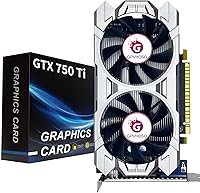
The GPVHOSO GTX 750Ti 4GB Graphics Card is, at its core, a ten-year-old GPU architecture being sold brand new in 2024 — and that context shapes everything you need to know before buying. GPVHOSO is a lesser-known board partner repackaging the Maxwell-generation 750 Ti chip, which NVIDIA originally launched back in 2014. That sounds like a red flag, but it isn't always. The card's no external power connector design is genuinely useful for anyone with a slim desktop or a weak PSU who just needs a functional GPU bump. Honest expectations matter here: this is light-duty hardware for office work, older games, and multi-monitor setups — not anything released in the last five years.
Features & Benefits

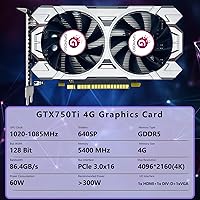
The budget 750 Ti runs on 640 CUDA cores clocked at 1085 MHz, paired with 4GB of GDDR5 memory — enough to handle 1080p in older titles and keep productivity apps running without complaint. What stands out most practically is the 60W power draw, meaning the card pulls everything it needs straight from the PCIe slot with no extra cables required. That said, the 128-bit memory bus is a real constraint worth acknowledging; bandwidth-heavy workloads will feel it. On the cooling side, the dual-fan setup does its job quietly during sustained use. Three video outputs — HDMI, DVI-D, and VGA — round things out, supporting up to three displays simultaneously.

Best For

This legacy GPU makes the most sense in a handful of specific scenarios. Think of the old office tower that ships with integrated graphics and struggles with multiple monitors — plugging in the GPVHOSO card solves that problem without touching the power supply. It also works well in a home media PC, where 4K video playback is the main goal and raw gaming muscle is irrelevant. Casual players revisiting titles from 2012 to 2016 will find it handles those at 1080p on medium settings without much fuss. If your PSU sits at 300W or below with no spare power connectors, this card is one of the few options that actually fits the constraint.

User Feedback

Across roughly 59 reviews, this budget 750 Ti sits at about 3.9 out of 5 stars — a reasonable result for a card operating in this niche. Installation ease comes up repeatedly as a genuine positive; most buyers report it working straight out of the box on Windows 10 and 11 with standard driver downloads. The no-power-connector angle earns consistent appreciation, especially from users with compact or older machines. On the critical side, buyers who expected more from modern titles were disappointed — which is fair, given what this hardware is. A few mention build consistency being uneven across units, a common concern with smaller board partners. Taken together, the feedback reflects a card that delivers on its narrow promise.

Pros

  • No external power connector needed — slots into almost any system with a standard PCIe slot and a modest PSU.
  • Handles 4K video playback smoothly in media center applications, making it a solid pick for HTPC builds.
  • Supports three monitors simultaneously via HDMI, DVI-D, and VGA — useful for multi-screen office setups.
  • Driver installation is straightforward on Windows 10 and 11, with most users up and running in minutes.
  • The dual-fan cooler operates quietly enough for shared office environments during typical workloads.
  • Covers a wide range of legacy monitor connections, including VGA, which many newer cards have dropped entirely.
  • At 60W TDP, it runs cool enough in properly ventilated cases without stressing surrounding components.
  • Older titles from the early-to-mid 2010s run at 1080p medium settings without significant configuration effort.

Cons

  • The 128-bit memory bus creates a real bandwidth bottleneck that no setting or driver tweak can work around.
  • Modern games released in the past five years are effectively off the table at any comfortable frame rate.
  • GPVHOSO has limited brand history and no long-term reliability data compared to established GPU manufacturers.
  • A small but consistent number of buyers report unit-to-unit build inconsistency, which introduces purchase risk.
  • NVIDIA has moved this GPU generation to legacy driver status, so no further performance optimizations are coming.
  • Competing used GPUs from newer generations occasionally appear at similar price points with meaningfully better performance.
  • The 4K gaming claim in the product listing is misleading — it applies only to the lightest 2D and media tasks.
  • Pairing this card with a very old CPU can surface a processor bottleneck that makes the GPU upgrade feel underwhelming.

Ratings

Our AI rating system analyzed verified global buyer reviews for the GPVHOSO GTX 750Ti 4GB Graphics Card, actively filtering out incentivized, bot-generated, and outlier feedback to surface what real users consistently experience. The scores below reflect an honest cross-section of this legacy GPU's performance across the specific scenarios it was built for — not the ones it was not. Both the genuine strengths and the frustrating limitations are represented without softening either side.

Value for Money
71%
29%
For buyers with a constrained budget and a low-wattage system that cannot accommodate a modern card, this legacy GPU delivers functional display output and light productivity performance at a price that few alternatives can match without requiring a PSU upgrade. That narrow equation works out favorably for the right buyer.
Measured against what the broader GPU market offers in 2024, the price-to-performance ratio feels strained. Slightly used cards from newer generations occasionally appear at comparable prices and offer meaningfully better performance, which makes the value proposition here dependent almost entirely on the power-connector constraint.
Gaming Performance
52%
48%
Older titles from the early-to-mid 2010s — think games released before 2016 — run acceptably at 1080p on medium settings. For someone revisiting a backlog of older games on a budget office machine, the GPVHOSO card gets the job done without demanding anything from the rest of the system.
Anything released in the last several years exposes the hardware's age quickly. Frame rates in modern titles drop to uncomfortable levels even at low settings, and the 128-bit memory bus creates a bandwidth ceiling that throttles performance in texture-heavy scenes. This is not a card for current-generation gaming under any reasonable expectation.
Power Efficiency
89%
The 60W TDP is the card's most genuinely practical attribute. Drawing all its power directly from the PCIe slot means no 6-pin connector is needed, which is a real-world lifesaver for slim form-factor desktops and older pre-built machines with modest power supplies. Buyers with 300W PSUs consistently highlight this as the deciding factor.
The low power draw is inherently tied to the card's limited performance headroom — there is no boosting past the hardware ceiling when workloads demand it. Users who later upgrade their system and PSU often find themselves quickly outgrowing this card's capabilities.
Multi-Monitor Support
81%
19%
Three simultaneous display outputs — HDMI, DVI-D, and VGA — give this budget 750 Ti a meaningful edge in office and productivity environments. Users setting up triple-monitor workstations on older machines report that the card handles extended desktop configurations reliably without complex configuration steps.
While three monitors are technically supported, running graphically intensive tasks across all three simultaneously can push the 128-bit bus to its limits. For basic office use and document work this is fine, but video editing or browser-heavy multitasking across three screens introduces noticeable sluggishness.
Installation Ease
86%
Buyer feedback on installation is consistently positive. The card slots in cleanly, Windows 10 and 11 detect it with standard NVIDIA driver packages, and most users report being up and running within minutes. No extra power cables to route and no BIOS adjustments needed in typical setups.
A small number of buyers encountered driver conflicts on systems with older chipsets or previously installed integrated graphics. These cases are not common, but they are worth noting for anyone working with aging hardware where legacy driver compatibility can occasionally cause headaches.
Thermal Management
74%
26%
The dual-fan cooler keeps the card running at manageable temperatures during sustained productivity workloads and casual gaming sessions. Several users specifically noted that the fans operate quietly enough not to be distracting in a shared office environment, which matters more than it might seem day-to-day.
Under prolonged gaming loads — even in older titles — some users report the fans ramping up noticeably. The cooler is adequate rather than impressive, and in poorly ventilated cases the card can run warmer than ideal. It does its job, but there is no thermal headroom to spare.
Build Quality
62%
38%
The PCB construction is standard for the category, and the card feels solid enough in hand. For a budget product from a lesser-known manufacturer, there are no obvious signs of cost-cutting in the physical assembly that would immediately raise concerns during installation.
GPVHOSO is not an established board partner with a long track record, and a handful of buyer reviews mention unit-to-unit inconsistency in build quality. Long-term reliability data is limited, which introduces some uncertainty for buyers expecting multi-year trouble-free operation.
Memory & VRAM Adequacy
58%
42%
4GB of GDDR5 is sufficient for the workloads this card is realistically targeting — older games, office applications, and 4K video playback through media players. In those contexts, the VRAM amount rarely becomes the limiting factor.
The 128-bit memory bus is the persistent weak point. Even when VRAM capacity is technically adequate, the bandwidth bottleneck becomes apparent in memory-intensive scenarios. Users who attempted more demanding tasks were consistently disappointed, and this limitation is effectively baked into the architecture with no workaround.
Display Output Compatibility
83%
The combination of HDMI, DVI-D, and VGA covers a wide range of monitor vintages, which is genuinely useful when connecting to older displays that lack HDMI inputs. Buyers working with legacy office monitors specifically appreciated not needing additional adapters for a standard two-monitor setup.
The HDMI output is not the latest specification, which limits some advanced display features. Users pairing this card with newer high-refresh-rate monitors found the output options restrictive, though at this performance tier that scenario is somewhat unlikely in practice.
Driver & Software Stability
77%
23%
NVIDIA's driver ecosystem is well-established, and the GTX 750 Ti has been supported for long enough that the driver stack is mature and stable. Most buyers had no issues downloading the correct drivers from NVIDIA's site and keeping the card updated without manual intervention.
NVIDIA has placed Maxwell-generation cards in its legacy driver category, meaning active optimization updates are no longer being pushed. The card works reliably on current Windows versions, but users should not expect performance improvements or feature additions through future driver releases.
Media & Video Playback
84%
For home theater PC use cases, this legacy GPU handles 4K video playback through dedicated media software without breaking a sweat. The hardware decode support reduces CPU load significantly, making it a practical upgrade for older machines used primarily as living room media players.
The 4K gaming claims in the product listing should be taken with considerable skepticism — 4K resolution is achievable only in the lightest 2D applications. Anyone expecting smooth 4K gaming performance will be firmly disappointed by what the hardware actually delivers.
Compatibility with Older Systems
88%
PCI Express 3.0 x16 compatibility combined with the absence of any external power requirement makes this budget 750 Ti unusually compatible with a broad range of aging desktops and pre-built machines. It slots into systems that most modern cards would either not fit or not power adequately.
While electrically compatible, some very old motherboards present slot clearance or BIOS recognition quirks. Additionally, pairing a decade-old GPU with a very old CPU can create a different kind of bottleneck that no graphics card upgrade will resolve.
Noise Levels
76%
24%
At idle and during light workloads, the dual-fan cooling solution is quiet enough to go unnoticed in a typical office or home setting. Buyers using this card in productivity-focused machines reported no complaints about fan noise interfering with daily use.
Under sustained load, the fans spin up audibly more than users accustomed to modern GPU coolers might expect. It is not disruptive, but it is noticeable — particularly in quiet environments where the system is otherwise silent.
Packaging & First Impressions
66%
34%
The card arrives in decent packaging with no reports of damage in transit being a widespread issue. What is in the box covers the basics, and the physical appearance of the card looks acceptable for its price tier.
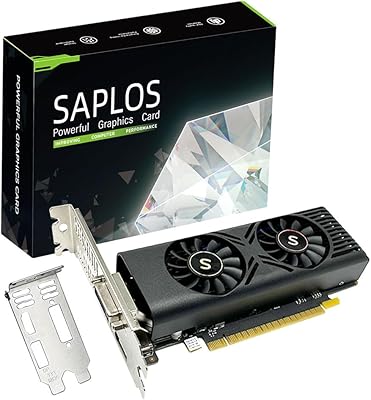
There is nothing premium about the unboxing experience, and documentation is minimal. GPVHOSO does not have the brand recognition or perceived quality of established GPU vendors, which affects first impressions even if the card itself functions correctly.

Suitable for:

The GPVHOSO GTX 750Ti 4GB Graphics Card makes the most sense for a very specific type of buyer, and for that buyer it can be a genuinely smart pick. If you have an aging office desktop or pre-built machine with a weak power supply — say 300W or under, with no spare PCIe power connectors — this legacy GPU slots in without requiring any other hardware changes whatsoever. It is also a practical choice for anyone building or repurposing a home theater PC, where the primary job is 4K video decode rather than gaming muscle. Casual players who want to revisit older titles from the early-to-mid 2010s at 1080p on medium settings will find it capable enough without overspending. And if you need a reliable triple-monitor setup for spreadsheets, document work, or browser-based tasks, the card's three simultaneous outputs cover that scenario without demanding anything exotic from the rest of your system.
Not suitable for:

The GPVHOSO GTX 750Ti 4GB Graphics Card is a poor fit for anyone whose expectations extend even slightly beyond the narrow use cases above, and being honest about that matters. If you want to play anything released in the last five or six years at playable frame rates, this card will disappoint you — the Maxwell architecture simply does not have the headroom, and the 128-bit memory bus compounds the problem in texture-heavy modern titles. Content creators, video editors, and anyone running GPU-accelerated software workloads will hit the bandwidth ceiling quickly and find the experience frustrating. Buyers who are vaguely hoping this will serve as a stepping stone to better gaming performance should instead save a little longer and invest in a used card from a more recent generation, where the gap in real-world capability is substantial. GPVHOSO is also not a brand with a long track record, so buyers prioritizing long-term reliability from an established manufacturer should look elsewhere.
Specifications

  • GPU Chip: The card is built on the NVIDIA GeForce GTX 750 Ti, a Maxwell-architecture GPU first introduced in 2014.
  • Shader Processors: 640 CUDA cores handle parallel processing tasks across gaming, video decode, and general GPU compute workloads.
  • Base Clock: The GPU runs at a base clock of 1085 MHz, with the listing also referencing a boost-adjacent figure of 1072 MHz in some descriptions.
  • Memory: 4GB of GDDR5 memory is onboard, operating on a 128-bit bus with a memory clock speed of 5400 MHz.
  • Memory Bus: The 128-bit memory interface is a known bandwidth constraint that limits performance in texture-heavy and memory-intensive workloads.
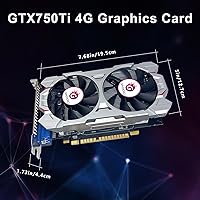
  • Power Draw: Total board power is rated at 60W TDP, allowing the card to operate entirely from PCIe slot power with no external connector required.
  • Power Connector: No external 6-pin or 8-pin power connector is needed; the card draws all required power directly through the PCI Express slot.
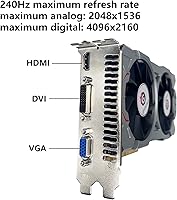
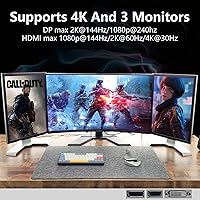
  • Display Outputs: Three video outputs are provided: one HDMI port, one DVI-D port, and one VGA port, supporting up to three monitors simultaneously.
  • Max Resolution: The card supports a maximum display resolution of 4096x2160 (4K UHD), suitable for video playback and desktop use at that resolution.
  • PCIe Interface: The card uses a PCI Express 3.0 x16 interface and is backward compatible with PCIe 2.0 slots found on older motherboards.
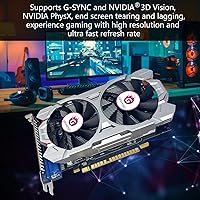
  • Cooling System: A dual-fan active cooler is mounted on the card to manage thermals during sustained workloads without excessive acoustic output.
  • OS Compatibility: Compatible with Windows 7, Windows 8, Windows 8.1, Windows 10, and Windows 11, in both 32-bit and 64-bit editions.
  • Dimensions: The card measures 12.6 x 6.57 x 2.64 inches, occupying a standard dual-slot profile in a full-height configuration.
  • Weight: The card weighs 1.46 pounds, which is typical for a dual-fan graphics card in this performance class.
  • PCB Construction: Standard PCB material is used throughout the card's construction, which the manufacturer states contributes to electrical stability and longevity.
  • Manufacturer: The card is produced by GPVHOSO, a third-party board partner that sources and repackages the GTX 750 Ti chip under its own label.
  • DirectX Support: The card supports DirectX 12, though its Maxwell architecture handles DX12 in feature level 11 mode, not full native DX12 capability.
  • Multi-Monitor: Up to three displays can be connected and driven simultaneously, making this card viable for basic triple-screen productivity setups.

Related Reviews

SAPLOS GTX 1050 4GB GDDR5 Graphics Card
83%
92%
Value for Money
85%
Performance for Gaming
90%
Cooling & Noise
88%
Build Quality
91%
Ease of Installation
More
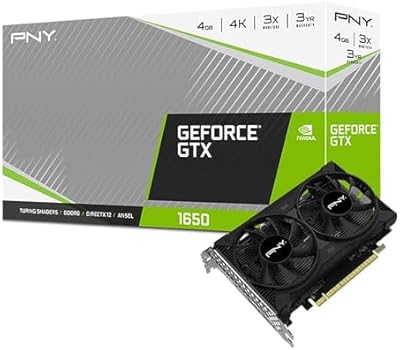
PNY GeForce GTX 1650 4GB GDDR6 Graphics Card
85%
87%
Gaming Performance (1080p)
92%
Value for Money
84%
Cooling & Thermals
90%
Setup & Installation
82%
Noise Levels
More
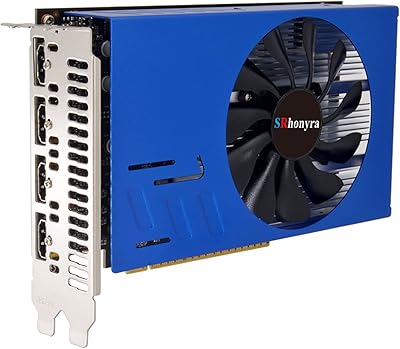
SRhonyra GTX 1050 Ti 4GB Graphics Card
74%
91%
Multi-Monitor Output
87%
Setup & Installation
83%
Driver Stability
71%
Resolution Performance
78%
Thermal Performance
More
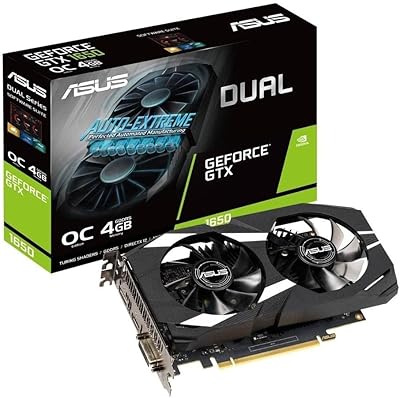
ASUS GeForce GTX 1650 Dual-Fan 4GB Graphics Card
84%
88%
Performance at 1080p
91%
Cooling Efficiency
92%
Value for Money
80%
VR Gaming Experience
85%
Multi-Display Support
More
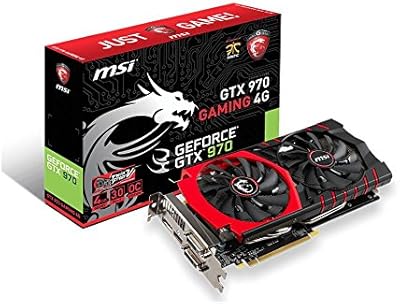
MSI NVIDIA GeForce GTX 970 Gaming 4GB Graphics Card
85%
88%
Gaming Performance (1080p/1440p)
93%
Cooling System Noise
91%
Price-to-Performance Ratio
85%
Installation Ease
72%
Driver Compatibility
More
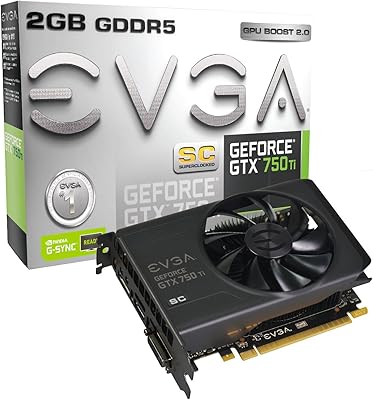
EVGA GTX 750 Ti 2GB Graphics Card
80%
62%
Gaming Performance
93%
Power Efficiency
94%
Ease of Installation
88%
Thermal Performance
84%
Build Quality
More
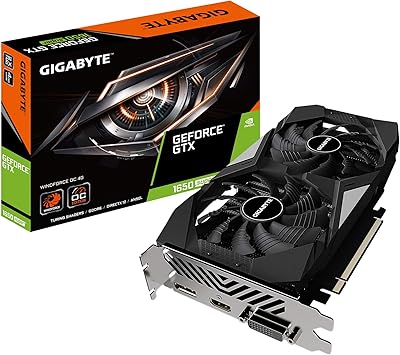
Gigabyte GeForce GTX 1650 Super Windforce OC 4GB Graphics Card
86%
92%
Value for Money
88%
Gaming Performance
85%
Cooling Effectiveness
90%
Noise Levels
80%
Build Quality
More
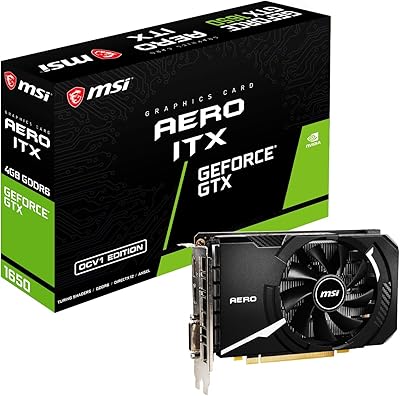
MSI GeForce GTX 1650 D6 AERO ITX 4GB Graphics Card
85%
85%
Performance at 1080p
88%
Noise Levels
87%
Cooling Efficiency
90%
Ease of Installation
79%
VR Performance
More
ASUS GTX 1050 Ti 4GB Graphics Card
82%
67%
Gaming Performance
93%
Power Efficiency
91%
Noise & Acoustics
88%
Thermal Management
86%
Build Quality
More
ASUS TUF Gaming GeForce GTX 1650 OC Edition 4GB Graphics Card
83%
86%
Performance at 1080p
90%
Cooling Efficiency
88%
Build Quality and Durability
84%
Noise Levels
92%
Ease of Installation
More

FAQ

No, and that is genuinely one of the best things about this card. It draws all its power through the PCIe slot, so as long as your system has a standard x16 slot, no additional cables or PSU upgrades are required. Most pre-built desktops with power supplies as modest as 300W will handle it without issue.

Honestly, not comfortably. The GPVHOSO GTX 750Ti 4GB Graphics Card is a 2014-era chip, and modern titles released in the last five or six years will struggle badly on it. Older games from the early-to-mid 2010s run acceptably at 1080p on medium settings, but if your library skews recent, this card is not the right tool.

Almost certainly yes, as long as the machine has a PCI Express x16 slot, which virtually all desktops from the past fifteen years do. The no-external-power requirement means you do not have to worry about PSU compatibility beyond the slot itself. Driver installation on Windows 10 and 11 is straightforward with a standard NVIDIA download.

Partially, and it deserves some context. The card can output a 4K resolution signal, which is fine for desktop use and media playback through video software. It cannot game at 4K in any meaningful sense — frame rates in even modest titles would be unplayable at that resolution. Think of the 4K spec as applying to display output and video decode, not rendering.

Yes. The card has HDMI, DVI-D, and VGA outputs, and all three can be active simultaneously. This is useful for office setups where you need an extended desktop across multiple screens. Just keep in mind that running graphically intensive tasks across all three at once will stress the 128-bit memory bus more than basic document and browser use.

The memory bus determines how fast data moves between the GPU and its onboard memory. A 128-bit bus is on the narrow side and creates a bandwidth ceiling that shows up in texture-heavy games and GPU-accelerated applications. For office work, video playback, and older games, it is a non-issue. For anything more demanding, it is a genuine bottleneck that no setting or driver change can eliminate.

At idle and during light tasks like web browsing or office work, the dual fans are quiet enough to go unnoticed. Under heavier load during gaming sessions, they spin up audibly but are not disruptive in a typical home or office environment. Users in very quiet spaces might notice the ramp-up, but it is not a common complaint in buyer reviews.

The simplest approach is to head to NVIDIA's official website, download the latest driver package for the GeForce GTX 750 Ti, run the installer, and restart your machine. Windows will often detect the card automatically, but using the official driver ensures you get the full feature set. Most buyers report the whole process taking under ten minutes.

It is actually one of the better justifications for buying this card in 2024. Hardware video decode for H.264 and H.265 content, including 4K HDR streams through compatible media player software, works reliably and takes the load off the CPU. If your living room PC is used primarily for streaming and video playback, this legacy GPU punches above its weight for that specific task.

GPVHOSO is a much smaller, lesser-known board partner without the established reputation or support infrastructure of the major brands. The underlying GPU chip is the same NVIDIA 750 Ti regardless of who makes the board, but factors like long-term reliability, warranty support, and build consistency are harder to verify with a newer entrant. A handful of buyers mention unit-to-unit variation, which is worth factoring into your decision if reliability over several years is a priority.