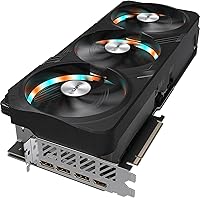
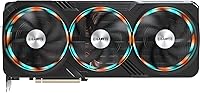
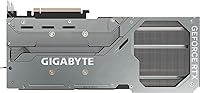
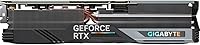
Overview

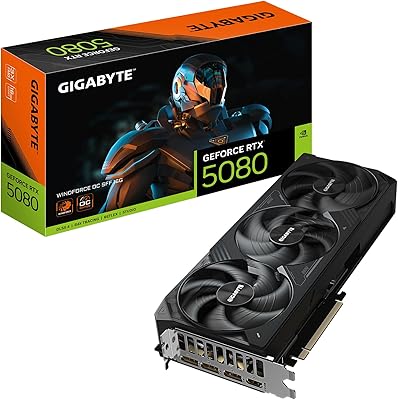
The GIGABYTE RTX 4080 Gaming OC 16GB GPU sits firmly at the top of the consumer graphics card market, built for enthusiasts who refuse to compromise on 4K output. GIGABYTE's Gaming OC line has always been about pushing Ada Lovelace silicon further than reference designs allow — factory-overclocked, better-cooled, and assembled to a higher physical standard. The Ada Lovelace architecture delivered real generational gains in both rasterization and ray-tracing efficiency, which translates to tangible frame-rate headroom rather than benchmark padding. That said, the competitive GPU landscape has grown considerably since the card's late-2022 launch, so the value equation deserves honest scrutiny rather than a free pass.
Features & Benefits

The RTX 4080 Gaming OC ships with a 2535 MHz boost clock, giving it a genuine performance cushion over base RTX 4080 cards without any manual tuning required. The WINDFORCE triple-fan cooling system uses composite heat pipes to handle a chip that can pull well over 300W, keeping temperatures in the low-to-mid 70s Celsius under sustained load. Sixteen gigabytes of GDDR6X running at 22400 MHz on a 192-bit bus means high-resolution textures and demanding 4K scenes stay loaded in the buffer. DLSS 3 with Frame Generation is genuinely useful in supported titles, often doubling perceived frame rates. The included anti-sag bracket and dual BIOS switch round out a physically well-considered package.

Best For

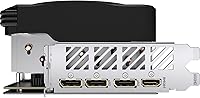
This overclocked Ada Lovelace GPU is a natural fit for 4K gaming enthusiasts who run demanding titles at maximum settings and want consistent frame rates without dropping quality presets. Content creators will also appreciate the headroom — GPU-accelerated video encoding and 3D rendering tasks scale well with the raw compute and available VRAM. Sim-racing and flight-sim users benefit from three DisplayPort 1.4 outputs supporting wide, multi-display configurations. If you are upgrading from a two- or three-generation-old card, the performance delta is significant. One firm caveat: at 13.46 inches long and nearly 4.5 pounds, this card does not suit compact mid-tower builds, and a 750W or higher PSU is a genuine requirement, not a suggestion.

User Feedback

Across 133 ratings, the RTX 4080 Gaming OC holds a well-earned 4.5-star average, with most buyers singling out low operating temperatures and consistent out-of-box stability as standout strengths. Build quality gets repeated praise — the backplate feels substantial and the anti-sag bracket earns its keep in heavier systems. The most common complaint centers on card length fitment: buyers with compact cases have found 13.46 inches to be a hard limit, not an approximation. Power connector demands also surface occasionally, largely from builders who underestimated their PSU requirements. Long-term reliability reports are encouraging so far, and GIGABYTE's 4-year warranty — which requires online registration to activate — adds meaningful reassurance at this price tier.

Pros

  • Factory overclocked to 2535 MHz, so there is genuine gaming headroom without touching any settings.
  • WINDFORCE triple-fan cooling keeps temperatures in a comfortable range even during extended sessions.
  • 16 GB of GDDR6X memory handles high-resolution textures and 4K workloads without constant VRAM pressure.
  • DLSS 3 Frame Generation delivers real, perceptible frame-rate gains in a growing library of supported titles.
  • The included anti-sag bracket is a thoughtful addition that protects both the slot and the card over time.
  • Dual BIOS switch lets users toggle between silent and performance modes without software or driver changes.
  • Metal backplate adds structural rigidity and a premium finish that cheaper AIB cards frequently skip.
  • Four-year warranty coverage is substantially longer than the two-year standard most competitors offer.
  • Three DisplayPort 1.4 outputs make multi-monitor and ultra-wide display setups easy to configure.
  • User ratings skew consistently positive, with recurring praise for out-of-box stability and build quality.

Cons

  • At 13.46 inches long, this overclocked Ada Lovelace GPU will not physically fit many popular mid-tower cases.
  • A 750W power supply is a firm minimum requirement — underpowered systems will cause instability or shutdowns.
  • The four-year warranty requires active online registration and is not applied automatically at purchase.
  • DLSS 3 Frame Generation only benefits users in a still-limited set of supported titles.
  • The card weighs nearly 4.5 pounds, which stresses PCIe slots in cases without a dedicated support bracket.
  • At this price tier, newer-generation competitors have entered the market since the card launched in late 2022.
  • The performance premium over a base RTX 4080 is modest and may not justify the added cost for most buyers.
  • RGB lighting, while tasteful, cannot be fully disabled without GIGABYTE's proprietary software.
  • 192-bit memory bus is narrower than some competing high-end cards, which slightly limits theoretical peak bandwidth.
  • Noise levels can climb noticeably under heavy sustained loads, particularly with the BIOS set to performance mode.

Ratings

The scores below were generated by our AI engine after analyzing verified global buyer reviews for the GIGABYTE RTX 4080 Gaming OC 16GB GPU, with spam, bot submissions, and incentivized feedback actively filtered out before any scoring was applied. The result is a balanced picture that reflects what real owners experienced after weeks and months of daily use — not just first impressions. Both the strengths that earned this card its loyal following and the friction points that frustrated a notable minority are transparently represented here.

Gaming Performance
93%
Owners consistently report smooth, high-frame-rate gameplay at 4K with demanding titles like Cyberpunk 2077 and Microsoft Flight Simulator running at maxed settings. The factory overclock delivers a perceptible edge over reference RTX 4080 cards without requiring any manual tuning, which resonates strongly with buyers who want performance out of the box.
A handful of users noted that the real-world performance gap over a standard RTX 4080 is narrower than the price premium might imply, particularly in titles that are not DLSS 3 optimized. For 1440p gaming specifically, the card's capabilities far exceed what the resolution demands, making the investment harder to justify at that display tier.
Thermal Management
89%
The WINDFORCE triple-fan setup earns consistent praise for keeping GPU core temperatures in the low-to-mid 70s Celsius during extended gaming sessions, even in relatively warm room conditions. Buyers running creative workloads like 3D rendering — which sustain higher loads longer than gaming — also reported stable thermals that never triggered thermal throttling.
Under prolonged stress testing or sustained rendering workloads, some users found junction temperatures climbing higher than expected despite the core staying comfortable. A few builders in cases with limited airflow reported that the card's own exhaust heat contributed to overall system temperature increases during summer months.
Build Quality
91%
The metal backplate and anti-sag bracket are the two features buyers mention most when describing why this card feels worth its price tier — the card does not flex, creak, or droop, even after months of continuous installation. Compared to AIB cards that skip these structural additions, owners feel confident the PCIe slot is protected for the long term.
A small number of buyers reported that the anti-sag bracket required minor adjustment to sit flush with their case standoff configuration, which was manageable but added an unexpected step to installation. The RGB lighting diffuser on some units showed minor light bleed at the seams, which bothered perfectionists building windowed systems.
Cooling Noise Level
74%
26%
In silent BIOS mode during light gaming or desktop use, the card is genuinely quiet and largely unnoticeable in closed-panel cases. The dual BIOS switch is appreciated by users who work in shared spaces or record audio and want the option to prioritize acoustics over peak performance without installing additional software.
Switching to performance BIOS mode or running GPU-intensive workloads for extended periods causes fan speeds to ramp up noticeably, and several owners described the noise as intrusive in open-frame builds or rooms without background noise. Users who expected near-silent operation at all times under heavy load were the most commonly disappointed group in this area.
DLSS 3 & Frame Generation
86%
In supported titles, Frame Generation delivers a tangible and visually smooth frame-rate uplift that owners describe as one of the most practically useful features on the card, particularly in ray-tracing-heavy scenarios where raw rasterization headroom gets consumed quickly. Buyers who game primarily in a DLSS 3 compatible library report getting substantially more out of their display's refresh rate.
The benefit is entirely dependent on game developers implementing DLSS 3 support, and the library — while growing — still excludes a significant portion of popular titles. Some users also noted minor ghosting artifacts in fast-motion scenes when Frame Generation is active at lower base frame rates, which required disabling the feature in select games.
Physical Fitment
58%
42%
For buyers who planned ahead and verified case clearance, installation was described as straightforward, with the card's included hardware and clear bracket positioning making the physical setup process manageable. Full-tower and large mid-tower owners with 340mm or more of GPU clearance had no fitment complaints whatsoever.
At 13.46 inches long, this overclocked Ada Lovelace GPU is simply too large for many mid-tower enclosures without case modification or front-panel cable rerouting, and multiple buyers left critical reviews after discovering this only at installation time. The card's nearly 4.5-pound weight also means it stresses PCIe slots noticeably in cases that lack a bottom-mounted GPU support point.
Power Efficiency
67%
33%
Buyers coming from older GPU generations were generally satisfied with the performance-per-watt improvement relative to cards like the RTX 3080 or AMD RX 6900 XT, acknowledging that the Ada Lovelace architecture made real efficiency strides. Those who monitored power draw reported that the card stays within expected TDP bounds under normal gaming conditions without unexpected spikes.
At full sustained load, the card demands more power than some competing high-end GPUs from the same generation, and buyers who had to upgrade their PSU to meet the 750W minimum requirement factored that added cost into their frustration. A few users with modular PSUs also reported difficulty sourcing a compatible 16-pin adapter cable when theirs was not included with the power supply.
Value for Money
63%
37%
Buyers who purchased with a clear use case — 4K gaming at maximum settings, professional GPU rendering, or multi-display creative setups — generally felt the card delivered on its performance promise and that the four-year warranty added measurable long-term value. For those upgrading from cards two or more generations old, the subjective performance jump reinforced the investment.
Given that newer-generation GPU options have entered the market since this card launched in late 2022, a growing number of reviewers question whether the price premium over competing or successor cards is still defensible for buyers shopping today. The modest performance uplift over a base RTX 4080 at a meaningfully higher cost remains the most cited value objection among critical reviewers.
4K Gaming Capability
92%
Owners gaming on 4K monitors consistently describe the experience as the card's strongest suit — high refresh rates at maxed settings in open-world and graphically demanding titles are achievable in a way that previous-generation flagship cards could not consistently deliver. The 16 GB VRAM buffer prevents the stuttering and texture pop-in that some high-VRAM-hungry titles expose in cards with less memory.
In a small number of the most unoptimized or GPU-hungry titles, even this card cannot sustain above 60 fps at 4K maximum settings without enabling DLSS, which some purists found disappointing at this performance tier. Ray tracing at native 4K without upscaling assistance remains a genuine challenge, and expectations need to be calibrated accordingly.
Multi-Monitor Support
88%
The combination of three DisplayPort 1.4 outputs and one HDMI 2.1a port gives this GIGABYTE Gaming OC card one of the more flexible display connectivity options in its class, and sim-racing and flight-simulation users specifically praised how straightforward triple-monitor configuration was without needing active adapters. The HDMI 2.1a port also makes connecting a 4K TV as a secondary display effortless.
Users attempting to run four monitors simultaneously found that performance in GPU-intensive applications dropped noticeably compared to triple-display configurations, as rendering four high-resolution outputs competes meaningfully with available compute resources. DisplayPort daisy-chaining is not supported, which limits flexibility for users with DSC-capable monitors who prefer cleaner cable routing.
Software & Driver Stability
81%
19%
The vast majority of buyers reported stable day-one driver performance with no crashes, black screens, or artifacting out of the box, which is a meaningful baseline given how common driver-related launch issues have been with high-end GPU releases historically. GIGABYTE's RGB Fusion 2.0 software worked reliably for owners who wanted to customize or disable the lighting.
A small subset of users experienced driver timeout errors during specific workloads that were later resolved through NVIDIA driver updates rather than anything card-specific, though the troubleshooting process was frustrating before the fix arrived. GIGABYTE's own utility software was described by several reviewers as heavier and less intuitive than competing AIB manufacturers' equivalents.
Warranty & Support
83%
Four years of warranty coverage is a genuine differentiator at this tier, and buyers who have interacted with GIGABYTE's support process for minor issues generally reported satisfactory resolution timelines. The extended coverage gives long-term builders real peace of mind, particularly given the investment involved.
The requirement to register online to activate the four-year warranty is an easy step to miss, and buyers who discovered this only after encountering an issue found themselves outside the extended coverage window. Some international buyers also reported that warranty service logistics added complexity not present when purchasing from local distributors.
Installation Experience
79%
21%
For experienced builders, the installation process is uncomplicated, and the included anti-sag bracket hardware is straightforward to attach within most standard ATX cases. The dual BIOS switch is clearly labeled on the bracket edge, and swapping between profiles does not require any disassembly.
First-time builders found the card's weight and length more physically unwieldy than expected during installation, especially when working alone in tighter cases. The 16-pin power connector's positioning on some units required a tight cable bend that caused minor tension on the connector housing, which a few users flagged as a concern for long-term connector health.
Content Creation Performance
87%
Video editors and 3D artists using DaVinci Resolve and Blender reported that GPU render times dropped substantially compared to previous-generation hardware, with the 16 GB VRAM buffer handling large project files and high-resolution footage without paging to system memory. Hardware-accelerated encoding using NVENC also proved faster and more efficient than software encoding on comparable workloads.
For users doing compute-heavy scientific or ML workloads rather than traditional creative tasks, the 192-bit memory bus width becomes a more noticeable constraint compared to cards with wider buses at similar price points. Professional workstation users occasionally found that driver optimizations prioritize gaming scenarios, requiring manual settings adjustments to maximize creative application performance.

Suitable for:

The GIGABYTE RTX 4080 Gaming OC 16GB GPU is built for a specific kind of buyer: someone who games at 4K resolution and genuinely wants to run demanding titles at maximum settings without constantly negotiating with frame-rate dips or dialing back quality sliders. Content creators who rely on GPU-accelerated workflows — video encoding, 3D rendering, or motion graphics — will find the 16 GB GDDR6X buffer and Ada Lovelace compute architecture meaningfully reduce processing times compared to mid-range alternatives. Sim-racing and flight-simulation enthusiasts benefit particularly from the three DisplayPort 1.4 outputs, which make wide or triple-monitor configurations straightforward. Builders who prioritize long-term peace of mind over a short warranty window will appreciate the four-year coverage, though registering online promptly after purchase is essential to activate it. Finally, anyone upgrading from a card that is two or more generations old will experience a performance jump large enough to justify the investment.
Not suitable for:

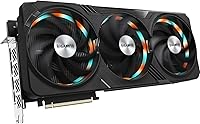
The GIGABYTE RTX 4080 Gaming OC 16GB GPU is a hard sell for anyone building inside a compact or mid-tower case without carefully measuring available GPU clearance first — at 13.46 inches long and nearly 4.5 pounds, it physically cannot fit many popular enclosures. Buyers running a power supply below 750W should also plan for an upgrade before committing, since the card's sustained power draw is not a negotiable variable. If your primary gaming resolution is 1080p or even 1440p at standard refresh rates, the performance ceiling this card offers is well beyond what those scenarios actually demand, making it poor value at this price tier. Budget-conscious builders or those who upgrade frequently will find the cost difficult to rationalize when capable alternatives exist at meaningfully lower price points. Anyone who dislikes managing warranties actively should also note that the four-year coverage does not apply unless the card is registered online — it does not activate automatically.
Specifications

  • GPU Chip: Powered by the NVIDIA GeForce RTX 4080 (Ada Lovelace architecture), offering strong generational gains in rasterization, ray tracing, and AI-accelerated rendering.
  • Boost Clock: Factory-overclocked boost clock runs at 2535 MHz, providing a performance cushion above the reference RTX 4080 specification without any manual tuning.
  • VRAM: Equipped with 16 GB of GDDR6X memory, giving the card a substantial buffer for 4K textures, large game assets, and GPU-accelerated creative workloads.
  • Memory Speed: The GDDR6X memory operates at 22400 MHz effective speed across a 192-bit bus, delivering high bandwidth suited to demanding resolutions.
  • Interface: Uses a PCI-E 4.0 x16 interface, ensuring full compatibility with current-generation motherboards while remaining backward compatible with PCI-E 3.0 slots at reduced bandwidth.
  • Display Outputs: Provides three DisplayPort 1.4 ports and one HDMI 2.1a port, supporting up to four simultaneous displays and resolutions up to 7680x4320 pixels.
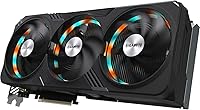
  • Cooling System: The WINDFORCE triple-fan cooling system uses composite heat pipes and alternate fan blade spinning to manage thermals efficiently across the card's full TDP range.
  • Dual BIOS: A physical dual BIOS switch allows users to toggle between a performance-oriented profile and a quieter, lower-speed mode without software or driver configuration.
  • DLSS Support: Supports NVIDIA DLSS 3 including Frame Generation, which reconstructs additional frames using AI to raise perceived frame rates in compatible titles.
  • Card Length: The card measures 13.46 inches (341.9 mm) in length, which requires careful case clearance verification before purchase, especially in mid-tower enclosures.
  • Card Weight: Weighs approximately 4.49 pounds (2.04 kg), making an anti-sag bracket a practical necessity rather than an optional accessory.
  • Anti-Sag Bracket: Ships with a dedicated metal anti-sag bracket to counteract the physical weight of the card and protect the PCIe slot from long-term mechanical stress.
  • Backplate: A full-cover metal backplate is installed at the factory, adding structural rigidity and protecting rear components from incidental contact.
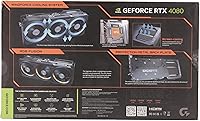
  • RGB Lighting: Includes integrated RGB lighting that can be customized or synchronized through GIGABYTE's RGB Fusion 2.0 software on supported systems.
  • Warranty: Covered by a four-year limited warranty, which requires online registration through GIGABYTE's website to activate and must be completed promptly after purchase.
  • PSU Requirement: GIGABYTE recommends a minimum 750W power supply, and real-world usage under sustained gaming or rendering loads makes this a firm floor rather than a conservative estimate.
  • Max Resolution: Officially supports output up to 7680x4320 pixels (8K), making it capable of driving high-refresh 4K monitors and forward-compatible with 8K display configurations.
  • Color: Ships in black with dark gray fan shroud accents, giving the card a neutral aesthetic that suits both windowed and closed-panel builds.

Related Reviews
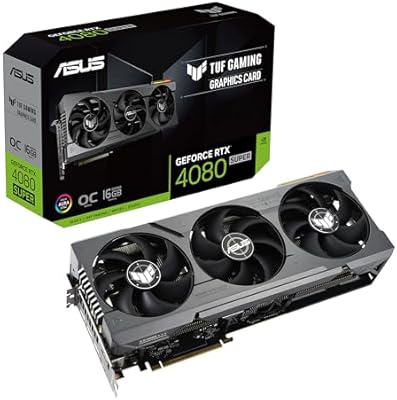
ASUS TUF Gaming NVIDIA GeForce RTX 4080 SUPER OC Edition 16GB
87%
96%
Gaming Performance
94%
Content Creation Performance
91%
Cooling Efficiency
93%
Ray Tracing Quality
88%
Overclocking Potential
More
Gigabyte RTX 2070 Super Gaming OC Graphics Card
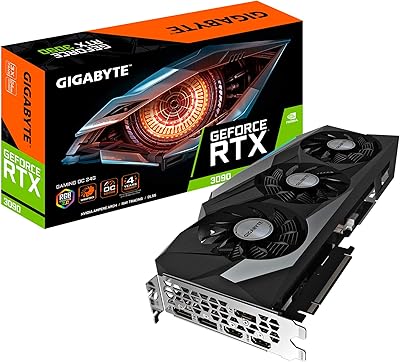
81%
91%
1440p Gaming Performance
93%
Thermal Management
88%
Noise Level
67%
Value for Money
62%
Ray Tracing Capability
More
Gigabyte GeForce RTX 4090 Gaming OC 24GB
85%
95%
Gaming Performance
90%
Cooling Efficiency
92%
Visuals & Resolution
91%
Build Quality
65%
Installation & Size Compatibility
More
GIGABYTE GeForce RTX 3060 Gaming OC 12G
80%
88%
Gaming Performance at 1080p
71%
Gaming Performance at 1440p
86%
Thermal Management
83%
Noise Levels
91%
VRAM Capacity
More
GIGABYTE RTX 3080 Gaming OC 12G GPU
79%
91%
Gaming Performance
93%
Thermal Management
88%
VRAM Adequacy
86%
Noise Level
89%
Build Quality
More
GIGABYTE RTX 3070 Gaming OC 8GB GPU
77%
91%
1440p Gaming Performance
89%
Thermal Performance
83%
Noise Level
88%
Build Quality
78%
DLSS & Ray Tracing
More
Gigabyte GeForce RTX 3090 Gaming OC 24GB Graphics Card
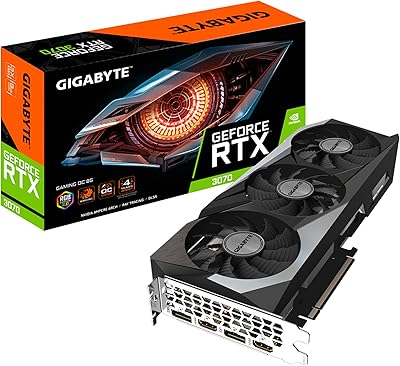
79%
88%
Raw Gaming Performance
94%
VRAM Capacity
91%
Thermal Performance
89%
Build Quality
83%
Ray Tracing Capability
More
PNY GeForce RTX 4080 Super 16GB Verto OC
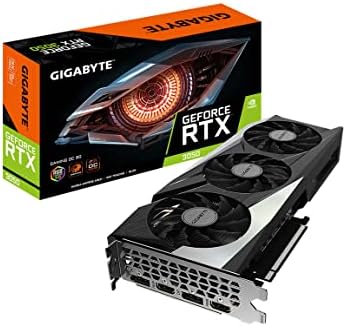
85%
94%
4K Gaming Performance
88%
Build Quality and Durability
91%
Cooling System Effectiveness
89%
Overclocking Stability
75%
Size and Compatibility
More
Gigabyte RTX 3080 Ti Gaming OC Graphics Card
78%
93%
4K Gaming Performance
88%
Thermal Management
84%
Ray Tracing Capability
91%
DLSS & AI Upscaling
79%
Cooling Noise Level
More
ZOTAC Gaming GeForce RTX 4080 16GB AMP Extreme AIRO
87%
96%
Gaming Performance
90%
Cooling & Noise Levels
89%
Build Quality & Durability
87%
Ease of Installation
92%
RGB Lighting & Aesthetics
More

FAQ

That depends entirely on your case's maximum GPU length clearance. The RTX 4080 Gaming OC measures 13.46 inches long, which exceeds the supported GPU length of many popular mid-tower enclosures. Before ordering, check your case manufacturer's spec sheet for the maximum card length — and account for any cables or obstructions near the front panel that might further reduce that clearance.

GIGABYTE officially recommends a 750W unit, and that figure is worth taking seriously rather than treating as a conservative buffer. Under sustained gaming loads or GPU compute tasks, the RTX 4080 can draw over 300W on its own. Factor in your CPU, storage, and other components, and a quality 850W PSU gives you a more comfortable operating margin without risking instability.

Frame Generation uses an AI model to synthesize additional frames between the ones your system renders traditionally, which raises the displayed frame rate in supported games without proportionally increasing the GPU's rendering workload. The catch is that it only works in titles that have been specifically updated to support DLSS 3, so the benefit is real but limited to a growing — not yet universal — game library. In supported titles, the difference can be significant, particularly at 4K.

GIGABYTE requires online registration through their official website to unlock the full four-year coverage — it does not apply automatically. The standard coverage without registration is shorter, so it is worth completing the registration process as soon as your system is up and running. Keep your proof of purchase handy during registration.

At moderate workloads and in silent BIOS mode, the WINDFORCE fans are relatively unobtrusive. However, under sustained 4K rendering or GPU compute tasks with the BIOS set to performance mode, fan noise becomes noticeable, particularly in an open or poorly dampened case. If acoustics matter to you, the dual BIOS switch gives you a practical way to trade some thermal headroom for a quieter experience.

Yes, provided your editing software takes advantage of GPU acceleration, which most major applications including Premiere Pro, DaVinci Resolve, and After Effects do. The 16 GB VRAM buffer handles high-resolution timelines and effects processing well, and the Ada Lovelace architecture includes dedicated hardware encoders and decoders that speed up export times meaningfully compared to software encoding.

Absolutely. The card ships with three DisplayPort 1.4 outputs and one HDMI 2.1a port, so triple-monitor setups are fully supported without any adapters. Sim-racing and flight-sim users in particular find this configuration straightforward to set up, and the HDMI 2.1a port adds flexibility for a TV or capture device as a fourth output if needed.

At nearly 4.5 pounds, this overclocked Ada Lovelace GPU puts real physical stress on the PCIe slot over time, particularly in systems that are moved or transported. The included anti-sag bracket attaches to a case standoff and supports the end of the card, distributing the weight load and preventing the slot from gradually bending. It is a small but genuinely useful addition, not a gimmick.

The switch is a small physical toggle on the card's bracket edge that selects between two pre-programmed BIOS profiles — one prioritizing performance and one prioritizing quieter fan operation. Switching between them is safe and does not require any software or driver changes. Because it is a hardware switch rather than a software override, it also gives you a recovery option if any firmware experimentation goes wrong, since one BIOS stays untouched.

The practical performance gap between the RTX 4080 Gaming OC and a reference-clocked RTX 4080 is real but modest — typically a few percentage points in gaming frame rates due to the factory overclock. Where this GIGABYTE Gaming OC card tends to separate itself more meaningfully is build quality: the cooling solution, the anti-sag bracket, the backplate, and the extended warranty collectively make a stronger case than the raw clock speed delta alone.

Where to Buy