Overview

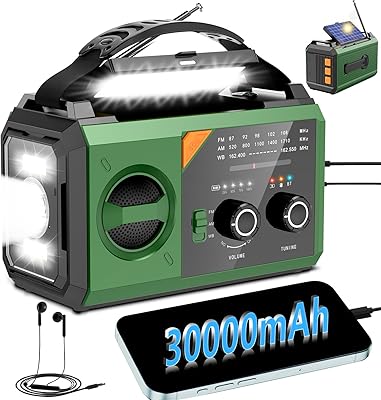
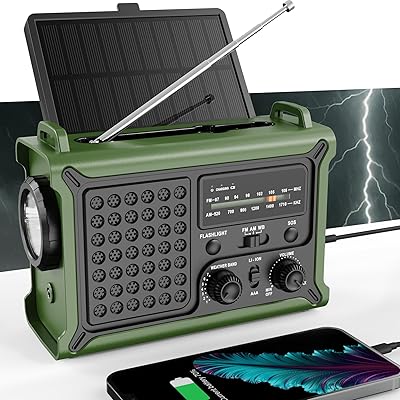
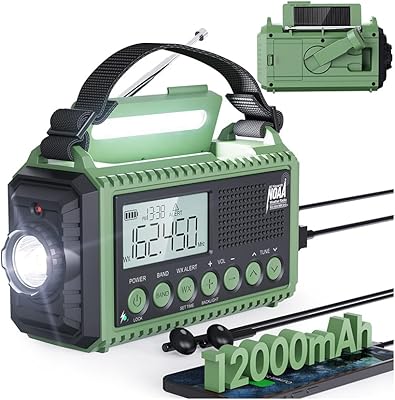
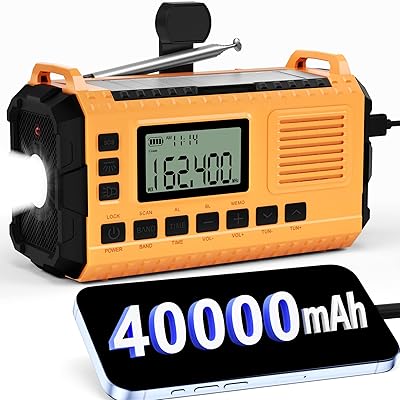
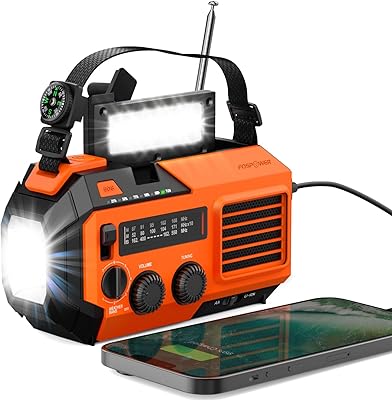
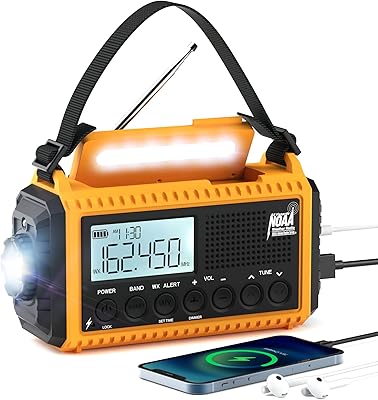
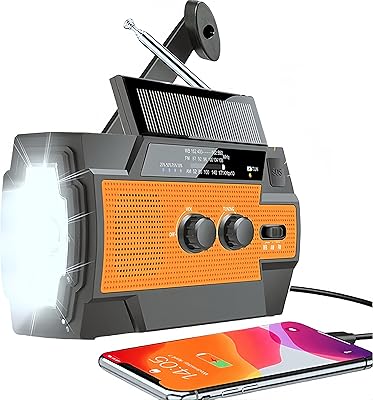
The GIDEZH H27 30000mAh Emergency Weather Radio launched in December 2024 as a 7-in-1 device that consolidates a power bank, weather radio, flashlight, reading lamp, compass, SOS alarm, and phone charger into one unit. That is a lot to pack in, and it sits at a mid-range price — not a throwaway bargain, but not a premium Midland or Eton either. Realistically, this emergency radio targets households assembling a disaster kit, campers who want fewer gadgets in their bag, and people in storm-prone regions who want NOAA access without buying multiple separate devices.
Features & Benefits

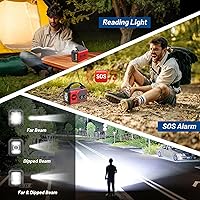
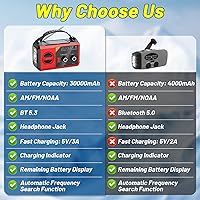
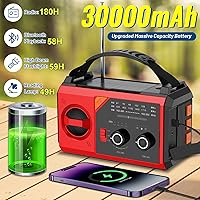
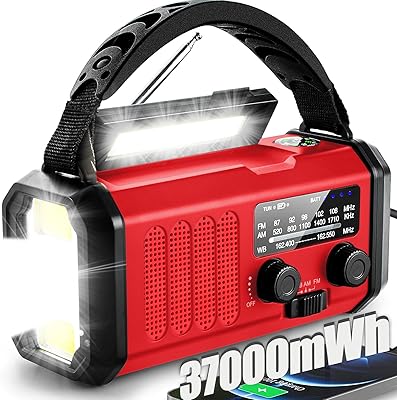
The H27's most notable spec is its large lithium-ion battery, which can realistically recharge a modern smartphone around five to six times — though actual usable output from mid-range batteries often runs below the nominal rated figure, so temper expectations slightly. Three charging methods are on board, but solar and hand crank are best treated as useful backups rather than primary sources; USB-C is significantly faster and more reliable. The radio covers AM, FM, and all seven NOAA weather bands through a 15.7-inch swivel antenna backed by a DSP chip that handles interference well. The three-mode flashlight and separate reading lamp genuinely serve different purposes — broad area lighting versus focused close-up tasks.

Best For

This hand-crank weather radio makes the most sense for people who want one consolidated device in their emergency kit rather than carrying a separate radio, flashlight, and power bank. It suits households in hurricane corridors, tornado alley, or wildfire regions where NOAA alerts can genuinely matter. Campers and overlanders will appreciate having backup power for phones with no outlet in sight. It also functions well as a practical preparedness gift for parents, grandparents, or anyone in a rural area who could benefit from weather monitoring. If you already own a dedicated premium radio and a high-capacity power bank, it may feel redundant — but for most people building a kit from scratch, it covers the essentials.

User Feedback

Early buyers tend to highlight all-in-one convenience and NOAA reception as genuine strengths — being able to tune in quickly during a storm warning without fumbling for multiple devices resonates with people who have actually been through an emergency. On the downside, hand crank charging draws consistent criticism: expect it to take a long time to meaningfully move the battery indicator, which is typical for the category but still frustrating in practice. Solar output in overcast conditions is similarly modest. Some reviewers note the build feels solid enough, though button tactility and antenna sturdiness have drawn occasional concern. Since the H27 only launched in late 2024, the review pool remains small and long-term durability is still an open question.

Pros

  • Covers seven emergency functions in one device, simplifying kit assembly considerably.
  • NOAA reception across all seven weather bands performs reliably in rural and suburban settings.
  • USB-C charging is fast and practical as the primary recharge method.
  • Battery capacity is large enough to recharge most smartphones five or more times.
  • Three-mode flashlight and a separate reading lamp serve genuinely different lighting needs.
  • SOS alarm activation is intuitive and does not require navigating menus under stress.
  • Clear battery indicator and charging status lights remove guesswork during use.
  • Well-packaged out of the box with a USB cable included — ready to use immediately.
  • Headphone jack allows private radio listening without disturbing others during a shared emergency.
  • Reasonable size and weight for a go-bag or vehicle emergency kit.

Cons

  • Hand crank charging is extremely slow — expect minimal battery gain after extended cranking.
  • Solar panel output under cloud cover or indirect light is too weak to be dependable.
  • Speaker distorts noticeably at higher volumes, undermining otherwise solid radio reception.
  • Compass accuracy is inconsistent and should not be trusted for precise navigation.
  • Button feel and antenna joint durability have drawn concern from early buyers.
  • Nominal battery capacity may overstate actual usable output under real load conditions.
  • No long-term durability data exists yet given the December 2024 launch date.
  • Reading lamp brightness is fixed with no dimming option, which limits adaptability.
  • The included manual lacks detail on optimizing solar angles and crank charging efficiency.
  • Build quality feels adequate but not ruggedized — not suited for harsh outdoor conditions.

Ratings

The GIDEZH H27 30000mAh Emergency Weather Radio has been evaluated by our AI rating system after processing verified global buyer reviews, with spam, bot-generated, and incentivized feedback actively filtered out. Scores reflect real-world performance across a range of use cases — from hurricane preparedness to backcountry camping — and both the strengths and the frustrations buyers consistently report are transparently baked into every number you see below.
Battery Capacity
82%
18%
Most buyers are genuinely impressed by how many times the H27 can recharge a phone before needing a top-up itself. For a preparedness scenario — a multi-day power outage, for example — having enough juice to keep two or three family members' phones alive over several days is exactly what people needed from this category.
A recurring concern is whether the rated capacity reflects real-world output or just the nominal cell rating. Some users noticed the battery depleted faster than expected during simultaneous radio and charging use, suggesting the usable capacity is somewhat lower than advertised.
NOAA Reception Quality
86%
The DSP chip earns genuine praise from buyers in rural and suburban areas who tested it during actual storm warnings. Several users noted they were able to pull in all seven NOAA weather band stations clearly, which is not always a given with budget radios that struggle with interference or weak signals.
A handful of buyers in densely built urban environments or areas with significant RF interference reported occasional static even with the antenna fully extended. Reception quality appears to vary by geography, so results in signal-challenged locations may be less consistent.
Charging Versatility
78%
22%
Having three independent charging paths — solar, hand crank, and USB-C — gives real peace of mind in a prolonged emergency. Buyers appreciated that USB-C charges the unit quickly under normal conditions, and the visual status indicators (orange for solar or crank, red for USB) make it easy to confirm charging without guessing.
Solar and hand crank performance in real-world conditions disappointed a portion of buyers. Overcast days yield minimal solar gain, and hand cranking for extended periods produces only a modest charge increment — useful as a last resort, but not a reliable primary recharge method.
All-in-One Convenience
88%
This is where the H27 earns its strongest user endorsements. Buyers building a 72-hour emergency kit specifically valued having a single device cover radio, lighting, phone charging, and an SOS alarm rather than sourcing and storing separate gadgets. It simplifies kit assembly considerably.
A few buyers with existing premium gear — a dedicated Midland radio and a high-capacity power bank, for instance — found the H27 redundant. The jack-of-all-trades design means no single function quite matches a purpose-built device, which matters more to experienced preppers than to first-time kit builders.
Flashlight Performance
74%
26%
The three-mode flashlight, including a steady beam, a strobe, and an SOS flash pattern, handles most emergency lighting needs adequately. Buyers used it during power outages to navigate homes and found the brightness sufficient for corridor and room lighting at close range.
Several users noted the flashlight output is not powerful enough for long-distance illumination or outdoor trail use in the dark. Compared to a dedicated tactical flashlight, the beam feels underwhelming, and the strobe mode lacks the intensity some buyers expected for distress signaling.
Reading Lamp Usability
71%
29%
The dedicated reading lamp — physically separate from the flashlight — is a thoughtful inclusion that buyers found genuinely useful for close-up tasks like reading maps, reviewing emergency documents, or finding items in a bag without blinding everyone in the room.
Brightness at the reading lamp falls in a middle zone that some buyers found adequate and others described as too dim for extended reading in complete darkness. A few users wished for an adjustable brightness setting rather than a fixed output level.
Build Quality & Durability
69%
31%
The H27 feels reasonably solid in hand for its price tier — not flimsy, and the rubberized grip areas give it a sturdier impression than typical ultra-budget radios. Most buyers noted it arrived well-packaged and showed no immediate defects out of the box.
Button tactility and antenna joint durability are the two most common structural concerns raised. Some buyers found the buttons slightly mushy and the antenna base connection felt less robust than expected under repeated adjustment. Long-term wear data is thin given the product only launched in late 2024.
Hand Crank Efficiency
47%
53%
The hand crank exists as a genuine last-resort backup, and buyers in that specific situation — no sun, no cable, power fully depleted — appreciated having any manual option at all. For running the radio directly off crank power for short periods, performance is acceptable.
As a battery charging mechanism, the hand crank is slow enough to frustrate most users who tried it. Multiple buyers reported cranking for 10 to 15 minutes and seeing negligible movement on the battery indicator. This is a category-wide limitation, but it is still a common source of disappointment.
Solar Charging Performance
52%
48%
On a clear, sunny day with the panel angled correctly, the solar input does contribute meaningfully to maintaining the battery level, which is useful for extended outdoor situations like multi-day camping trips where USB-C access is unavailable.
Real-world solar output under partial cloud cover or indirect light is minimal. Buyers who expected to rely on solar as a meaningful charging source during overcast emergencies — precisely when storms are most likely — found the panel inadequate and ended up defaulting to USB-C or crank.
AM/FM Radio Quality
79%
21%
AM and FM reception through the telescopic antenna and DSP chip performed well for most buyers in standard residential and rural settings. Tuning into local FM stations produced clear audio, and the 180-degree swivel antenna made signal optimization straightforward.
At higher volumes, some buyers noted the built-in speaker distorts slightly, which undercuts the otherwise solid reception quality. Audio clarity at moderate volume is fine, but the speaker itself is not particularly rich-sounding compared to even entry-level portable radios.
SOS & Emergency Signaling
81%
19%
The SOS alarm and flashing light mode are legitimately loud and visible enough to function as distress signals in realistic scenarios. Buyers appreciated that activating SOS is intuitive and does not require navigating complex menus during a high-stress situation.
The compass, while a nice inclusion, drew skepticism from several buyers who found its accuracy inconsistent. It functions well enough for basic orientation but should not be relied upon for precise navigation, which is worth knowing before heading into backcountry terrain.
Ease of Use
83%
Setup is minimal — unbox, extend the antenna, tune the dial, and the H27 is operational within minutes. Buyers with no technical background appreciated that the controls are labeled clearly and the battery indicator gives an at-a-glance status without needing to consult the manual.
The manual included in the box is brief and occasionally unclear on specifics like optimal solar charging angles and crank-to-battery conversion rates. Buyers who wanted detailed guidance on getting the most out of each charging mode had to rely on trial and error.
Portability & Form Factor
76%
24%
At 2.38 pounds, the H27 is heavy enough to feel substantial but light enough to pack into a go-bag without significant weight penalty. The dimensions are compact for a 7-in-1 device, and buyers fitting it into emergency kits or vehicle storage found it did not take up unreasonable space.
Compared to slim, radio-only emergency devices, the H27 is noticeably bulkier. Backpackers counting every ounce or buyers wanting something truly pocketable will find it too large, and the overall form factor prioritizes capacity over compactness.
Value for Money
77%
23%
For buyers who genuinely needed multiple emergency functions consolidated into one device, the H27 represents reasonable value at its price point. Getting a usable power bank, weather radio, lighting system, and SOS tool in a single purchase is objectively more economical than buying each separately.
Buyers who compared it head-to-head with established brands in a similar price range noted that individual functions — particularly radio reception and flashlight output — fall slightly short of dedicated competitors. You pay for the convenience of consolidation, not for best-in-class performance in any one area.
Out-of-Box Experience
84%
Packaging was consistently praised as careful and professional for the price tier. Most buyers reported the device arrived fully intact with the USB cable and manual included, and the unit powered on immediately without needing an initial charge cycle to function.
A small number of buyers reported calibration issues with the radio dial out of the box, requiring a manual re-scan to correctly locate NOAA and FM stations. This was not widespread but appeared in enough reviews to be worth noting as an occasional quality-control variable.

Suitable for:

The GIDEZH H27 30000mAh Emergency Weather Radio is a practical fit for households in hurricane corridors, tornado alley, or wildfire regions who want a single device covering the essentials without assembling a kit piece by piece. If you are building your first 72-hour emergency supply and have not yet bought a dedicated radio, power bank, or flashlight separately, this hand-crank weather radio consolidates all of those into one purchase that is easy to store and grab quickly. Campers and weekend overlanders who want NOAA weather alerts and backup phone charging without hauling multiple gadgets will find the trade-offs reasonable for the weight and size. It also works well as a practical gift for elderly parents, relatives in rural areas, or anyone who lives alone in a region prone to severe weather — people who need something straightforward and self-contained rather than technically impressive. First-time preppers who want to check multiple boxes on a preparedness list without overspending on premium gear will find the H27 a credible starting point.
Not suitable for:

The GIDEZH H27 30000mAh Emergency Weather Radio is not the right choice for buyers who already own a quality dedicated weather radio and a high-capacity power bank, since the consolidated design does not outperform purpose-built devices in any single function. Serious preppers or amateur radio enthusiasts who prioritize best-in-class reception, speaker clarity, and long-term hardware durability will find themselves drawn toward established names like Midland or Eton that carry years of reliability data behind them. Ultralight backpackers counting every ounce will find the H27 too bulky — at over two pounds, it is better suited to a car kit or home shelf than a multi-day trail pack. Anyone expecting to rely primarily on the solar panel or hand crank for meaningful battery recovery will be repeatedly frustrated, particularly during extended overcast weather events when charging is most needed. And given that this is a brand launched in late 2024 with a still-limited review pool, buyers who prioritize long-term durability assurance and established brand support should wait for more real-world data before committing.
Specifications

  • Model: The H27 is manufactured by Shenzhen Huashengtimes Electronic Technology Co., LTD under the GIDEZH brand.
  • Dimensions: The unit measures 8.27″ in length, 5.63″ in width, and 4.61″ in height.
  • Weight: The H27 weighs 2.38 pounds, making it suitable for go-bags and vehicle emergency kits.
  • Battery Capacity: An internal 30000mAh lithium-ion battery powers all onboard functions and is included pre-installed.
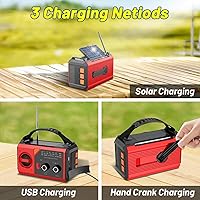
  • Charging Methods: The battery recharges via three independent methods: solar panel, manual hand crank, and USB Type-C cable.
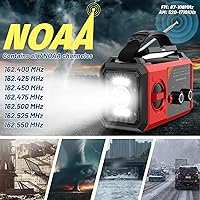
  • Radio Bands: The tuner covers AM (520–1710kHz), FM (87–108MHz), and NOAA Weather Band (162.400–162.550MHz) across up to 7 NOAA stations.
  • Tuner Technology: A DSP anti-jamming chip provides improved signal clarity and interference rejection across all supported radio bands.
  • Antenna: A 15.7″ telescopic antenna with 180-degree swivel capability allows directional tuning for optimal signal reception.
  • Flashlight: The built-in flashlight offers three modes: steady beam, strobe, and SOS flash pattern.
  • Reading Lamp: A dedicated reading lamp is included as a separate lighting mode designed for close-up task illumination.
  • SOS Alarm: An audible SOS alarm function is built in for emergency distress signaling in survival scenarios.
  • Compass: A basic built-in compass is included for general orientation; it is suited for rough directional use only.
  • Connectivity: The unit includes a USB output port for charging external devices and a 3.5mm headphone jack for private listening.
  • Battery Indicator: A 4-segment battery level display gives an at-a-glance power status without requiring the device to be powered on fully.
  • Charging Indicators: Dual LED charging status lights indicate active charging mode: orange for solar or crank input, red for USB charging.
  • In Box Contents: Each unit ships with the emergency radio, a USB charging cable, and an owner's manual.
  • Power Source: The device is battery-powered with supplemental solar and manual crank recharging capability.
  • Availability Date: The H27 became available for purchase in December 2024, making it a relatively new entrant in the emergency radio market.

Related Reviews

RAOUOEN 30000mAh Emergency Weather Radio
85%
89%
Battery Life & Charging
91%
Performance in Emergencies
75%
Portability & Weight
84%
Sound Quality & Reception
87%
Ease of Use
More
QAUYYW Emergency Weather Radio XSY330
86%
89%
Battery Life
85%
Ease of Use
92%
Portability
75%
Radio Reception
88%
Build Quality
More
OnLyee CR1030 Emergency Weather Radio
76%
88%
Power Source Redundancy
83%
Hand Crank Durability
61%
Solar Charging Performance
79%
NOAA Reception Quality
67%
Battery Capacity & Phone Charging
More
FosPower A6 5200mAh Emergency Weather Radio
77%
91%
NOAA Reception
84%
Build Quality
67%
Power Bank Utility
53%
Hand Crank Efficiency
49%
Solar Charging
More
Roxicosly CR1009Ultra 12000mAh Emergency Weather Radio
74%
88%
Battery Life
91%
Charging Versatility
86%
NOAA Alert Performance
58%
Hand Crank Durability
44%
Solar Charging Speed
More
Sttfaishen F20 Emergency Hand Crank Weather Radio
72%
82%
NOAA Alert Reception
54%
Battery Capacity & Honesty
61%
Hand Crank Usability
57%
Solar Charging Performance
83%
USB-C Charging Speed
More
TFTDOUP Emergency Weather Alert Radio
86%
88%
Overall Performance
85%
Battery Life
90%
Charging Options
80%
Ease of Use
87%
Build Quality
More
Midland ER210 Emergency Weather Radio
75%
91%
NOAA Reception Quality
83%
Power Source Versatility
78%
Battery Life
89%
Ease of Use
67%
Flashlight Performance
More
MangePagar MA-091 4000mAh Emergency Weather Radio
75%
88%
Value for Money
82%
NOAA Reception Quality
84%
Battery Capacity & Runtime
61%
Hand Crank Charging
57%
Solar Charging Performance
More
Lanshanchu XG-098 Emergency Weather Radio
86%
95%
Battery Life & Charging Options
92%
NOAA Alert Accuracy
89%
Radio Reception Quality
88%
Portability & Size
90%
LED Flashlight & SOS Function
More

FAQ

In practical terms, expect somewhere between five and six full charges for a typical modern smartphone under real-world conditions. The nominal 30000mAh figure represents the rated cell capacity, but usable output after conversion losses is somewhat lower, which is standard for this class of power bank.

It is genuinely useful as a last resort, but it will not replenish the battery in any meaningful way for sustained use. Cranking for ten to fifteen minutes typically produces only a small increment of charge — enough to make a short phone call or run the radio briefly. Think of it as an emergency trickle source, not a primary charging method.

Honestly, not well. Direct sunlight on a clear day produces the best results, but under overcast conditions the panel output drops significantly. If you are preparing for a storm scenario — which is the main reason most people buy this type of radio — USB-C should be your plan A for keeping the battery topped up before the weather event hits.

The H27 covers all seven NOAA weather band frequencies and you can manually scan to find the strongest signal for your area. It does not have an automatic SAME alert feature that wakes the radio from standby — you need to have it on and tuned to a NOAA channel to receive real-time alerts.

No waterproofing or weather-resistance rating is specified for this unit. It is not designed for direct exposure to rain or submersion. Keep it sheltered during outdoor use and store it in a dry location within your emergency kit.

It has a standard 3.5mm headphone jack, so any wired headphones or earbuds with that connector will work. Bluetooth audio is not supported, so wireless headphones are not compatible.

The reading lamp is optimized for close-up illumination rather than brightness — it is well-suited for reading maps or finding items in a bag in low light, but it is noticeably softer than the main flashlight beam. The brightness is fixed with no dimming adjustment, so what you get is what you get.

An exact charge time is not officially published, but given the large battery capacity, expect several hours on a standard USB charger. Using a higher-wattage USB-C adapter will speed this up. It is worth doing a full charge via USB-C before storing it in your emergency kit so it is ready when you need it.

Not really, at least not as a primary tool. The built-in compass is adequate for rough orientation — figuring out which general direction is north — but multiple buyers have noted inconsistent accuracy. For serious hiking or navigation, a dedicated compass or GPS is a much safer choice.

Keep it fully charged via USB-C before storing it, and top it off every three to six months since lithium-ion batteries slowly self-discharge over time. Store it somewhere cool, dry, and easily accessible — not buried at the back of a closet. Running a quick function check every few months is also a good habit to catch any issues before you actually need the device.