Overview

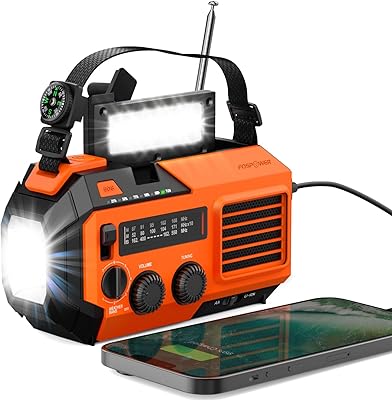
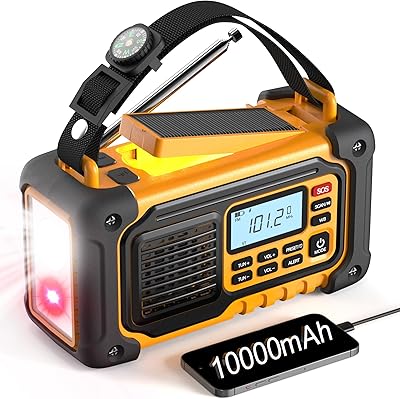
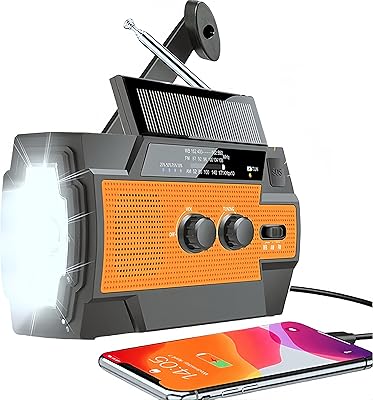
The AXYEBI AB-US-107Y Emergency Weather Radio arrived on the market in mid-2024 as a genuinely practical option for anyone building out a storm kit without spending a lot. It covers all seven NOAA weather channels, plus standard AM and FM, and the extended antenna actually makes a noticeable difference in signal clarity compared to cheaper competitors. At 15.8 oz, it fits easily in a go-bag or kitchen drawer. What stands out at this price point is how much ground it covers — radio, flashlight, SOS alarm, and solar charging in one compact orange unit.
Features & Benefits

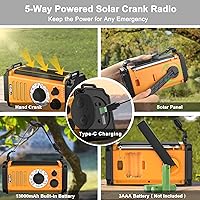
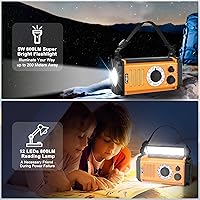
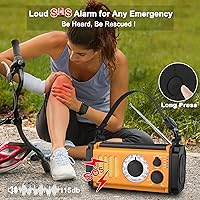
The two charging methods — hand crank and solar panel — mean you are never fully stranded, even after days without power. The 800LM COB flashlight is legitimately bright for this size, with a claimed 200-meter throw that feels credible outdoors. Flip the top panel up and it converts to a reading lamp, which is a thoughtful touch for tent or shelter use. The 115dB SOS alarm is loud enough to be heard from a distance. An LED display and an oversized tuning knob make station changes easy under stress, and the 3.5mm jack lets you listen privately without waking others.

Best For

This hand-crank weather radio makes the most sense for households in hurricane or tornado-prone areas who want a reliable backup without committing to a premium device. It also works well as a camping pack essential — light enough not to be a burden, functional enough to handle real emergencies. Preppers who want one box to check off multiple survival needs will appreciate the consolidation. It also makes a practical, low-stakes gift for family members who keep putting off building an emergency kit. If your priority is core emergency readiness on a tight budget, this fits that need squarely.

User Feedback

With a 4.5-star average across nearly 200 ratings, this survival radio has built a solid early reputation. Buyers consistently praise how easy it is to operate right out of the box and are often surprised by the flashlight brightness. That said, a few users note the 90-hour runtime claim feels optimistic under real cranking conditions — battery longevity appears to vary. Some reviewers mention the crank feels a bit light-duty over extended use, which is worth keeping in mind. Overall, the tone from buyers is pragmatic: most are not expecting professional-grade hardware, and at this price, few are disappointed.

Pros

  • Covers all seven NOAA weather channels with an extended antenna that genuinely improves reception over budget competitors.
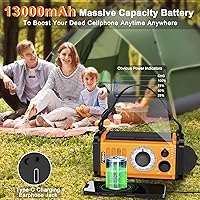
  • Three charging options — hand crank, solar panel, and Type-C — mean you are rarely without a way to power up.
  • The COB flashlight is legitimately bright and useful for both indoor outages and outdoor navigation at night.
  • Compact and light enough to fit in a backpack side pocket or kitchen drawer without taking up meaningful space.
  • The 115dB SOS alarm with flashing lights provides real dual-channel signaling in low-visibility emergencies.
  • Flip-up reading lamp mode adds practical value for tent or shelter use beyond basic flashlight function.
  • Setup requires zero technical knowledge — most buyers are using it within minutes of opening the box.
  • Includes useful accessories: compass, wrist strap, and Type-C cable all come in the box at no extra cost.
  • The oversized tuning knob and LED band display make station changes manageable even under stress.
  • At its price point, the feature-to-cost ratio is difficult to match among comparable emergency radios.

Cons

  • The hand crank feels lightweight under sustained use, and long-term durability of the mechanism is an open question.
  • Advertised battery runtime figures are optimistic — real-world continuous use falls noticeably short of the 90-hour claim.
  • Solar charging is too slow to be a primary power source; it works best as a passive trickle supplement.
  • AM band audio through the speaker can get muddy, limiting usefulness for clear broadcasts in noisy environments.
  • The compass attached to the wrist strap is difficult to read in low-light conditions — exactly when you would need it.
  • The rubber Type-C port cover shows early signs of wear and could degrade with repeated field use over time.
  • Urban signal reception is inconsistent; interference can make reliable NOAA tuning frustrating in dense areas.
  • The included user manual lacks detail on charging behavior and indicator light meanings, leaving some buyers guessing.

Ratings

The AXYEBI AB-US-107Y Emergency Weather Radio has been evaluated by our AI system after analyzing verified buyer reviews from global markets, with spam, bot-generated, and incentivized feedback actively filtered out. What emerges is a clear picture of a budget-friendly survival device that punches above its price in several areas while showing predictable trade-offs in others. Both the genuine strengths and the recurring frustrations are reflected honestly in the scores below.
Value for Money
91%
Buyers consistently express surprise at how much functionality is packed into a single low-cost unit. Getting a working NOAA radio, a bright flashlight, solar charging, and an SOS alarm in one device at this price point is genuinely hard to argue with, and most users say they would buy it again.
A handful of reviewers note that the savings show up in plastic feel and crank resistance over time. For buyers expecting durability on par with mid-range brands, the value calculus shifts — this is a device that delivers for the price, not beyond it.
NOAA Signal Reception
82%
18%
The extended antenna makes a real difference for users in suburban and rural areas who struggled with other budget radios. Multiple buyers in storm-prone states report picking up all seven NOAA weather channels clearly, which is ultimately the core job of this device.
In dense urban environments or areas with known interference, some users report inconsistent reception on weaker NOAA frequencies. A few note that repositioning the antenna repeatedly gets old, especially when you need fast, reliable alerts during an actual storm warning.
Flashlight Performance
88%
The COB LED flashlight consistently draws praise as one of the standout features. Buyers use it during power outages around the home and on camping trips, noting the beam is genuinely strong enough to navigate outdoors at night — not just a token light.
The 200-meter range claim is treated with skepticism by several reviewers who tested it directly. In practice, the throw is solid for close-to-mid range use, but buyers expecting a long-distance spotlight may find the real-world output a step below the advertised figure.
Build Quality & Durability
63%
37%
For a first-time use or grab-and-go emergency kit, the construction feels adequate. The casing is lightweight and the buttons are responsive out of the box, and most users who deployed it during a single storm event reported no issues with basic function.
Longer-term durability is a recurring concern. Some buyers who used the hand crank repeatedly over several sessions noted it felt flimsy, and a small number reported the crank mechanism becoming stiff or losing resistance after extended use — a real issue for a device meant to be relied on.
Hand Crank Usability
67%
33%
For short charging sessions during an emergency, the crank works as intended and generates enough power to keep the radio running. Users who cranked for five to ten minutes during a power outage generally found the experience acceptable for a budget device.
Sustained cranking to meaningfully charge the battery is tiring and slow. Several buyers note that the runtime-per-crank ratio is lower than expected, meaning you need to crank significantly longer than feels intuitive to see a noticeable charge gain on the indicator lights.
Solar Charging Efficiency
58%
42%
On a clear day with direct sunlight, the solar panel does charge the unit and buyers in sunny climates appreciate having a completely passive charging option for their emergency kit or campsite.
Overcast conditions or indirect sunlight yield very slow charge rates, which limits the solar feature's practical reliability. Several users mention it works best as a trickle supplement rather than a standalone charging method, which is worth factoring into storm preparedness expectations.
SOS Alarm
84%
The 115dB alarm is legitimately loud and draws positive comments from buyers who tested it outdoors. The combination of audio alarm and flashing lights gives it a dual-channel signaling capability that feels well-suited for night emergencies or low-visibility situations.
The button requires a deliberate long press to activate, which is a reasonable safety design choice but takes a moment under stress. A small number of users wished the button had a more distinct tactile feel to locate it quickly in the dark without looking.
Reading Lamp
76%
24%
The flip-up reading lamp mode is a genuinely useful addition that buyers do not always expect. Campers and people sheltering during power outages mention using it to read or navigate a room, and the 12 COB LEDs spread light broadly enough to illuminate a small area.
Brightness is adequate rather than impressive in lamp mode, and a few users note it does not fully replace a proper lantern for group use. The hinge on the flip panel has received occasional comments about feeling less solid than the rest of the unit.
AM/FM Radio Quality
72%
28%
For casual AM and FM listening during outdoor trips or quiet evenings at a campsite, the audio quality is perfectly serviceable. The LED band display makes tuning straightforward and buyers who use it for everyday listening alongside emergency preparedness find it a nice bonus.
Audio clarity at the lower end of the AM band can get muddy, and the built-in speaker is small enough that volume has a ceiling. In noisy outdoor environments, users lean on the headphone jack rather than the speaker, which somewhat limits the hands-free convenience.
Battery Life Accuracy
54%
46%
The onboard battery does hold a charge well enough for multi-day light use, and buyers who keep it pre-charged in an emergency kit report it holding capacity over moderate storage periods without significant degradation.
The 90-hour radio runtime claim is widely questioned. Real-world use suggests the figure applies under optimal, low-volume conditions, and several buyers who stress-tested the battery found actual continuous runtime fell noticeably short. Managing expectations here is important.
Ease of Setup & Operation
89%
Out of the box, this survival radio requires almost no learning curve. Buyers of varying tech comfort levels — including older adults setting up emergency kits — consistently note that tuning, switching modes, and activating the alarm are all intuitive within minutes.
The user manual has been flagged as thin on detail by a few buyers who wanted clearer guidance on the Type-C charging behavior and the indicator light meanings. Most users figure it out, but a more thorough guide would reduce confusion for first-time emergency radio owners.
Portability & Size
86%
At under a pound and roughly the size of a thick paperback, this hand-crank weather radio fits naturally into a backpack side pocket or emergency kit without taking up meaningful space. Campers and hikers specifically mention its footprint as a reason they chose it over larger alternatives.
The bright orange color and wrist strap design lean utilitarian, which is fine for a survival tool but not for buyers who want something discreet. A small number of users also note the wrist strap attachment point feels like a potential weak spot under heavy field use.
Charging Input (Type-C)
78%
22%
Having a Type-C input as a third charging option is a practical addition that lets users top off the battery at home or in a vehicle before heading into a situation where grid power may not be available. Most buyers have Type-C cables on hand, which reduces friction.
Charging speed via Type-C is modest rather than fast, and the port cover — a small rubber flap — has drawn comments about long-term durability. Repeated removal and replacement in field conditions could degrade the seal over time, though no widespread failures have been reported yet.
Compass Utility
61%
39%
The included compass attached to the wrist strap is a thoughtful inclusion for a survival kit, and buyers who tested it in open areas found it functionally accurate for basic directional orientation during hikes or post-disaster navigation.
The compass is small and the markings are not the easiest to read under low-light conditions, somewhat limiting its usefulness in exactly the scenarios where you would need it most. It works, but buyers expecting a precision instrument will find it more symbolic than tactical.
Headphone Jack
80%
20%
The 3.5mm jack works reliably with standard earbuds and headphones, and buyers who use the radio in shared spaces — shelters, tents, or hospital waiting rooms during emergencies — appreciate being able to monitor weather alerts without broadcasting to everyone around them.
No headphones are included in the package, which is a minor but noted omission at this price. A couple of buyers also flagged slight audio hiss on the AM band through earphones, though this is a common limitation across budget radio hardware rather than a specific defect.

Suitable for:

The AXYEBI AB-US-107Y Emergency Weather Radio is a strong fit for households in hurricane, tornado, or severe storm corridors who want a capable emergency backup without a significant upfront investment. If you are building or refreshing a go-bag, this survival radio checks several boxes at once — NOAA weather monitoring, a bright flashlight, solar and hand-crank charging, and an SOS alarm all in one compact unit. Campers and weekend hikers will appreciate how little space and weight it adds to a pack while still delivering real emergency functionality. It also makes practical sense as a gift for a family member who keeps delaying their emergency prep, since setup requires no technical knowledge and the device is ready to use almost immediately. For anyone whose primary concern is having a reliable weather alert source and a decent light during a power outage, this hand-crank weather radio covers that ground convincingly.
Not suitable for:

Buyers who depend on emergency gear under demanding, repeated-use conditions should think carefully before relying solely on this emergency crank radio. The build quality is honest budget-tier — the crank mechanism and plastic casing are adequate for occasional use but have not proven themselves over months of heavy handling. If you are an outdoor professional, search-and-rescue volunteer, or someone who needs a radio they can drop, soak, or crank for extended periods without hesitation, this device is likely to disappoint. The advertised 90-hour battery runtime should also be treated with skepticism; buyers who need precise, predictable power reserves in critical situations will find the real-world figures less reassuring than the spec sheet. This survival radio is also not the right call for audiophiles or serious AM DX listeners — signal sensitivity and audio fidelity are functional, not refined.

Specifications

  • Dimensions: The unit measures 6.5″ long by 3.3″ wide by 3.5″ tall, making it compact enough to fit in a standard go-bag side pocket.
  • Weight: At 15.8 oz, this emergency crank radio is light enough for extended carry without adding meaningful burden to a pack.
  • Power Sources: The radio supports three independent charging methods: hand crank, built-in solar panel, and Type-C USB cable input.
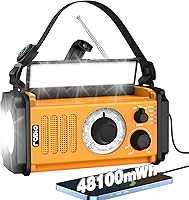
  • Battery Capacity: The built-in rechargeable battery carries a rated capacity equivalent to 48100mWh, which powers all onboard functions without external batteries.
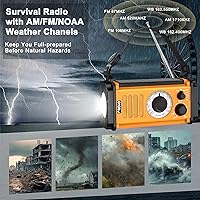
  • Radio Bands: Supported bands include AM (520–1710kHz), FM (87–108MHz), and NOAA Weather Band (162.400–162.550MHz) across all 7 preset WB channels.
  • Antenna: An extended-length antenna is included to improve signal reception across AM, FM, and NOAA weather band frequencies compared to standard-length designs.
  • Flashlight Output: The integrated COB LED flashlight delivers a rated 800LM with a claimed beam range of up to 200 meters in straight-line projection.
  • Reading Lamp: Flipping up the top solar panel activates a reading lamp mode powered by 12 COB LEDs designed to diffuse light across a wider area.
  • Runtime (Radio): Under optimal conditions, the fully charged unit supports up to 90 hours of continuous radio playback, though real-world results typically fall below this ceiling.
  • Runtime (Flashlight): The flashlight mode is rated for up to 60 hours of continuous operation on a full charge under controlled testing conditions.
  • Runtime (Lamp): Reading lamp mode is rated for up to 50 hours of continuous use on a full charge, slightly shorter than flashlight mode due to the broader LED array.
  • SOS Alarm: The built-in SOS alarm produces a 115dB audio signal combined with simultaneous flashing lights, activated by holding down the dedicated SOS button.
  • Headphone Jack: A standard 3.5mm auxiliary headphone jack allows private listening to AM, FM, or NOAA broadcasts without using the built-in speaker.
  • Display: An LED band display provides clear visibility of the current frequency and selected radio band during tuning.
  • Tuning Knob: The tuning knob is designed at 2x standard size to allow more precise and deliberate channel adjustment, particularly under stressful or low-light conditions.
  • Included Accessories: Each unit ships with one compass attached to a nylon wrist strap, one Type-C charging cable, and a printed user manual.
  • Color & Brand: The device is available in orange and is manufactured by Suzhou Siyulang E-commerce Co., Ltd under the AXYEBI brand.
  • Connectivity: Audio output connectivity is provided via a single 3.5mm auxiliary jack; there is no Bluetooth or wireless audio output.
  • Compass: A small directional compass is attached to the nylon wrist strap and provides basic cardinal orientation for field navigation.
  • First Available: This model was first listed for sale in June 2024, making it a relatively recent entry in the budget emergency radio category.

Related Reviews
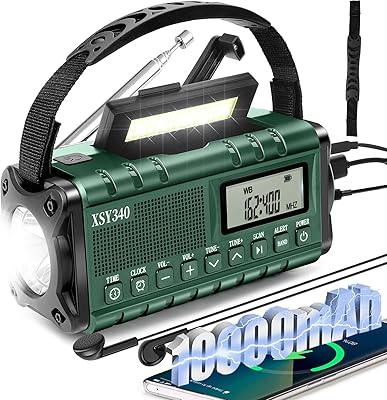
Roxicosly CR1009Ultra 12000mAh Emergency Weather Radio
74%
88%
Battery Life
91%
Charging Versatility
86%
NOAA Alert Performance
58%
Hand Crank Durability
44%
Solar Charging Speed
More
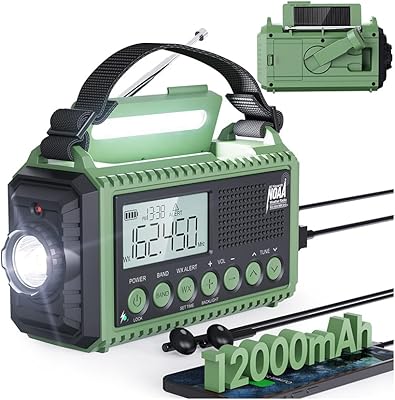
TFTDOUP Emergency Weather Alert Radio
86%
88%
Overall Performance
85%
Battery Life
90%
Charging Options
80%
Ease of Use
87%
Build Quality
More
Sttfaishen F20 Emergency Hand Crank Weather Radio
72%
82%
NOAA Alert Reception
54%
Battery Capacity & Honesty
61%
Hand Crank Usability
57%
Solar Charging Performance
83%
USB-C Charging Speed
More
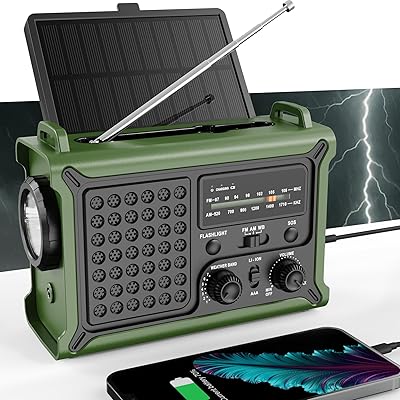
FosPower A6 5200mAh Emergency Weather Radio
77%
91%
NOAA Reception
84%
Build Quality
67%
Power Bank Utility
53%
Hand Crank Efficiency
49%
Solar Charging
More
RAOUOEN 30000mAh Emergency Weather Radio
85%
89%
Battery Life & Charging
91%
Performance in Emergencies
75%
Portability & Weight
84%
Sound Quality & Reception
87%
Ease of Use
More
QAUYYW Emergency Weather Radio XSY330
86%
89%
Battery Life
85%
Ease of Use
92%
Portability
75%
Radio Reception
88%
Build Quality
More
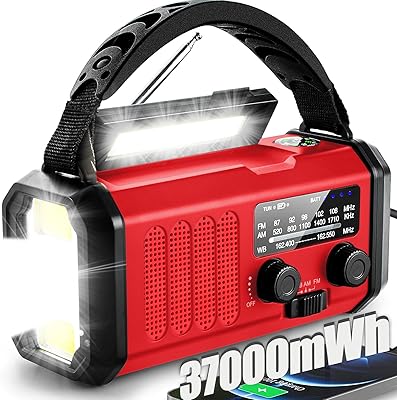
OnLyee CR1030 Emergency Weather Radio
76%
88%
Power Source Redundancy
83%
Hand Crank Durability
61%
Solar Charging Performance
79%
NOAA Reception Quality
67%
Battery Capacity & Phone Charging
More
RunningSnail Emergency Crank Weather Radio
72%
88%
Value for Money
84%
Power Redundancy
91%
Built-in Cables
73%
NOAA Reception Quality
62%
Battery Capacity
More
Leaton Emergency NOAA Weather Alert Radio
85%
88%
Battery Life & Charging Options
85%
Weather Alerts & Reception
90%
Build Quality & Durability
93%
Portability & Size
87%
Ease of Use
More
PRUNUS J-369 Emergency Weather Radio
84%
88%
Value for Money
93%
Power Options Flexibility
85%
Ease of Use
90%
SOS Alarm Effectiveness
80%
Battery Life
More

FAQ

Yes, this hand-crank weather radio is designed to receive all seven preset NOAA weather band frequencies between 162.400 and 162.550MHz. In practice, reception quality depends on your location and how fully you extend the antenna. Most users in suburban and rural areas report picking up local NOAA stations without issue, though dense urban environments can introduce interference.

Cranking is best thought of as a top-up method rather than a full charging solution. A few minutes of cranking will add enough power to run the radio or flashlight for a short period, but charging the full battery this way would take hours of sustained effort. For serious pre-storm preparation, charging via the Type-C cable beforehand is the smarter move.

Treat it as a best-case figure measured under controlled, low-volume conditions. Real-world testing from buyers suggests continuous runtime lands noticeably below 90 hours during typical use. That said, the battery is still capable of powering the radio through multi-day emergencies if you are not running it at full volume continuously.

No — this survival radio uses a built-in rechargeable battery and does not have a compartment for replaceable AA or AAA batteries. The charging options are limited to the hand crank, solar panel, and Type-C USB cable, so keep that in mind when planning your emergency kit.

It is genuinely bright for a built-in emergency radio light. The 800LM output is comparable to a decent mid-range handheld flashlight, and buyers consistently note it is brighter than they expected. The beam has solid throw for navigating outdoors at night, though the 200-meter range figure is a bit generous — expect strong performance out to a more modest distance in real conditions.

It will charge, but very slowly. The solar panel performs best under direct outdoor sunlight. Near a sunny window you will get a trickle at best, which is enough to extend battery life slightly during a prolonged outage but not enough to meaningfully recharge a depleted battery in a reasonable timeframe.

No, this device does not carry a waterproof or water-resistance rating. It is designed for emergency preparedness and outdoor use, but you should keep it dry and protected from rain. Storing it in a zip-lock bag or small dry pouch inside your go-bag is a sensible precaution.

The SOS function requires a deliberate long press to activate, so accidental triggering during normal handling is unlikely. That said, if the device is loose in a bag with other items pressing against it, it is worth storing it in a way that protects the button face — a small pouch works well.

Any standard wired earbuds or headphones with a 3.5mm plug will work fine. This covers the vast majority of wired earphones on the market. Note that no earphones are included in the package, so you will need to supply your own.

It is actually one of the better options in this category for first-timers, precisely because it requires no setup or technical knowledge. You switch it on, extend the antenna, and turn the tuning knob — that is essentially it. The bright orange color also makes it easy to find in a cluttered closet or bag during a stressful situation, which matters more than people realize.