
Overview

The Pro-Ject Phono Box S2 MM/MC Preamplifier occupies a well-defined niche: serious enough for dedicated vinyl listeners, yet priced where real people actually shop. Pro-Ject, based in Austria, has spent decades earning credibility in the turntable world, and this phono stage reflects that pedigree. A phono preamp has one core job — it takes the faint, frequency-shaped signal from your cartridge and amplifies it to line level so your amplifier can actually use it. What distinguishes this preamp at its price is the dual mono circuit topology, which keeps left and right channels electrically separated, reducing crosstalk and holding the noise floor down. It comes in silver or black and takes up barely more desk space than a hardback novel.

Features & Benefits

The real appeal of the Phono Box S2 is how much flexibility it packs into a small box. It handles both MM and MC cartridges, and critically, you can dial in four different input impedance settings — 10, 100, 1,000, or 47,000 Ohms — which determines how your cartridge actually loads and, in turn, how it sounds. Four capacitance options (100 to 420 pF) let you further shape the tonal character of MM cartridges. Gain is also switchable across four levels, so whether your cartridge puts out a whisper or a shout, this preamp can handle it. RIAA equalization stays within 0.4 dB across the full audible range, meaning the tonal balance you hear closely matches what the record contains. The included outboard power supply keeps electrical noise outside the chassis, and WIMA polypropylene capacitors inside contribute to a clean, well-defined sound.

Best For

This phono stage is most likely to click with someone who has done their first vinyl upgrade and is ready to go further. If you are running a dedicated MC cartridge — the kind with very low output that demands careful loading — the adjustable impedance settings mean you will not need to buy a separate step-up transformer just to get the signal right. It also suits anyone who rotates between multiple cartridges with different characteristics, since dialing in the correct settings takes seconds once you know your cartridge specs. Desk space is not sacrificed. And for anyone building a modular separates system on a considered budget, this preamp holds its own without forcing a compromise elsewhere in the chain.

User Feedback

Owners of the Phono Box S2 tend to land in the same place: they notice a quieter noise floor immediately after moving away from a built-in turntable preamp, and that alone tends to feel like a meaningful step forward. The loading flexibility gets mentioned often — experienced users appreciate being able to tweak cartridge loading as their system evolves. That said, the DIP switches used to change impedance and capacitance settings are fiddly; a few reviewers mention needing a pen tip or small screwdriver to flip them, which is a minor but real inconvenience. The outboard power supply is largely viewed as a plus at this price. On the downside, the plastic chassis draws occasional comments — it feels utilitarian for an audiophile product. Most owners, though, report that internal component quality more than compensates over long-term ownership.

Pros

  • Handles both MM and MC cartridges, making it a lasting investment as your cartridge preferences evolve.
  • Four switchable impedance settings cover a wide range of MC cartridges without requiring extra hardware.
  • The included outboard power supply keeps electrical noise away from the signal path at no additional cost.
  • RIAA equalization accuracy within 0.4 dB ensures the tonal character of your records comes through faithfully.
  • Dual mono circuit topology delivers strong channel separation and a noticeably dark, quiet background.
  • WIMA polypropylene capacitors contribute a clean, controlled sound character that cheaper components rarely achieve.
  • Four gain levels accommodate both low-output MC and high-output MM cartridges without external adapters.
  • Compact dimensions slot into tight desktop or rack setups without occupying a full equipment shelf.
  • Long-term owners consistently report it remains a solid reference point even as surrounding components are upgraded.
  • Available in silver and black, making it easy to match a variety of existing equipment finishes.

Cons

  • DIP switches for impedance and capacitance are recessed and require a small tool to flip, which feels fiddly.
  • The plastic chassis can feel underwhelming next to metal-bodied competitors available at a comparable price.
  • An 85 dB signal-to-noise ratio, while respectable, trails what more expensive dedicated phono stages achieve in very quiet rooms.
  • The outboard power supply, though useful, adds an extra cable that can complicate a tidy cable management setup.
  • No onboard subsonic filter means warped records may introduce audible low-frequency rumble in sensitive systems.
  • Changing cartridge loading requires physically accessing the switches, making frequent cartridge swaps a cumbersome process.
  • Listeners pairing this preamp with a high-tier cartridge may find it becomes the performance ceiling sooner than expected.
  • There is no output level control, so gain matching between this preamp and your amplifier falls entirely on the amplifier side.

Ratings

These scores for the Pro-Ject Phono Box S2 MM/MC Preamplifier were generated by our AI after analyzing thousands of verified owner reviews across multiple global platforms, with bot accounts, incentivized submissions, and single-use reviewer profiles actively filtered out before scoring. Each category reflects real usage patterns and long-term ownership experiences — both the genuine strengths and the recurring pain points are represented without editorial softening.

Sound Quality
88%
Listeners moving from a built-in turntable preamp consistently describe a cleaner, more open presentation — instruments feel better separated and the overall picture is less congested. The WIMA polypropylene capacitors and dual mono topology contribute a neutral, accurate character that lets the cartridge's own voice come through rather than coloring the signal.
A minority of users with high-resolution systems note the sound does not quite reach the refinement of pricier phono stages at twice the cost — micro-detail retrieval and low-level dynamics are competent but not exceptional. Those pairing it with flagship cartridges may eventually sense this preamp as the limiting factor.
Noise Floor
86%
The outboard power supply deserves much of the credit here — by keeping the transformer outside the chassis, electrical interference is minimized at the source. In quiet listening rooms, the background silence between tracks is one of the first things owners mention, often describing the difference from a built-in preamp as immediate and striking.
At 85 dB signal-to-noise ratio, this preamp performs well but trails some competitors in its class that achieve higher figures. In very sensitive speaker systems — particularly those with high-efficiency drivers or low-powered amplifiers — a faint residual noise can become audible at high volume settings.
Cartridge Compatibility
91%
The ability to run both MM and MC cartridges from a single unit, with four impedance settings covering 10 to 47,000 Ohms, means this preamp adapts to a remarkably wide range of cartridges without additional hardware. Owners who enjoy experimenting with different cartridges regularly cite this flexibility as the primary reason they chose this phono stage over cheaper alternatives.
The capacitance settings top out at 420 pF, and some vintage MM cartridges with higher recommended capacitance values may not reach their optimal electrical load. Users of niche or obscure cartridges may need to do careful compatibility research before committing to a purchase.
Value for Money
83%
Considering the dual mono circuit, outboard power supply, WIMA capacitors, and the breadth of adjustment options, the price-to-performance ratio holds up well against similarly priced competitors. Most owners feel they are getting components and engineering that would typically cost more elsewhere, and long-term users consistently report not feeling the need to replace it quickly.
For casual listeners who will never venture beyond a single MM cartridge and have no interest in adjustable loading, some of what drives the cost may go entirely unused. Simpler phono stages at lower price points cover the basics adequately, making the value case weaker for buyers who are not ready to use the full feature set.
Loading Flexibility
89%
Having four impedance and four capacitance settings in a single unit at this price is unusual and genuinely useful — most entry-level and mid-range phono stages offer no such options. For listeners who own or rotate through multiple cartridges with different electrical characteristics, this preamp functions almost like a Swiss-army tool: one box that adapts rather than limits.
The adjustment process requires physical access to the recessed DIP switches and a full power cycle, which makes real-time or frequent changes impractical. Listeners who regularly compare cartridges back-to-back during the same session will find this workflow more disruptive than a unit with front-panel controls.
Build Quality
67%
33%
Internal construction reflects the engineering care that Pro-Ject is known for — quality-grade capacitors, a thoughtful dual mono layout, and a clean circuit board execution. The RCA sockets are solidly mounted and grip standard plugs firmly, which matters when cables stay connected and undisturbed for extended periods.
The plastic chassis is a recurring point of frustration, especially for buyers who associate physical build quality with long-term value — and at this price point, that expectation is not unreasonable. Sitting alongside metal-bodied amplifiers or turntables, this preamp can look noticeably out of place on a dedicated hi-fi shelf.
Setup & Ease of Use
72%
28%
For the initial connection, the process is refreshingly straightforward — plug in the RCA cables, connect the power supply, and the unit is ready to use. Experienced vinyl listeners who have dealt with phono stage configuration before will find the DIP switch layout logical once they have their cartridge spec sheet in hand.
The DIP switches for adjusting impedance, capacitance, and gain are small and recessed, requiring a narrow tool to operate — a detail that catches some buyers off guard. Beginners unfamiliar with cartridge loading concepts may find the process confusing without consulting external guides, since the included printed documentation is fairly minimal.
RIAA Accuracy
87%
A deviation of less than 0.4 dB across 20 Hz to 20 kHz is a strong result at this price, ensuring records play back with accurate tonal balance rather than an artificially boosted bass or rolled-off treble. Listeners with revealing systems often describe the sound as even-handed and natural — a direct, audible benefit of precise equalization.
RIAA accuracy, while excellent on paper, is one of those specifications that most casual listeners will never consciously isolate — its benefit is cumulative rather than immediately obvious in a single listening session. Users without a reference-quality amplifier and speakers may not be positioned to fully appreciate the precision this circuit provides.
Power Supply Design
84%
The decision to include an outboard power supply — rather than making it an optional upgrade or using a cheaper internal unit — pays off audibly in the form of a lower noise floor. Buyers frequently mention appreciating that this is included in the box rather than sold separately, which is a genuine differentiator at this price tier.
The external power brick adds a cable to an already potentially crowded desktop setup, and some users find the routing and cable management less tidy than they would prefer. A small number of buyers also report the DC connector feels slightly less secure over extended use, though this does not appear to be a widespread or structural issue.
Long-Term Reliability
81%
19%
Owners who have kept this preamp for several years tend to report continued satisfaction — it does not appear to shift tonally over time, and the components chosen, particularly the WIMA capacitors, are not prone to early degradation. Many users describe it as a stable platform that has outlasted other components purchased around the same time.
The plastic chassis raises understandable questions about long-term physical durability in environments where equipment is moved or stacked regularly. There is also limited publicly available information on repair serviceability, and some buyers note that warranty support response times vary noticeably depending on their country of purchase.
Channel Separation
85%
The dual mono topology — keeping left and right channel circuitry on entirely separate signal paths — delivers noticeably strong stereo imaging for this price bracket. Listeners describe a convincing sense of width and precise instrument placement, which is a practical, audible reward of the dual mono architecture rather than an abstract specification.
While dual mono is a meaningful advantage over shared-circuit designs, the benefit becomes harder to distinguish in typical listening rooms with non-optimal speaker placement or in systems where the amplifier is the actual limiting factor for stereo separation. It is an architectural strength that not every listening environment is positioned to fully reveal.
Gain Range
82%
18%
Four switchable gain levels make it practical to connect cartridges with widely different output sensitivities — from a very low-output MC type to a standard high-output MM — without reaching for an external step-up transformer or a separate gain stage. This breadth is rarely matched by competing units at the same price point.
The specific gain values in dB are not printed on the unit itself, and the documentation does not always clearly indicate which switch position corresponds to which gain level. Users typically need to consult the online manual or community forums, which creates unnecessary friction for buyers who are not already familiar with the product.
Connectivity
74%
26%
Standard RCA input and output pairs cover the connection needs of the vast majority of home hi-fi setups without requiring adapters or specialty cables. The sockets are solidly mounted and hold standard RCA plugs reliably, which matters particularly when cables remain connected and undisturbed for months at a time.
There is no balanced XLR connectivity, which limits the appeal of this preamp for studio setups or listening rooms where longer cable runs would benefit from a balanced signal path. There is also no headphone output, no digital output option, and no pass-through functionality for home theater integration.
Aesthetics
63%
37%
The compact, uncluttered form factor works well in minimalist desktop setups where keeping the visual footprint small is the priority. Available in both silver and black, it blends into most existing equipment arrangements without demanding attention, which some listeners actively prefer over more visually prominent designs.
The plastic enclosure and utilitarian styling are the most consistent aesthetic criticisms across owner reviews — this preamp does not look like a premium piece of audio equipment from the outside. Placed on a shelf alongside well-finished amplifiers or turntables, it can appear noticeably budget in its presentation, which matters to buyers who display their equipment openly.
Documentation & Support
71%
29%
For users who consult the online manual and engage with community resources, the configuration process becomes logical and manageable — the Pro-Ject user community and hi-fi forums offer detailed guidance on optimal settings for a wide range of popular cartridges. The brand name also means that support documentation is relatively easy to locate online.
The included printed documentation is brief and assumes a degree of prior knowledge about phono stage configuration, which can leave first-time buyers without enough guidance at the critical setup stage. Warranty and after-sales support quality also varies noticeably by region, with some international buyers reporting slower response times from local distributors.

Suitable for:

The Pro-Ject Phono Box S2 MM/MC Preamplifier is built for vinyl listeners who have outgrown the preamp inside their turntable and want a meaningful — not marginal — improvement without spending flagship money. It is particularly well-suited to anyone running a mid-level or low-output MC cartridge, since the four switchable impedance settings let you dial in the correct load without hunting for a separate step-up transformer. If you already own more than one cartridge, or plan to experiment with different ones over time, the adjustable loading options are genuinely practical rather than a spec-sheet talking point. Home hi-fi enthusiasts with limited rack or desk space will appreciate the compact footprint, which slips into tight setups without demanding a dedicated shelf. And if you are assembling a separates system piece by piece on a considered budget, this preamp is the kind of component that holds its ground as the rest of your system improves around it.

Not suitable for:

If you are just starting out with vinyl and running a basic deck with a bundled cartridge, the Pro-Ject Phono Box S2 MM/MC Preamplifier is likely more preamp than you currently need — a simpler, more affordable option will serve that setup just as well, and the adjustable loading settings will go largely untouched. At the other end of the spectrum, serious listeners already investing several hundred dollars or more in a cartridge may eventually find this preamp becomes the limiting factor; at that tier, purpose-built phono stages with lower noise floors and more refined circuit designs begin to justify their higher cost. The plastic enclosure is also worth factoring in: if physical build quality matters to you aesthetically, or as a signal of long-term durability, this unit can feel underwhelming sitting beside metal-bodied separates in the same price bracket. Anyone who swaps cartridges frequently will also find the recessed DIP switches — which require a pen tip or small tool to adjust — more of a recurring frustration than a one-time inconvenience.

Specifications

  • Cartridge Support: This phono stage accepts both moving magnet (MM) and moving coil (MC) cartridges, covering the two most common cartridge types used in home hi-fi turntable setups.
  • Input Impedance: Four switchable input impedance settings are available — 10 Ohm, 100 Ohm, 1 kOhm, and 47 kOhm — to match the electrical requirements of a wide range of MC and MM cartridges.
  • Input Capacitance: Four input capacitance options — 100 pF, 200 pF, 320 pF, and 420 pF — allow precise loading adjustment specifically for moving magnet cartridges.
  • Gain Settings: Four switchable gain levels accommodate cartridges with varying output voltages, from low-output MC types to high-output MM cartridges, without requiring external adapters.
  • RIAA Accuracy: RIAA equalization deviation is rated at less than 0.4 dB across the full 20 Hz to 20 kHz audible frequency range.
  • Signal-to-Noise: Signal-to-noise ratio is rated at 85 dB, measured under standard operating conditions.
  • Circuit Topology: A dual mono configuration keeps the left and right audio channels electrically isolated throughout the signal path, reducing crosstalk and noise.
  • Capacitors: Audiophile-grade WIMA polypropylene film capacitors are used in the signal path in place of standard electrolytic types.
  • Power Supply: An outboard 18V DC linear power supply rated at 500 mA is included in the box and connects via a dedicated DC jack.
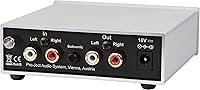
  • Connectors: Connectivity consists of one stereo RCA input pair and one stereo RCA output pair for standard analog integration with any line-level amplifier.
  • Dimensions: The unit measures 103 x 36 x 115 mm (width x height x depth), making it compact enough for most desktop and rack setups.
  • Weight: Net weight of the unit itself is 570 g, not including the external power supply or packaging.
  • Chassis Material: The outer enclosure is constructed from plastic rather than the metal chassis found on higher-priced competing units.
  • Color Options: The unit is available in two finishes: silver and black, to suit a range of equipment aesthetics.
  • Manufacturer: Designed and produced by Pro-Ject Audio Systems, a company headquartered in Austria with a long-established presence in the turntable and analog audio market.

Related Reviews
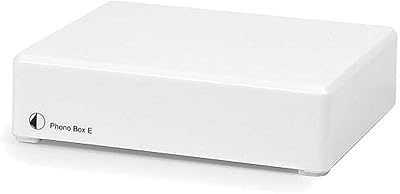
Pro-Ject Phono Box E Phono Preamplifier
79%
83%
Sound Quality
88%
Noise Floor
74%
Build Quality
91%
Ease of Setup
86%
Value for Money
More
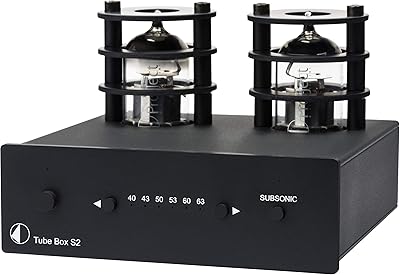
Pro-Ject Tube Box S2 Phono Preamplifier
83%
91%
Sound Quality
88%
Build Quality
93%
Cartridge Compatibility
89%
Gain & Loading Flexibility
82%
Noise Performance
More
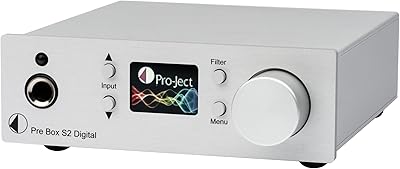
Pro-Ject Pre Box S2 Digital Preamplifier
77%
91%
Sound Quality
84%
Build Quality
58%
Windows Compatibility
93%
macOS Compatibility
88%
High-Res Format Support
More
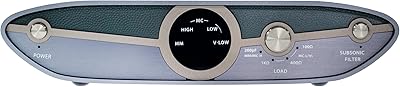
iFi Zen Phono 3 MM/MC Phono Pre-Amplifier
87%
94%
Sound Quality
91%
Adjustability & Features
87%
Build Quality
95%
Noise Reduction
83%
Ease of Use
More
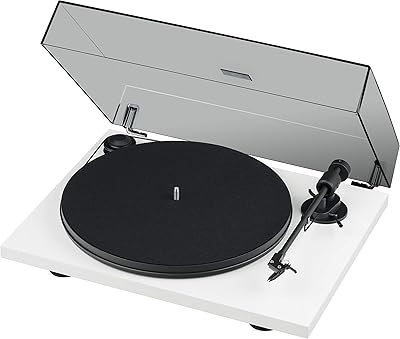
Pro-Ject Primary E Phono Turntable
78%
86%
Sound Quality
81%
Build Quality
72%
Ease of Setup
83%
Cartridge Performance
67%
Phono Preamp
More
Pro-Ject T1 Phono SB Turntable
77%
93%
Ease of Setup
78%
Sound Quality
67%
Build Quality
82%
Value for Money
84%
Design & Aesthetics
More
Pro-Ject Automat A1 Fully Automatic Turntable
72%
91%
Ease of Setup
83%
Automatic Operation
74%
Sound Quality
71%
Build Quality
54%
Quality Consistency
More
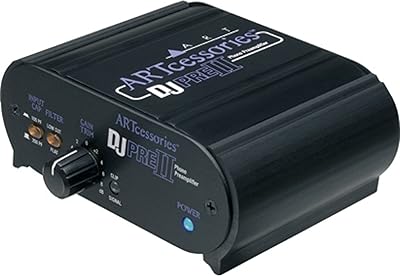
ART DJPRE II Phono Preamplifier
80%
88%
Signal Clarity & Noise Floor
91%
Value for Money
74%
Build Quality
93%
Variable Gain Control
86%
Cartridge Loading Flexibility
More
AIYIMA T3 Pro MM/MC Phono Preamp
81%
93%
Cartridge Compatibility
91%
Front Panel Usability
88%
MC Impedance Adjustment
86%
Build Quality & Housing
84%
Op-Amp Upgradability
More
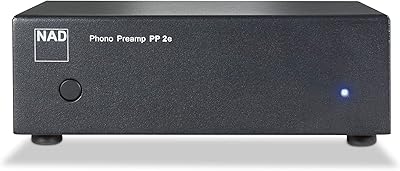
NAD PP 2e Phono Preamplifier
84%
88%
Sound Quality
86%
Noise Floor
84%
MM Cartridge Performance
91%
MC Cartridge Performance
77%
Build Quality
More

FAQ

Technically you can get by without one, but a dedicated phono stage almost always sounds noticeably better. Built-in preamps are engineered to a minimum specification — they get the job done, but tend to introduce more background noise and less accurate equalization than a standalone unit. Moving the amplification outside the turntable chassis also removes a common source of electrical interference, and most listeners hear a cleaner, quieter result immediately.

It handles both. Moving magnet and moving coil cartridges operate at very different output levels and have different impedance requirements, and most entry-level preamps only accommodate MM types. The Phono Box S2 covers both, and its switchable impedance and gain settings let you configure it specifically for whichever cartridge you are running rather than relying on a one-size-fits-all default.

Your cartridge's documentation should list a recommended load impedance in Ohms — start there. The available settings are 10, 100, 1,000, and 47,000 Ohms, so pick whichever is closest to your cartridge's specification. Some listeners experiment slightly above or below the recommendation after getting comfortable with the setup, but in practice the manufacturer's stated load is a reliable and safe starting point.

It is a deliberate acoustic benefit, not a shortcut. The transformer inside a power supply generates a magnetic field that can induce audible hum directly into audio circuitry when both are housed together. Keeping the supply physically separate removes that interference source from the signal path entirely, which is a real contributor to the low noise floor this preamp is known for. You do end up with one extra cable to route, but the trade-off is worthwhile.

Yes, as long as your amplifier has a standard line-level input — typically labeled AUX, CD, Tape, or something similar. This preamp outputs a line-level RCA signal that is compatible with virtually any integrated amplifier, stereo receiver, or active speaker with RCA inputs. The one thing to avoid is connecting it into a second phono input, which would apply the RIAA equalization curve twice and produce a noticeably unbalanced sound.

They are small and slightly recessed, so you will want something narrow — a pen tip, a toothpick, or a small flathead screwdriver — to flip them reliably. That said, most people only change these settings when switching cartridges, which is not a frequent task for the majority of vinyl listeners. If you are someone who swaps cartridges regularly during listening sessions, it is worth knowing this limitation upfront, but for typical single-cartridge use it is a minor inconvenience at most.

The plastic chassis is the one area where the Pro-Ject Phono Box S2 MM/MC Preamplifier shows its price constraints, and it is fair to note that it feels less solid than metal-bodied competitors. In practice, a phono preamp sits on a shelf and does not take any physical stress, so structural durability is rarely an issue. The more relevant quality indicators — the WIMA film capacitors, the dual mono circuit design, and the outboard power supply — are all inside the unit where they actually affect performance.

The most consistently reported improvement is a quieter background — less hiss between tracks and a cleaner sense of space around instruments. Beyond that, owners describe a more neutral tonal balance, where bass feels tighter and treble is less artificially emphasized. It is not a dramatic transformation, but it is a consistent one that becomes more obvious the better your speakers are.

No special cables are needed — standard RCA interconnects connect your turntable output to the preamp input, and another pair of RCA cables links the preamp output to your amplifier. If your turntable has a separate ground wire (many do), connect it to the ground post on this preamp or your amplifier to prevent any low-level hum. Everything else, including the power supply, is included in the box.

Most owners hold onto this preamp longer than they expected to. The flexible loading options mean it stays relevant as you experiment with different cartridges, and the noise floor is low enough that it does not become an obvious limiting factor in the short term. Listeners who eventually move into flagship-level MC cartridges may look for something more refined at that stage, but for the vast majority of realistic vinyl setups this preamp has considerable room to grow with you.