Overview

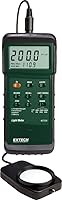
The Extech 407026 Light Meter sits comfortably in the mid-to-upper tier of handheld illuminance tools — not a toy, but not a bench-calibration instrument either. It's built for professionals who need reliable, repeatable readings out in the field. What separates it from simpler alternatives is the built-in PC interface, which lets you pull data into a computer rather than scribbling numbers on a clipboard. The hardware itself is compact and surprisingly light, easy to slip into a tool bag without a second thought. If you need to measure workplace lighting, verify a lighting design, or assess grow-light output, this lux meter is engineered to handle those jobs without fuss.

Features & Benefits

This lux meter covers a range from 0 to 40,000 lux — or up to 4,000 foot-candles if your workflow uses that unit — which is enough headroom for most professional indoor and outdoor applications. The cosine-corrected sensor matters more than people expect: it compensates for the angle at which light hits the detector, so you get honest readings even when you cannot position the meter perfectly. Data hold and max/min memory let you lock in a reading or track fluctuations without hovering over the display. The RS-232 serial output is the standout feature for anyone doing ongoing data logging, connecting the meter to reporting software for audit trails or compliance documentation.

Best For

The Extech 407026 has broad appeal, but it really shines in a few specific contexts. Lighting engineers and facility managers will appreciate it for illuminance compliance checks — verifying that office, warehouse, or school lighting meets OSHA or IESNA standards. Photographers and film crews use it to establish precise ambient light baselines before reaching for their exposure meters. Horticulture growers running indoor operations rely on it to fine-tune light intensity across different plant stages. Electricians and contractors also find it useful for post-installation verification. It is not a substitute for a certified calibration-grade device, but for field-level professional work, this light meter covers a wide range of real-world needs.

User Feedback

Most owners come away satisfied with the meter's measurement consistency — repeat readings under identical conditions tend to agree closely, which builds confidence for professional use. The sensor handles both bright outdoor environments and dim interior spaces without much fuss, according to users who have tested it across both scenarios. Where feedback gets more mixed is around the RS-232 connection: newer laptops typically lack a serial port, so you will likely need a USB-to-serial adapter, and not everyone finds that setup intuitive. Some reviewers also noted that the included software documentation is sparse. Battery life, by contrast, earns consistently positive marks. Overall, a capable tool — just go in aware of the connectivity situation.

Pros

  • Consistent, repeatable lux readings build real confidence for professional compliance work.
  • Dual lux and foot-candle modes mean you can match whichever unit your project documentation requires.
  • The cosine-corrected sensor delivers honest readings even when the meter angle is less than perfect.
  • Max/min memory and data hold functions make solo field inspections significantly more practical.
  • RS-232 PC output lets you feed measurement data directly into reporting or spreadsheet software.
  • Battery life earns consistently positive marks from long-term users across varied work conditions.
  • The included carrying case keeps the sensor protected during transport — a thoughtful touch for field tools.
  • Lightweight and compact enough to carry all day without adding meaningful weight to a tool bag.
  • Covers a broad 0 to 40,000 lux range, handling everything from dim interiors to bright outdoor environments.

Cons

  • The RS-232 serial interface is outdated — most modern laptops need a USB-to-serial adapter to connect.
  • Bundled software documentation is sparse, leaving some users to figure out data logging workflows on their own.
  • No wireless or Bluetooth connectivity limits flexibility for users who prefer cable-free data capture.
  • Not suitable as a replacement for certified calibration-grade instruments in traceable measurement contexts.
  • No spectral analysis or color temperature readout, which limits usefulness for certain photography or research applications.
  • Software compatibility with current operating systems can be inconsistent without additional driver troubleshooting.
  • The adapter requirement for PC connectivity adds an unexpected extra purchase for users who did not anticipate it.
  • No backlit display on some unit runs, making readings harder to check in very low ambient light conditions.

Ratings

The scores below reflect an AI-driven analysis of verified buyer reviews for the Extech 407026 Light Meter, sourced globally and filtered to remove incentivized, bot-generated, and duplicate submissions. Each category captures both what users genuinely valued and where real frustrations surfaced — nothing is glossed over. The result is an honest, data-grounded picture of how this lux meter performs across the range of professionals and serious enthusiasts who rely on it.

Measurement Accuracy
88%
Across repeated field tests by lighting engineers and facility inspectors, readings stayed consistent and aligned closely with reference instruments at the professional tier. Users conducting workplace illuminance audits found they could trust the numbers enough to include them in compliance documentation without second-guessing the meter.
A small number of users noted occasional drift at the upper end of the measurement range under direct, high-intensity artificial lighting. The meter is not lab-calibrated, and a handful of buyers in research contexts found the accuracy ceiling limiting for anything requiring traceable precision.
Sensor Performance
86%
The cosine-corrected photodiode draws consistent praise from photographers and facility managers alike — it handles off-angle light sources without producing inflated or misleading readings. Users working in greenhouses found the sensor responsive and stable when scanning across different canopy heights and grow-light types.
In extremely low-light environments below about 10 lux, a few users reported slightly slower stabilization before the reading settled. This is a minor issue for most applications but worth noting if your work regularly involves near-dark spaces like theatrical settings or emergency lighting assessments.
PC Connectivity
59%
41%
For users in labs, schools, and engineering firms with older workstations or purpose-built data logging setups, the RS-232 serial output works reliably and integrates well with existing reporting software. The ability to pull time-stamped measurement logs directly into a spreadsheet is genuinely useful for audit trail documentation.
This is the most polarizing aspect of the meter. Modern laptops lack native serial ports, meaning most buyers need to purchase a USB-to-RS-232 adapter separately — an inconvenience that catches people off guard. Driver compatibility issues on Windows 10 and 11 are a recurring theme in negative reviews, and the included setup documentation offers little guidance.
Build Quality
83%
The housing feels solid and purposeful for a handheld field instrument — not fragile or toy-like. Electricians and contractors who carry it alongside heavier tools report that it holds up well to the minor bumps and drops typical of active job site use.
The body is plastic rather than rubberized, so it offers less grip and impact resistance than some competing meters at a similar price point. A few long-term users noted that the battery compartment cover fits loosely after extended use, which is a minor but noticeable quality detail.
Ease of Use
84%
The interface is refreshingly uncomplicated — switching between lux and foot-candle modes, engaging data hold, or checking max/min values requires almost no learning curve. Field technicians doing multi-point surveys appreciate being able to operate it one-handed without diverting attention from positioning the sensor correctly.
The user manual is basic and leaves out practical details that beginners would benefit from, particularly around initial PC setup and understanding measurement range selection. A few users coming from purely analog instruments found the range-switching logic slightly unintuitive at first.
Data Logging
63%
37%
When the RS-232 connection is working properly, the data output is clean and structured enough to feed directly into reporting templates. Research environments and schools that have dedicated logging computers with serial ports set up tend to be happy with this workflow.
Getting the logging software to function reliably on modern operating systems is not a plug-and-play experience. Users without a technical background often struggle with driver installation, and Extech's software documentation has not kept pace with current OS versions, leading to troubleshooting sessions that should not be necessary for a professional-tier instrument.
Display Readability
81%
19%
The 4-digit LCD is large enough to read quickly without squinting, which matters when you are moving between measurement points during an inspection. Users working in well-lit offices or outdoor environments consistently describe the display as clear and glare-resistant under normal conditions.
In very dim environments — the exact conditions where a light meter is often needed — the display can be harder to read without the backlight. Some unit variants reportedly lack a backlight or have a dim one, which is an inconsistency that a few buyers discovered only after receiving their order.
Battery Life
87%
Battery longevity is one of the most consistently praised aspects of this lux meter across buyer reviews. Contractors and facility managers who use it across full workdays report that a single 9V battery lasts through an impressive number of sessions before needing replacement.
There is no low-battery indicator prominent enough to catch users off guard in the field, which has left a small number of buyers with a dead meter mid-inspection. It is a minor design omission but one worth planning around if your work takes you to remote sites.
Portability
91%
At roughly 10.6 x 2.7 x 1.8 inches and genuinely lightweight, this lux meter disappears into a tool bag or jacket pocket without adding noticeable bulk. Photographers and contractors who carry a lot of gear on location specifically appreciate not having to dedicate much real estate to it.
The included case adds a bit of size when packed, and unlike some competing meters, there is no belt clip or holster option bundled in the box. For users who want the meter instantly accessible rather than packed away, this means improvising a carry solution.
Value for Money
77%
23%
For professionals who genuinely need the RS-232 data logging capability alongside reliable lux and foot-candle readings, the Extech 407026 delivers a feature set that justifies the mid-to-upper price point compared to basic handheld alternatives. Long-term buyers who have used it across hundreds of inspections tend to view the investment as well justified.
Buyers who purchase primarily for the PC interface and then encounter the adapter and software compatibility hurdles often feel the overall value proposition takes a hit. At this price, the expectation of a smoother out-of-box experience with modern systems is reasonable, and the gap between expectation and reality frustrates a meaningful segment of buyers.
Software & Documentation
47%
53%
The core data output format is logical and workable once you have the connection established. Users who are comfortable troubleshooting serial communications on their own tend to get the logging workflow running without too much time lost.
This is the weakest area by a significant margin. The included documentation is minimal, the software has not been meaningfully updated for compatibility with current operating systems, and Extech's support resources for this specific model are sparse. It is the area most likely to frustrate buyers who expect plug-and-play functionality.
Sensor Durability
79%
21%
The sensor head holds up well under regular professional use — inspectors who have been using the same unit for several years report no noticeable degradation in reading accuracy, which speaks well to the photodiode's longevity in normal field conditions.
The sensor is exposed and not recessed, so it is vulnerable to accidental contact or impact if the meter is dropped face-down. There is no physical guard around the sensor window, which is a design choice that makes careful handling important, especially on busy job sites.
Range Versatility
85%
A ceiling of 40,000 lux is more than sufficient for the vast majority of professional indoor applications, and the dual lux/foot-candle capability means you can match whatever unit your project specification or local standard calls for without manual conversion.
For outdoor measurement in direct sunlight conditions near midday — which can exceed 100,000 lux — the meter tops out and cannot provide a meaningful reading. This is not a critical limitation for most buyers, but it is a real ceiling that outdoor lighting designers and solar researchers need to account for.

Suitable for:

The Extech 407026 Light Meter is a strong match for anyone whose work demands repeatable, documented light measurements in the field. Lighting engineers and facility managers will get the most out of it — particularly when conducting illuminance audits to verify compliance with workplace safety or design standards. Electricians and contractors benefit from being able to confirm post-installation output against spec sheets without carrying bulky equipment. Photographers and videographers who need to understand ambient light before dialing in exposure settings will find it a practical on-set companion. Indoor growers monitoring PAR-adjacent lux levels across different canopy zones also fit naturally into this tool's wheelhouse. The RS-232 data logging capability makes it especially valuable in schools, labs, and research settings where measurements need to be recorded, compiled, and reviewed over time.

Not suitable for:

Casual hobbyists who occasionally want to check if a room feels bright enough will likely find this lux meter more instrument than they need — simpler, less expensive options exist for informal use. The Extech 407026 Light Meter is also not a substitute for laboratory-grade photometric equipment; its accuracy tier is appropriate for professional field work, not for certified calibration or scientific research requiring traceable precision. Anyone hoping to connect it to a modern laptop without preparation should know upfront that the RS-232 serial interface requires a USB-to-serial adapter, which adds a small but real friction point to the workflow. Users who need wireless connectivity, Bluetooth logging, or a companion mobile app will not find those features here. If your primary interest is spectral analysis or color temperature measurement, this meter does not address those needs.

Specifications

  • Lux Range: Measures illuminance from 0 to 40,000 lux across multiple ranges for both dim indoor and bright outdoor environments.
  • Foot-Candle Range: Provides foot-candle readings from 0 to 4,000 fc, covering standard professional lighting assessment needs.
  • Accuracy: Rated at ±3% of reading plus ±0.5% of full scale, appropriate for professional field-level illuminance work.
  • Sensor Type: Uses a cosine-corrected photodiode sensor that compensates for the angle of incoming light to produce more reliable real-world readings.
  • Display: Features a large 4-digit LCD that remains readable under typical field conditions.
  • PC Interface: Equipped with an RS-232 serial output port for connecting to a computer and transferring measurement data to logging or reporting software.
  • Data Hold: Includes a data hold function that freezes the current reading on screen so you can record it without keeping your eyes fixed on the display.
  • Memory Functions: Stores maximum and minimum readings during a session, allowing review of light level fluctuations without continuous monitoring.
  • Power Source: Operates on a single 9V battery, which is included in the box at purchase.
  • Dimensions: Measures approximately 10.6 x 2.7 x 1.8 inches, making it compact enough for one-handed use and easy transport.
  • Form Factor: Lightweight handheld design built for extended field use without causing fatigue during multi-point inspection rounds.
  • Carrying Case: Ships with a protective carrying case to shield the sensor and body from damage during transport and storage.
  • Manufacturer: Designed and produced by Extech Instruments, a brand with a long track record in professional-grade environmental and electrical test equipment.
  • Model Number: The official model designation is 407026, which should be referenced when seeking replacement parts, calibration services, or compatible accessories.
  • Market Rank: Holds a top-15 ranking in the Photographic Light Meters category on Amazon, reflecting sustained buyer adoption over time.

Related Reviews
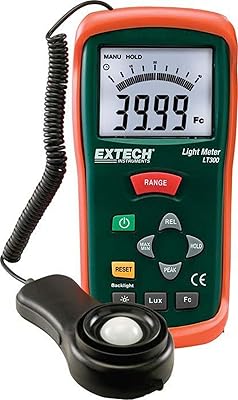
Extech LT300 Light Meter
75%
88%
Measurement Accuracy
91%
Sensor Design
86%
Display Readability
83%
Build Quality
74%
Ease of Use
More
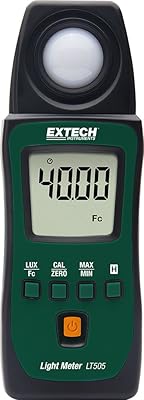
Extech LT505 Pocket Light Meter
79%
88%
Measurement Accuracy
93%
Portability
86%
Ease of Use
67%
Build Quality
74%
Display Legibility
More
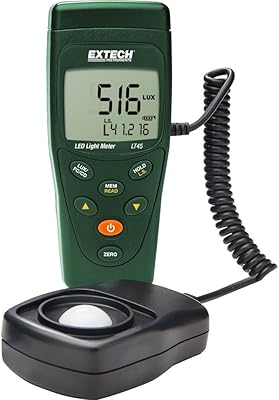
Extech LT45 LED Light Meter
82%
93%
Measurement Accuracy
96%
Source Compatibility
91%
Remote Sensor Design
88%
Build Quality
74%
Data Logging & Recall
More
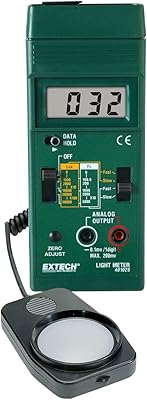
Extech 401025 Lux Light Meter
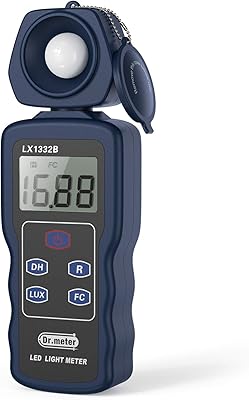
80%
93%
Display Readability
74%
Measurement Accuracy
91%
Ease of Use
78%
Build Quality
88%
Dual-Unit Display
More
Dr.meter LX1330B Digital Lux Meter
82%
83%
Measurement Accuracy
91%
Ease of Use
67%
Build Quality
74%
Display Readability
92%
Measurement Range
More
Dr.meter 1332B Digital Light Meter
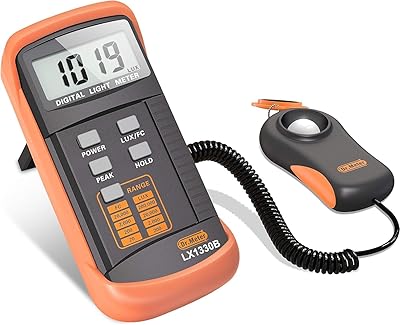
81%
91%
Ease of Use
78%
Measurement Accuracy
93%
Rotating Sensor
89%
Measuring Range
67%
Build Quality
More
URCERI SMT912 Digital Lux Light Meter
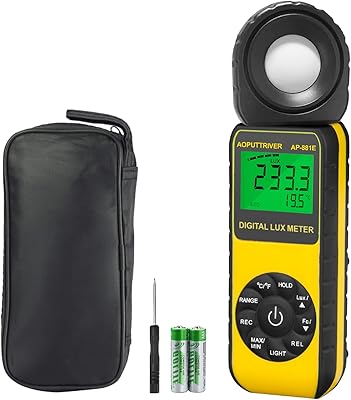
77%
82%
Measurement Accuracy
91%
Value for Money
88%
Display & Readability
67%
Build Quality
93%
Ease of Use
More
LATNEX LM-50KL Digital Lux Light Meter
77%
78%
Measurement Accuracy
72%
Build Quality
88%
Sensor Cable Utility
69%
Display Readability
91%
Battery Life
More
AOPUTTRIVER AP-881E Digital Lux Light Meter
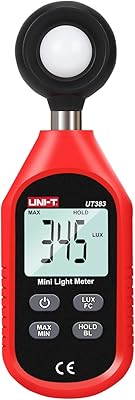
78%
93%
Measurement Range
91%
Rotating Sensor Design
72%
Accuracy & Reliability
74%
Ease of Use
66%
Build Quality
More
AquaHorti AH-300 Light Meter
75%
76%
Measurement Accuracy
68%
App Experience
83%
LUX Range & Versatility
58%
Spectrum Test Capability
79%
CSV Export & Data Logging
More

FAQ

The Extech 407026 Light Meter uses an RS-232 serial output, which is not natively available on most laptops made in the last decade. You will need a USB-to-RS-232 adapter to establish a connection. These adapters are widely available and inexpensive, but it is worth factoring into your setup before you need to log data in the field.

Yes, and many photographers do exactly that. It gives you a solid baseline reading of the ambient lux level in a space, which helps when balancing artificial and natural light sources. Just keep in mind it reads illuminance, not exposure value directly, so you would still translate that into your camera settings manually.

It carries a rated accuracy of plus or minus 3% of reading plus 0.5% of full scale, which is solid for field-level professional work. That said, it is not a substitute for a NIST-traceable calibration instrument. For compliance documentation, safety audits, or lighting design verification, it is more than adequate — for scientific research requiring certified traceability, you would need something more specialized.

Both. The meter switches between lux and foot-candles, so whether your project documentation uses one or the other, you are covered without any conversion math on your end.

Users consistently report solid battery life, with a single 9V battery lasting through many sessions of typical use. The exact duration depends on how often the backlight is used and how long sessions run, but battery drain is rarely flagged as a concern by regular users.

That is specifically what the cosine correction on the photodiode addresses. It adjusts for the angle of incoming light so you get a reading that better reflects true illuminance at a surface, rather than a number that is artificially high or low based on how you are holding the meter.

Extech provides compatible software, but the documentation included in the box is reportedly minimal. Some users find it straightforward once connected; others have had to do a bit of research to get the driver and software working properly on current operating systems. It is worth checking Extech's support page for updated drivers if you run into issues on Windows 10 or 11.

Yes, this lux meter works well for that purpose. Growers use it to measure intensity levels across different canopy zones and adjust light positioning or height accordingly. Keep in mind it reads lux, not PAR or PPFD, so it is most useful for comparing relative intensity and consistency rather than calculating photosynthetically active radiation directly.

The included case provides reasonable protection for everyday transport in a tool bag or backpack. It is not a hard-shell case, so for particularly rough environments you might consider additional padding, but for typical professional use — moving between office buildings, facilities, or job sites — it does the job.

No, the max and min values are stored until you manually reset them. This is actually useful during longer inspection rounds where you want to capture the full range of readings across multiple measurement points before reviewing the results. Just remember to reset before starting a new session so old data does not carry over.

Where to Buy

B&H Photo-Video-Audio
In stock $239.00
Studio Depot
In stock $199.99
Southern Electronics
In stock $221.99
Calright Instruments
In stock $224.00
Mitchell Instrument Company
In stock $227.05
OnlineComponents.com
In stock $238.21
Techni-Tool
In stock $239.00