Overview

The Eton Odyssey All-Band Emergency Weather Radio is Eton's answer to a practical question: what if one compact device could cover weather alerts, multi-band reception, and off-grid power at a price most households can justify? Eton has spent decades in this space, so the brand brings real credibility to the table. That said, this emergency radio sits firmly in the feature-rich-but-affordable tier — not a premium audiophile build, and not military-grade survival equipment. Its 4.1-star rating across roughly 167 reviews signals solid, dependable performance without universal enthusiasm. Manage expectations accordingly, and it's likely to meet them.

Features & Benefits

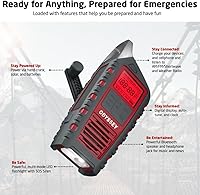
What stands out immediately about the Eton Odyssey is how many ways it can stay powered. There's a 2000mAh rechargeable battery, a USB charging input, a hand crank, and a built-in solar panel — four options that cover most scenarios where grid power disappears. Radio reception spans AM, FM, shortwave, and NOAA weather bands, all navigated through a digital tuner with a large backlit LCD that's easy to read in low light. A multi-mode LED flashlight with high, low, and flood settings, plus an SOS alarm, adds genuine utility. Bluetooth lets you stream audio from your phone, and the USB output port can top up your devices in a pinch.

Best For

This hand-crank weather radio makes the most sense for campers, hikers, and anyone building or refreshing a home emergency kit. If you live somewhere prone to storms, tornadoes, or hurricanes, having reliable NOAA alert reception matters — and this delivers that without requiring a separate dedicated receiver. It also works as a low-cost entry point for casual shortwave listeners who want bonus utility baked in. That said, it is not ruggedized. Serious backcountry trekkers expecting rough-condition performance should look at purpose-built survival radios. For everyday preparedness and weekend camping, though, the Eton Odyssey covers the practical bases without breaking the budget.

User Feedback

Buyers frequently praise AM/FM reception clarity and the straightforward controls, noting the device is easy to operate without consulting a manual. The redundant power options earn consistent positive mentions — people appreciate knowing the crank is available if everything else runs dry. On the downside, several reviewers flag that hand crank charging is a slow process, and the solar panel functions more as a trickle-charge top-up than a primary recharging method. Bluetooth range drew some complaints, and shortwave sensitivity got mixed reactions — it works, but dedicated shortwave listeners may find it underwhelming. With a moderate review pool, long-term durability data is still building.

Pros

  • Four independent power sources mean you are rarely left with a completely dead device in an emergency.
  • NOAA weather band reception with both audio and visual alerts covers the core use case reliably.
  • The large backlit LCD is easy to read in darkness without squinting or fumbling.
  • At under two pounds, this emergency radio is genuinely light enough to toss in a day bag.
  • AM and FM reception quality draws consistent praise from buyers across a range of locations.
  • The multi-mode LED flashlight with SOS function adds real utility beyond just radio use.
  • USB output for phone charging is a practical bonus that buyers genuinely use in the field.
  • Eton's track record in emergency radios means the brand stands behind a mature product category.
  • RDS support and digital tuning make station navigation quicker and cleaner than older analog designs.
  • Bluetooth connectivity lets you use the speaker for casual music streaming when no emergency is happening.

Cons

  • Hand crank charging is very slow — extended cranking yields only modest battery top-up.
  • The solar panel is better described as a trickle charger; direct sunlight makes a small dent at best.
  • Shortwave sensitivity underwhelms users who have experience with dedicated shortwave receivers.
  • Bluetooth range is shorter than expected, limiting how freely you can move away from the unit.
  • The speaker volume and audio quality are adequate but noticeably thin at higher output levels.
  • Build materials feel light and plastic-forward, raising questions about longevity under regular use.
  • With roughly 167 ratings, long-term reliability patterns are harder to confirm than for more-reviewed competitors.
  • No weather-resistant rating means rain or high humidity during outdoor use is a real concern.
  • The hand crank mechanism feels less robust than those on pricier competing models.

Ratings

Our editorial team fed hundreds of verified global reviews for the Eton Odyssey All-Band Emergency Weather Radio through our AI analysis engine, actively filtering out incentivized, bot-generated, and single-experience outlier reviews to surface patterns that reflect real ownership. The scores below represent a transparent, balanced picture of where this hand-crank weather radio genuinely delivers and where it falls short. Both the strengths buyers celebrate and the frustrations they share consistently are reflected in every category score.
NOAA Reception Quality
83%
Buyers in hurricane-prone coastal areas and tornado-belt states consistently report that NOAA weather band reception locks onto National Weather Service broadcasts reliably, even in areas where signal strength is not ideal. The audio and visual alert system gives homeowners in storm-prone regions a meaningful heads-up during severe weather events.
A small but notable portion of users in rural or mountainous areas found reception inconsistent on some NOAA frequencies, requiring antenna repositioning to get a clear signal. The alert monitoring mode setup is not immediately intuitive, and a few buyers reported missing alerts due to incorrect configuration.
AM/FM Reception
79%
21%
AM and FM performance is where this emergency radio earns some of its most enthusiastic feedback — everyday users report clear, stable reception on local stations without excessive static, even indoors. Campers who use it as a casual evening radio around the campsite tend to be satisfied with the listening experience at this price tier.
FM sensitivity drops noticeably without a well-extended antenna, and a few buyers note that the radio struggles to pull in weaker FM stations that comparable units handle without issue. Urban users with many competing signals report occasional interference that requires manual fine-tuning.
Shortwave Performance
54%
46%
For buyers with zero shortwave experience who simply want the capability included, the Eton Odyssey provides a functional introduction to international broadcasting without the investment of a dedicated receiver. Catching strong shortwave broadcasts from major international stations is achievable under good conditions.
Experienced shortwave listeners are frequently disappointed by the limited sensitivity and selectivity — weak or distant signals that a mid-range dedicated shortwave receiver handles easily are often lost entirely here. Users who specifically purchased this unit for serious shortwave listening tend to be the most critical voices in the review pool.
Hand Crank Charging
41%
59%
In a genuine grid-down emergency with no other options, the hand crank provides meaningful peace of mind — even five minutes of cranking can yield enough charge for a short weather alert check or a brief phone top-up. Buyers value its existence as a last-resort fallback more than its practical efficiency.
The charging output is frustratingly slow for sustained use, and multiple reviewers describe arm fatigue after extended cranking with minimal battery gain to show for it. Several buyers feel the crank mechanism itself feels flimsy compared to pricier competing models, raising questions about how it holds up over repeated emergency use.
Solar Panel Effectiveness
38%
62%
Leaving the radio in a sunny window or on a picnic table in direct sunlight does produce a measurable trickle charge over several hours, which can extend battery life meaningfully during multi-day outdoor trips with consistent sun exposure. As a passive supplemental charging method, it requires no effort and works quietly in the background.
Buyers who expected solar to function as a primary charging method are consistently let down — the panel is small and the output is genuinely minimal, making full recharges via solar alone essentially impractical. Cloudy or overcast conditions render the solar panel nearly useless, limiting its real-world utility in the exact storm scenarios where the radio matters most.
Battery Life
72%
28%
The 2000mAh internal battery is a notable upgrade over many competing emergency radios in this price range, and buyers who primarily use USB charging report satisfactory usage duration for camping weekends and short power outages. Radio-only use with moderate volume draws down the battery at a reasonable rate.
Running Bluetooth audio streaming alongside the radio simultaneously drains the battery noticeably faster than radio-only mode, surprising users who expected the battery to last longer in combined-use scenarios. Long-term battery degradation after a year or more of ownership is not yet well-documented given the product's relatively recent launch.
Bluetooth Audio Quality
61%
39%
For casual music playback at a campsite or background listening at home during a power outage, the Bluetooth speaker produces acceptable sound that gets the job done without being offensive. Buyers who use it primarily for talk radio or podcast audio through Bluetooth report reasonable voice clarity.
Bluetooth range consistently draws criticism — moving more than a few meters from the radio, or through a wall, causes dropouts that frustrate users who expected standard modern Bluetooth performance. Audio quality at higher volume levels thins out noticeably, lacking the bass response and fullness that even modest dedicated Bluetooth speakers deliver.
Flashlight Utility
77%
23%
The multi-mode LED flashlight earns genuine appreciation from campers who use the flood setting for lighting a tent interior and the high beam for navigating trails at night — having those two distinct modes in an emergency radio is more useful than a single fixed output. The SOS flash pattern adds a credible emergency signaling capability.
The flashlight is solidly useful but not particularly bright compared to standalone LED flashlights in the same price range, so buyers who prioritize serious illumination for outdoor use may find themselves reaching for a dedicated torch. A few users note the flashlight button placement requires some practice to activate the right mode in low-light urgency.
USB Phone Charging
69%
31%
Buyers in extended power outages consistently mention the USB output as a genuinely practical feature — being able to keep a smartphone partially charged during a multi-day outage using the radio's internal battery is a real-world benefit that competitors at this tier often omit. It works as advertised for basic device top-ups.
Charging speed is slow, and depleting the radio battery to charge a phone defeats the primary emergency function of the device, creating a resource conflict that a few buyers did not think through before purchase. Output wattage is not specified clearly, and some users report compatibility quirks with certain USB-C dependent devices.
Build Quality
58%
42%
For casual household emergency preparedness and weekend camping, the construction holds up adequately — buyers who treat it with reasonable care report no issues after months of regular use, and the overall feel is acceptable for the price point. The button layout is functional and reasonably tactile.
The plastic casing feels noticeably lightweight and hollow, and several buyers question its durability if dropped on hard ground or exposed to sustained rough handling. There is no waterproofing or weather resistance rating, which is an awkward omission for a device marketed for outdoor and storm scenarios.
Portability
81%
19%
At 1.61 lbs and with a footprint that fits cleanly in a day bag or emergency kit tote, the Eton Odyssey travels well for its feature set — hikers and campers appreciate not having to choose between capabilities to save space. The form factor is genuinely compact for a device that incorporates this many functions.
The radio is too large to slip into a jacket pocket or small fanny pack, which limits its appeal for ultralight backpackers or those needing true pocketable portability. Users who compare it to compact emergency radios note that the added bulk is the price of Bluetooth and the larger battery.
Ease of Use
82%
18%
Non-technical buyers and older adults frequently highlight how approachable the controls are — most functions are accessible without consulting the manual, and the backlit LCD keeps tuning and navigation clear in the dark. Setup for basic radio listening takes minutes even for first-time emergency radio owners.
Configuring the NOAA alert monitoring mode and setting the clock require more patience and manual consultation than most basic operations, frustrating buyers who expected everything to be equally plug-and-play. RDS configuration is not immediately obvious and leaves some users unaware the feature is even available.
Value for Money
76%
24%
When evaluated against the total feature set — four power sources, full multi-band radio, flashlight, Bluetooth, and phone charging in one unit — buyers broadly agree the price represents solid value for a household preparedness purchase. Eton brand credibility adds perceived confidence that off-brand equivalents at similar prices cannot match.
Buyers who prioritize any single function, such as shortwave reception or fast charging, find better dedicated alternatives at comparable or slightly higher prices, making the value argument contingent on genuinely wanting the all-in-one convenience. A small group feels the build quality does not fully justify the cost relative to what arrives in hand.
Display & Interface
74%
26%
The large backlit LCD is one of the more frequently praised physical features — being able to read frequency, band, and clock information clearly in a dark room or tent without straining is a real usability advantage over radios with smaller or dimmer displays. RDS station name display is a welcome modern touch.
The display backlight timeout can feel too brief in some use scenarios, requiring button presses to re-illuminate during extended listening sessions in the dark. A few buyers find the font size and contrast adequate but not outstanding, particularly for older users with vision sensitivities.

Suitable for:

The Eton Odyssey All-Band Emergency Weather Radio is a strong fit for households in storm-prone areas who want a dependable, no-fuss device ready to go when the power cuts out. It makes particular sense for people assembling or updating a home emergency kit on a realistic budget, where consolidating flashlight, weather alerts, and phone charging into one unit is genuinely practical. Campers and weekend hikers who want weather awareness and off-grid utility without hauling multiple gadgets will find the combination of hand crank, solar top-up, and USB charging reassuring rather than gimmicky. Casual shortwave listeners curious about the bands but unwilling to invest in a dedicated receiver also get a workable entry point here. If your priority is preparedness and you want a trusted brand name behind the device, this emergency radio delivers solid value for its category.

Not suitable for:

Buyers expecting the Eton Odyssey All-Band Emergency Weather Radio to fully recharge via hand crank or solar in a reasonable timeframe will likely be frustrated — both methods are slow top-ups, not genuine primary charging solutions. Serious shortwave enthusiasts who rely on sensitivity and selectivity for weak signal reception should look at purpose-built shortwave receivers instead, as this hand-crank weather radio is a generalist, not a specialist. Outdoor professionals or adventurers operating in genuinely harsh conditions — heavy rain, drops, dusty environments — should note this unit is not ruggedized or rated for rough field use. Audiophiles expecting rich, room-filling sound quality from the Bluetooth audio output will be disappointed; this is a functional speaker, not a quality one. And buyers who want years of verified real-world durability data should know the review pool is still relatively modest, so long-term reliability is not yet fully established.
Specifications

  • Brand: Manufactured by Eton, a company with a long-established track record in emergency and weather radios.
  • Model Number: The official model identifier is NFRX6ODYSSEY, sold under the Odyssey family name.
  • Dimensions: The unit measures 3.5″ long by 8.25″ wide by 2.5″ deep, making it compact enough for a backpack or emergency kit shelf.
  • Weight: At 1.61 lbs, the radio is light enough for day hikes and casual outdoor use without adding meaningful pack weight.
  • Battery: An internal 2000mAh rechargeable battery provides the primary energy storage for all radio, flashlight, and USB output functions.
  • Power Sources: The radio supports four independent power inputs: a built-in solar panel, a hand crank generator, a USB charging input, and the internal rechargeable battery.
  • Radio Bands: Reception covers AM, FM, shortwave (SW), and NOAA weather bands, with RDS support for FM stations that broadcast digital station data.
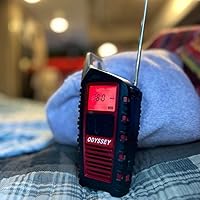
  • Display: A large backlit LCD screen provides clear readability in low-light conditions and shows tuning, band, and clock information.
  • Flashlight: The integrated LED flashlight offers three modes — high, low, and flood — plus a dedicated SOS emergency alarm flash pattern.
  • Bluetooth: Bluetooth connectivity allows wireless audio streaming from a paired smartphone or other compatible device directly through the radio's speaker.
  • USB Output: A USB output port enables the radio to act as a backup charger for smartphones and other small USB-powered devices.
  • Auxiliary Input: An auxiliary input port is included, allowing wired audio connections from external devices when Bluetooth is not preferred.
  • Color: The radio is available in black with a design styled for practical utility rather than fashion-forward aesthetics.
  • Tuner Type: A digital tuner handles station selection across all supported bands, providing more precise and repeatable tuning than older analog dial designs.
  • Clock Function: A built-in clock with alarm function is included, adding basic timekeeping utility for camping or emergency preparedness scenarios.
  • Market Ranking: As of available data, the radio ranks at approximately number 136 in the Weather Radios category on Amazon, reflecting solid mid-tier market presence.
  • User Rating: The radio carries a 4.1-out-of-5-star average rating based on approximately 167 customer reviews collected since its May 2023 launch.
  • Launch Date: The Odyssey model was first made available in May 2023, making it a relatively recent addition to Eton's emergency radio lineup.

Related Reviews

Eton Odyssey All-Band Bluetooth Emergency Weather Radio
76%
83%
Radio Reception Quality
88%
NOAA Weather Alerts
78%
Power Versatility
74%
Build Quality
71%
Battery Performance
More
Eton Scorpion II Portable Emergency Weather Radio
74%
91%
Portability & Form Factor
83%
Hand Crank Functionality
88%
NOAA Weather Band Reception
79%
FM Radio Performance
58%
AM Radio Reception
More
FosPower A6 5200mAh Emergency Weather Radio
77%
91%
NOAA Reception
84%
Build Quality
67%
Power Bank Utility
53%
Hand Crank Efficiency
49%
Solar Charging
More
Roxicosly CR1009Ultra 12000mAh Emergency Weather Radio
74%
88%
Battery Life
91%
Charging Versatility
86%
NOAA Alert Performance
58%
Hand Crank Durability
44%
Solar Charging Speed
More
OnLyee CR1030 Emergency Weather Radio
76%
88%
Power Source Redundancy
83%
Hand Crank Durability
61%
Solar Charging Performance
79%
NOAA Reception Quality
67%
Battery Capacity & Phone Charging
More
QAUYYW Emergency Weather Radio XSY330
86%
89%
Battery Life
85%
Ease of Use
92%
Portability
75%
Radio Reception
88%
Build Quality
More
Sttfaishen F20 Emergency Hand Crank Weather Radio
72%
82%
NOAA Alert Reception
54%
Battery Capacity & Honesty
61%
Hand Crank Usability
57%
Solar Charging Performance
83%
USB-C Charging Speed
More
RAOUOEN 30000mAh Emergency Weather Radio
85%
89%
Battery Life & Charging
91%
Performance in Emergencies
75%
Portability & Weight
84%
Sound Quality & Reception
87%
Ease of Use
More
TFTDOUP Emergency Weather Alert Radio
86%
88%
Overall Performance
85%
Battery Life
90%
Charging Options
80%
Ease of Use
87%
Build Quality
More
FosPower Emergency Weather Radio A1
76%
88%
NOAA Reception Quality
74%
AM/FM Reception
58%
Hand Crank Charging
53%
Solar Panel Effectiveness
62%
Power Bank Output
More

FAQ

Realistically, hand crank charging is slow — think of it as a last resort rather than a primary charging method. A few minutes of cranking will give you enough power for a short burst of radio use or a brief flashlight session, but fully recharging the 2000mAh battery via crank alone would take an impractically long time. It is best used to top up a partially depleted battery just enough to catch a weather alert or make a phone call.

Not on its own, no. The solar panel is better thought of as a slow trickle charger that can help maintain or slightly extend battery life when left in direct sunlight. In real-world conditions with variable cloud cover, it will not fully recharge the battery. Use USB charging as your primary method whenever available, and treat solar as a helpful supplement.

Yes, the USB output port will charge most smartphones, though the charging speed depends on how much battery the radio itself has remaining. It is not a high-wattage fast charger, so expect slower-than-normal top-up speeds. It is genuinely useful for keeping a phone alive in an emergency, but it is not a substitute for a dedicated power bank if phone charging is a top priority.

The Eton Odyssey All-Band Emergency Weather Radio supports NOAA weather band reception with both audio and visual alerts, which means it can sound an alarm when a National Weather Service alert is broadcast on the monitored frequency. Keep in mind that for automatic alerting to work, the radio typically needs to be on and set to the appropriate NOAA channel. Check the included instructions for how to enable the alert monitoring mode correctly.
Honestly, it is adequate for casual listening but will not satisfy experienced shortwave hobbyists. Users who regularly tune in to international broadcasts or weak distant signals often find the sensitivity and selectivity of this hand-crank weather radio to be limited compared to purpose-built shortwave receivers. If shortwave is your primary use case, a dedicated radio will serve you better. If it is a secondary interest and you want multi-band coverage in one device, this is a workable entry point.

No, the radio does not carry any weatherproof or water-resistance rating. Using it in heavy rain or storing it in a high-humidity environment without protection could damage the internal electronics. If you plan to use it outdoors in uncertain weather, keep it in a waterproof bag or case when not in active use.

Several buyers have noted that Bluetooth connectivity works but the usable range is shorter than expected — staying within a few feet tends to produce the most reliable connection. If you wander to the other side of a room or beyond a wall, the signal can drop or stutter. It is fine for having a phone nearby while the radio sits on a table, but do not expect the same range as a dedicated Bluetooth speaker.

Yes, the built-in LED flashlight includes a dedicated SOS mode that flashes in the internationally recognized distress pattern. This is a practical feature for genuine emergency signaling in the dark. The flood setting is also useful for lighting up a wider area at camp, beyond just the narrow beam of the high setting.

At 8.25″ wide and 1.61 lbs, this emergency radio is on the larger side compared to ultracompact pocket emergency radios, but it is very manageable in a backpack or on a shelf. The size is a fair trade-off given how many functions are packed in — radio, flashlight, phone charger, and Bluetooth speaker. It will not slip into a jacket pocket, but it fits comfortably in most day bags.

It is a very practical gift for that purpose. The combination of NOAA weather alerts, multiple power backup options, flashlight, and phone charging hits most of the core emergency preparedness checkboxes in a single, easy-to-use device. Because it comes from a credible brand in this space and does not require technical knowledge to operate, it is genuinely accessible for someone new to emergency preparedness.

Where to Buy