Overview

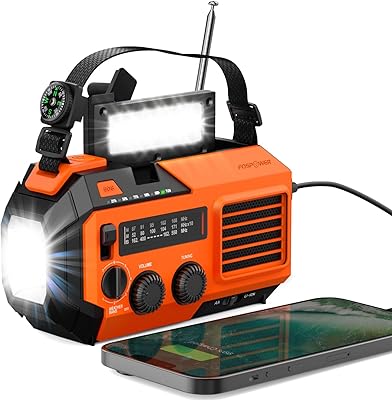
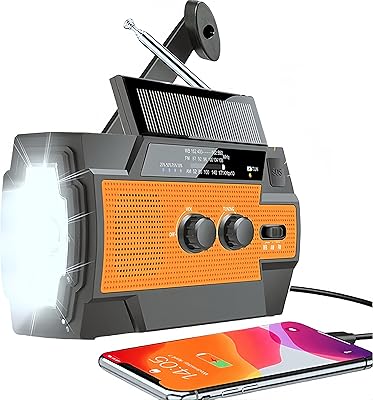
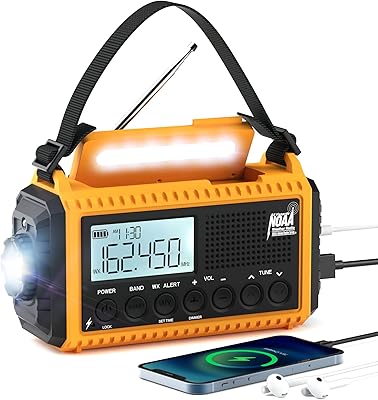
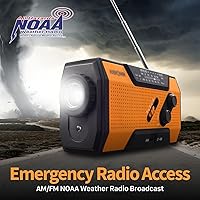
The FosPower Emergency Weather Radio A1 is one of those rare budget preparedness tools that actually earns its place in an emergency kit rather than collecting dust in a drawer. Since its release in 2018, it has quietly built a strong sales track record, sitting near the top of the weather radio category. The design is intentionally practical: a palm-sized orange body that's easy to spot in a dark room or cluttered bag, with a build that feels solid without being heavy. It combines a radio, power bank, and two light sources into one device. Just keep expectations realistic — this is a capable backup tool, not a substitute for dedicated gear.
Features & Benefits

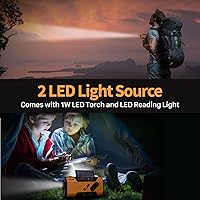
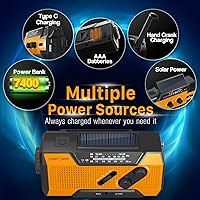
This hand-crank weather radio draws power from three independent sources — a manual crank, a built-in solar panel, and standard AAA batteries. None of these are fast charging methods; the crank and solar are best thought of as slow trickle sources to keep the internal battery alive during an extended outage. The USB-C power output (2000mAh) can push a partial charge to a phone when you're desperate, but won't fill it from zero. The NOAA weather band is the real star here, pulling in emergency broadcasts clearly. You also get a 1W flashlight and a 4-LED reading lamp for different lighting needs, plus an audible SOS alarm — useful for attracting nearby attention, though it carries no GPS or distress signal capability.

Best For

The FosPower A1 makes most sense for households putting together a basic emergency kit without spending a lot. It's a natural fit for a bug-out bag or a closet shelf alongside flashlights and bottled water. Campers and day hikers who want a lightweight backup for communication and light will find it earns its keep. It's also a strong choice for anyone living in a hurricane or severe storm corridor who wants reliable NOAA alert access without depending on a smartphone and cell towers. And as a practical gift for a parent, grandparent, or anyone who wants simple preparedness tools without complexity, this emergency radio hits a useful sweet spot.

User Feedback

Buyers consistently point to ease of use and solid radio reception as standout qualities. The antenna picks up the NOAA weather band reliably, and most users report FM works well, though AM sensitivity draws mixed opinions. On the critical side, the crank charges slowly — most owners treat it as a last resort rather than a regular power source, and the solar panel is similarly limited in output. Build quality generally earns approval for the price; it feels sturdy and well-assembled, even if it's not waterproof or drop-rated. The power bank capacity draws the most measured feedback: genuinely helpful for a partial top-off, but don't count on a full recharge. Most buyers seem to accept these trade-offs as reasonable given what this hand-crank weather radio costs.

Pros

  • NOAA weather band reception is reliable and clear, which is the most critical function in an actual emergency.
  • Three independent power sources mean you are rarely completely without options, even in a prolonged outage.
  • The compact, palm-sized form factor fits easily into a bug-out bag, car kit, or closet shelf without taking up real estate.
  • Intuitive controls make this emergency radio usable by anyone immediately, no learning curve required.
  • The bright orange body is easy to spot in a dark room or cluttered drawer when every second counts.
  • Dual lighting modes — a focused flashlight and a softer reading light — cover two genuinely different use cases.
  • USB-C output provides a meaningful partial charge to a phone for making emergency calls or sending messages.
  • Build quality feels solid and well-assembled for the price, with no cheap hollow feel to the casing.
  • A Limited Lifetime Warranty adds a layer of long-term confidence that is uncommon in this price range.
  • FM reception is clean and dependable, making it useful for general listening between emergency events.

Cons

  • Hand crank charging is very slow — plan on several minutes of cranking for a minimal gain.
  • Solar panel output is negligible in anything less than direct, bright sunlight.
  • The 2000mAh power bank cannot fully recharge a modern smartphone from zero.
  • AM band sensitivity is inconsistent and noticeably weaker than FM or weather band performance.
  • Not waterproof or shockproof — a single drop or rain exposure can cause real damage.
  • No digital tuning or preset memory, so finding a specific station under stress takes patience.
  • AAA batteries are not included, and four are required — easy to overlook when first stocking a kit.
  • The SOS alarm is local-only with no signal or GPS component, which some buyers discover only after purchase.
  • Warranty support quality appears inconsistent based on buyer reports, with some experiencing slow resolution.
  • Long-term battery degradation in storage means the internal battery needs periodic maintenance charging.

Ratings

Our AI rating system analyzed thousands of verified global purchases of the FosPower Emergency Weather Radio A1, actively filtering out incentivized reviews, bot activity, and unverified submissions to surface what real buyers actually experienced. The scores below reflect a honest composite of praised strengths and recurring frustrations — nothing is glossed over. Whether this hand-crank weather radio earns a spot in your emergency kit depends heavily on understanding both sides of the picture.

NOAA Reception Quality
88%
Most buyers report that the NOAA weather band locks onto local emergency broadcasts reliably, even in areas with weaker signal coverage. During storm prep or power outages, this is the function people reach for first, and it consistently delivers — which is exactly why so many users trust it as their primary alert device.
A smaller subset of users in rural or geographically challenging areas noted occasional static on WB channels. Extending the antenna fully makes a noticeable difference, but the manual doesn't always make that clear upfront, leading to some initial disappointment.
AM/FM Reception
74%
26%
FM reception is generally well-regarded, pulling in local stations cleanly enough for casual listening during a campsite evening or a prolonged indoor outage. Users appreciate having a familiar, comfortable radio function alongside the emergency features.
AM performance draws noticeably more mixed feedback. Buyers in urban settings report interference and inconsistent clarity, and a number of reviews specifically call out AM as the weakest of the three bands. It works, but it's not the device's strong suit.
Hand Crank Charging
58%
42%
The crank mechanism serves its core purpose: keeping the internal battery alive when no other power source is available. In a true emergency where phones are dead and outlets are offline, even slow regeneration is better than none, and buyers acknowledge this trade-off fairly.
Charging via the crank is genuinely slow — users describe needing several minutes of consistent cranking to generate a modest gain. It is not a practical way to charge a phone and should be understood strictly as a radio and light sustainer, not a power recovery tool.
Solar Panel Effectiveness
53%
47%
On a bright, sunny day outdoors — think a camping trip or post-storm yard assessment — the solar panel does contribute a useful trickle charge over several hours. Buyers who set it on a windowsill or dashboard during daylight reported it helped maintain radio and alarm readiness.
Expectations need to be set very low here. Cloudy days, indoor light, and partial shade render the solar panel nearly ineffective. Several buyers expressed frustration expecting faster results, and the product listing language arguably oversells this feature's real-world contribution.
Power Bank Output
62%
38%
The USB-C output provides a meaningful partial charge to a smartphone when you truly need it — enough to send a few texts, make a short call, or check an emergency app during a blackout. For that narrow but critical use case, buyers find genuine value in having it available.
At 2000mAh effective output, this will not fully recharge a modern smartphone. Buyers expecting a complete charge were routinely disappointed, and a handful of reviews note the USB-C output feels more like a top-off port than a real power solution. Honest expectations matter a lot here.
Flashlight Performance
79%
21%
The 1W LED flashlight is bright enough to navigate a dark hallway, find items in a cabinet, or walk a short path outdoors. It punches above what buyers expected from a secondary feature on a budget device, and several reviewers specifically praised it for outage situations.
It is not a powerful outdoor spotlight. Users who expected something comparable to a dedicated flashlight were underwhelmed over longer distances or in large open spaces. Battery draw also increases noticeably when the flashlight is running alongside the radio.
Reading Light Utility
76%
24%
The 4-LED reading light produces a soft, spread-out glow that works well for close-range tasks — reading a map, looking through a first-aid kit, or keeping a small room dimly lit. Buyers with kids particularly appreciated having a gentler light option that doesn't feel aggressive in the dark.
The spread is limited to a fairly tight area, so it is not useful for lighting a whole room or an outdoor perimeter. A few buyers wished the angle was adjustable, as the fixed orientation doesn't always point light exactly where it's needed.
SOS Alarm Function
71%
29%
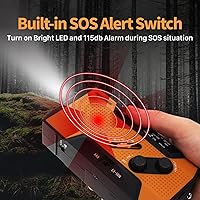
The audible SOS alarm is genuinely loud and attention-grabbing, making it useful for signaling to nearby rescuers, neighbors, or campground staff during a localized emergency. Buyers who understood its purpose — a loud local alert — rated it positively as a practical safety addition.
Some buyers purchased assuming the SOS function had a connected or GPS-based distress signal capability. It does not — it is strictly an audible alarm. This misunderstanding led to disappointment that is really a product description issue rather than a flaw in the device itself.
Build Quality & Durability
77%
23%
For a modestly priced emergency device, the construction feels more substantial than expected. The casing has a solid, non-hollow feel, buttons have a reassuring click, and the overall assembly doesn't suggest it will fall apart after a few uses or a couple of years sitting in storage.
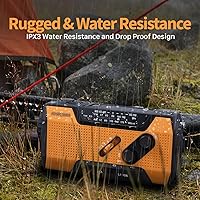
It is not waterproof, shockproof, or rated for rugged outdoor abuse. A handful of buyers who dropped it or used it in wet conditions reported damage. If you need something truly field-hardened, this device will not meet that bar.
Portability & Form Factor
86%
At under a pound and sized to fit in a standard backpack pocket, the FosPower A1 is easy to include in a bug-out bag without adding noticeable weight. The compact footprint means it takes up minimal shelf space when stored in a home emergency kit, and the orange color makes it quick to locate.
The crank handle adds a small amount of bulk when deployed, and a few buyers noted it can feel slightly awkward to operate comfortably without a firm surface to brace against. It is a minor ergonomic quirk rather than a serious design flaw.
Ease of Use
91%
This is consistently one of the most praised aspects across buyer reviews. Controls are clearly labeled, mode switching is intuitive, and the device can be handed to someone with no prior experience and understood within minutes. That simplicity matters enormously in high-stress emergency situations.
The tuning dial requires a bit of patience to find a clean station, as it is analog rather than digital with preset memory. Users accustomed to digital scanning radios may find this slightly frustrating when trying to locate a specific station quickly under pressure.
Battery Life (AAA-Powered)
83%
Running the radio on AAA batteries provides the most consistent and predictable performance of the three power sources. Buyers who kept a fresh set of batteries in the device reported extended listening sessions during storms and outages without any power anxiety.
AAA batteries are not included, and the device requires four of them — which means a buyer who stores this device long-term needs to remember to check and replace the batteries periodically. A few reviews noted dead batteries after extended storage periods.
Value for Money
87%
Buyers repeatedly frame this as one of the better returns on investment in the emergency preparedness category. Getting a NOAA radio, a partial phone charger, two light sources, and an SOS alarm in a single compact device at this price point is genuinely hard to match with individual purchases.
The value equation only holds if you go in with calibrated expectations. Buyers who treated it as a premium power bank or a high-sensitivity radio walked away feeling short-changed. It does five things adequately, not two things exceptionally — and that distinction defines satisfaction.
Warranty & Brand Support
73%
27%
FosPower backs this device with a Limited Lifetime Warranty, which is a meaningful commitment for a product in this price range. Several buyers mentioned the warranty gave them confidence in the purchase, particularly for a device they hope to never actually need but want to trust when they do.
Warranty service experiences in the review pool are mixed. Some buyers reported smooth resolution processes while others noted slow response times or difficulty reaching support. The warranty is a positive differentiator on paper, but execution appears inconsistent.

Suitable for:

The FosPower Emergency Weather Radio A1 was built for people who want a single, affordable device covering the basics of emergency preparedness without needing to buy and store multiple separate tools. It's a natural fit for households in hurricane-prone, tornado-alley, or flood-risk regions where NOAA weather alerts can genuinely save lives, and where a power outage might last days rather than hours. Campers, hikers, and weekend overlanders who want a lightweight backup for communication and light — without depending on cell service — will find it earns its place in a pack. It also makes an exceptionally practical gift for elderly parents or family members who want simple, no-fuss emergency readiness without learning complicated technology. If your goal is a compact, reliable grab-and-go kit item that does several important things adequately, this hand-crank weather radio delivers real value at its price point.
Not suitable for:

The FosPower Emergency Weather Radio A1 is not the right choice for buyers who need a serious, high-capacity power bank to keep multiple devices charged through a multi-day outage — the 2000mAh output is a top-off solution, not a primary power source. People expecting to fully charge a modern smartphone will be consistently disappointed, and those relying heavily on the crank or solar panel as their main charging strategy will find both frustratingly slow for anything beyond sustaining the radio itself. It is also not suitable for buyers who need a waterproof or ruggedized device for demanding outdoor environments — this emergency radio is not rated for water exposure or heavy impact, and field conditions can damage it. If you need a high-sensitivity AM receiver for long-distance or shortwave listening, the AM band performance here likely won't satisfy you. Finally, anyone who expects the SOS alarm to function as a connected distress beacon should look elsewhere — it is purely a local audible alert with no GPS or network capability.
Specifications

  • Dimensions: The unit measures 6.2″ long by 2.9″ wide by 2.1″ deep, making it compact enough to fit in a standard backpack side pocket.
  • Weight: At 14.8 ounces, this hand-crank weather radio is light enough for a go-bag without adding meaningful load to a pack.
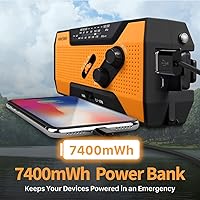
  • Battery Capacity: The internal rechargeable battery carries a capacity of 7400mWh (2000mAh), sufficient for trickle-charging small devices or sustaining radio and light functions.
  • Charging Methods: Three independent power inputs are supported: a manual hand crank, a built-in solar panel, and four AAA batteries used as a direct power source.
  • AAA Batteries: Four AAA batteries are required for battery-mode operation and are not included in the package.
  • USB Output: A USB-C port provides power output for charging external devices such as smartphones from the internal battery.
  • Radio Bands: The radio receives AM, FM, and NOAA Weather Band (WB) transmissions for broad coverage of both general broadcasts and emergency alerts.
  • Flashlight: A 1W LED flashlight is built into the unit, providing a focused beam suitable for navigation and close-range task lighting.
  • Reading Light: A secondary 4-LED array produces a softer, wider spread of light designed for reading maps, manuals, or general close-up illumination.
  • SOS Alarm: An audible SOS alarm function is included, emitting a loud alert signal intended to attract attention from nearby individuals in a localized emergency.
  • Color: The unit is available in orange, a visibility-optimized colorway chosen to make the device easy to locate in dark or cluttered storage environments.
  • Model Number: The official model designation is FOSPWB-2376, used for warranty registration and replacement part identification.
  • Warranty: FosPower covers this device under a Limited Lifetime Warranty; full terms and claims procedures are detailed on the manufacturer's official website.
  • Brand: Manufactured and sold by FosPower, a consumer electronics brand specializing in portable power and emergency preparedness devices.
  • Availability: This model has been commercially available since August 2018 and is listed as an active, non-discontinued product by the manufacturer.
  • Connectivity: The device uses USB-C connectivity for power output; no Bluetooth, Wi-Fi, or digital data connectivity is included.
  • Tuner Type: The radio uses an analog tuner across all three supported bands — AM, FM, and NOAA Weather Band — with no digital preset or scanning memory.
  • Included Items: The package includes the radio unit and an owner's manual; AAA batteries, charging cables, and carrying accessories are not included.

Related Reviews

FosPower Emergency Weather Radio A6
86%
91%
Value for Money
89%
Ease of Use
93%
Charging Options
85%
Portability
87%
Build Quality
More
RAOUOEN 30000mAh Emergency Weather Radio
85%
89%
Battery Life & Charging
91%
Performance in Emergencies
75%
Portability & Weight
84%
Sound Quality & Reception
87%
Ease of Use
More
QAUYYW Emergency Weather Radio XSY330
86%
89%
Battery Life
85%
Ease of Use
92%
Portability
75%
Radio Reception
88%
Build Quality
More
OnLyee CR1030 Emergency Weather Radio
85%
88%
Value for Money
91%
Battery Life and Charging
85%
Durability and Build Quality
82%
Ease of Use
78%
Portability
More
Sttfaishen Emergency Weather Radio F20
87%
91%
Performance in Emergencies
94%
Battery Life & Power Capacity
67%
Signal Reception in Extreme Weather
90%
Charging Options & Flexibility
88%
Portability & Size
More
TFTDOUP Emergency Weather Alert Radio
86%
88%
Overall Performance
85%
Battery Life
90%
Charging Options
80%
Ease of Use
87%
Build Quality
More
Roxicosly CR1009Ultra Emergency Weather Radio
87%
94%
Battery Life
89%
Weather Alert Effectiveness
85%
Build Quality
91%
Portability
72%
Reception Range
More
Leaton Emergency NOAA Weather Alert Radio
85%
88%
Battery Life & Charging Options
85%
Weather Alerts & Reception
90%
Build Quality & Durability
93%
Portability & Size
87%
Ease of Use
More
DexScout Crank Emergency Weather Radio 10000mAh
86%
91%
Value for Money
88%
Battery Life and Charging
94%
Portability & Size
85%
Weather Alert Accuracy
90%
Build Quality and Durability
More
AXYEBI 48100mWh Crank Emergency Weather Radio
85%
91%
Value for Money
88%
Portability and Size
83%
Battery Life
85%
Ease of Use
74%
Radio Reception
More

FAQ

It is a real but modest power source. The FosPower Emergency Weather Radio A1 outputs through a USB-C port from a 2000mAh internal battery, which is enough to push a partial charge to most smartphones — think 30 to 50 percent on a modern phone, not a full recharge. It is genuinely useful for making an emergency call or sending messages during a blackout, but it was never designed to replace a dedicated power bank.
Quite a while, honestly. The hand crank is best thought of as a slow trickle source rather than a real charging method. A few minutes of cranking will help sustain the radio and keep the lights running, but it is not practical for building up significant battery charge. Use it to keep the device alive when you have no other option, not as a primary way to power up.

Barely. The solar panel performs best in direct, unobstructed sunlight outdoors. Through glass or in indirect indoor light, the output drops to the point where it is essentially negligible. If you store this emergency radio near a south-facing window and sunlight hits it directly for several hours, you will get some trickle charge — but do not count on window charging as a reliable strategy.

It is not waterproof or water-resistant in any rated sense. Light splashes might be fine, but rain exposure or submersion carries real risk of damage. If you are using this outdoors during a storm — which is a reasonable scenario — try to keep it sheltered or inside a zip-lock bag when not in active use.

NOAA weather band is where this hand-crank weather radio performs most consistently, and it is clearly the priority band for the design. FM comes in cleanly for most users in typical coverage areas. AM is the weakest link — it works, but interference and inconsistent clarity are common complaints, particularly in urban environments or areas with weaker AM transmitters.

No — it is strictly a local audible alarm. Pressing the SOS function produces a loud alert sound designed to attract attention from people nearby, like neighbors, campground staff, or rescue workers already in the area. It has no GPS, no cellular connection, and no link to any emergency dispatch service. Think of it as a very loud whistle, not a distress beacon.

You can store it without AAA batteries, but it is worth periodically charging the internal battery to prevent it from degrading during long storage. If you are building an emergency kit, consider swapping in fresh AAA batteries every year or two, and give the internal battery a top-off charge on the same schedule. An emergency device that runs flat before you need it defeats the purpose.

Yes, this is one of the things buyers consistently praise about it. The controls are clearly labeled, the buttons have a good tactile feel, and there is no app, pairing process, or menu navigation involved. Most people can pick it up and operate every function within a few minutes. It was designed for stress situations where complexity is the enemy, and that shows in the interface.

No. This device covers AM, FM, and NOAA Weather Band only. Shortwave reception is not supported, so if you are specifically looking for a radio that picks up international broadcasts or ham radio frequencies, this is not the right device for that use case.

FosPower describes it as a Limited Lifetime Warranty, but the specific terms — including what defects are covered and what the claims process involves — are detailed on their official website rather than in the included manual. Buyer experiences with warranty service have been mixed: some report smooth resolutions, while others describe slower response times. It is worth registering your purchase and bookmarking their support page so you are not hunting for it during an already stressful situation.