

Overview

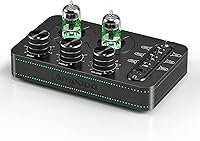
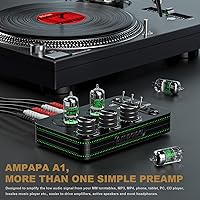
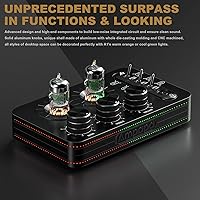
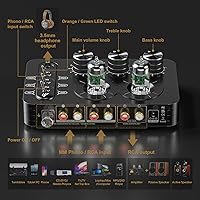
The AMPAPA A1 is a tube phono preamp that doubles as a headphone amplifier, aimed squarely at vinyl listeners who want real tube character without spending a fortune. Built around a pair of JAN GE5654 vacuum tubes, it delivers that warm, slightly rounded sonic signature that solid-state units at this price point rarely pull off convincingly. The chassis is aluminum die-cast with CNC machining — pick it up and it feels genuinely solid, not hollow or plasticky. They launched this unit in 2022 and positioned it at the entry end of the audiophile market, though its dual inputs — MM phono and standard RCA line — give it range well beyond a basic turntable box.

Features & Benefits

The RIAA equalization on the phono input keeps frequency response within ±2dB of the RIAA curve — sloppy EQ smears tonal balance in ways that are hard to diagnose, so this matters. The tone controls are a genuinely practical addition; rotating them produces real, musical results rather than subtle coloring. The headphone output handles 16–300Ω impedances, covering most popular cans reasonably well at moderate volumes. With a signal-to-noise ratio of 106dB on the RCA output, background hiss stays out of the picture even on sensitive speakers. The tube sockets are also compatible with 6AK5 and EF95 types, which gives tube-rolling enthusiasts room to experiment with the sound character over time.

Best For

This tube preamp hits a sweet spot for vinyl beginners who have outgrown the built-in phono stage on their turntable and want a meaningful sonic step up without buying into a full separates system. It is equally useful for desktop headphone listeners who need one box to handle both turntable amplification and driving their cans. Anyone with a passing curiosity about tube audio — but not ready to spend on a dedicated high-end stack — will find this a low-risk introduction. The warm LED glow and compact, solid chassis look good on a desk without dominating it. One firm boundary: this is an MM-only device, so MC cartridge users will need a different solution entirely.

User Feedback

Most buyers land somewhere between genuinely pleased and impressed, with the recurring theme being how much warmer and fuller records sound compared to their previous built-in stage. The tone controls draw consistent praise — people actually notice the difference when they use them, which is not always the case with budget EQ options. Build quality earns regular positive mentions; the knobs and chassis feel more expensive than the price implies. On the critical side, some users with very high-impedance headphones in the 250–300Ω range find the output runs out of headroom at loud volumes. New tube owners should also know that the unit runs warm after extended sessions — that is normal tube behavior, not a fault. A few buyers were caught off guard when the power supply was not included.

Pros

  • Noticeable sonic improvement over built-in turntable phono stages, with more warmth and body on vinyl playback.
  • Tone controls are genuinely musical and useful, not just cosmetic additions to the spec sheet.
  • Aluminum die-cast chassis with CNC knobs feels considerably more premium than the price suggests.
  • MM phono and standard RCA line inputs covered in one box, reducing desktop clutter for mixed-source setups.
  • Headphone output handles 16–300Ω impedances, making it compatible with a wide range of popular headphones.
  • RIAA equalization accuracy within ±2dB keeps tonal balance honest across the full frequency range.
  • Tube rolling compatibility with 6AK5 and EF95 types gives enthusiasts a genuine path to personalize the sound.
  • Signal-to-noise ratio of 106dB on the RCA output keeps background hiss out of the picture with most speakers.
  • Compact footprint and warm LED glow integrate naturally into a tidy desktop listening setup.

Cons

  • No bypass switch means tone control circuitry stays in the signal path even when knobs are set to neutral.
  • Power supply is absent from certain purchase bundles, which is a frustrating and avoidable out-of-box experience.
  • Headphone amp runs out of headroom with high-impedance headphones at louder listening volumes.
  • Phono S/N ratio of 80dB can surface a faint noise floor through high-efficiency or horn-loaded speakers.
  • A relatively young brand with limited long-term reliability data across a large owner sample.
  • Occasional reports of channel imbalance developing after extended use, though it appears to affect a minority of units.
  • No MC cartridge support whatsoever — upgrading your cartridge down the line may mean replacing this unit too.
  • The warm, retro LED aesthetic is fixed at purchase and will not suit listeners who prefer a neutral, modern look.

Ratings

The AMPAPA A1 has been put through its paces by vinyl enthusiasts and headphone listeners across multiple markets, and these scores reflect what our AI found after parsing verified buyer reviews worldwide — actively filtering out incentivized, bot-generated, and unverified feedback. The result is an honest picture of where this tube preamp genuinely delivers and where it falls short, with no attempt to smooth over the rough edges.

Sound Quality
88%
Buyers who switched from a turntable's built-in phono stage consistently describe the improvement as immediately obvious — more body, more warmth, and a sense of depth that solid-state alternatives at this price rarely reproduce. The JAN GE5654 tubes contribute a natural, non-fatiguing character that holds up well across extended listening sessions with jazz, folk, and acoustic recordings.
Listeners coming from higher-end tube setups may find the sound slightly soft in the upper midrange and lacking the last word in resolution. It is a genuinely warm presentation, which works beautifully for some genres but can make bright or heavily compressed recordings feel a touch congested.
Phono Stage Accuracy
83%
The RIAA equalization curve is held to within ±2dB across the full audio band, which is a meaningful spec at this price tier — loose RIAA tracking is a common weakness in budget phono stages and noticeably skews tonal balance. Users report that records simply sound more balanced and natural compared to cheaper integrated stages.
This is strictly an MM-compatible stage, so anyone running a moving-coil cartridge will need to look elsewhere entirely. The phono S/N ratio of 80dB, while acceptable, does leave a faint noise floor that becomes audible on very sensitive speakers in quiet rooms.
Headphone Amplifier Performance
72%
28%
For mid-impedance headphones in the 32–150Ω range — think ATH-M50X, DT770 Pro, or similar — the output is clean and has enough drive to reach satisfying listening volumes without obvious strain. The 3.5mm jack is conveniently placed and the output feels quiet and stable.
Push into the 250–300Ω territory with something like a Beyerdynamic T1 or a Sennheiser HD800 and the amp starts running out of headroom at louder volumes. It is not the right primary amp for high-impedance headphone aficionados, and reviewers who expected otherwise were disappointed.
Build Quality
91%
The aluminum die-cast chassis with CNC-machined finishing is the first thing buyers comment on when the unit arrives — it feels dense and well-assembled in a way that belies the price. The solid aluminum knobs have a satisfying resistance and no audible mechanical noise when turned, which is a small but telling detail.
A small number of users have noted that the LED lighting on a handful of units was uneven at delivery, with one side glowing slightly dimmer than the other. The rear input/output labeling is functional but not as refined as the front panel suggests.
Tone Controls
86%
Unlike many budget preamps where tone controls exist largely as a checkbox feature, the treble and bass knobs here produce real, musical adjustments that are audible without being exaggerated. Listeners tuning older or bass-light records particularly appreciated the ability to dial in more weight without reaching for an external EQ.
There is no bypass switch, so the tone control circuitry remains in the signal path even when the knobs are centered. Purists who want a completely unprocessed signal have no way to achieve that without a separate bypass solution.
Value for Money
87%
At its price point, finding a unit that combines a competent tube phono stage, workable headphone amp, and tone controls in a solid metal chassis is genuinely difficult. Most buyers feel they are getting considerably more than they paid for, particularly after handling the chassis.
The occasional absence of a power supply in certain purchase bundles is a real frustration that undercuts the out-of-box experience — a 12V DC adapter is not an exotic accessory, and having to source one separately at this price tier is a legitimate gripe.
Ease of Setup
84%
Connections are straightforward for anyone familiar with a basic home audio system — phono in, RCA out, done. The dual output paths mean most common speaker and headphone configurations are covered without adapters, and the unit is ready to use within minutes of unboxing.
First-time tube owners sometimes need reassurance that the unit running warm to the touch after an hour of use is expected behavior, not a fault. A more informative quick-start guide addressing tube heat and break-in time would reduce unnecessary returns and support queries.
Tube Rolling Potential
79%
21%
The tube sockets accept compatible types including 6AK5, EF95, and 5654W variants, giving curious owners a real playground to explore different sonic characters without expensive upgrades. Several buyers have documented rolling experiments online, which adds genuine long-term value for enthusiasts.
The stock JAN GE5654 tubes are a solid starting point but the overall benefit of rolling is limited by the circuit design around them — gains are real but incremental rather than transformative. Casual buyers who are not already invested in tube culture may not find it worth the extra cost or effort.
Noise Floor
81%
19%
On the RCA output path, the 106dB S/N ratio translates to a genuinely quiet listening experience through most speaker systems — no audible hiss between tracks or during quiet passages at normal listening volumes. This was a consistent positive in reviews from users running active bookshelf speakers.
The phono input path's 80dB S/N ratio is adequate but not exceptional, and listeners with high-efficiency speakers or horn-loaded systems may catch a faint noise floor during quiet passages on records. It is not disruptive for most setups, but it is there.
Aesthetics & Desktop Presence
89%
The warm amber or cool green LED glow from the tubes and chassis accent lighting has won over a lot of buyers who care about how their desk looks as much as how it sounds. The compact footprint means it tucks neatly next to a turntable or monitor without dominating the surface.
The aesthetic is retro and warm, which is intentional — but buyers expecting a more modern or neutral industrial look may find it slightly kitschy. The LED color cannot be changed after purchase, so picking the right variant at the order stage matters.
Input Versatility
77%
23%
Having both an MM phono input and a standard RCA line input on a single compact unit means this desktop amp can pull double duty — switching from a turntable to a CD player or a DAC without any cable swapping is a genuine convenience for mixed-source listening setups.
The MM-only phono input is a firm limitation for anyone using or planning to upgrade to a moving-coil cartridge. There is no MC gain stage or impedance loading option, so MC users are simply outside the scope of what this unit was designed to do.
Packaging & Unboxing
73%
27%
The unit arrives well-protected and the physical presentation is tidy enough that it would make a reasonable gift for a vinyl-loving friend. Accessories like RCA cables are included in most configurations, which reduces day-one friction.
The bundling inconsistency around the power supply is the main issue here — some buyers receive a complete package while others do not, with no clear pattern. For a unit that requires a specific 12V DC supply, this needs to be standardized and clearly communicated at the point of sale.
Long-Term Reliability
74%
26%
The majority of long-term owners report no functional issues after a year or more of regular use, and the standard tube lifespan for the GE5654 type runs into thousands of hours under normal conditions. Replacement tubes are inexpensive and widely available if one does eventually need swapping.
There is a small but present thread of reviews mentioning channel imbalance developing after extended use, though it is unclear whether this reflects a manufacturing inconsistency or isolated batch issues. The brand is relatively young, so long-term durability data across a large sample is still limited.

Suitable for:

The AMPAPA A1 is a strong fit for vinyl listeners who have outgrown the phono stage built into their turntable and want a tangible sonic upgrade without committing to an expensive separates system. If your setup involves a passive MM turntable feeding into active bookshelf speakers, this desktop amp handles that chain cleanly in a single compact box. Headphone listeners who want one unit to cover both turntable duty and late-night listening through mid-impedance cans like the Sennheiser HD650 or Beyerdynamic DT770 will find it genuinely capable. It also suits anyone who is tube-curious but cautious — the tube-rolling compatibility with 6AK5 and EF95 types gives hobbyists room to experiment without a steep entry cost. The solid aluminum build and warm LED accent lighting make it a natural fit for a well-considered desktop or small-room listening space where aesthetics matter alongside audio performance.

Not suitable for:

The AMPAPA A1 is a hard pass for anyone running a moving-coil cartridge — there is no MC gain stage here, and no workaround short of adding a separate step-up transformer. Listeners who own demanding high-impedance headphones in the 250–300Ω range, such as the Beyerdynamic T1 or Sennheiser HD800, will likely find the headphone output underpowered at higher volumes and should look at a dedicated headphone amplifier instead. Strict signal-path purists who want a flat, uncolored phono stage with a hard bypass for the tone controls will be frustrated — the tone circuitry stays in the chain regardless of knob position. If you are after a professional or studio-grade reference stage with tightly measured performance, the price tier and design philosophy of this unit simply do not aim for that. Finally, buyers who are genuinely bothered by equipment running warm to the touch may find the normal operating temperature of the tubes disconcerting, even though it is not a defect.

Specifications

  • Tube Type: The unit uses two JAN GE5654 vacuum tubes, which are mil-spec variants of the 6AK5 family known for low noise and consistent performance.
  • Audio Inputs: Accepts a moving-magnet phono signal via RCA and a standard line-level stereo signal via a second RCA input pair.
  • Audio Outputs: Provides a stereo RCA line output for connection to amplifiers or active speakers, plus a front-panel 3.5mm headphone jack.
  • Headphone Power: Delivers 125mW into 32Ω, 62.5mW into 64Ω, and 30mW into 128Ω, covering most consumer headphone impedances adequately.
  • Headphone Range: The headphone output is rated for headphones with an impedance between 16Ω and 300Ω.
  • Frequency Response: RCA output measures 20Hz–20kHz at ±0.5dB; the phono input follows the RIAA curve to within ±2dB across the audio band.
  • Signal-to-Noise: S/N ratio is ≥106dB on the RCA output and ≥80dB on the phono input, both measured under standard operating conditions.
  • Distortion: Total harmonic distortion is specified at ≤0.1%, keeping coloration from the amplification circuitry at a negligible level.
  • Input Sensitivity: Line-level RCA input sensitivity is 0.775V RMS; phono input sensitivity is 0.005V RMS, calibrated for MM cartridge output levels.
  • Output Level: RCA output delivers 1.5V RMS; phono output delivers 0.6V RMS under standard signal conditions.
  • Power Supply: Requires an external DC 12V supply rated at a minimum of 1.5A; a center-positive barrel connector is standard.
  • Chassis Material: The enclosure is constructed from die-cast aluminum with CNC-machined surfaces and solid aluminum control knobs.
  • Dimensions: The unit measures 260mm wide by 145mm deep by 78mm tall, equivalent to approximately 10.2″ × 5.7″ × 3.1″.
  • Weight: Complete unit weighs 900g (approximately 1.98 lb) excluding power supply and cables.
  • Tone Controls: Independent treble and bass rotary knobs on the front panel allow manual adjustment of the output frequency response.
  • Turntable Type: Compatible exclusively with moving-magnet (MM) cartridges; moving-coil (MC) cartridges are not supported without an external step-up transformer.
  • LED Lighting: Front panel accent lighting is available in warm orange or cool green, selected at the time of purchase as a variant option.
  • Tube Compatibility: The tube sockets accept compatible substitute types including 6AK5, EF95, 6J1, and 5654W, supporting aftermarket tube rolling.
  • Cartridge Impedance: Phono input is designed to work with standard MM cartridges presenting a typical source impedance of 47kΩ loading.
  • First Available: The unit was first listed for sale in April 2022 and is manufactured by AMPAPA, based in Washington, USA.

Related Reviews
ZIUTY A1 Wireless Earbuds
86%
91%
Battery Life
86%
Sound Quality
88%
Build Quality & Durability
89%
Comfort & Fit
92%
Waterproof Rating (IPX7)
More
TOZO A1 Wireless Earbuds
87%
88%
Sound Quality
91%
Battery Life
87%
Comfort & Fit
80%
Connectivity
85%
Water Resistance
More
Sudio A1 True Wireless Earbuds
86%
87%
Sound Quality
90%
Comfort and Fit
91%
Battery Life
84%
Noise Cancellation
88%
Water Resistance (IPX4)
More
Pro-Ject Automat A1 Turntable
86%
89%
Sound Quality
94%
Ease of Use
87%
Build Quality
91%
Design and Aesthetics
88%
Setup and Installation
More
JusTalk A1 Kids Bluetooth Headphones
87%
92%
Value for Money
89%
Comfort and Fit
83%
Sound Quality
90%
Durability and Build Quality
88%
Battery Life
More
Audioengine A1-MR Desktop Speakers
86%
92%
Sound Quality
85%
Bass Performance
90%
Build Quality
88%
Ease of Setup
87%
Connectivity Options
More
Avylet A1 2K Dash Cam
83%
91%
Video Quality
87%
Ease of Setup
72%
App Control & Features
89%
Night Vision Performance
80%
Parking Mode Effectiveness
More
SPIKECAM Body Camera A1 64GB
82%
88%
Battery Life
85%
Video Quality
91%
Portability & Weight
84%
Mounting Flexibility
87%
Night Vision Performance
More
FosPower Emergency Weather Radio A1
76%
88%
NOAA Reception Quality
74%
AM/FM Reception
58%
Hand Crank Charging
53%
Solar Panel Effectiveness
62%
Power Bank Output
More
GANDASHI Electric Compressed Air Duster A1
86%
91%
Performance
88%
Battery Life
92%
Airflow Power
85%
Ease of Use
87%
Build Quality
More

FAQ

It works with any turntable that uses a moving-magnet (MM) cartridge and has a standard RCA phono output — which covers the vast majority of entry and mid-range turntables sold today. If your turntable already has a built-in phono stage, you would connect it to the RCA line input instead of the phono input. Moving-coil cartridges are not compatible without a separate step-up transformer.

Nothing is wrong — that is completely normal for any vacuum tube device. The JAN GE5654 tubes generate heat as part of their operation, and the chassis will become noticeably warm to the touch during extended listening sessions. As long as there is reasonable airflow around the unit and it is not enclosed in a tight cabinet, it is operating exactly as designed.

Yes. The standard RCA line input accepts signal from any source — a CD player, DAC, or streaming device — and the front headphone jack will amplify it independently of the phono input. It is a genuinely useful secondary function, not just a bonus feature.

For both of those headphones, yes — they sit in the mid-impedance range where this desktop amp performs well at moderate to moderately loud volumes. If you listen at very high volumes or have exceptionally low-sensitivity headphones in the 250–300Ω range, you may find the output starts to feel constrained. For everyday listening levels, most HD650 and DT770 owners report no issues.

This is one of the more common sources of confusion around this unit. Some purchase configurations include a 12V DC adapter and some do not, depending on the bundle and regional listing. Check the specific listing description carefully before ordering, and if in doubt, have a 12V center-positive adapter rated at 1.5A or higher on hand.

Tube rolling means swapping the stock JAN GE5654 tubes for compatible alternatives like 6AK5, EF95, or 5654W types, each of which has a slightly different character — some warmer, some more detailed or extended in the highs. The changes are real but subtle rather than dramatic, and compatible tubes are generally inexpensive. If you enjoy tinkering, it is an entertaining way to fine-tune the sound; if you just want it to work well out of the box, the stock tubes are a solid starting point.

Yes, the AMPAPA A1 has both a stereo RCA output and a 3.5mm headphone jack available simultaneously. In practice, plugging into the headphone jack does not automatically mute the RCA output on most units, so you may want to check your specific setup. If you need hard switching between the two, a simple passive switch box would handle it cleanly.

For most setups with average-sensitivity speakers, the noise floor is acceptably low and does not intrude on the music. The phono S/N ratio of 80dB is solid for this price tier. Listeners using high-efficiency speakers — particularly horn-loaded or full-range designs — may detect a faint background hiss during very quiet passages, but it is rarely described as intrusive in practice.

Unfortunately, no. There is no bypass switch on this unit, meaning the tone control circuitry remains in the signal path regardless of the knob positions. When both knobs are set to their center detent position, the response is nominally flat, but signal purists who want a genuinely bypassed path would need to use a different preamp for that purpose.

Under normal use, the GE5654 tubes are rated for several thousand hours of operation — realistically, years of regular listening before any degradation becomes noticeable. When the time comes, compatible replacement tubes including the 6AK5 and EF95 types are widely available from audio retailers and online tube sellers, and they are not expensive. Swapping them is straightforward and requires no soldering.