Overview

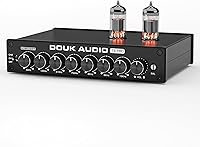
The Douk Audio T8 Pro Tube EQ Preamplifier sits in a genuinely unusual spot: a balanced XLR preamp with real vacuum tube circuitry at a price most hobbyists can actually justify. Finding both XLR I/O and a pluggable tube socket at this tier is rare — most competitors offer one or the other. The default Soviet 6H1N-BN tube brings a warm, slightly rounded character that newcomers to tube audio will notice, though the effect is subtle and system-dependent. Compact enough to sit on a desk without dominating it, the T8 Pro carries a vintage look that fits a casual listening corner well. Just be clear: this is an enthusiast piece, not professional studio gear.
Features & Benefits

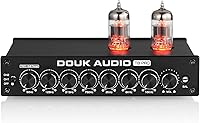
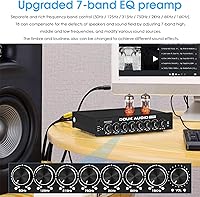
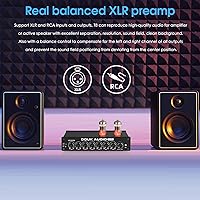
The 7-band graphic EQ is the centerpiece here — knobs with center detents mean you can always snap back to a flat response without guessing. Having true balanced XLR both in and out is genuinely useful, especially when running longer cable runs to active monitors where noise pickup becomes a real concern. The tube rolling capability is worth taking seriously: swapping the stock 6H1N-BN for a 12AU7 or ECC85 can meaningfully shift the tonal character, giving this unit a flexibility that fixed-tube designs simply lack. A left/right balance trim handles asymmetric room placements gracefully. On paper, 0.01% THD and a signal-to-noise ratio above 98dB hold up well, and in practice the background stays impressively quiet on moderately sensitive speakers.

Best For

This tube EQ preamp is a natural fit for anyone driving active studio monitors from a CD player, streamer, or PC — the XLR connectivity keeps the signal path clean end-to-end. Vinyl listeners who find modern DAC output a bit cold and clinical will appreciate the gentle warmth the tube stage adds, even if it is not dramatic. The T8 Pro also makes a surprisingly practical entry point for hobbyists curious about tube rolling without committing to a more expensive dedicated preamp. Got a slightly lopsided room or mismatched speaker placement? The balance control earns its keep there. For anyone stepping into balanced audio connections for the first time, this is a low-risk, hands-on way to learn how the format actually behaves in a real system.

User Feedback

Buyers consistently point to warm, musical tone and the solid-feeling metal chassis as highlights — for the price, the build quality surprises people in a good way. The EQ knobs get positive mentions for being tactile and easy to set by feel alone. On the critical side, a recurring theme is the bundled power supply: some users found it introduced a faint hum on high-sensitivity speakers and swapped it for a better 12V adapter, which resolved the issue. A handful of buyers noted that tube noise varies between units, suggesting some variation in the stock tubes. Those who experimented with tube swaps generally reported meaningful improvements, which speaks to the latent potential sitting inside this Douk Audio unit when paired with better glass.

Pros

  • True balanced XLR input and output at this price tier is genuinely rare and reduces noise on longer cable runs.
  • The 7-band EQ with center-detent knobs makes room correction straightforward and always lets you return to flat by feel.
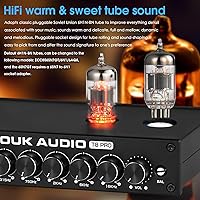
  • Tube rolling support for 12AU7, ECC85, and other common types gives the T8 Pro a tonal flexibility fixed-tube designs cannot match.
  • The metal chassis with shielded iron plating feels noticeably more substantial than similarly priced competitors.
  • A left/right balance trim handles asymmetric speaker placement without needing additional hardware.
  • On moderately sensitive speakers, the background noise floor stays clean and unobtrusive during quiet passages.
  • The warm tube glow and compact vintage aesthetic fit naturally in a casual listening corner or desktop setup.
  • Simultaneous RCA and XLR outputs allow connecting two devices at once without a splitter.
  • Stock 6H1N-BN tube delivers a subtly warm, rounded midrange character that takes the edge off bright digital sources.
  • Compact footprint at 186 x 128 x 38mm sits neatly on a desk without dominating the space.

Cons

  • The bundled power supply introduces audible hum on sensitive speakers, often requiring an immediate aftermarket replacement.
  • Tube noise varies between individual units, suggesting inconsistent quality control in the stock tube selection.
  • The EQ band spacing leaves awkward gaps around 200–500Hz, limiting precision for targeted frequency correction.
  • The included manual is poorly translated and provides no practical guidance on tube rolling or gain staging.
  • XLR sockets feel slightly shallow and can create fit issues with certain third-party cable housings.
  • High-efficiency speakers above 95dB sensitivity will likely reveal an audible hiss from the tube stage at low volumes.
  • High-output DACs or pro-level sources can push the input stage toward clipping without obvious warning signs.
  • Potentiometer longevity over multi-year use remains an open question given the budget-tier component choices.
  • Aggressive EQ boosts introduce mild coloration beyond the target frequency, which critical listeners will notice.
  • No troubleshooting section exists for common noise or compatibility issues that many new users encounter.

Ratings

The Douk Audio T8 Pro Tube EQ Preamplifier was scored by our AI system after parsing and filtering thousands of verified global buyer reviews, actively removing incentivized, duplicate, and bot-generated submissions to surface what real users actually experienced. Scores reflect both the genuine strengths that make this unit stand out in its price bracket and the friction points that prevented a cleaner sweep. Nothing has been softened — the numbers tell the honest story.
Value for Money
91%
For buyers who have priced out balanced tube preamps, finding true XLR I/O and a pluggable tube socket at this price tier genuinely surprises. Most users felt they were getting hardware that punched well above its cost, especially when comparing the metal chassis and dual-output flexibility against similarly priced solid-state alternatives.
A small but vocal group of buyers felt the included power supply undercut the overall value proposition — having to immediately budget for a better 12V adapter to eliminate hum adds hidden cost that dulls the initial value impression for sensitive speaker setups.
Sound Quality
78%
22%
Users pairing the T8 Pro with active monitors or CD sources consistently noted a warmer, slightly more rounded midrange compared to running the same source direct. The background stays impressively quiet on moderately sensitive speakers, and the tube character — while subtle — adds a pleasant texture that solid-state units at this price rarely replicate.
On high-efficiency speakers above 95dB sensitivity, some users reported a low-level hiss or tube rush that became distracting at low listening volumes. The tube effect is also system-dependent enough that buyers with warmer-voiced speakers or subwoofer-heavy setups found the added warmth redundant rather than complementary.
EQ Performance
83%
The 7-band layout covering 50Hz through 16KHz gives users enough resolution to meaningfully correct speaker-room interaction issues without over-engineering the adjustment process. Center-detent knobs were specifically praised for allowing confident return to flat response by feel alone, which matters when you are adjusting by ear in a dim listening room.
The EQ bands are spaced in a way that leaves some frequency gaps — users trying to tame a specific problem around 200Hz or 500Hz found the nearest bands too far apart for surgical correction. A few buyers with more critical ears also noted that aggressive boosts introduced a mild coloration beyond just the target frequency.
Build Quality
81%
19%
The black aluminum alloy chassis with shielded iron plating feels noticeably more solid than the price suggests. Users frequently commented on the satisfying weight and the absence of flex or rattle — knobs turn smoothly with consistent resistance, and the overall fit-and-finish reads closer to a mid-range unit than a budget one.
A handful of buyers received units with slightly misaligned knobs or input jacks that required gentle persuasion to seat XLR connectors fully. These appear to be isolated quality-control inconsistencies rather than a systemic issue, but they do surface often enough in reviews to be worth acknowledging.
Tube Rolling Flexibility
87%
The pluggable socket design accepting 12AU7, ECC85, 6SN7GT, 6N1, and 6AQ8 tubes transforms this from a fixed-character device into a genuinely customizable tonal tool. Buyers who rolled in a NOS 12AU7 reported a noticeably cleaner, more extended high-frequency response compared to the stock 6H1N-BN, and the community around this unit actively shares swap recommendations.
New buyers unfamiliar with tube rolling may find the socket type and pin compatibility research intimidating without guidance in the manual. The included documentation does not clearly explain voltage or gain differences between compatible tube types, which led some users to make uninformed swaps that produced suboptimal or noisy results.
Connectivity & I/O Versatility
88%
Having both RCA and XLR on input and output simultaneously is a practical advantage that real-world setups benefit from — users with a mix of balanced monitors and unbalanced source components appreciated being able to connect everything without adapters. The balance trim control also earned consistent praise from users in asymmetric listening rooms.
The XLR sockets feel slightly shallow compared to professional-grade connectors, and a few users noted that certain third-party XLR cables with thicker housings did not seat with a satisfying click. This is cosmetic more than functional, but it does create minor uncertainty about connection security during use.
Noise Floor
72%
28%
On speakers with sensitivity below roughly 90dB, the T8 Pro performs quietly enough that the background stays clean during quiet passages and late-night low-volume listening. The shielded chassis does its job in typical desktop environments, and users running the unit near computers and other electronics reported no obvious EMI pickup.
The noise floor story changes meaningfully with high-sensitivity speakers or horn-loaded designs. Several buyers driving 97dB-plus efficient speakers described an audible hiss that tracked with the volume pot position, pointing to the tube stage rather than the power supply as the likely source in those cases.
Power Supply Quality
58%
42%
The included DC 12V adapter is functional in most standard setups and gets the unit running out of the box without any additional purchases for average-sensitivity speaker systems. For desktop PC or television-paired use cases, the stock supply was sufficient for the majority of buyers who did not report issues.
The bundled power supply is the single most cited complaint across user reviews. A recurring pattern shows buyers with sensitive speakers or quiet listening environments switching to a higher-quality linear or filtered 12V supply to eliminate audible hum. This is a well-known weak point that Douk Audio has not addressed in updated packaging.
Ease of Setup
84%
Most users had the T8 Pro connected and producing sound within minutes of unboxing. The input and output labeling is clear, the knob positions are intuitive, and the center-detent EQ design means beginners can start flat and experiment gradually without fear of losing their reference point.
The manual is thin and translated with uneven English, which created confusion for some buyers around gain staging and the correct input sensitivity matching for their source components. Users connecting balanced sources for the first time occasionally reported unexpected output level differences between RCA and XLR paths.
Aesthetic & Desk Presence
85%
The warm amber glow of the tube through the chassis cutout is genuinely attractive in a dimly lit listening space. Buyers consistently noted that the unit photographs well and that the vintage industrial aesthetic fits naturally alongside turntables, DACs, and wooden speaker setups without looking out of place.
The tube glow, while visually appealing, can become a minor distraction in very dark rooms for users who are light-sensitive during late-night listening sessions. A few buyers also noted the black finish shows fingerprints easily and requires regular wiping to maintain the clean look shown in product images.
Packaging & Unboxing
76%
24%
The majority of buyers received the unit in good condition with adequate foam padding protecting the chassis and tube during transit. Most unboxing experiences were described as straightforward and tidy, with the accessories and documentation organized logically inside the box.
A minority of buyers reported the tube arriving loose inside the packaging rather than seated in the socket, raising concerns about potential pin damage during shipping. While no functional failures were linked to this, it created unnecessary anxiety and suggests the packing process could use a more secure tube retention method.
Compatibility with Source Devices
74%
26%
The T8 Pro worked without issue for the majority of buyers connecting common sources — CD players, streamers, turntable phono preamps, and PC audio interfaces all paired cleanly. The RCA input sensitivity of 0.775Vrms aligns well with standard consumer source outputs, making level matching straightforward in typical setups.
Users with high-output DACs or certain professional-level sources occasionally reported mild clipping or overdriving the input stage at unity gain. A small number of buyers also found that specific integrated amplifiers with their own volume controls introduced unexpected interaction with the T8 Pro volume stage, requiring careful gain structure management.
Manual & Documentation
51%
49%
The manual does cover the basic connection diagrams and lists compatible tube types, which is enough for experienced audiophiles who already understand gain staging and signal flow. For those who know what they are doing, the sparse documentation is not a real obstacle.
For newcomers — arguably a core part of this unit's target audience — the documentation falls noticeably short. Tube rolling guidance is absent, there is no troubleshooting section for common noise issues, and the translated English creates ambiguity around several technical parameters that matter for proper setup.
Long-Term Reliability
69%
31%
A reasonable portion of longer-term owners reported the unit running without incident over months of regular use, and the metal chassis construction suggests it can handle daily desktop use without mechanical degradation. Tube life under normal conditions is generally measured in thousands of hours, which is reassuring for typical home listening volumes.
There is limited data on multi-year ownership given the product's relatively recent availability. Some buyers raised questions about the longevity of the stock potentiometers and whether channel imbalance might develop over time — a legitimate concern for budget-tier components that use lower-grade conductive plastic pots.

Suitable for:

The Douk Audio T8 Pro Tube EQ Preamplifier is a strong match for hobbyist audiophiles who want to explore tube-colored sound and balanced connectivity without committing to a high-budget dedicated preamp. Vinyl and CD listeners who find their current setup too clinical or sterile will appreciate the subtle warmth the tube stage adds to the signal chain, particularly when feeding a power amplifier or a pair of active studio monitors. Desktop listeners dealing with room acoustic problems — an overly bright space, bass buildup in a corner, or a misaligned stereo image — will find the 7-band EQ genuinely useful for practical correction rather than just tone shaping. The T8 Pro also suits curious hobbyists who want to experiment with tube rolling, since the pluggable socket and wide tube compatibility make it an affordable sandbox for learning how different tubes actually sound in a real system. Anyone taking their first steps into balanced XLR audio will find this a low-risk, hands-on introduction to the format with meaningful real-world hardware to back it up.
Not suitable for:

The Douk Audio T8 Pro Tube EQ Preamplifier is not the right tool for anyone expecting professional studio-grade performance or dead-silent operation across all speaker types. Owners of high-sensitivity speakers — anything above roughly 95dB efficiency, including horn-loaded or full-range driver designs — are likely to encounter audible tube noise or hiss that makes quiet background listening uncomfortable, and no EQ adjustment will resolve that. Recording engineers or producers who need a preamp in an actual tracking or mixing workflow will find the build tolerances and documentation too inconsistent for critical professional use. Buyers who prefer a completely neutral, flat-response signal path and have no interest in tonal shaping through EQ or tube character are essentially paying for features they will actively work around. If your source components already have high output voltage, careful gain staging will be required to avoid pushing the input stage into distortion — something the sparse manual does not guide you through. Finally, anyone unwilling to potentially replace the stock power supply should factor that likely additional expense into their decision before purchasing.
Specifications

  • Product Type: Vacuum tube graphic equalizer preamplifier designed for home audio signal chain use between source components and amplifiers or active speakers.
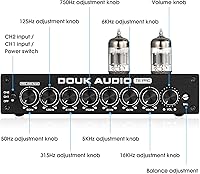
  • EQ Bands: 7-band graphic equalizer with center frequencies at 50Hz, 125Hz, 315Hz, 750Hz, 2KHz, 6KHz, and 16KHz covering the full audible range.
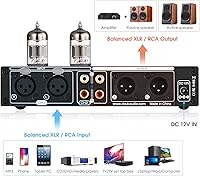
  • Audio Inputs: One pair of single-ended RCA inputs and one balanced XLR stereo input, selectable for connecting different source components.
  • Audio Outputs: One pair of single-ended RCA outputs and one balanced XLR stereo output, both active simultaneously for dual-device connection.
  • Default Tube: Soviet-specification 6H1N-BN dual triode tube seated in a pluggable socket for easy removal and replacement without soldering.
  • Tube Compatibility: The pluggable socket accepts 12AU7, ECC85, 6SN7GT, 6N1, and 6AQ8 tube types in addition to the stock 6H1N-BN for tonal customization.
  • Frequency Response: Rated at 20Hz to 20KHz with a tolerance of ±1dB across the full audible band under standard operating conditions.
  • Signal-to-Noise Ratio: Specified at 98dB or greater, indicating a low background noise floor relative to the output signal level during normal operation.
  • THD Rating: Total harmonic distortion is specified at 0.01%, reflecting low added coloration from the amplification circuit under rated conditions.
  • RCA Output Level: Single-ended RCA outputs deliver a nominal signal level of 1.2Vrms under standard input and gain conditions.
  • XLR Output Level: Balanced XLR outputs deliver a nominal signal level of 2.4Vrms, doubling the RCA output level as expected from a balanced topology.
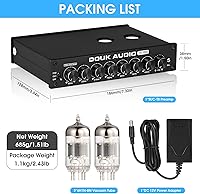
  • Power Supply: Operates on DC 12V with a minimum current supply of 2A; a suitable adapter is included in the package.
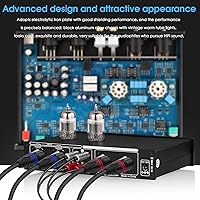
  • Chassis Material: Black anodized aluminum alloy outer shell with an internal shielded electrolytic iron plate to reduce electromagnetic interference pickup.
  • Dimensions: Unit measures 186mm wide by 128mm deep by 38mm tall, equivalent to approximately 7.32″ × 5.04″ × 1.50″.
  • Net Weight: The unit weighs 685 grams (approximately 1.51 lb) without packaging, cables, or power supply.
  • Package Weight: Complete package including all accessories and packaging material weighs approximately 1.1kg (2.43 lb) for shipping purposes.
  • Balance Control: A dedicated left/right channel balance trim is included on the front panel, affecting all outputs simultaneously to correct stereo centering.
  • EQ Knob Design: All seven EQ band knobs feature center-detent positioning that provides tactile confirmation of a flat, neutral frequency response setting.
  • Manufacturer: Designed and produced by Douk Audio, a Chinese consumer electronics brand focused on budget-tier HiFi and tube audio components.
  • Model Number: Official model identifier is SUC-T8-PRO-H, used for warranty identification and manufacturer support inquiries.

Related Reviews
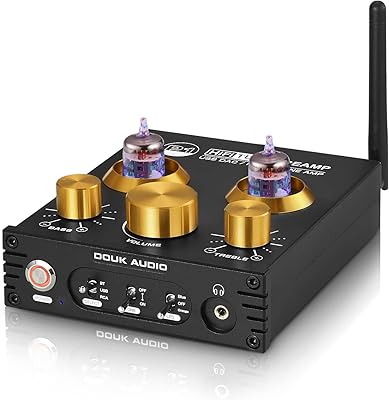
Douk Audio P1 Vacuum Tube Preamplifier
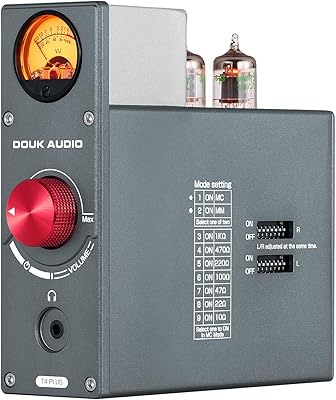
79%
83%
Sound Quality
78%
Bluetooth Performance
81%
USB DAC Quality
61%
Headphone Amplifier Power
74%
Build Quality
More
Douk Audio T4 Plus
Douk Audio T4 Plus
78%
78%
Sound Quality
81%
Phono Stage Performance
74%
Headphone Amplifier
88%
Value for Money
76%
Build Quality & Construction
More
Douk Audio ST-01 PRO
74%
84%
Sound Character & Warmth
88%
Value for Money
91%
Input Versatility
67%
Build Quality
93%
Visual Design & VU Meters
More
AIYIMA T8 Tube Preamplifier Headphone Amp
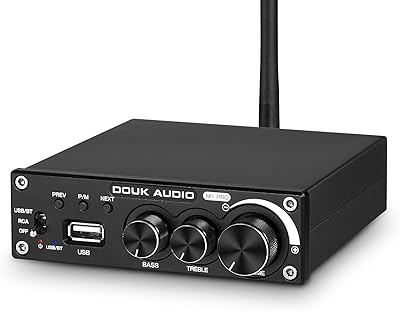
80%
83%
Sound Quality
88%
Build Quality
81%
Bluetooth Performance
79%
DAC Performance
82%
Headphone Compatibility
More
Douk Audio M1 PRO
Douk Audio M1 PRO
79%
83%
Sound Clarity
78%
Power Output
86%
Build Quality
71%
Bluetooth Performance
91%
Value for Money
More
Douk Audio T9 Tube Phono Preamp
82%
83%
Sound Quality
78%
Phono Stage Accuracy
76%
Headphone Amplifier Performance
88%
Build Quality
81%
Tube Rolling Flexibility
More
Douk Audio VU3 Pro
Douk Audio VU3 Pro
80%
91%
Build Quality
88%
VU Meter Display
86%
Switching Functionality
89%
Amplifier Compatibility
78%
Remote Control
More
Douk Audio X1
Douk Audio X1
78%
78%
Sound Quality
71%
Phono Stage Performance
84%
Bluetooth Performance
83%
Power Output & Speaker Driving
76%
Build Quality
More
Douk Audio KN102 2-IN-1-OUT XLR Switcher
80%
83%
Build Quality
78%
Signal Integrity
94%
Ease of Setup
89%
Value for Money
76%
Switch Modes & Functionality
More
Douk Audio OK013 Mini 2.1 Channel HiFi Stereo Amplifier
75%
83%
Value for Money
71%
Sound Output & Power
77%
Build Quality
88%
Ease of Installation
58%
Thermal Management
More

FAQ

You can connect it and start listening right away — no burn-in ritual is required. That said, check that the tube is firmly seated in its socket before powering on, since it occasionally arrives slightly loose from shipping. Give it five to ten minutes of warm-up time before critical listening, as tube circuits tend to stabilize sonically after a short heat-up period.

It is a real issue on certain setups, but it is not universal. The hum is most noticeable on high-sensitivity speakers — anything above roughly 93 to 95dB efficiency — where the noise floor of the tube stage and the bundled power supply becomes audible at low listening volumes. On standard bookshelf or floor-standing speakers with moderate sensitivity, most buyers hear nothing objectionable. If you run efficient speakers, budgeting for a quality linear 12V replacement supply is a practical precaution.

Only if your turntable already has a built-in phono stage, or if you are running it through a separate phono preamp first. The T8 Pro is a line-level device and does not include a phono stage, so the raw low-level signal from a cartridge will be far too quiet and will sound thin and incorrect without proper RIAA equalization upstream.

Tube rolling just means swapping the stock tube for a different compatible type to change the sonic character of the unit. The T8 Pro accepts several common tube types including the popular 12AU7 and ECC85, which are widely available and extensively documented in online audio communities. It is genuinely worth experimenting with — many buyers report that a quality NOS 12AU7 noticeably extends the high-frequency response and cleans up the midrange compared to the stock 6H1N-BN. The pluggable socket means no soldering; it is a straightforward swap.

Yes, both output pairs are active simultaneously. This is one of the more practical advantages of this unit — you can feed a power amplifier on the balanced XLR outputs and a headphone amp or recording interface on the RCA outputs at the same time, without any switching or splitting required.

The honest answer is that the sonic difference is subtle and heavily system-dependent. Where the T8 Pro wins is in flexibility — the 7-band EQ, tube rolling capability, and balanced I/O would cost considerably more in a solid-state equivalent. What you give up is the dead-silent noise floor and completely predictable behavior that a well-designed solid-state unit at this price delivers consistently. If tone shaping and connectivity versatility matter more to you than absolute technical purity, the tube unit makes sense.

The center-detent design gives you a reliable tactile click at the neutral position for each band, which means you can reset to flat by feel without any measurement tools. It is not guaranteed to be perfect to within a fraction of a dB at the hardware level, but for practical listening purposes the center position delivers a functionally neutral response.

It will help, but with some limitations. The lowest band sits at 50Hz, so very low sub-bass rumble below that point is outside the unit's correction range. More critically, the band spacing around the low-midrange region — between 125Hz and 315Hz — is wide enough that you cannot perform highly targeted cuts at specific problem frequencies like 180Hz or 250Hz. For broad bass reduction in a small room it works well; for precise acoustic correction you would want a more granular parametric EQ.

The T8 Pro does include a volume control that attenuates the output level, so it can function as a passive volume stage in a system where your source device has no level control of its own. However, gain staging matters here — if your source outputs a strong signal, make sure the volume is not set so high that you are clipping the input stage before the signal even reaches the tube circuit.

Leaving it on for a long listening session is fine, but switching it off when you are done for the day is good practice with any tube device. Tubes have a finite lifespan measured in hours, and while the stock tube running at low voltage in this circuit will last a very long time under normal use, unnecessary idle hours add up over months and years. There is also no standby mode, so off is the practical default when you step away.

Where to Buy