Overview

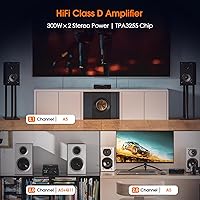
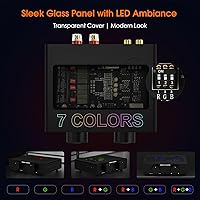
The Douk Audio A5 is a compact Class D stereo amplifier built around Texas Instruments' TPA3255 chip, designed to sit on a desk or shelf without dominating the space. It ships ready to use — power adapter included — so there's no scrambling for compatible supplies on day one. The transparent top panel with adjustable LED lighting sets it apart visually from the sea of plain black boxes in this tier, though the aesthetic feels purposeful rather than gimmicky. At roughly the size of a thick paperback book, this mini amp offers a surprisingly serious foundation for a compact home audio setup.

Features & Benefits

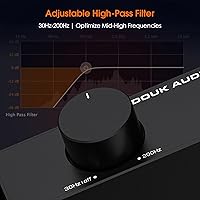
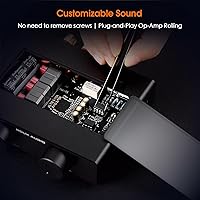
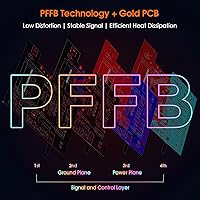
The standout feature for anyone running a 2.1 setup is the adjustable high-pass filter, spanning 30 to 200Hz, which lets you offload bass duties to a subwoofer without buying a separate crossover box. Op-amp swapping is handled through a tempered glass panel on top — no soldering, no disassembly — a genuine plus for hobbyists who like experimenting with sound signatures. Under the hood, the four-layer immersion gold PCB and Post-Filter Feedback circuitry keep distortion impressively low for a Class D unit at this price. You also get both banana speaker jacks and a 3.5mm pre-out, adding real connectivity flexibility for more complex setups.

Best For

This Class D amplifier is a strong fit for anyone building a compact desktop system around bookshelf or passive speakers, especially where a full-size receiver would feel excessive. It suits 2.1 configurations particularly well — the high-pass filter is practically designed for that use case. Hobbyists interested in op-amp rolling will find the accessible design genuinely inviting. That said, it's worth being clear about what the Douk A5 isn't: there are no tone controls, no Bluetooth, and no digital inputs. If you need those features, look elsewhere. For a clean, low-distortion signal path in a small chassis, though, it hits a spot that's hard to match at this price.

User Feedback

Buyers consistently praise the sound clarity and imaging for a compact amp at this price, with many noting it outperforms expectations straight out of the box. Build quality draws positive comments too — the construction feels more deliberate than most budget units. On the flip side, LED lighting is a recurring point of contention: some find it atmospheric, others find it distracting enough to tape over. A smaller subset has flagged the included power adapter as feeling lightweight compared to the rest of the package, though most report no issues in practice. Op-amp swapping gets a mixed reaction — straightforward for experienced users, but potentially fiddly for complete beginners.

Pros

  • Ships with a power adapter included — no compatibility guessing or extra purchases required on day one.
  • The built-in high-pass filter covers a wide enough range to handle real subwoofer integration without a separate crossover.
  • Op-amp swapping requires no tools or soldering, making sound customization accessible to hobbyists at any skill level.
  • Distortion levels are genuinely low for a Class D unit at this price, audible on resolving speaker pairings.
  • The four-layer immersion gold PCB is a meaningful internal upgrade over what most competitors offer at this tier.
  • Compact enough to sit beside a monitor or on a media shelf without rearranging your entire setup.
  • Both banana post speaker outputs and a 3.5mm pre-out are included, covering more connection scenarios than typical rivals.
  • Build quality feels more deliberate than the price suggests, with a solid chassis and quality top panel.
  • Sound clarity and imaging draw frequent praise from buyers stepping up from budget all-in-one systems.

Cons

  • The included power adapter feels noticeably cheaper than the amplifier itself, prompting many users to upgrade it separately.
  • No tone controls whatsoever — bass and treble adjustments require an external preamp or EQ.
  • LED lighting cannot be fully disabled, which becomes a genuine irritation in dark-room or late-night listening environments.
  • Op-amp socket requires firm, even pressure to seat correctly — beginners risk bending pins on a first attempt.
  • Only analog RCA input means digital sources like TVs or computers need an external DAC to connect properly.
  • The HPF adjustment knob lacks detents or clear markings, making repeatable crossover settings difficult to dial in precisely.
  • High-sensitivity speakers may reveal a low-level noise floor hiss that is clearly audible in quiet listening environments.
  • The translated user manual leaves some setup steps ambiguous, particularly around HPF use and op-amp compatibility.
  • No Bluetooth or wireless input of any kind limits spontaneous or multi-room audio use cases.
  • Rear connector spacing is tight, and thick or oversized plugs can make cable management behind the unit awkward.

Ratings

The Douk Audio A5 has been evaluated by our AI review engine after processing verified buyer feedback from global sources, with spam, incentivized reviews, and bot activity actively filtered out before scoring. Across categories spanning audio performance, build quality, and usability, the analysis reflects both what buyers genuinely appreciate and where real frustrations surfaced. Scores are deliberately precise — no rounding to tidy numbers — because that is what honest aggregation looks like.

Sound Clarity
88%
Buyers consistently describe the midrange reproduction as punchy and articulate, particularly when paired with quality bookshelf speakers. At moderate listening volumes in a home office or small living room, the background stays black and instruments retain good separation — something users switching from entry-level receivers notice quickly.
At higher volumes pushing lower-impedance speakers, a small number of users report a slight hardness in the upper midrange. It is not a widespread pattern, but listeners with bright-sounding speakers may find the pairing less forgiving than with warmer-tuned alternatives.
Value for Money
93%
For a Class D amp that ships with a power supply, features a high-pass filter, and is built on a four-layer PCB, the asking price is genuinely difficult to argue with. Most buyers frame it as a noticeable step up from cheaper options without requiring a significant budget jump — a real sweet spot for cost-conscious audiophiles.
Some buyers expected more in the box at this price tier, specifically a better quality power adapter. The included supply functions adequately but feels noticeably less substantial than the amplifier itself, which can leave a slightly unfinished impression on unboxing.
Build Quality
81%
19%
The chassis feels solid for its footprint, and the tempered glass panel adds a premium touch that most competitors at this size and price skip entirely. Users frequently note that the unit does not flex or rattle under typical desk use, which builds confidence in daily long-term placement.
The external finish, particularly around the side vents and bottom panel, shows minor inconsistencies in fit and finish on some units. Nothing structurally problematic, but buyers with high cosmetic standards may spot small imperfections that contrast with the otherwise polished top panel.
High-Pass Filter Usability
86%
The onboard HPF is a practical differentiator that buyers running 2.1 setups genuinely rely on. Being able to roll off bass at the amp level — dialing it per room acoustics without an external crossover box — saves money and desk clutter simultaneously, and users appreciate that the range is wide enough to be genuinely useful.
The filter adjustment control is small and lacks detents or markings precise enough for repeatable tuning. Users who want to set an exact crossover frequency find themselves estimating by ear rather than dialing to a specific value, which can be frustrating during setup fine-tuning.
Op-Amp Swapping Experience
74%
26%
Audiophiles familiar with op-amp rolling find the glass access panel a refreshingly accessible design choice — no screwdrivers required for basic swaps. Several users report that trying different op-amps meaningfully shifted the sonic character, validating the feature beyond pure novelty.
For less experienced buyers, the process is less intuitive than marketed. The socket mechanism requires confident, even pressure, and a few users reported bending pins during their first attempt. Without prior op-amp experience, this feature can cause anxiety rather than enthusiasm.
Thermal Management
83%
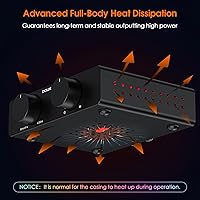
Under extended listening sessions, the unit stays warm rather than hot, and the four-layer PCB design appears to distribute heat competently across the chassis. Users who run the amp for several hours continuously report no thermal shutdowns or noticeable performance changes.
The chassis has no active cooling, so in enclosed shelving or warm ambient environments the surface temperature climbs noticeably. It rarely causes problems, but placing it in a poorly ventilated cabinet is not advisable for long listening sessions.
LED Lighting
62%
38%
For buyers who want their audio gear to match a lit desk setup or home studio aesthetic, the adjustable internal LEDs are a genuine plus. The ability to change color adds a layer of personalization that most plain-chassis competitors simply do not offer.
The LEDs are divisive. A consistent segment of buyers finds them too bright for dark-room listening environments and ends up covering them with tape. The inability to fully disable the lighting via software or a switch is a recurring complaint that Douk Audio has yet to address.
Input & Output Flexibility
77%
23%
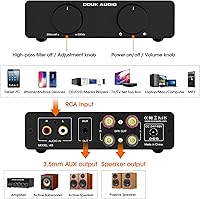
Having both banana binding posts for speakers and a 3.5mm AUX pre-output on the same unit adds genuine versatility for users who want to loop in a headphone amp or secondary device. The RCA stereo input is clean and well-positioned for typical desk cable routing.
The input options are limited to analog RCA only. There is no optical, coaxial, or USB input, meaning buyers who need digital connectivity from a TV or PC will require a separate DAC — an extra cost and cable run that some buyers only realize after purchase.
Power Supply Quality
67%
33%
The bundled 32V adapter means the unit is genuinely plug-and-play, which reduces friction for buyers new to separate-component audio. For the majority of typical use cases, the included supply performs without issue and delivers stable power during moderate listening.
Experienced users frequently swap the included adapter for a higher-quality linear or regulated switching supply, noting audible improvement in noise floor and dynamics. The stock adapter is functional but represents the weakest link in an otherwise capable chain.
Compact Form Factor
91%
The footprint is small enough to sit beside a monitor, on a bookshelf corner, or in a media cabinet without demanding significant space. Users who have moved from full-size receivers specifically call out the size reduction as a meaningful quality-of-life improvement for smaller rooms.
The compact dimensions do create some practical trade-offs — the rear panel connectors sit close together, and thicker banana plugs or oversized RCA connectors can feel cramped. Cable management behind the unit requires a bit more planning than a larger chassis would demand.
Compatibility with Speakers
79%
21%
The amp handles 4 to 8 ohm speakers confidently in most reported pairings, and users running typical bookshelf speakers — including popular budget and mid-range models — report clean, stable output without distortion at reasonable levels.
A handful of users with high-sensitivity speakers have noted a slight noise floor hiss at idle, which is audible in quiet rooms. The amp also does not behave ideally with speakers at the very low end of the impedance range under sustained high-volume use, though this is an edge case rather than a systemic issue.
Setup & Ease of Use
89%
Unboxing to first sound takes under ten minutes for most users — connect the power supply, run RCA cables from a source, attach speaker wire to the banana posts, and the amp is operational. No app, no pairing process, no firmware. Buyers who are frustrated with complex modern audio gear find that simplicity refreshing.
The user manual is brief and translated from Chinese, with some ambiguous phrasing around the HPF adjustment and op-amp compatibility guidance. First-time buyers occasionally post setup questions that a clearer manual would have preempted.
Distortion & Noise Performance
87%
The measured distortion figures are genuinely low for a Class D unit at this price point, and listeners with revealing speakers can actually perceive the cleanliness — particularly in complex musical passages where cheaper amps tend to smear detail. The signal-to-noise ratio holds up well even when the source is not ideal.
The performance advantage over cheaper alternatives is most apparent with high-quality source material and revealing speakers. Buyers pairing this amp with budget speakers and a basic streaming source may not perceive a meaningful difference, making the technical specs feel academic in those setups.

Suitable for:

The Douk Audio A5 is a strong match for anyone building a compact 2.0 or 2.1 stereo system around passive bookshelf speakers, particularly in a home office, bedroom, or small living room where a full-size receiver would be overkill. Listeners who already own or plan to add a subwoofer will find the built-in high-pass filter especially practical — it handles the crossover work natively, cutting out an extra box from the chain. Audiophile hobbyists who enjoy experimenting with op-amps will appreciate the tool-free access panel, which makes swapping a genuine option rather than a technical ordeal. It also suits buyers upgrading from a basic all-in-one system who want measurably cleaner amplification without committing to a large or expensive separate component setup. If your priority is a low-distortion, analog signal path in a small chassis that ships ready to use, this mini amp covers that ground reliably.

Not suitable for:

The Douk Audio A5 is not the right call if your setup depends on digital inputs — there is no optical, coaxial, or USB connection, so TV and PC users without a separate DAC will need to budget for one. Buyers who want tone controls, a bass or treble knob, or built-in Bluetooth will also need to look elsewhere, as this Class D amplifier is deliberately stripped of those conveniences in favor of a clean signal path. The advertised power output is a peak figure into low-impedance speakers, so anyone expecting to fill a large room at high volume may find real-world headroom more modest than the spec sheet implies. Users with high-sensitivity speakers in a quiet room have reported audible idle hiss, which makes this amp a questionable pairing for near-field listening with efficient drivers. And if you want a truly plug-and-forget appliance with zero tinkering, the op-amp socket and modest manual may introduce more friction than expected.

Specifications

  • Amplifier Chip: Powered by the Texas Instruments TPA3255, a high-efficiency Class D chip widely used in audiophile-grade compact amplifiers.
  • Channels: Stereo two-channel configuration designed for standard left and right speaker setups.
  • Peak Output: Rated at 300W per channel into a 4-ohm load, with real-world continuous output lower depending on source signal and speaker impedance.
  • Speaker Impedance: Compatible with passive speakers rated between 4 and 8 ohms, covering the vast majority of bookshelf and tower speaker models.
  • Distortion (THD+N): Total harmonic distortion plus noise is rated at 0.002%, indicating an exceptionally clean output signal for a Class D design at this price tier.
  • Signal-to-Noise: SNR is rated at 114dB, meaning background noise is kept extremely low relative to the audio signal during typical listening use.
  • Frequency Response: Covers the full audible spectrum from 20Hz to 20kHz with a tolerance of plus or minus 0.7dB, ensuring accurate tonal balance across bass, midrange, and treble.
  • High-Pass Filter: Onboard adjustable high-pass filter spans 30Hz to 200Hz, allowing users to roll off low frequencies sent to bookshelf speakers when a subwoofer handles bass duties.
  • Audio Input: Single stereo RCA analog input; no digital inputs such as optical, coaxial, or USB are included.
  • Audio Output: Dual output options: spring-loaded banana binding posts for speaker connections and a 3.5mm AUX jack for pre-out use with a secondary device.
  • Working Voltage: Operates on DC power between 24V and 48V, with the included 32V adapter sitting in the middle of that range for balanced headroom.
  • Included Power Supply: Ships with a 32V DC at 5A switching power adapter, providing sufficient current for typical listening levels without requiring an immediate upgrade.
  • PCB Construction: Built on a four-layer immersion gold PCB, which improves signal integrity, reduces interference between layers, and aids thermal dissipation compared to standard two-layer boards.
  • Op-Amp Access: User-swappable op-amp socket accessible via a tempered glass top panel without tools or disassembly, supporting common DIP-8 format op-amp upgrades.
  • Dimensions: Unit measures 95mm wide by 92mm deep by 50mm tall (approximately 3.74″ × 3.62″ × 1.97″), making it one of the more compact amplifiers in its class.
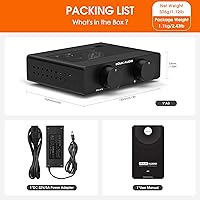
  • Net Weight: The amplifier unit itself weighs 506g (approximately 1.12 lb), light enough for easy repositioning on a desk or shelf.
  • LED Lighting: Internal LED lighting with adjustable color settings is visible through the transparent top panel, with no option to fully disable it via hardware switch.
  • Mounting Type: Freestanding only; no rack-mount hardware or wall-bracket provisions are included or officially supported.
  • Package Contents: Box includes the A5 amplifier unit, one DC 32V/5A power adapter, and a printed user manual.
  • Manufacturer: Designed and produced by Douk Audio, a Chinese audio electronics brand known for compact amplifiers and DAC products targeting the budget-to-mid audiophile segment.

Related Reviews
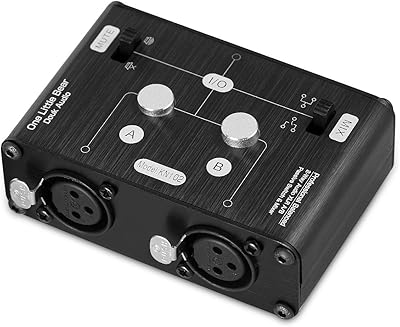
Douk Audio KN102 2-IN-1-OUT XLR Switcher
80%
83%
Build Quality
78%
Signal Integrity
94%
Ease of Setup
89%
Value for Money
76%
Switch Modes & Functionality
More
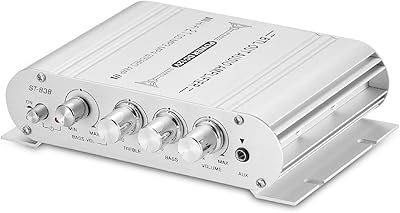
Douk Audio OK013 Mini 2.1 Channel HiFi Stereo Amplifier
75%
83%
Value for Money
71%
Sound Output & Power
77%
Build Quality
88%
Ease of Installation
58%
Thermal Management
More
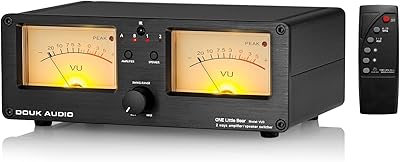
Douk Audio VU3
Douk Audio VU3
90%
94%
Build Quality
91%
VU Meter Accuracy
87%
Ease of Setup
89%
Remote Control Functionality
93%
Channel Isolation
More
Douk Audio U3 Headphone Amplifier
89%
94%
Sound Clarity
91%
Frequency Response Accuracy
89%
Output Power
86%
Build Quality
90%
Ease of Setup
More
Douk Audio ST-01 Plus
81%
83%
Sound Quality
78%
Phono Preamp Performance
74%
Bluetooth Performance
71%
Build Quality
91%
Value for Money
More
Douk Audio P1 Vacuum Tube Bluetooth Preamplifier
85%
89%
Sound Quality
92%
Bluetooth Connectivity
85%
Build Quality
88%
Ease of Use
87%
Tone Control Flexibility
More
Douk Audio M1 PRO
Douk Audio M1 PRO
79%
83%
Sound Clarity
78%
Power Output
86%
Build Quality
71%
Bluetooth Performance
91%
Value for Money
More
Douk Audio T9 Vacuum Tube Phono Preamp
87%
92%
Sound Quality
88%
Ease of Setup
93%
Tube Warmth & Performance
86%
Build Quality
89%
Adjustability (Bass/Treble)
More
Douk Audio T4 Plus
Douk Audio T4 Plus
78%
78%
Sound Quality
81%
Phono Stage Performance
74%
Headphone Amplifier
88%
Value for Money
76%
Build Quality & Construction
More
Douk Audio VU3 Pro
Douk Audio VU3 Pro
80%
91%
Build Quality
88%
VU Meter Display
86%
Switching Functionality
89%
Amplifier Compatibility
78%
Remote Control
More

FAQ

It comes ready to use — a 32V DC adapter is included in the box. Just connect your RCA source, attach your speaker wires to the banana posts, and you are good to go. Some experienced users eventually swap the included adapter for a higher-quality supply, but it is not a requirement to get started.

Yes, the Douk Audio A5 is rated for speakers between 4 and 8 ohms, so standard 8-ohm bookshelf speakers are well within its supported range. Just keep in mind that peak power output figures assume 4-ohm loads — with 8-ohm speakers, real-world output will be lower, though still more than adequate for typical home listening rooms.

The HPF lets you tell the amp to stop sending low bass frequencies to your bookshelf speakers and redirect that work to a subwoofer instead. You turn a small knob on the front panel to set the cutover point somewhere between 30Hz and 200Hz — whatever matches your subwoofer crossover or speaker capabilities. It is a practical feature that most budget amps simply do not include.

The LEDs are visible through the transparent top panel and glow continuously during use — there is no hardware switch to turn them off entirely. The brightness is adjustable and some colors are subtler than others, but if you are sensitive to light in a dark room, a few users have simply covered the panel with a small piece of black tape as a workaround.

Op-amp rolling is the practice of swapping the small audio amplification chip (the op-amp) inside the unit to subtly change the sound signature — some op-amps sound warmer, others more detailed. You absolutely do not need to do it; the amp sounds good with the stock op-amp. It is an optional hobby feature for audiophiles who enjoy experimenting. If you decide to try it, the glass panel lifts open without tools, but take care to seat the replacement chip evenly to avoid bending pins.

Only if your TV or PC has an analog RCA output or a 3.5mm headphone jack you can adapt to RCA. This mini amp has no digital inputs, so if your source only has optical, HDMI ARC, or USB audio output, you will need a separate DAC between the source and the amp. It is a common oversight worth checking before purchase.

The 300W figure is a peak measurement into a 4-ohm load under ideal conditions — it does not reflect typical continuous listening levels. In practice, this Class D amplifier delivers plenty of volume for small to medium rooms at normal listening distances, but it is not designed to shake walls. Think of it as an amplifier that has good headroom for dynamic music rather than one you would use for a party or large open space.

The unit runs warm during extended use, which is normal for any amplifier. The four-layer PCB helps spread heat across the chassis reasonably well, and most users report no thermal shutdowns under normal conditions. That said, placing it in a fully enclosed cabinet without ventilation is not a good idea for long listening sessions — leave at least a few centimeters of clearance around the sides and top.

This is worth checking carefully. A subset of users with sensitive speakers, particularly those rated above 90dB sensitivity, have reported a faint hiss audible in quiet moments between tracks in near-field setups. It is not a universal issue, but if you are pairing this amp with high-efficiency speakers in a quiet room at close range, it may be noticeable. With average-sensitivity bookshelf speakers in a typical listening position, the background is generally clean.

The banana binding posts are your main speaker outputs — this is where you connect the wires running to your passive speakers. The 3.5mm AUX jack is a pre-output, meaning it carries a line-level signal you can route to a secondary device like a headphone amplifier, powered subwoofer with line input, or another amplifier. They serve completely different purposes, so you would typically use the banana posts for speakers and the AUX out for any secondary device in the chain.