Overview

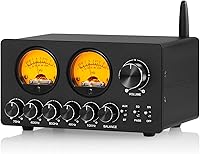
The Douk Audio EQ5 Tone is a compact 5-band graphic equalizer and Bluetooth preamp designed to sit between your source and amplifier, giving you hands-on tone control that most modern systems simply don't offer. It builds on the EQ5 Pro with improved bass response and more capable VU meter controls. The all-metal chassis feels noticeably solid for its price tier — aluminum knobs turn with satisfying resistance, nothing rattles. Power comes via USB-C at 5V, which means any phone charger or USB port can run it. That's a small but genuinely useful detail when you're trying to keep a desktop setup tidy.

Features & Benefits

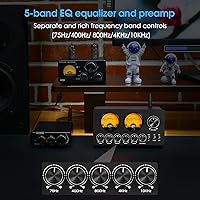
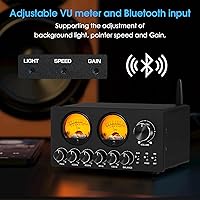
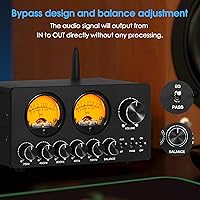
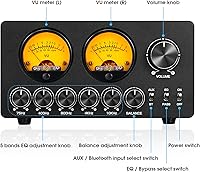
The five EQ bands — 75Hz, 400Hz, 800Hz, 4kHz, and 10kHz — cover the frequency zones most listeners actually want to adjust, and each runs through its own op-amp to keep channel crosstalk low. Connectivity is broad: Bluetooth 5.0, stereo RCA, and 3.5mm AUX all feed into the same unit. The bypass switch is one of the more practical inclusions here — flick it and the signal passes through untouched, making A/B comparisons straightforward. The dual 45mm VU meters, with adjustable pointer speed and brightness, respond visibly and dynamically to the music rather than sitting stiff. Distortion is rated at 0.003% THD at 1kHz — respectable for this class of device.

Best For

This EQ preamp makes the most sense for listeners who already have a system they like but want more control over how it sounds. Think desktop setups routed through a DAC or small amplifier, or a vintage hi-fi stack where the receiver has no tone controls at all. The VU meter aesthetics will appeal to anyone who appreciates a bit of old-school visual flair alongside function. It's also a natural step up for someone currently using a bare-bones Bluetooth receiver — the added EQ flexibility is real, and the analog inputs mean you're not locked into wireless. If your room has an acoustic problem that new speakers won't fix alone, this desktop tone controller gives you a practical way to compensate.

User Feedback

Across 72 reviews and a 4.1-star average, the picture is positive but not without caveats. Build quality and the VU meter display draw the most consistent praise — buyers frequently note that the unit feels more substantial than they expected. The low-frequency improvements over its predecessor are appreciated, though most describe the difference as subtle rather than dramatic. On the critical side, a handful of users report Bluetooth pairing issues with certain devices, and a recurring note is that five fixed bands can feel restrictive if you're used to a 10-band unit and want finer control. The 18-month warranty gets a quiet but genuine nod in several reviews, and overall satisfaction runs high, with most complaints landing in nuisance territory rather than deal-breaker range.

Pros

  • Solid all-metal build with aluminum knobs that feels noticeably premium for its price tier.
  • Dual 45mm VU meters respond dynamically to music and are genuinely satisfying to watch in a dim room.
  • Flexible connectivity covers Bluetooth 5.0, stereo RCA, and 3.5mm AUX in one compact unit.
  • The hardware bypass switch removes EQ processing entirely, making honest A/B comparisons quick and easy.
  • USB-C power at 5V means any spare phone charger or USB port can run it — no proprietary brick needed.
  • Left/right balance control corrects stereo image issues at the preamp level without touching the amplifier.
  • Low distortion rating of 0.003% THD keeps the signal clean even through a quality downstream amplifier.
  • 18-month limited warranty offers better post-purchase protection than most comparable Chinese audio brands.
  • Compact footprint fits easily on a crowded desk or shelf without demanding dedicated rack space.
  • Subtle but real low-frequency improvements over the previous generation are confirmed by repeat buyers.

Cons

  • Five fixed EQ bands make precise frequency targeting difficult, especially in the critical midrange region.
  • Bluetooth pairing can be unreliable with certain Android devices and older laptops, requiring repeated reconnection attempts.
  • No aptX or LDAC support limits wireless audio quality for listeners using high-resolution source files.
  • A USB-C power adapter is not always included in the box, which catches some buyers off guard.
  • No digital inputs — optical and USB audio connections are completely absent from the unit.
  • The EQ knobs sit close together, making fine adjustments fiddly for anyone with larger hands.
  • No LED indicator shows bypass state at a glance, leading to occasional confusion in low-light setups.
  • Customer support response times can be slow, particularly for buyers outside Douk Audio's primary time zone.
  • Stereo image correction via the balance pot is limited — severe channel mismatches may require a more capable solution.

Ratings

The Douk Audio EQ5 Tone scores below were generated by AI after analyzing verified buyer reviews from global marketplaces, with spam, bot-submitted, and incentivized feedback actively filtered out. Based on real-world usage patterns — desktop audio setups, home stereo integrations, and Bluetooth streaming scenarios — the ratings reflect where this EQ preamp genuinely delivers and where it falls short. Both strengths and recurring frustrations are transparently represented in every category.

Build Quality
88%
The all-metal enclosure and weighted aluminum knobs consistently surprise buyers who expect something flimsier at this price tier. Nothing flexes, nothing creaks, and the gold-plated I/O jacks feel like they belong on a unit costing considerably more.
A few users note that the knob detents could feel more precise — there is slight play on some units. The front panel labeling on a small number of devices arrived slightly misaligned, suggesting minor quality control variance in production batches.
Sound Quality
83%
The low-noise signal path — with THD rated at 0.003% at 1kHz — keeps the unit from adding unwanted coloration, which matters when you are running it in front of a quality amplifier. The improved bass response over the previous generation is a genuine step forward, not just marketing language.
The EQ's effect is subtle at moderate settings, which some users appreciate but others find underwhelming if they are expecting dramatic tonal shifts. At higher boost levels, a faint warmth is introduced that not everyone finds neutral — it suits some speaker pairings better than others.
EQ Flexibility
67%
33%
Five bands covering 75Hz through 10kHz handles the most common tonal adjustments — taming a boomy bass, adding presence to dull mids, or dialing back harsh treble — without requiring a degree in audio engineering. For casual and intermediate listeners, it is genuinely sufficient.
Power users accustomed to 10-band or parametric equalizers will find the fixed band spacing limiting. You cannot target a narrow problem frequency precisely, and the 400Hz and 800Hz bands sit close enough that boosting one inevitably colors the other's range.
Bluetooth Performance
69%
31%
Bluetooth 5.0 handles most common source devices without any perceptible latency during casual listening, and the wireless connection holds steadily within a normal room distance. For streaming from a phone or tablet on a desktop setup, it works reliably under typical conditions.
Pairing inconsistency is the most cited complaint in this category — some Android devices and older laptops require multiple attempts or a power cycle to reconnect. There is no aptX or LDAC support mentioned, which limits wireless audio quality for listeners with high-resolution source files.
VU Meter Display
91%
The dual 45mm meters are the most talked-about feature in positive reviews, and for good reason — they respond dynamically and naturally to music dynamics rather than lagging or peaking artificially. The ability to adjust pointer speed, gain, and backlight brightness makes them genuinely customizable for different room lighting conditions.
The meters are primarily an aesthetic and rough monitoring tool; they do not provide enough resolution for any kind of precise level-matching work. A small number of users report minor meter calibration asymmetry between left and right channels straight from the box.
Connectivity Options
84%
Having Bluetooth, stereo RCA, and 3.5mm AUX inputs on a single compact unit covers virtually every common source scenario in a home or desktop setup. Switching between a wired turntable preamp and a wireless phone stream without replumbing cables is a practical daily convenience.
There is no optical or USB audio input, which leaves it out of reach for some modern TV or computer audio routing scenarios. The unit also lacks a dedicated input selector switch — users need to manually manage which source is active, which can cause brief noise during transitions.
Bypass Function
86%
The hardware bypass is one of the more underrated features here — it genuinely removes the EQ circuit from the signal path rather than simply flattening the bands. This makes A/B comparisons between processed and unprocessed audio immediate and fair, which is useful when dialing in settings.
There is no LED indicator confirming bypass state at a glance, which means you occasionally have to double-check the switch position in low-light listening environments. Some users wish the bypass also muted the VU meters to avoid visual confusion about whether processing is active.
Balance Control
79%
21%
The left/right balance adjustment is a genuinely practical addition for anyone dealing with asymmetric room placement or mismatched speaker sensitivity. Being able to correct the stereo image at the preamp level rather than in software or at the amplifier keeps the signal chain clean.
The balance pot on some units has a slightly loose center detent, making it harder to return to a perfectly neutral position by feel alone. It is a trim control rather than a precision tool, so listeners with severe channel imbalances may find it insufficient on its own.
Ease of Setup
87%
Connecting the unit takes only a few minutes — run RCA or AUX from your source into the inputs, run outputs to your amplifier or powered speakers, plug a USB-C cable into any 5V adapter, and you are done. No drivers, no firmware setup required for wired use.
The manual is brief to the point of being unhelpful for first-time users unfamiliar with signal chain concepts. Bluetooth first-time pairing instructions are particularly thin, and a few buyers had to resort to online forums to troubleshoot initial connection failures.
Power Supply Convenience
82%
18%
Running on 5V via USB-C is a smart design choice — virtually any USB wall adapter, power bank, or spare computer USB port can run this unit without hunting for a proprietary power brick. It simplifies cable management noticeably in a typical desktop or shelf setup.
Douk Audio does not always include a USB-C power adapter in the box, which catches some buyers off guard — especially those who expected a dedicated supply for audio equipment. Using a shared USB port from a PC can occasionally introduce a faint ground hum depending on the host device.
Value for Money
81%
19%
At its mid-range price point, the combination of metal construction, functional EQ, Bluetooth connectivity, and live VU meters is difficult to match from competing brands. Buyers consistently note that the physical quality alone would justify a higher asking price in their estimation.
The five-band limitation and Bluetooth inconsistencies do chip away at the overall value proposition for more demanding listeners. If you need reliable wireless performance and fine-grained EQ control, spending more on a unit with parametric bands and aptX may be the smarter long-term investment.
Aesthetic Design
89%
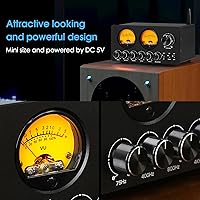
The retro-inspired combination of brushed metal, analog meters, and machined aluminum knobs looks genuinely attractive on a desk or shelf — several buyers mention it draws comments from visitors. It has a purposeful, instrument-like quality rather than the plasticky look common in budget audio accessories.
The unit only comes in one finish, so those with a lighter or more modern aesthetic setup may find the dark industrial look a mismatch. The VU meter backlight color is fixed and cannot be changed to match different room setups beyond brightness adjustment.
Compact Footprint
85%
At 164 x 108 x 82mm and just 730 grams, it fits comfortably on a crowded desk or inside a component rack without demanding dedicated shelf space. The compact size also makes it genuinely portable for users who move between listening environments.
The compact size means the five EQ knobs are spaced fairly close together, which makes fine adjustments slightly fiddly, especially for anyone with larger hands. There is also limited clearance around the rear I/O panel when the unit is placed in a tight rack or against a wall.
Warranty & After-Sales Support
74%
26%
An 18-month limited warranty is better than what most competing budget-to-mid-range Chinese audio brands offer, and buyers who have needed to use it report reasonably prompt responses from Douk Audio. It adds a layer of confidence for a relatively niche purchase.
Customer support is primarily handled via email and can be slow during peak periods or across time zones. Replacement parts availability is uncertain for units that develop issues outside the warranty window, which is a reasonable concern for a product you might keep long-term.

Suitable for:

The Douk Audio EQ5 Tone is a strong fit for anyone who has an existing stereo or desktop audio setup they are happy with but wants more control over how it actually sounds. If you own a pair of passive bookshelf speakers driven by a budget amplifier, or powered monitors connected to a PC, this EQ preamp slots in between your source and amplifier without requiring you to replace anything. It is particularly well-suited to listeners dealing with room acoustic problems — a bass-heavy corner, overly bright reflections — where a few dB of adjustment at the right frequency makes a real, audible difference. Vintage hi-fi enthusiasts will appreciate the analog VU meters, which are not decorative afterthoughts but live, responsive gauges that actually track the music. People upgrading from a bare Bluetooth receiver will also find this a meaningful step up, since the added wireless input, tone shaping, and balance control together address most of the frustrations that come with simpler receivers.

Not suitable for:

The Douk Audio EQ5 Tone is unlikely to satisfy listeners who need surgical precision in their sound adjustments. If you are used to a 10-band or parametric equalizer and care about targeting a specific resonant frequency within a narrow range, five fixed bands will feel like a blunt instrument — the 400Hz and 800Hz bands in particular overlap enough that precise midrange sculpting becomes difficult. Buyers who rely heavily on wireless audio from a laptop or older Android device may also run into Bluetooth pairing frustrations that, while not universal, are common enough to factor into your decision. This unit also lacks optical or USB audio inputs, which rules it out for anyone routing audio from a smart TV or modern DAC via digital connections. Finally, if you are searching for a purely transparent preamp with zero added character, be aware that some listeners detect a slight warmth at higher EQ boost levels — it is subtle, but it is there.

Specifications

  • EQ Bands: Five fixed graphic equalizer bands at 75Hz, 400Hz, 800Hz, 4kHz, and 10kHz, each processed by an independent op-amp for channel isolation.
  • Bluetooth: Bluetooth 5.0 wireless input for streaming audio from smartphones, tablets, and compatible computers.
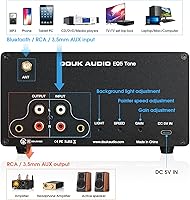
  • Audio Inputs: Three input options are supported: Bluetooth 5.0, stereo RCA, and 3.5mm AUX.
  • Audio Outputs: Stereo RCA and 3.5mm AUX outputs for connecting to amplifiers, powered speakers, or other downstream components.
  • Frequency Response: Full-range frequency response from 5Hz to 20kHz ensures the unit handles the complete audible spectrum without roll-off.
  • Distortion: Total harmonic distortion is rated at 0.003% at 1kHz, indicating a low-coloration signal path suitable for quality audio systems.
  • VU Meters: Dual analog VU meters with a 45mm diameter each, featuring adjustable pointer speed, backlight brightness, and gain sensitivity.
  • Input Impedance: Input impedance is rated at 50kΩ, making it compatible with a wide range of source components without loading issues.
  • Output Impedance: Output impedance is rated at 15Ω, suitable for driving standard amplifier inputs without signal degradation.
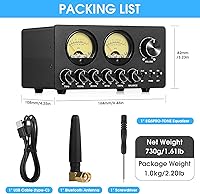
  • Power Supply: Powered via USB Type-C at DC 5V with a minimum current requirement of 500mA; a USB-C cable is typically included but a wall adapter may not be.
  • Dimensions: Unit measures 164 × 108 × 82mm (approximately 6.46 × 4.25 × 3.23 inches), making it compact enough for desktop and shelf placement.
  • Net Weight: The unit weighs 730g (approximately 1.61 lb) without packaging, giving it a solid, substantial feel in hand.
  • Chassis: Full all-metal enclosure with machined aluminum control knobs and gold-plated RCA and AUX input/output interfaces.
  • Bypass Function: A dedicated hardware bypass switch removes the EQ circuit entirely from the signal path, routing audio directly from input to output without processing.
  • Balance Control: Independent left/right channel balance adjustment is supported, allowing stereo image correction without modifying the amplifier or source settings.
  • Warranty: Covered by an 18-month limited warranty provided directly by Douk Audio.
  • Package Weight: Total shipping weight including packaging is approximately 1.0kg (2.20 lb).
  • Package Dimensions: Retail packaging measures approximately 210 × 185 × 100mm, suitable for safe shipping and compact storage.

Related Reviews
Douk Audio KN102 2-IN-1-OUT XLR Switcher
80%
83%
Build Quality
78%
Signal Integrity
94%
Ease of Setup
89%
Value for Money
76%
Switch Modes & Functionality
More
Douk Audio OK013 Mini 2.1 Channel HiFi Stereo Amplifier
75%
83%
Value for Money
71%
Sound Output & Power
77%
Build Quality
88%
Ease of Installation
58%
Thermal Management
More
Douk Audio VU3
Douk Audio VU3
90%
94%
Build Quality
91%
VU Meter Accuracy
87%
Ease of Setup
89%
Remote Control Functionality
93%
Channel Isolation
More
Douk Audio U3 Headphone Amplifier
89%
94%
Sound Clarity
91%
Frequency Response Accuracy
89%
Output Power
86%
Build Quality
90%
Ease of Setup
More
Douk Audio ST-01 Plus
81%
83%
Sound Quality
78%
Phono Preamp Performance
74%
Bluetooth Performance
71%
Build Quality
91%
Value for Money
More
Douk Audio P1 Vacuum Tube Bluetooth Preamplifier
85%
89%
Sound Quality
92%
Bluetooth Connectivity
85%
Build Quality
88%
Ease of Use
87%
Tone Control Flexibility
More
Douk Audio T9 Vacuum Tube Phono Preamp
87%
92%
Sound Quality
88%
Ease of Setup
93%
Tube Warmth & Performance
86%
Build Quality
89%
Adjustability (Bass/Treble)
More
Douk Audio M1 PRO
Douk Audio M1 PRO
79%
83%
Sound Clarity
78%
Power Output
86%
Build Quality
71%
Bluetooth Performance
91%
Value for Money
More
Douk Audio VU3 Pro
Douk Audio VU3 Pro
80%
91%
Build Quality
88%
VU Meter Display
86%
Switching Functionality
89%
Amplifier Compatibility
78%
Remote Control
More
Douk Audio T4 Plus
Douk Audio T4 Plus
78%
78%
Sound Quality
81%
Phono Stage Performance
74%
Headphone Amplifier
88%
Value for Money
76%
Build Quality & Construction
More

FAQ

The connection follows a straightforward signal chain: run your source output (turntable preamp, CD player, or DAC) into the RCA or AUX input on the unit, then run the RCA or AUX output from the unit into your amplifier's line-level input. Power it with any USB-C cable connected to a 5V USB adapter or spare computer port. The whole process takes under ten minutes and requires no special tools.

Douk Audio typically includes a USB-C cable in the box, but a wall adapter is not always included — this varies by retailer and shipment batch. Any standard 5V USB charger rated at 500mA or higher will work, so a spare phone charger is usually sufficient. It is worth confirming with the seller before purchasing if this is important to you.

Most iOS devices and modern Android phones pair without issues on the first attempt. However, a subset of users — particularly those on older Android firmware or certain laptop Bluetooth stacks — report inconsistent reconnection behavior after the initial pairing. If you encounter problems, a full power cycle of the unit usually resolves it. Keep in mind there is no aptX or LDAC support, so Bluetooth audio quality is limited to standard SBC or AAC codecs depending on your device.

It works with both. If you have powered (active) speakers with an AUX or RCA input, you can connect this EQ preamp directly between your source and the speakers. For passive speakers, you still need an amplifier in the chain — the unit is a preamp and equalizer, not a power amplifier, so it does not drive passive drivers on its own.

The bypass switch physically removes the EQ circuit from the signal path so audio passes straight from input to output without any processing or amplification. It is most useful when you want to compare the equalized sound against the unprocessed original — flip it back and forth a few times and you will quickly hear whether your EQ settings are actually helping. Some users also leave it in bypass mode when the unit is being used purely as a Bluetooth or input switcher without tone shaping.

For most casual to intermediate listeners, five bands covering the key frequency zones — low bass, upper bass/lower mids, midrange, presence, and air — is genuinely sufficient for correcting common tonal imbalances and room acoustic issues. If you are trying to notch out a specific resonance at an exact frequency, or if you do serious mixing and mastering work, you will likely find the fixed spacing limiting. For everyday home listening and speaker correction, it handles the job well.

They respond live to the audio signal — Douk Audio uses a dedicated VU driver chip rather than a generic LED display tied loosely to volume. You can watch the needles track dynamic swings in the music in real time, and the adjustable pointer speed and gain settings let you tune how aggressively they react. In a dim room they look genuinely impressive and add a tactile connection to the listening experience that static displays do not.

In most cases yes, but results vary depending on the quality of your computer's USB power delivery. Some users report a faint ground hum when powered directly from a PC USB port, particularly on budget motherboards with noisy power planes. Using a dedicated USB wall adapter is the safer and cleaner option if you notice any interference. A USB power filter or isolator can also resolve hum issues if they appear.

The main improvements in this version are a more pronounced bass response at the low end, enhanced low-frequency performance overall, and the expanded VU meter controls — specifically the addition of pointer speed, brightness, and gain adjustment. The core form factor, band count, and connectivity are the same. If you already own the EQ5 Pro and are happy with it, the upgrade is incremental rather than transformational. For new buyers, the current version is simply the better starting point.

It handles moderate channel imbalances well — if one speaker sounds slightly louder due to room placement, mismatched speaker sensitivity, or a slight amplifier channel variance, the balance pot gives you enough range to center the image convincingly. For more severe mismatches caused by a faulty amplifier channel or a significantly different speaker pair, you may find the adjustment range insufficient and need to address the root cause separately. The center detent on some units is not perfectly firm, so dial it carefully to avoid overcorrecting.