Overview

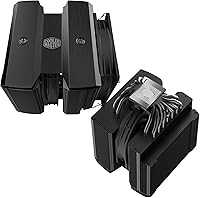
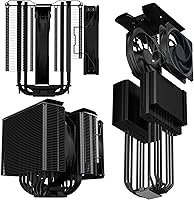
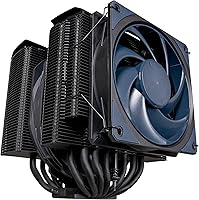
The Cooler Master MasterAir MA824 Stealth CPU Cooler arrived in mid-2023 as a serious option for builders who want strong thermal performance without the noise that typically comes with it. At 165.6mm tall, it fits most mid-tower cases — but not all, so checking your case clearance before buying is genuinely important. It covers AMD AM5/AM4 and Intel LGA 1851/1700/1200, keeping it relevant for current-gen builds on either platform. The nickel-plated copper base and eight custom heat pipes set it apart from cheaper dual-tower designs that cut corners on materials where thermal contact matters most.
Features & Benefits

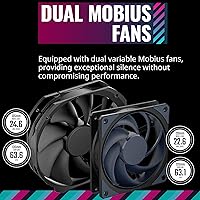
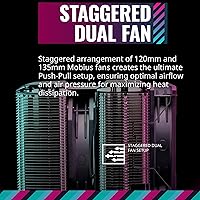
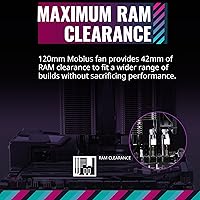
The MA824 Stealth is built around eight superconductive composite heat pipes with a groove-and-powder wick structure — an engineering choice that spreads heat evenly across the full aluminum fin stack rather than clustering dissipation near the center. The dual Mobius fans are a real highlight: the 120mm front unit maintains 42mm of RAM clearance, removing the fan-shuffle workarounds that plague competing towers with tall DIMMs. The 130mm rear fan moves air quietly, staying well under 25 decibels at typical loads — a figure that holds up in actual use, not just on a datasheet. No RGB means a cleaner look and one fewer thing to eventually fail.

Best For

This dual tower air cooler is best suited to builders running high-TDP processors — Ryzen 9 or Core i9 territory — who want reliable long-term cooling without the leak risk or pump-failure anxiety that comes with liquid setups. It is also a smart choice for quiet workstation or home-office builds where idle fan noise genuinely matters. Builders who have hit RAM clearance walls with other dual-tower designs will find the extra headroom refreshing. At this price tier it competes directly with 240mm and 280mm AIOs, and for those who value the simplicity and proven longevity of air cooling, the MA824 Stealth holds its own well.

User Feedback

Owners who have used this Cooler Master cooler for several months most consistently praise its real-world noise levels, with many noting it runs quieter under sustained loads than they expected — that kind of subjective confirmation carries more weight than a spec number. Installation feedback is divided: most find the process straightforward, but some report that backplate alignment demands patience, particularly in tighter cases. Fan connector placement draws occasional complaints depending on motherboard layout. On value, the majority feel it justifies the cost against comparably priced liquid coolers, though a handful of buyers on compact mid-tower builds found the height clearance tighter than anticipated — worth verifying before purchasing.

Pros

  • Holds temperatures impressively steady during sustained workloads on high-TDP processors.
  • Real-world noise levels match the advertised specs — genuinely quiet at typical loads.
  • 42mm RAM clearance eliminates the tall DIMM heatspreader conflicts that trip up rival coolers.
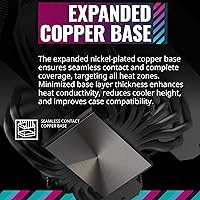
  • Nickel-plated copper base ensures solid heat-spreader contact across the full CPU surface.
  • Covers AM5, AM4, LGA 1851, and LGA 1700 with no extra bracket purchases required.
  • Understated all-black finish works cleanly in professional and minimalist build aesthetics.
  • No pump, no tubing, no radiator — long-term reliability is straightforward with air cooling.
  • The MA824 Stealth competes credibly against comparably priced 240mm AIO liquid coolers on thermals.
  • Fin stack and base show no signs of material degradation even after extended ownership.
  • PWM fan curve is smooth and gradual, avoiding the jarring ramp-up spikes some coolers exhibit.

Cons

  • At 165.6mm tall, it will not fit in many compact mid-tower cases — verify clearance before buying.
  • No daisy-chain or Y-splitter included, so two separate fan headers are required on the motherboard.
  • Backplate alignment during installation demands patience, especially when working alone in a tight case.
  • Fan clips feel noticeably cheaper than the rest of the cooler and resist removal during maintenance.
  • Zero lighting options make it a visual mismatch in RGB-focused windowed builds.
  • Instruction manual lacks detailed visuals, which adds friction for less experienced builders.
  • Falls a few degrees short of top-tier rivals when cooling flagship CPUs pushed past 200W all-core.
  • Two separate PWM connectors rather than a combined solution adds minor cable management complexity.
  • Long-term fan bearing reliability beyond two years is not yet well-documented given its 2023 launch.
  • LGA 115X socket support is absent, ruling it out for users on older Intel platforms.

Ratings

The scores below reflect an AI-driven analysis of verified global buyer reviews for the Cooler Master MasterAir MA824 Stealth CPU Cooler, with spam, bot-submitted, and incentivized feedback actively filtered out before scoring. Each category captures what real builders experienced — from weekend hobbyists to daily-driver workstation users — across a range of CPU platforms and case configurations. Both standout strengths and genuine friction points are represented transparently so you can weigh them against your own build requirements.

Thermal Performance
88%
Most buyers running demanding processors report temperatures that hold steady under sustained workloads — rendering, gaming sessions, and compilation runs included. The eight heat pipes and expanded copper base appear to distribute heat across the fin stack effectively rather than letting hot spots develop near the center.
A small number of users with flagship CPUs operating above 200W found that the MA824 Stealth trails top-tier competitors by a few degrees under extreme all-core loads. It is a capable cooler, but it is not infallible against the very highest TDP chips pushed to their limits.
Noise Level
91%
This is where the MA824 Stealth earns consistent praise. Buyers repeatedly note that under moderate loads the system is nearly inaudible from a normal seating distance, and even under full fan speed the sound profile stays smooth rather than becoming a high-pitched whine.
A handful of users mention a faint bearing hum from one of the Mobius fans at specific RPM ranges, which is noticeable in a quiet room at night. It is not a widespread complaint, but it surfaces often enough to acknowledge for noise-sensitive environments.
RAM Clearance
93%
For builders running tall DIMM heatspreaders — particularly popular DDR5 kits with oversized fins — the front fan placement offering around 42mm of clearance is a practical relief. Many reviewers specifically switched to the MA824 Stealth after clearance conflicts with rival dual-tower designs.
The clearance advantage is specific to the front fan position; the rear 130mm fan sits closer to the second DIMM slot on some motherboard layouts, which can be a minor tension point on densely populated boards with four RAM slots fully occupied.
Installation Experience
72%
28%
Buyers familiar with aftermarket cooler installations generally describe the process as manageable, and the included mounting hardware covers both AMD and Intel platforms without needing separate accessory kits. The backplate design is sturdy and the bracket alignment is logical once oriented correctly.
First-time builders and those installing in smaller mid-tower cases report genuine frustration — the backplate alignment requires both hands and steady positioning, and working around the cooler mass inside a tighter chassis adds time and patience to what should be a straightforward swap.
Build Quality & Materials
89%
The nickel-plated copper base feels substantial and the fin stack shows no flex or rough edges out of the box. Buyers who have owned the cooler for over a year report no discoloration, no fin damage from normal handling, and no mounting hardware fatigue.
The fan clips, while functional, feel slightly cheaper than the rest of the cooler — a few users mention they require more force than expected to seat and unseat, raising minor concern about repeated fan removals during maintenance or reseating.
Value for Money
79%
21%
Against comparably priced 240mm AIOs, the MA824 Stealth offers competitive thermal results without the added complexity of a pump, tubing, or radiator placement decisions. For buyers who factor in long-term reliability, the air cooling proposition at this price tier is genuinely attractive.
At its asking price, some buyers feel the lack of any visual element — even subtle lighting — makes it harder to justify versus rivals that include addressable RGB without a premium. Those focused purely on function will not miss it, but budget-conscious builders might pause.
Fan Performance
86%
The Mobius fan design produces airflow that feels consistent across the fin array rather than concentrated at the fan hub, which aligns with how users describe the cooler running evenly during extended workloads. PWM response is smooth and the speed curve ramps gradually.
At maximum RPM the fans move a respectable volume of air, but some users feel the airflow ceiling is modest compared to higher-speed alternatives. Builders in poorly ventilated cases who rely heavily on the CPU cooler fans for overall chassis airflow may find headroom limited.
Case Compatibility
71%
29%
The cooler fits comfortably in most standard mid-tower and full-tower cases with clearances of 170mm or above, which covers a large share of popular enclosures. Buyers in HAF series and similar spacious cases report zero fitment issues.
The 165.6mm height is close enough to the limit of compact mid-towers that several buyers had to verify clearance post-purchase — a few narrowly avoided a return. Slim mid-tower owners and SFF-adjacent builds should treat this as a firm constraint, not a rough estimate.
Socket & Platform Support
92%
Coverage of AM5, AM4, LGA 1851, LGA 1700, and LGA 1200 means the cooler stays relevant across multiple CPU generations without additional bracket purchases. Buyers upgrading platforms mid-ownership appreciate not needing a new cooler alongside a new motherboard.
LGA 115X support is absent from the bracket set, which affects users on older Intel platforms who might otherwise consider this an upgrade path. It is a reasonable tradeoff for a cooler targeting current-gen builders, but worth flagging for legacy system owners.
Aesthetics
67%
33%
The all-black matte finish reads as intentionally understated — builders who prefer a clean, tool-like look rather than a light show find it refreshing. It disappears inside a dark case without demanding visual attention.
For builders investing in a windowed panel build with RGB components throughout, the MA824 Stealth creates a visual dead zone. No lighting option at all — not even an optional header — is a deliberate choice that does limit its appeal in style-forward builds.
Mounting Hardware Quality
74%
26%
The included bracket set is platform-complete and the screws are well-threaded with no stripping reported at normal installation torque. The backplate is solid and does not shift during fan installation, which helps during solo installs.
The screwdriver access to the mounting points becomes awkward once the cooler body is in place, and the instruction manual assumes a level of prior experience that first-time builders may not have. A clearer step-by-step visual guide would reduce installation errors.
Cable Management
66%
34%
Both fan headers are 4-pin PWM and reach a typical mid-tower motherboard header placement without strain. Buyers with tidy cable routing habits report the fan leads are long enough to run behind the motherboard tray on most standard ATX boards.
The dual-fan setup means two separate PWM connectors rather than a daisy-chain or Y-splitter solution out of the box. In builds with limited fan header count, users have to source a splitter independently, which is a small but unnecessary inconvenience.
Long-Term Durability
83%
With the product available since mid-2023, a growing group of buyers now has over a year of use logged. Reports of fan bearing degradation, fin deformation, or mounting stress are minimal, suggesting the build holds up under regular desktop use conditions.
The sample size for multi-year reliability is still relatively limited given the product age. Buyers looking for decade-long durability data comparable to older Cooler Master flagships will simply have to wait — the track record is promising but not yet extensive.

Suitable for:

The Cooler Master MasterAir MA824 Stealth CPU Cooler is a strong fit for enthusiast PC builders who want serious thermal headroom without the maintenance concerns that come with liquid cooling. If you are running a high-TDP processor — think Ryzen 9 or Core i9 class chips — and you want temperatures kept in check during long rendering jobs, gaming sessions, or heavy compilation workloads, this dual tower air cooler is built for exactly that scenario. It is equally well-suited to home office and content creation setups where fan noise is a real quality-of-life issue, not just a spec on paper. Builders who have struggled with RAM clearance on other dual-tower designs will find the front fan placement particularly thoughtful, especially with taller DDR5 kits. Anyone on a current AMD or Intel platform — AM5, AM4, LGA 1851, or LGA 1700 — can buy this cooler knowing it works out of the box without hunting for additional brackets.

Not suitable for:

The Cooler Master MasterAir MA824 Stealth CPU Cooler is not the right choice for every build, and being honest about that matters. At just under 166mm tall, it will not physically fit in a number of popular compact mid-tower cases, so checking your case specifications before purchasing is non-negotiable — this is not a minor caveat. Builders assembling small form factor or slim desktop systems should look elsewhere entirely. If you are chasing the absolute lowest CPU temperatures on a flagship processor running sustained all-core loads above 200W, a 280mm or 360mm AIO will likely edge it out by a meaningful margin. Those building RGB showcase rigs with windowed side panels will find the MA824 Stealth underwhelming visually — there is no lighting option whatsoever. Finally, first-time builders working solo in tighter cases may find the installation more demanding than expected, and should budget extra time for the backplate and bracket process.
Specifications

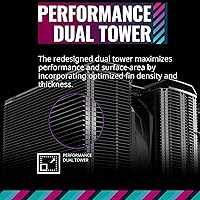
  • Cooler Type: Dual tower air cooler with an optimized fin stack designed for high-performance desktop CPU cooling.
  • Heat Pipes: Eight superconductive composite heat pipes using a groove-and-powder wick structure for even heat distribution across the full fin array.
  • Base Material: Expanded nickel-plated copper base engineered for full contact coverage across the CPU heat spreader with a minimized base layer thickness.
  • Fin Material: Aluminum fin stack with optimized density and thickness to maximize surface area for passive and active heat dissipation.
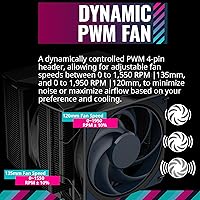
  • Fans Included: Two Mobius PWM fans: a 120mm unit on the front and a 130mm unit on the rear, both variable-speed.
  • Max Fan Speed: Fans spin up to 1950 RPM at maximum load, with PWM control allowing quieter operation at lower thermal demands.
  • Noise Level: Rated at 24.6 dB under typical operating conditions, placing it among the quieter options in the high-performance air cooler category.
  • Airflow: Combined airflow capacity of 63.6 CFM, providing sufficient throughput for sustained high-TDP workloads.
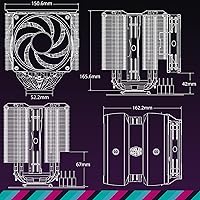
  • RAM Clearance: The front 120mm fan position maintains 42mm of clearance above the DIMM slots, accommodating most tall DDR4 and DDR5 heatspreader kits.
  • Cooler Height: Total installed height of 165.6mm, which requires verification against case specifications before purchase.
  • Dimensions: Full cooler body measures 162.2mm × 150.6mm × 165.6mm (L × W × H) including fans.
  • Weight: Complete assembly weighs approximately 2.2 lbs, which is within the typical range for dual-tower air coolers.
  • Socket Support: Compatible with AMD AM5 and AM4, and Intel LGA 1851, LGA 1700, and LGA 1200 sockets via included mounting brackets.
  • Power Connector: Both fans use 4-pin PWM connectors, requiring two available fan headers on the motherboard or a separately sourced splitter.
  • Power Draw: Total system power consumption is 3.6W at full fan speed, making it negligible relative to overall system power budgets.
  • Voltage: Operates at a standard 12V DC input, compatible with all modern ATX power delivery through the motherboard fan headers.
  • RGB Lighting: No RGB or addressable lighting is included by design, keeping the aesthetic minimal and eliminating a potential long-term failure point.
  • Release Date: First made available in July 2023, with a growing base of real-world user feedback from over a year of retail availability.

Related Reviews
Cooler Master Hyper 212 Black CPU Cooler
79%
83%
Thermal Performance
79%
Noise Level
93%
Value for Money
76%
Installation Experience
81%
Build Quality
More
Cooler Master V8 GTS High Performance CPU Cooler
84%
90%
Cooling Performance
88%
Ease of Installation
65%
Fan Noise
92%
Build Quality
85%
Aesthetic Appeal (LED Lighting)
More
Cooler Master Hyper 212 Halo CPU Air Cooler
84%
88%
Cooling Performance
91%
Noise Level
85%
Ease of Installation
89%
Build Quality
80%
RGB Aesthetics
More
Cooler Master MasterLiquid Atmos 240 Liquid Cooler
82%
76%
Thermal Performance
88%
Noise Level
82%
Build Quality
84%
Pump Performance
91%
RGB & Lighting
More
Cooler Master MasterLiquid Atmos 360 AIO Cooler
83%
88%
Thermal Performance
91%
Noise Level
83%
Build Quality
87%
Installation Experience
84%
RGB & Lighting Quality
More
Cooler Master i70C Low-Profile CPU Cooler
78%
72%
Thermal Performance
88%
Noise Level
93%
Form Factor & Fit
86%
Installation Ease
78%
ARGB Lighting
More
Cooler Master 240 Elite Liquid White CPU Liquid Cooler
85%
91%
Cooling Performance
84%
Noise Levels
92%
Ease of Installation
89%
Build Quality
88%
aRGB Lighting Effect
More
Cooler Master MasterLiquid ML240L V2 AIO Cooler
77%
78%
Thermal Performance
91%
Installation Experience
63%
Pump Noise & Vibration
82%
Fan Performance
88%
ARGB Lighting
More
Cooler Master i71C RGB Intel Low-Profile CPU Air Cooler
84%
88%
Cooling Performance
91%
Noise Level
85%
RGB Customization
89%
Build Quality
75%
Installation Ease
More
Cooler Master Hyper 622 Halo Dual Tower CPU Cooler
82%
83%
Thermal Performance
88%
Noise Level
89%
Ease of Installation
67%
RAM Clearance
86%
Build Quality
More

FAQ

It depends on your specific case. The cooler stands 165.6mm tall, which clears most standard mid-towers but is tight in compact designs. Check your case manufacturer's CPU cooler clearance spec before ordering — do not assume it fits based on case size alone. Many popular mid-towers list 160mm or 165mm as their limit, so a millimeter or two can matter.

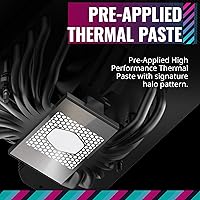
Yes, Cooler Master includes thermal paste in the box, so you do not need to purchase it separately for the initial installation. If you ever reseat the cooler later, you will want to clean off the old paste and apply a fresh layer — the included amount is typically only enough for one application.

It handles these chips well under typical workloads including gaming and moderate multithreaded tasks. Under sustained all-core loads at stock or near-stock settings, it performs respectably, though if you run extended heavy workloads like 3D rendering or large compilation jobs at maximum power limits, a 280mm or 360mm AIO may maintain slightly lower peak temperatures. For most users, the MA824 Stealth is more than adequate.

Yes, each fan has its own 4-pin PWM connector, so you will need two available fan headers. Most modern mid-range and enthusiast motherboards have at least three or four fan headers, so this is rarely a problem. If you are short on headers, a simple PWM splitter cable will handle both fans from a single port.

Most likely yes. The front fan sits high enough to clear heatspreaders up to about 42mm in height, which covers the majority of DDR5 kits currently on the market, including popular high-performance sets with oversized fins. If your RAM is unusually tall — some extreme-profile kits push past 50mm — it is worth double-checking the specific heatspreader dimensions.

Most experienced builders find it manageable, but it is not the easiest cooler to install solo. The backplate needs to sit flush behind the motherboard while you align the mounting bracket on top, which can be awkward without a second pair of hands. If you are building alone, consider propping the motherboard or placing it flat on a surface during cooler installation rather than trying to do it with the board already in the case.

No, there is no lighting of any kind on the MA824 Stealth — no RGB, no ARGB header, nothing. This is intentional. If you are building a clean, minimal system or simply do not care about lighting, that is a non-issue. If your build is centered around a matching RGB theme, this cooler will look visually plain next to illuminated components.

Both are genuinely competitive at this price tier. The MA824 Stealth is typically within a few degrees of a mid-range 240mm AIO on most real-world workloads. The air cooler wins on long-term simplicity — no pump to fail, no coolant to degrade, no radiator placement to plan. The AIO has a slight edge on extreme sustained loads and may fit more easily in cases with limited CPU cooler height clearance but good radiator mounting options. Neither is clearly the better buy for everyone; it comes down to your priorities.

Yes, LGA 1851 support is included out of the box with the bracket set that ships with the cooler. You do not need to request a separate mounting kit for current-generation Intel platforms, which makes it a practical long-term purchase for anyone building on or upgrading to Arrow Lake.

Noticeably quieter than most buyers expect. At moderate loads — web browsing, light gaming, background tasks — the fans are nearly inaudible from a normal desk distance. Even under sustained CPU stress the noise profile stays smooth rather than becoming a sharp whine. Buyer impressions consistently align with the rated noise level, which is a positive sign since marketed dB figures often flatter coolers in the real world.

Where to Buy