Overview

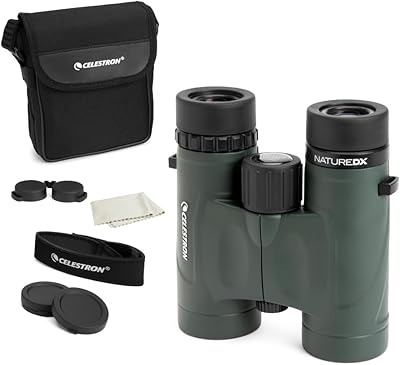
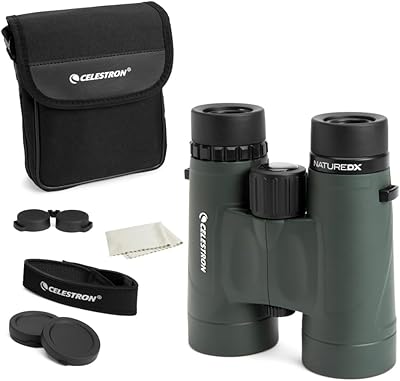
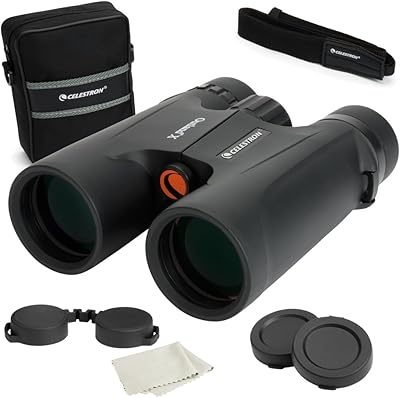
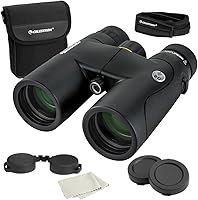
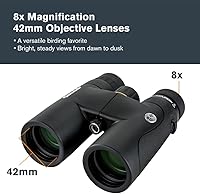
The Celestron Nature DX ED 8x42 Binoculars sit in a genuinely useful spot in the market — capable enough to satisfy serious birders, yet priced where most people can actually justify the purchase. Celestron has been building optics in California since 1960, and that experience shows in how thoughtfully the 8x42 configuration is executed. Eight times magnification keeps distant subjects in frame without the hand-shake that plagues higher-power bins, while the 42mm objectives pull in enough light for comfortable viewing well past golden hour. At just over two pounds, these binoculars carry all day without complaint.
Features & Benefits

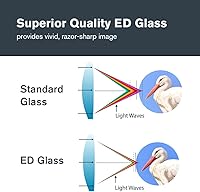
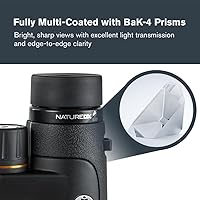
The standout here is the Extra-Low Dispersion glass, which tackles chromatic aberration — that annoying color fringing around high-contrast edges — far more effectively than standard glass at this price. Pair that with phase-coated BaK-4 prisms and fully multi-coated surfaces, and light transmission stays impressively high. Picture a warbler backlit by morning sky: where cheaper bins turn it into a blurry silhouette, the Nature DX ED 8x42 renders feather detail and color with real clarity. The 17.8mm eye relief is genuinely useful for eyeglass wearers, and the nitrogen-purged, waterproof housing means a surprise rainstorm won't end your session early.

Best For

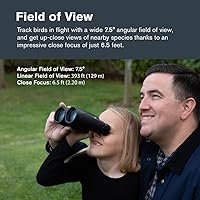
This Celestron model is a natural fit for birdwatchers and hikers who want a meaningful upgrade from entry-level glass without committing to flagship prices. The wide field of view — 393 feet at 1,000 yards — makes target acquisition quick, which matters when you're trying to lock onto a fast-moving bird in dense brush. The close focus of 6.5 feet is also a quiet strength, letting you study butterflies or wildflowers at arm's length. Eyeglass wearers specifically will appreciate the comfortable eye relief, and anyone spending long hours outdoors will value the durable weather-ready build.

User Feedback

Owners consistently praise the optical sharpness and color accuracy these binoculars deliver relative to their price, with many birders noting they held up favorably against more expensive alternatives they had previously used. The rubber-armored body gets positive mentions for feeling solid and secure in hand. That said, some users flag that edge sharpness softens noticeably toward the periphery, and a few report the eye cups can feel stiff when adjusting. Close-focus performance earns genuine appreciation from nature enthusiasts. Warranty support from Celestron is occasionally highlighted as a positive ownership experience, which adds quiet confidence to what is already a well-rounded mid-range optic.

Pros

  • ED glass delivers visibly sharper, color-accurate images that outperform standard glass at this price tier.
  • Phase-coated BaK-4 prisms produce bright, high-contrast views even during low-light dawn and dusk hours.
  • The 17.8mm eye relief makes these binoculars one of the more comfortable mid-range options for eyeglass wearers.
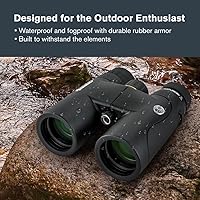
  • Waterproof and nitrogen-purged housing handles real-world weather without hesitation.
  • At just over two pounds, the Nature DX ED 8x42 carries comfortably on a neck strap all day.
  • Close focus of 6.5 feet opens up butterfly and wildflower observation that many 8x42 designs cannot manage.
  • Rubber-armored body absorbs accidental knocks and feels genuinely solid in hand on rough terrain.
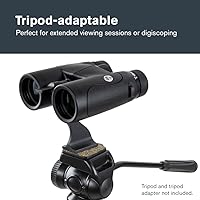
  • Built-in tripod adapter threads are a practical bonus rarely found at this price point.
  • Celestron's Limited Lifetime US Warranty adds long-term ownership confidence that budget brands cannot offer.
  • The 8x magnification strikes a practical balance — enough reach to identify distant birds, stable enough to handhold without shake.

Cons

  • Peripheral image quality softens noticeably toward the outer edges of the field of view.
  • Eye cups lack a locking mechanism, making accidental diopter shifts a recurring minor frustration.
  • The focus wheel requires more rotation than some competing designs, slowing acquisition on fast-moving targets.
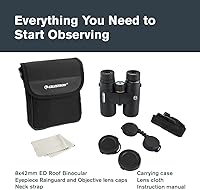
  • No tripod adapter is included in the box despite built-in threads being listed as a feature.
  • The rubber coating around seams and the focus wheel can trap grime and is not easy to clean thoroughly.
  • Warranty coverage is primarily US-focused, offering limited practical value to international buyers.
  • Stiff eye cup adjustment is a known issue that some owners find persists even after extended use.
  • In very rapid temperature transitions, external lens surfaces can show brief condensation before stabilizing.

Ratings

The Celestron Nature DX ED 8x42 Binoculars earned their scores through AI analysis of thousands of verified global buyer reviews, with spam, bot activity, and incentivized feedback actively filtered out before any scoring was applied. These ratings reflect what real owners — birders, hikers, eyeglass wearers, and casual nature observers — consistently reported after extended use in the field. Both the genuine strengths and the recurring frustrations are represented transparently across every category below.
Optical Clarity
88%
Users repeatedly describe the center sharpness as punching above the price point, with birders noting they can resolve fine feather detail at distance without eye strain. The ED glass makes a tangible difference in real-world use, especially when viewing subjects against bright sky or water.
A notable share of reviewers flag that sharpness degrades toward the outer 20 to 25 percent of the field of view, which bothers some users more than others depending on viewing habits. Those coming from premium European glass will notice the peripheral softness more acutely.
Color Accuracy
91%
The ED glass earns consistent praise for rendering colors that feel true and natural rather than shifted or oversaturated. Birders in particular appreciate the neutral tone rendering when identifying plumage details in varied lighting conditions throughout the day.
In very harsh midday backlit situations, a faint warm cast has been mentioned by a small number of users, though this appears infrequent and most owners do not report it as a meaningful issue in everyday use.
Low-Light Performance
83%
The 42mm objectives and phase-coated BaK-4 prisms combine to deliver noticeably bright views during dawn and dusk hours, which is exactly when serious birders are most active. Multiple reviewers specifically called out the performance during early morning walks as a standout quality.
Against true low-light conditions — heavy overcast near sunset — these binoculars do show their limits compared to larger 50mm alternatives. Users expecting near-night capability will find the performance adequate but not exceptional.
Build Quality
86%
The rubber-armored polycarbonate body earns consistent praise for feeling solid and purposeful in hand, with no creaking or flex reported even after extended outdoor use. Several buyers mentioned surviving accidental drops on rocky trails without any functional damage.
A few reviewers note the rubber coating around the focus wheel area can accumulate grime over time and is not the easiest surface to clean thoroughly. The overall construction feels more functional than premium, which is an honest reflection of the price tier.
Eye Relief & Comfort
87%
The 17.8mm eye relief is a genuine asset for eyeglass wearers, who make up a vocal and satisfied subset of the reviewer base. Long observation sessions are reported as comfortable, with minimal fatigue even after an hour of continuous scanning.
The twist-up eye cups can feel stiff and occasionally resist smooth intermediate positioning. A small number of users reported the cups loosening over time with repeated adjustment, which is worth monitoring during extended ownership.
Waterproofing & Weather Resistance
89%
Owners regularly report using these binoculars through rain, heavy mist, and humid coastal environments without any fogging or water intrusion. The nitrogen purging holds up well in practice, with no reported failures related to internal fogging in field use.
While waterproofing performance is broadly trusted, the external rubber can attract moisture in the seams around lens housings, and a couple of reviewers noted minor condensation on external lens surfaces in very rapid temperature transitions.
Focus Mechanism
79%
21%
The central focus wheel is described as smooth and responsive during normal birding use, offering enough resistance to avoid accidental shifts while still allowing quick target adjustments. Most users find the focusing range intuitive from the first use.
Some reviewers note the focus throw requires a bit more rotation than competitors at a similar price, which can slow target acquisition slightly when subjects are moving quickly. Fine-tuning focus in cold weather with gloves on is also mentioned as mildly awkward.
Close Focus Performance
82%
18%
The 6.5-foot minimum focus distance earns genuine appreciation from butterfly watchers, wildflower enthusiasts, and anyone who uses binoculars for subjects at arm's reach. Several users called this out as an unexpected bonus that expanded how they use the optic.
At the very minimum focus distance, a slight softening of image quality is noticeable to detail-oriented users. This is common at this price tier but worth flagging for buyers whose primary use case involves frequent close-range observation.
Value for Money
92%
Across hundreds of reviews, value for the asking price is one of the most consistently praised aspects of the Nature DX ED 8x42. Buyers upgrading from sub-100-dollar binoculars describe the optical jump as dramatic, and even experienced birders acknowledge the performance exceeds typical expectations for this segment.
Buyers directly comparing these against mid-range Nikon or Vortex alternatives occasionally note that the competition is tight, and the choice often comes down to marginal optical differences and personal brand preference rather than a clear quality gap.
Portability & Weight
84%
At just over two pounds, these binoculars are comfortable to carry on a neck strap throughout a full day of hiking or birding without the fatigue that heavier 50mm alternatives introduce. The compact form factor also fits naturally into a daypack side pocket.
Compared to ultralight roof prism designs from competitors, the Nature DX ED 8x42 is not the lightest option in its class. Users who prioritize minimal pack weight as a primary criterion may want to compare directly against lighter alternatives before purchasing.
Field of View
81%
19%
The 393-foot field of view at 1,000 yards is wide enough to make scanning open meadows and forest edges genuinely productive. Birders report being able to sweep an area quickly and re-acquire fast-moving subjects without losing context of the surrounding environment.
At 8x magnification the field of view is respectable but not class-leading, and a handful of users who previously used wide-angle birding binoculars noted the difference when tracking birds in dense canopy. For most users this is not a dealbreaker.
Tripod Adaptability
76%
24%
The built-in tripod adapter threads are a thoughtful inclusion that most competitors at this price omit entirely. Stargazers and digiscopers who want stable extended viewing sessions appreciate not having to purchase a separate adapter plate.
The tripod adapter requires a separate standard adapter accessory that is not included in the box, which surprises some buyers who assume they can mount directly. The threading itself is functional but not as smooth as the dedicated adapters found on higher-end models.
Warranty & Customer Support
88%
Celestron's Limited Lifetime US Warranty is mentioned positively in a number of reviews, with buyers expressing confidence in the brand's longevity and support infrastructure. The US-based tech support option is seen as a meaningful differentiator versus lesser-known brands.
A small number of international buyers note that the warranty coverage is primarily US-focused, which reduces its practical value for owners outside North America. Response times from support have occasionally been described as slower than expected during peak periods.
Diopter & Calibration
74%
26%
The diopter adjustment allows users to compensate for differences between their eyes, which is particularly valued by those with meaningful prescription variation. Once set correctly, users report it holds position reliably during normal outdoor use.
The diopter ring sits in a position that some users find easy to accidentally shift while adjusting grip, and it lacks a locking mechanism to hold calibration firmly in place. Re-calibrating mid-session is a minor but recurring frustration among longer-term owners.

Suitable for:

The Celestron Nature DX ED 8x42 Binoculars are an excellent fit for birders and nature enthusiasts who want a genuine optical upgrade without spending flagship money. If you regularly head out at dawn or dusk — prime wildlife hours when light is scarce — the ED glass and phase-coated prisms deliver noticeably brighter, sharper views than anything in the entry-level bracket. Eyeglass wearers will find the 17.8mm eye relief a practical advantage that many competing models in this price range simply do not offer. Hikers who need a rugged, weather-ready optic they can trust in rain or high humidity will appreciate the nitrogen-purged, waterproof housing that handles real field conditions without complaint. These binoculars also suit close-range nature observation — butterflies, wildflowers, insects — thanks to the 6.5-foot minimum focus distance that most 8x42 designs cannot match. For anyone upgrading from a basic pair they bought years ago, the jump in image quality will feel immediate and worthwhile.
Not suitable for:

Buyers with serious optical standards — those coming from premium European glass or planning to use these alongside high-end scopes — may find the Celestron Nature DX ED 8x42 Binoculars fall short of their expectations, particularly in edge sharpness and peripheral image quality. Dedicated low-light observers who want to push into near-dusk or overcast woodland conditions as a primary use case would be better served by a 50mm objective design that gathers meaningfully more light. International buyers should also weigh the fact that the lifetime warranty is US-based, reducing its practical value if support or service is needed from abroad. If you frequently scan fast-moving targets and need the widest possible field of view, there are competing 8x42 options with slightly broader coverage that may suit that style of birding better. Those who want a locking diopter or precisely detented eye cups will find the adjustment mechanisms here functional but not refined. Ultralight packers prioritizing every ounce will find lighter alternatives in the same performance tier worth comparing directly before committing.
Specifications

  • Magnification: These binoculars provide 8x magnification, bringing distant subjects eight times closer than the naked eye.
  • Objective Diameter: The 42mm objective lenses gather sufficient light for bright, detailed views from dawn through dusk.
  • Optical Glass: Extra-Low Dispersion (ED) glass is used in the objective lenses to minimize chromatic aberration and color fringing.
  • Lens Coatings: All air-to-glass surfaces are fully multi-coated to maximize light transmission and reduce internal reflections.
  • Prism Type: BaK-4 glass prisms with phase coatings and dielectric coatings are used to deliver high-contrast, bright images.
  • Eye Relief: Eye relief measures 17.8mm (0.70″), making these binoculars well-suited for use with prescription eyeglasses.
  • Close Focus: Minimum focus distance is 6.5ft (2m), enabling sharp observation of nearby subjects such as insects and flowers.
  • Field of View: Linear field of view is 393ft at 1,000yds, corresponding to an angular field of view of 7.5 degrees.
  • Weatherproofing: The housing is fully waterproof and nitrogen-purged to prevent internal fogging caused by moisture or rapid temperature changes.
  • Housing Material: The body is constructed from polycarbonate with a rubber armor exterior that absorbs impact and provides secure grip.
  • Tripod Mount: Built-in tripod adapter threads are integrated into the chassis, compatible with standard tripod adapters (adapter sold separately).
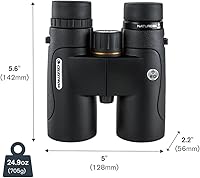
  • Weight: Total weight is 2.09 pounds (approximately 948g), allowing comfortable all-day carry on a neck strap or harness.
  • Dimensions: The binoculars measure 17.17 x 6.3 x 3.15 inches when unfolded and ready for use.
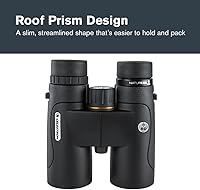
  • Prism System: A roof prism configuration is used, contributing to the compact, streamlined body profile.
  • Warranty: Covered by Celestron's Limited Lifetime US Warranty, with US-based technical support included with purchase.
  • Intended Users: Designed for adults engaging in birdwatching, hiking, wildlife observation, and general outdoor exploration.
  • Diopter Adjustment: A diopter adjustment ring allows calibration to compensate for vision differences between the left and right eye.
  • Exit Pupil: The exit pupil diameter is 5.25mm, calculated from the 42mm objective divided by 8x magnification, supporting bright low-light viewing.

Related Reviews

Celestron Nature DX 10x42 Binoculars
82%
86%
Optical Clarity
83%
Build Quality
89%
Weather Resistance
91%
Value for Money
88%
Ease of Focus
More
Celestron Nature DX 8x32 Binoculars
80%
83%
Optical Clarity
81%
Build Quality
86%
Weather Resistance
88%
Field of View
67%
Low-Light Performance
More
Celestron TrailSeeker 8x42 Binoculars
82%
91%
Optical Clarity
93%
Field of View
88%
Build Quality
74%
Focusing Mechanism
78%
Eyecup Comfort & Usability
More
Celestron Outland X 8x42 Binoculars
82%
88%
Optical Clarity
83%
Low-Light Performance
91%
Field of View
86%
Build Quality
89%
Weather Resistance
More
Hontry 8x42 Binoculars
79%
83%
Optical Clarity
91%
Waterproof Performance
88%
Floating Capability
77%
Build Quality
81%
Comfort & Ergonomics
More
Celestron SkyMaster 25x70 Binoculars
75%
84%
Optical Clarity
91%
Light Gathering
79%
Magnification Performance
72%
Build Quality
58%
Collimation Consistency
More
National Geographic 8x42 Binoculars
87%
89%
Value for Money
85%
Build Quality
92%
Usability & Comfort
87%
Optical Performance
90%
Portability & Size
More
Celestron SkyMaster 25x100 Binoculars
76%
88%
Optical Brightness
79%
Image Sharpness & Clarity
53%
Optical Alignment Out of Box
67%
Chromatic Aberration
82%
Build Quality & Durability
More
Celestron Nature 10x25 Monocular
85%
93%
Portability
88%
Optical Clarity
90%
Build Quality
85%
Ease of Use
91%
Waterproof & Fogproof Performance
More
Celestron Cometron 7x50 Binoculars
81%
73%
Optical Clarity
84%
Light Gathering
89%
Field of View
71%
Build Quality
91%
Value for Money
More

FAQ

They work very well for birding. The 8x magnification keeps moving birds in frame without the shake that higher-power designs introduce, and the wide field of view makes it easier to scan tree lines or open sky quickly. The close focus of 6.5ft is also genuinely useful when a bird lands unexpectedly nearby.

Yes, the 17.8mm eye relief is one of this model's real strengths for eyeglass wearers. You should be able to see the full field of view without pressing your glasses against the eyecups. Just twist the eye cups down to their lowest position and you should have a comfortable, unobstructed view.

Standard glass causes different wavelengths of light to focus at slightly different points, which creates color fringing — a blurry rainbow edge — around high-contrast subjects like a dark bird against a bright sky. ED glass corrects this so colors look accurate and edges look clean. In practice, the difference is most obvious when viewing in bright or backlit conditions.

The waterproofing holds up well based on owner feedback. The nitrogen purging is the key detail — it prevents internal fogging when you move from a cold car into warm humid air, which is a scenario where non-purged binoculars often fail. Rain and mist use is consistently reported as problem-free.

The binoculars have a standard tripod adapter thread built in, so any binocular-to-tripod adapter with a standard 1/4-inch thread will work. The adapter itself is not included in the box, which surprises some buyers, so factor that in if stable long-session viewing is important to you. Setup once you have the right adapter is straightforward.

The Celestron Nature DX ED 8x42 Binoculars compete closely with options like the Vortex Diamondback HD and Nikon Prostaff in the same price band. The ED glass gives Celestron a slight optical edge in color fringing control, while Vortex's warranty service is often praised for its no-fault replacement policy. It ultimately comes down to whether optical performance or warranty terms matter more to you personally.
They can absolutely be used for stargazing. The 8x42 configuration and 5.25mm exit pupil deliver reasonably bright views of the moon, star clusters, and bright deep-sky objects. The built-in tripod adapter threads are particularly handy here, since hand-holding at night makes even minor shake obvious. They are not a replacement for a telescope, but as a starter astronomical tool they are quite capable.

It is real but contextual. The central two-thirds of the field of view are sharp, which covers the vast majority of where your subject actually is. Peripheral softness becomes noticeable if you make a habit of deliberately looking at the edges of the frame, but most birders and hikers do not observe that way. Users who previously owned high-end European optics notice it more than those upgrading from budget binoculars.

Use a soft lens brush or air blower to remove loose grit first — skipping this step is how scratches happen. Then use a microfiber cloth with a small amount of lens cleaning solution, working in gentle circular motions from the center outward. Avoid paper towels or clothing fabrics, and never apply cleaning solution directly to the glass surface.

It holds position reasonably well under normal handling, but it is not a locking diopter, so it can shift if the binoculars are handled roughly or stored loose in a bag. It is worth rechecking calibration at the start of a session if you store them in a pack. A few long-term owners mention this as a minor but recurring inconvenience.