Celestron Labs S10-60 Stereo Microscope
Overview
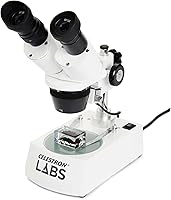
The Celestron Labs S10-60 Stereo Microscope sits in an interesting spot in the market — capable enough to satisfy serious hobbyists and entry-level professionals, yet approachable enough for students just getting started. What sets it apart from cheaper alternatives is the dual eyepiece system combined with a rotating objective housing, giving you real flexibility in how you observe specimens. The full-metal body feels immediately substantial out of the box — not a toy, not a research instrument, but something solidly in between. It also ships with two stage plates and four insect specimen blocks, which are genuinely useful for beginners getting their bearings.
Features & Benefits
The scope offers four magnification levels — 10x, 20x, 30x, and 60x — achieved by swapping between WF10x and WF20x widefield eyepieces and clicking through the two-position objective nosepiece. That click-stop mechanism makes switching magnifications quick and repeatable, which you appreciate more than you might expect when you are deep into examining a sample. The dual LED illumination is a real practical advantage: top lighting works well for opaque subjects like rocks or coins, while bottom lighting lets you examine transparent specimens like thin tissue sections. The 45-degree binocular head keeps your posture comfortable during longer sessions, and the coarse focus knob tracks smoothly without any of the slippage common on cheaper scopes.
Best For
This binocular microscope is particularly well-matched to students from middle school through early college — anyone studying biology, geology, or entomology who needs more than a basic loupe but does not yet require professional-grade optics. Hobbyists examining coins, stamps, insects, or small electronics will find the magnification range genuinely practical day to day. Homeschool parents and classroom teachers also appreciate the durable all-metal build, which can survive the kind of handling that cheaper plastic scopes simply cannot. Makers and electronics repair enthusiasts find it useful for inspecting solder joints or components. It is not a compound microscope, though — cellular-level biology is outside what this scope was designed to do.
User Feedback
Across 61 ratings, this stereo microscope holds a 3.9 out of 5, and reading through the reviews reveals a consistent pattern. Image clarity at lower magnifications — particularly 10x through 30x — draws repeated praise, with crisp and well-lit views satisfying most practical use cases. Build quality earns compliments too; buyers note it feels more substantial than expected. Where satisfaction dips is at 60x: the image gets noticeably dimmer, and the focus knob requires a delicate touch to avoid overshooting. The upper LED can also cast shadows on textured surfaces at higher magnification. The specimen blocks are a welcome addition, though seasoned users should not expect them to stand in for a proper specimen collection.
Pros
- Sharp, bright images at 10x through 30x make everyday observation tasks genuinely satisfying.
- The full-metal construction feels noticeably more solid and stable than comparably priced plastic-bodied scopes.
- Dual LED illumination — top and bottom — covers both opaque and transparent specimens without needing extra accessories.
- The click-stop rotating nosepiece makes switching between magnification levels quick and repeatable.
- The 45-degree binocular head keeps viewing comfortable during extended sessions, reducing neck and back strain.
- Included stage plates and specimen blocks give beginners an immediate hands-on starting point.
- The coarse focus knob tracks smoothly and holds position well at lower magnifications.
- Compact enough to sit permanently on a desk or workbench without dominating the space.
- Celestron is a well-established optics brand, and the scope benefits from that reputation in terms of quality control.
- At its price point, the combination of dual illumination and a widefield eyepiece set is genuinely hard to match.
Cons
- Image brightness drops significantly at 60x, making it the least useful of the four magnification settings.
- The focus knob demands a very light touch at maximum zoom — small adjustments can easily overshoot the focal plane.
- Upper LED illumination can cast distracting shadows on textured or uneven specimens at higher magnifications.
- Only a coarse focus mechanism is included; there is no fine focus adjustment for precise or delicate work.
- No trinocular port means attaching a camera for documentation or teaching requires aftermarket adapters that may not fit well.
- The four included insect specimens are a novelty rather than a practical long-term resource.
- The scope requires an AC power outlet, so portability for field or outdoor use is limited.
- At nearly 6.6 pounds, it is heavier than it looks and less convenient to move between rooms or pack for travel.
Ratings
The scores below reflect our AI-powered analysis of verified buyer reviews for the Celestron Labs S10-60 Stereo Microscope, drawn from global purchasing data with spam, bot-generated, and incentivized feedback actively filtered out. Each category is scored independently to give you an honest, granular picture of where this binocular microscope genuinely delivers and where it falls short. Both the consistent praise and the recurring frustrations are reflected transparently in every scorecard.
Optical Clarity (10x–30x)
Optical Clarity (60x)
Build Quality
Illumination System
Focus Mechanism
Magnification Range
Ergonomics & Comfort
Included Accessories
Setup & Ease of Use
Value for Money
Stability & Vibration Resistance
Portability
Durability Over Time
Suitable for:
The Celestron Labs S10-60 Stereo Microscope is a strong fit for anyone who needs a meaningful step up from a basic magnifying loupe without committing to the complexity or cost of a professional lab instrument. Students from middle school through early college — particularly those studying biology, geology, or entomology — will find the four magnification levels genuinely useful for coursework and personal exploration. Homeschool parents and classroom teachers will appreciate the all-metal build, which can withstand regular handling without the wobble or fragility common in plastic alternatives. Hobbyists with an interest in examining coins, stamps, insects, rocks, or small natural specimens will get real mileage from the dual LED illumination system, which adapts well to both surface and transmitted-light viewing. Makers and electronics repair enthusiasts who need to inspect solder joints or small components at a comfortable working distance will also find this binocular microscope a practical bench companion.
Not suitable for:
Buyers expecting professional-grade optical performance across all magnification levels should look elsewhere — the Celestron Labs S10-60 Stereo Microscope is an entry-to-mid-range tool, and that ceiling becomes apparent at maximum zoom. At 60x, image brightness drops noticeably and the depth of field narrows sharply, making it frustrating for detailed work at that power level. Anyone requiring compound microscopy — studying individual cells, bacteria, or stained tissue slides at high resolution — will find this scope fundamentally unsuitable, as stereo microscopes are designed for three-dimensional surface observation, not cellular magnification. Researchers or advanced science students who need a parfocal zoom system, a trinocular port for camera attachment, or a mechanical stage for precise specimen positioning will quickly outgrow what this scope can offer. If your use case demands consistent, high-quality imaging at or near 60x, the investment in a more capable instrument is likely worth it.
Specifications
- Brand: Manufactured by Celestron, a well-established American optics company known for telescopes and microscopes.
- Model Number: This scope carries the model designation 44208, also referred to as the S10-60.
- Magnification: Offers four discrete magnification levels: 10x, 20x, 30x, and 60x, achieved through two eyepiece and objective combinations.
- Eyepieces: Includes two pairs of widefield eyepieces — WF10x and WF20x — which are swapped manually to change the effective magnification.
- Objectives: Two objective lenses (1x and 3x) are housed in a two-position click-stop rotating nosepiece for quick switching.
- Head Type: Adjustable binocular head set at a 45-degree incline to reduce neck strain during extended viewing sessions.
- Illumination: Dual LED system provides both upper (incident) and lower (transmitted) illumination to accommodate opaque and transparent specimens.
- Stage Plates: Ships with two stage plates: one transparent plate for bottom illumination and one reversible black-and-white plate for surface contrast viewing.
- Focus System: Equipped with a single coarse focus knob only; no fine focus adjustment mechanism is included.
- Body Material: Full metal construction throughout the main body and arm, contributing to stability and long-term durability.
- Included Accessories: Package includes four pre-prepared insect specimen blocks intended as introductory viewing samples for new users.
- Power Supply: Operates via a standard AC plug rated at 110V; no battery option is available, limiting portability.
- Dimensions: The assembled unit measures 13 x 12 x 16 inches, making it a desktop instrument that requires dedicated bench space.
- Weight: Weighs approximately 6.58 pounds (roughly 2.99 kg), which is substantial but typical for a full-metal stereo microscope.
- Voltage: Rated at 110V AC for North American markets; international buyers should verify local voltage compatibility before purchasing.
- User Rating: Holds an average rating of 3.9 out of 5 stars based on 61 customer ratings on Amazon as of the time of review.
- First Available: This model was first listed for sale in December 2014, indicating a mature, stable product rather than a newly launched design.
- Compatibility: Celestron notes compatibility with personal computers, laptops, and tablets, though a camera adapter would be required for digital imaging.
Related Reviews
Celestron Labs S20 Stereo Microscope
Celestron CM1000C Monocular Compound Microscope
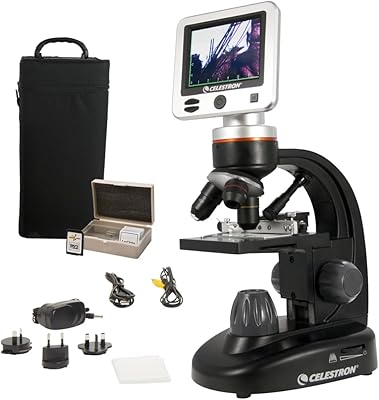
Celestron LCD Digital Microscope II
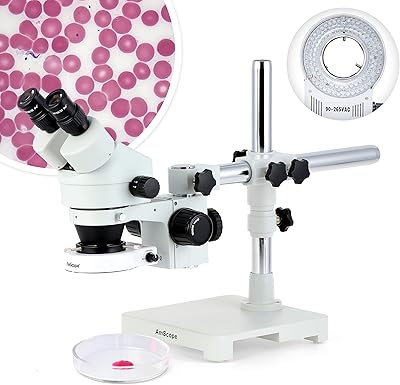
AmScope SM-3B Binocular Zoom Stereo Microscope
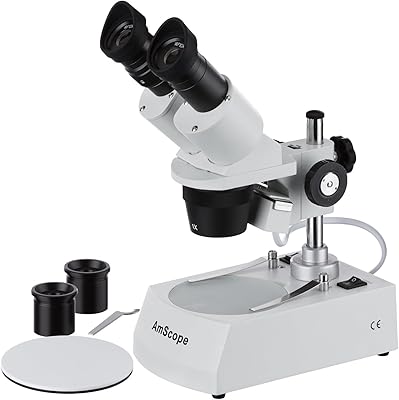
AmScope SE305R-PZ Stereo Microscope
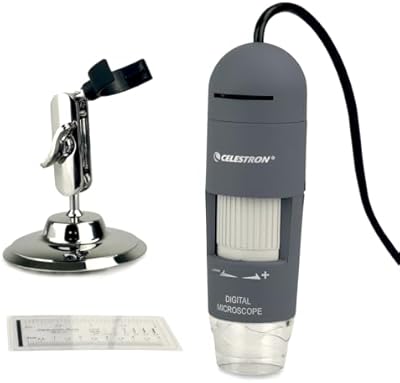
Celestron Deluxe Handheld Digital Microscope
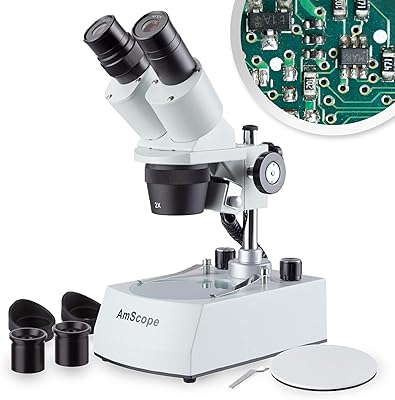
AmScope SE306R-PZ-LED Binocular Stereo Microscope
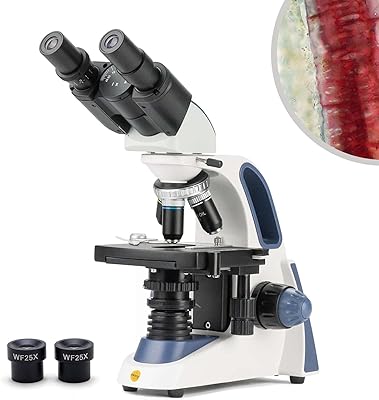
Swift SW380B Binocular Compound Microscope
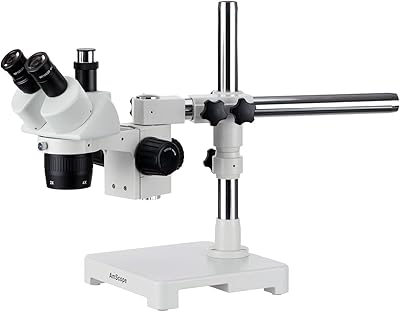
AmScope SW-3T24Z Trinocular Stereo Microscope