Overview

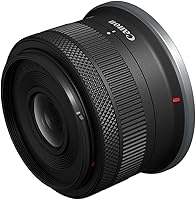
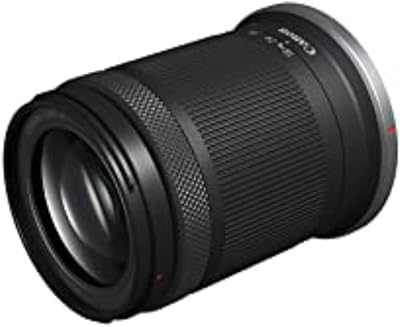
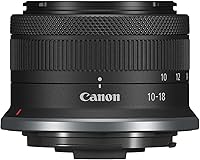
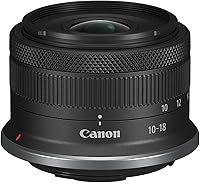
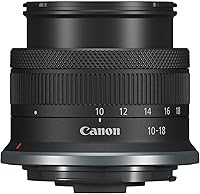
The Canon RF-S10-18mm F4.5-6.3 IS STM Zoom Lens is Canon's dedicated ultra-wide answer for APS-C mirrorless shooters on the RF-S mount, arriving in November 2023 as one of the more practical additions to that growing lineup. What stands out immediately is how small and light it is — 5.3 ounces and barely larger than a hockey puck, which is genuinely unusual for a lens covering this focal range. It carries a variable aperture, so it is built for versatile everyday shooting rather than demanding low-light studio work. Early reception has been strong, sitting at 4.7 stars across verified buyers — a solid indicator that it is delivering on its promises for real users.
Features & Benefits

The 10-18mm focal range — equivalent to 16-29mm on a full-frame body — gives this ultra-wide RF-S lens genuinely sweeping coverage without requiring you to step back several feet. The 4-stop image stabilizer does real work here, compensating for what the variable f/4.5-6.3 aperture cannot always provide in dimmer conditions; that said, it is not magic in truly dark environments. Autofocus is driven by an STM motor, meaning near-silent, smooth focus transitions — exactly what matters mid-video. In manual focus mode, the lens reaches 0.5x magnification, making close-up shots of small subjects surprisingly usable. Optically, Canon engineered this specifically for mirrorless sensors, and the sharpness holds toward the edges rather than dropping off in the corners, which is a notable achievement for such a compact build.

Best For

The Canon 10-18mm makes the most sense for a few specific types of shooters. Vloggers and creators using flip-screen bodies like the R50 or R10 will appreciate how its wide angle captures both face and background in one frame at arm's length — no selfie stick required. Travel photographers who refuse to carry heavy gear will find the 5.3-ounce build a very easy yes. It is also a solid pick for interiors, real estate walkthroughs, and architecture, where squeezing an entire room into frame is non-negotiable. Beginners stepping up from kit lenses will find this wide-angle zoom offers real creative range without a steep technical barrier. One important note: this lens is exclusively for APS-C RF-S mount bodies, not full-frame Canon R cameras.

User Feedback

Across a solid base of verified buyers, this wide-angle zoom earns consistent praise for two things: center-to-edge sharpness and how little space it takes up in a bag. Most users feel the optical quality holds up well against alternatives at this price tier. The image stabilizer gets real credit for enabling handheld shooting in moderate indoor light, though buyers are clear it is not a full substitute for a faster prime when conditions get genuinely dim. Autofocus in video scores well overall for smoothness, though a handful of reviewers flag occasional hunting during fast continuous tracking. One caveat worth knowing: distortion correction depends on in-camera processing or editing software, so barrel distortion may surface in workflows that bypass those corrections. Overall sentiment leans strongly positive.

Pros

  • Exceptionally compact and light at 5.3 oz — easy to carry all day without fatigue.
  • The 4-stop image stabilizer provides meaningful handheld stability for both stills and video.
  • STM autofocus is smooth and near-silent, making it a reliable choice for on-camera video work.
  • Edge-to-edge sharpness is notably strong for a lens in this size and price category.
  • The 16-29mm full-frame equivalent range covers a genuinely useful spread of wide-angle perspectives.
  • In manual focus mode, 0.5x magnification enables close-up shooting that goes well beyond typical wide-angle expectations.
  • Pairs naturally with entry-level and mid-range Canon APS-C bodies without creating an imbalanced, front-heavy rig.
  • Rated among the top sellers in its category, with a 4.7-star average reflecting consistent real-world satisfaction.
  • Wide enough at 10mm for selfie-style vlogging at arm's length without needing extra accessories.

Cons

  • Variable aperture drops to f/6.3 at the tele end, limiting exposure flexibility in darker conditions.
  • Barrel distortion correction relies on in-camera processing or software — raw shooters must handle it manually.
  • Autofocus can hunt intermittently when tracking fast or erratically moving subjects in video mode.
  • Exclusively compatible with Canon APS-C RF-S mount bodies — no use on full-frame R-series cameras.
  • No weather sealing, which limits confidence when shooting in rain, dust, or humid outdoor conditions.
  • At the widest focal length, peripheral sharpness can soften slightly depending on aperture and subject distance.
  • The zoom range tops out at 18mm, so users needing even moderate telephoto reach will need a second lens.
  • Close-up magnification at 0.5x is only available in manual focus mode, adding a workflow step for macro-style shots.

Ratings

The Canon RF-S10-18mm F4.5-6.3 IS STM Zoom Lens has been scored below using an AI-driven analysis of verified global buyer reviews, with spam, incentivized posts, and bot activity actively filtered out before any scoring was applied. The ratings reflect the honest consensus across a broad range of real-world shooters — vloggers, travelers, interior photographers, and everyday enthusiasts — and do not smooth over the genuine trade-offs this lens carries. Both its standout strengths and its meaningful limitations are represented transparently in every category.
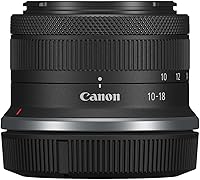
Image Sharpness
91%
Center sharpness consistently earns praise from buyers shooting architecture, interiors, and travel scenes where fine detail matters. What surprises many users is how well edge sharpness holds up — even in the corners of the frame, which is often where ultra-wide lenses disappoint.
At the widest apertures and extreme focal length corners, a small degree of softness is visible under close pixel-level scrutiny. For casual social content this is invisible, but photographers cropping heavily or printing large may notice it at f/4.5 wide open.
Autofocus Performance
84%
The STM motor is genuinely quiet during video — reviewers consistently note that it does not bleed into on-camera audio recordings, which matters enormously for solo vloggers. For stationary or slowly moving subjects, locking focus is fast and confident across a range of lighting conditions.
Continuous AF tracking during fast or erratic subject movement is where some users encounter brief focus hunting before the system reacquires. It is not a persistent problem, but shooters covering unpredictable action or fast-moving kids will feel the limitation more than controlled-environment creators will.
Image Stabilization
88%
The 4-stop optical IS makes a real, tangible difference when shooting handheld indoors or while walking — users report usably sharp stills in moderately dim rooms where they would otherwise need a tripod or much faster glass. For slow travel walk-and-shoot video, the stabilization noticeably smooths out casual movement.
IS cannot fully compensate for the exposure disadvantage of f/6.3 at the tele end in genuinely dark environments like candlelit restaurants or dim evening interiors. Users expecting to shoot clean handheld video in very low light will still need to push ISO higher than they might prefer.
Build Quality & Handling
76%
24%
The physical construction feels solid and purposeful for its weight class — nothing flexes or rattles, and the zoom and focus rings operate with smooth, consistent resistance. Paired with a compact body like the R50 or R10, the balance feels natural rather than front-heavy.
The absence of any weather or dust sealing is a recurring frustration for buyers who shoot outdoors regularly or in unpredictable conditions. The plastic exterior, while entirely functional, does not convey the premium tactile feel that some users expect at this price point.
Vlogging Usability
93%
At 10mm, the angle of view is wide enough to capture the shooter's face and a meaningful amount of background context at arm's length — no selfie stick required when paired with a flip-screen body. The silent AF and effective IS combine to make this one of the most practical single-lens vlogging setups available in the Canon APS-C ecosystem.
The variable aperture means indoor vlogging in low ambient light requires either a well-lit setup or willingness to accept higher ISO noise. Users shooting in darker home environments without supplemental lighting will notice the exposure constraints more than those shooting outdoors or in well-lit spaces.
Portability & Size
96%
At 5.3 oz and dimensions barely larger than a large lens cap, this wide-angle zoom fits easily into a jacket pocket alongside a compact mirrorless body. Travel photographers who obsess over kit weight consistently single out the size-to-focal-length ratio as the lens's most surprising and appreciated characteristic.
The compact size does mean the zoom ring travel is relatively short, which can make precise focal length selection feel slightly abrupt for photographers used to larger, more graduated zoom rings. This is a minor ergonomic adjustment rather than a functional flaw.
Low-Light Capability
61%
39%
The IS system does provide meaningful help in moderate indoor conditions — window-lit interiors, covered outdoor markets, and bright café environments are genuinely manageable handheld. When paired with Canon bodies that handle high ISO well, the results in mixed-light conditions are acceptable for web and social use.
The f/6.3 maximum aperture at 18mm is a real constraint that buyers with experience in low-light shooting will feel regularly. In dim evening scenes or artificially lit indoor environments without supplements, this wide-angle zoom simply cannot gather enough light to avoid significant noise or motion blur at reasonable shutter speeds.
Distortion Control
69%
31%
When shooting JPEG or using Canon's native raw processing pipeline, in-camera distortion correction handles barrel distortion cleanly and automatically — most users in this workflow will never even notice the underlying geometric distortion at 10mm.
Shooters working in third-party software without applying lens correction profiles will encounter visible barrel distortion, particularly on straight architectural lines near the frame edges. This is a known characteristic of ultra-wide zooms, but it adds a mandatory post-processing step that some buyers find inconvenient.
Video Quality
87%
Color rendering and tonal response are consistent with what Canon users expect from RF-glass — footage integrates well with material from other Canon lenses without significant grading work. The wide angle makes environmental context shots and establishing footage look cinematic even from handheld positions.
Rolling shutter, while partially mitigated by the IS, can appear during fast panning movements at wider focal lengths. This is a sensor-side limitation compounded by the wide field of view, and it is more pronounced on certain R-series bodies than others.
Close-Up & Macro Capability
78%
22%
The 0.5x manual focus magnification is a genuine differentiator for a wide-angle zoom at this price tier — users shooting product flat-lays, food details, or nature close-ups find it opens up creative options they did not expect from a wide-angle lens. At close focus distances, subject separation is more pronounced than at typical shooting distances.
The 0.5x capability is only accessible in manual focus mode, which adds a workflow interruption when switching between wide environmental shots and close-up subjects. In AF mode, the 0.23x ceiling is respectable but less impressive, and some buyers feel the transition between modes could be more intuitive.
Value for Money
83%
Given the limited native RF-S competition in the ultra-wide zoom category, buyers generally feel the pricing is justified — there is no obvious alternative that clearly beats it on optical quality within the same ecosystem and mount. The sharpness, IS, and silent AF together represent a coherent package that holds up against the asking price.
Buyers who are price-sensitive and compare against full-frame ultra-wide options or manual-focus third-party lenses may feel the value case is less clear-cut. The variable aperture and lack of weather sealing are the two features most commonly cited by buyers who feel the lens could offer more for what it costs.
Compatibility & Ecosystem Fit
89%
For Canon APS-C mirrorless users on R50, R10, or R100 bodies, the RF-S mount integration is flawless — EXIF data, in-body IS coordination, and lens correction profiles all communicate natively with no workarounds required. It slots into the Canon ecosystem without any friction.
The RF-S exclusivity is a hard boundary that limits the lens's long-term versatility if a user upgrades to a full-frame Canon body in the future. Buyers who anticipate moving to an R5 or R6 series body will not be able to carry this lens forward as a primary wide-angle option.
Chromatic Aberration
74%
26%
In-camera correction handles lateral chromatic aberration well in JPEG and Canon raw workflows, and most buyers shooting for web or video output will never encounter it as a practical issue. The optical design manages fringing reasonably well for a wide-angle zoom at this aperture range.
Under high-contrast edges — bright window frames against dark interiors, or tree branches against bright sky — some residual color fringing surfaces when shooting at wide apertures. It is correctable in post, but buyers shooting uncorrected RAW in demanding high-contrast scenes will need to address it manually.
Ease of Use
92%
Beginners transitioning from kit lenses consistently describe the Canon 10-18mm as intuitive and forgiving — the autofocus handles most decisions automatically, and the zoom range provides enough flexibility to experiment without feeling constrained. There is genuinely very little setup friction between attaching the lens and shooting.
New users unfamiliar with ultra-wide perspective distortion may go through an adjustment period where their initial shots feel unflattering or geometrically odd, particularly with close subjects or portraits. This is a learning curve inherent to the focal length rather than a flaw in the lens itself.

Suitable for:

The Canon RF-S10-18mm F4.5-6.3 IS STM Zoom Lens is a natural fit for APS-C mirrorless Canon shooters who want a dedicated wide-angle option without adding significant weight or bulk to their kit. Vloggers using flip-screen bodies like the R50 or R10 will find it particularly practical — the wide field of view captures face and surroundings comfortably at arm's length, removing the need for an extended selfie stick. Travel photographers who already carry a standard zoom will appreciate this as a lightweight companion for landscapes, cityscapes, and tight alleyways where stepping back simply is not an option. It also makes a genuinely useful tool for interior and architecture photography, fitting entire rooms into a single frame without distorting the subject beyond recognition. Beginners who have outgrown their kit lens and want to explore wide-angle composition will find the learning curve here manageable and rewarding.
Not suitable for:

Photographers who shoot primarily in low-light environments — think event coverage, dim restaurants, or night interiors — should think carefully before committing to the Canon RF-S10-18mm F4.5-6.3 IS STM Zoom Lens, since the variable aperture reaching f/6.3 at the long end is a real constraint that image stabilization alone cannot fully compensate for. Full-frame Canon R-series users are entirely excluded, as the RF-S mount is physically and electronically designed for APS-C bodies only. Professional videographers who need flawless continuous autofocus tracking during fast-moving subjects may find occasional focus hunting frustrating compared to premium cinema-oriented options. Shooters who work in post-production pipelines that skip in-camera corrections will need to manually handle barrel distortion, which is present and requires intentional correction. Anyone expecting a fast prime's low-light output from a compact zoom at this price tier will likely come away disappointed.

Specifications

  • Focal Length: Covers 10-18mm, equivalent to 16-29mm on a full-frame sensor when used on an APS-C body.
  • Max Aperture: Variable maximum aperture of f/4.5 at the wide end, narrowing to f/6.3 at the telephoto end.
  • Image Stabilization: Optical IS system rated at 4.0 stops of shake compensation for handheld stills and video.
  • Autofocus: STM (Stepping Motor) autofocus delivers smooth, near-silent focus transitions optimized for continuous video use.
  • Max Magnification: Reaches 0.23x magnification in AF mode and up to 0.5x in manual focus mode for close-up shooting.
  • Lens Mount: Canon RF mount with RF-S designation, compatible exclusively with Canon APS-C mirrorless camera bodies.
  • Dimensions: Measures 1.8 inches in length and 2.7 inches in diameter, making it one of the most compact lenses in its focal class.
  • Weight: Weighs 5.3 oz (approximately 150g), well within the range for all-day carry without fatigue.
  • Lens Type: Ultra-wide-angle zoom lens designed for versatile coverage across landscapes, interiors, and vlogging applications.
  • Optical Design: Engineered specifically for mirrorless sensors with corrections applied across the full image circle, not just the central zone.
  • Distortion Correction: Barrel distortion correction is applied digitally via in-camera processing or compatible editing software such as Canon's Digital Photo Professional.
  • Model Number: Official Canon model number is 6262C002, also referenced by Canon as the RF-S10-18mm F4.5-6.3 IS STM.
  • Release Date: First made available in November 2023 as part of Canon's expanding RF-S lens lineup for APS-C mirrorless shooters.
  • Filter Thread: Accepts 49mm screw-in filters, consistent with Canon's compact RF-S lens family standard.
  • Aperture Blades: Features 7 rounded aperture blades to produce reasonably smooth bokeh for a wide-angle zoom at this aperture range.
  • Weather Sealing: No official weather or dust sealing is included, so caution is advised when shooting in harsh outdoor conditions.
  • Manufacturer: Designed and manufactured by Canon USA, with global distribution through Canon's authorized retail network.
  • Market Rank: Holds a top-5 position in the Mirrorless Camera Lenses bestseller category on Amazon as of its verified listing data.

Related Reviews

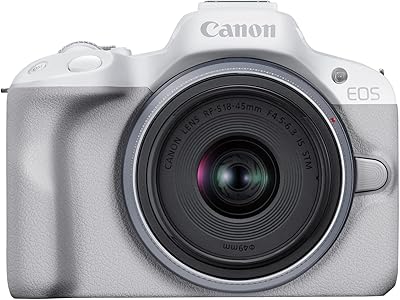
Canon EOS R50
Canon EOS R50
79%
93%
Autofocus Performance
88%
Image Quality
86%
4K Video Quality
57%
Battery Life
91%
Portability & Build
More
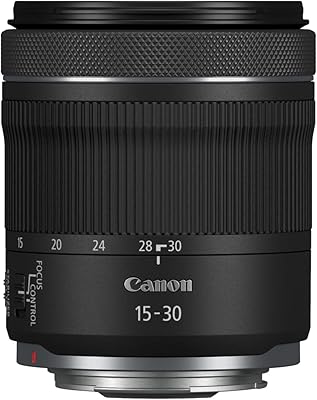
Canon RF15-30mm F4.5-6.3 Wide-Angle Zoom Lens
81%
88%
Image Sharpness
91%
Image Stabilization
84%
Autofocus Performance
76%
Optical Distortion Control
81%
Chromatic Aberration
More
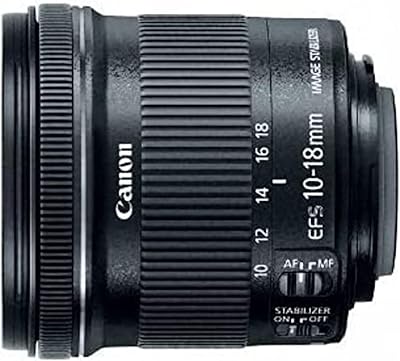
Canon EF-S 10-18mm STM Wide-Angle Lens
75%
83%
Image Sharpness
86%
Autofocus Performance
81%
Image Stabilization
58%
Distortion & Vignetting
54%
Low-Light Capability
More
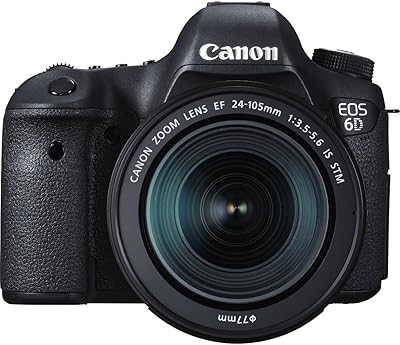
Canon EOS 6D DSLR Camera with EF 24-105mm f/3.5-5.6 IS STM Lens Kit
84%
94%
Image Quality
82%
Autofocus Performance
88%
Ease of Use
90%
Low-Light Performance
85%
Build Quality
More
Canon RF-S 18-150mm Mirrorless Zoom Lens
79%
93%
Zoom Versatility
88%
Image Stabilization
76%
Autofocus Performance
84%
Video Quality
67%
Image Sharpness
More
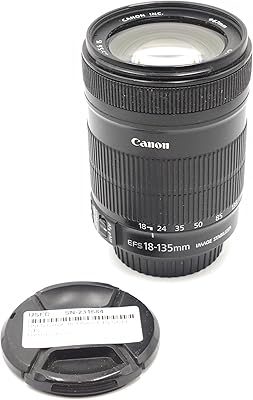
Canon EF-S 18-135mm f/3.5-5.6 IS Zoom Lens
77%
91%
Zoom Versatility
88%
Image Stabilization
76%
Sharpness & Clarity
58%
Low-Light Performance
79%
Autofocus Speed
More
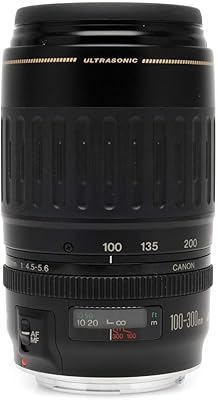
Canon EF 100-300mm f/4.5-5.6 Telephoto Zoom Lens
75%
88%
Autofocus Speed
91%
Autofocus Noise
67%
Image Sharpness
43%
Image Stabilization
78%
Build Quality
More
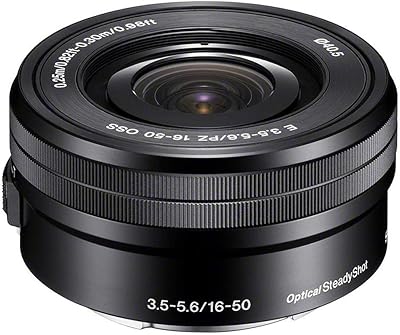
Sony 16-50mm f/3.5-5.6 OSS Alpha E-Mount Retractable Zoom Lens
85%
91%
Value for Money
87%
Image Quality
93%
Portability/Size
88%
Ease of Use
82%
Build Quality
More
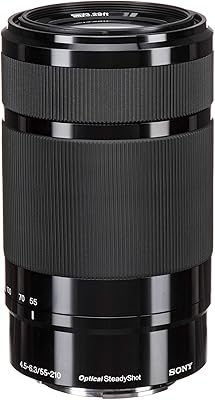
Sony E 55-210mm F4.5-6.3 Telephoto Zoom Lens
78%
78%
Image Sharpness
74%
Autofocus Speed & Accuracy
88%
Optical Stabilization (OSS)
67%
Build Quality & Durability
86%
Focal Range Versatility
More
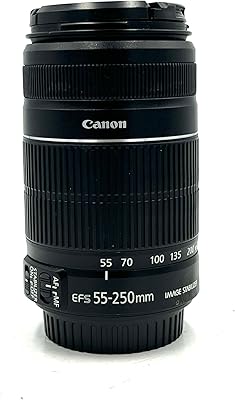
Canon EF-S 55-250mm f/4-5.6 IS II Telephoto Zoom Lens
82%
91%
Value for Money
88%
Image Stabilization Performance
65%
Autofocus Speed in Low Light
93%
Portability & Size
85%
Image Quality & Sharpness
More

FAQ

No — the Canon RF-S10-18mm F4.5-6.3 IS STM Zoom Lens is designed exclusively for APS-C mirrorless bodies using the RF-S mount, such as the R50, R10, or R100. While it physically attaches to full-frame RF-mount bodies, Canon does not support or recommend this use, and image quality and coverage will be significantly compromised. If you are shooting full-frame, you would need a different lens entirely.
Yes, comfortably. At 10mm on an APS-C sensor, the angle of view is wide enough to capture your face plus a good portion of the background at a normal arm's length. If your camera has a flip-out touchscreen — like the R50 or R10 does — you can frame yourself easily without any additional accessories. It is one of the more practical setups for solo creators working without a tripod operator.

The 4-stop IS makes a noticeable difference when shooting handheld stills in moderate indoor light, and it smooths out minor camera wobble during slow walking video shots. That said, it is not a substitute for fast glass in genuinely dark environments — at f/6.3 on the tele end, you will still need to raise ISO or slow your shutter in dim rooms. For typical indoor vlogging or daytime travel shooting, most users find it more than adequate.

For the vast majority of video use cases — talking-head vlogs, slow pans, walkthroughs — the STM motor tracks focus smoothly and quietly with no audible noise on the audio track. Where some users report occasional issues is during fast or unpredictable subject movement, where the AF can briefly hunt before locking back on. For controlled shooting situations, it is genuinely solid.

It depends on your workflow. If you shoot JPEG or use Canon's Digital Photo Professional, in-camera correction handles most of it automatically and transparently. If you shoot RAW and import into Lightroom or Capture One, lens correction profiles are available and apply with a single click. Where it becomes a manual task is if you use editing software without a profile for this lens — in that case you will need to correct it by hand, which is doable but adds a step.

Yes, the filter thread is 49mm, which is a common and affordable size. Polarizing filters and ND filters are both usable, though keep in mind that ultra-wide lenses can show uneven polarization effects across a very wide sky. A slim-profile filter is recommended to avoid corner vignetting.

It is actually one of the more approachable wide-angle options for someone new to the focal length. The autofocus is reliable, the image stabilizer forgives minor hand movement, and the zoom range lets you experiment with different degrees of wide-angle perspective rather than committing to a single fixed focal length. The main thing to get used to is managing distortion on straight lines near the frame edges — but that is a skill that develops quickly with practice.

Third-party RF-S options at this focal range are limited, and native Canon glass typically holds an advantage in autofocus integration, in-camera correction compatibility, and overall reliability. Buyers generally report that the sharpness and edge-to-edge consistency of this wide-angle zoom justifies the cost relative to what else is available in the ecosystem. If you are already invested in Canon APS-C, there is not a compelling native alternative that clearly beats it at this price tier.

The minimum focusing distance is approximately 4.7 inches (12cm) from the subject when in manual focus mode, where it reaches 0.5x magnification. That is genuinely impressive for a wide-angle zoom and opens up creative close-up shooting of small objects, food, or product details. In AF mode the magnification drops to 0.23x, which is still useful but less dramatic. True 1:1 macro it is not, but for a wide-angle zoom, the close-focus capability stands out.

No, there is no official dust or moisture sealing on this lens. Light mist or briefly damp conditions may not cause immediate damage, but shooting in rain, dusty environments, or humid conditions carries real risk. If you regularly shoot outdoors in unpredictable weather, pairing it with a weather-sealed body does not offer full protection without a sealed lens. For those situations, factoring in a protective lens filter and cautious handling is a reasonable precaution.