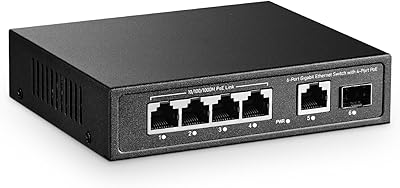
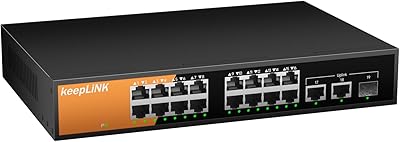
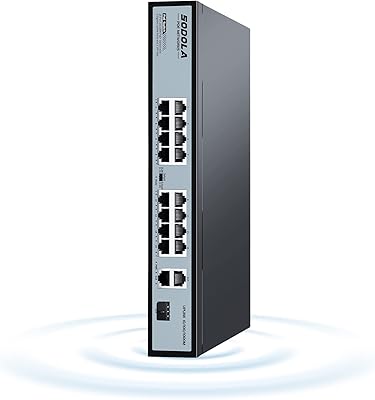
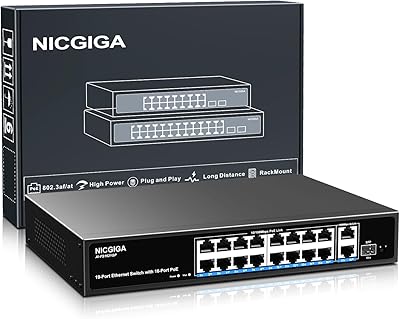
Overview

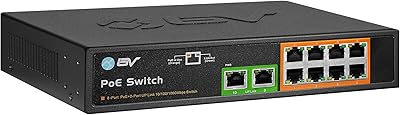
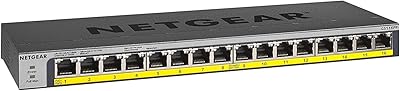
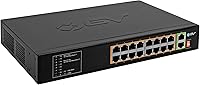
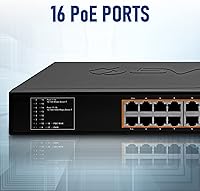
The BV-Tech 16-Port 135W Long Range PoE+ Switch is a practical, no-frills option built for small business owners and home installers who need to power multiple devices without wrestling with complex configuration. You get 16 PoE+ ports plus 2 Gigabit uplinks, which covers most camera or access point deployments comfortably. It sits flat on a desk or slots into a 19-inch rack using the included mounting extensions — a genuinely useful flexibility for tighter spaces. Just be clear about what this is: an unmanaged switch, with no VLAN, QoS, or traffic management. If you need those features, look elsewhere.
Features & Benefits

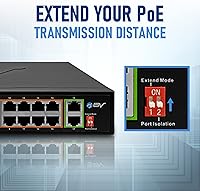
The 135W shared power budget is the spec that deserves the most attention here. Standard ports handle up to 30W each, while ports 1 and 2 support Hi-PoE at up to 60W — handy for PTZ cameras or higher-draw access points. Run the numbers before you buy: eight cameras pulling 15W each already consumes 120W, leaving little headroom. The extended PoE range pushing transmission to 656ft is a standout for outdoor runs where standard 328ft falls short. Built-in 6kV surge protection is a quiet but meaningful inclusion. One honest note: the PoE ports top out at 10/100Mbps — the two uplinks are full Gigabit, but the PoE side is not.

Best For

This unmanaged PoE switch hits its stride in small-scale surveillance builds — think a retail shop, small warehouse, or home with a dozen IP cameras spread across a property. DIY installers who want to plug in and walk away will appreciate the zero-configuration setup. The long-range mode makes it particularly useful when devices are positioned far from the main network closet, beyond what standard PoE cabling supports. It also suits users who need Hi-PoE on select ports without paying for a fully managed switch. If your cameras are Gigabit models, though, factor in the 10/100Mbps port ceiling before committing.

User Feedback

Buyers consistently highlight the easy out-of-box setup and the reliability of camera powering over extended runs as genuine strengths. For straightforward installations, most report it just works. The recurring concern, however, centers on the shared power budget — users who loaded all 16 ports with higher-draw devices found the 135W ceiling tighter than expected in practice. A few noted the unit runs warm under sustained full load, so ventilation around the unit matters. Opinions on the rack-mount extensions are mixed — functional, but not the most rigid fit. Long-range mode feedback is mostly positive, with installers confirming reliable performance at distances where standard PoE setups would otherwise fail.

Pros

  • Plug-and-play setup means cameras are live within minutes — no software, no configuration, no frustration.
  • Extended PoE range to 656ft covers large properties and outbuildings where standard switches fall short.
  • Hi-PoE on ports 1 and 2 supports up to 60W per port, handling PTZ cameras and power-hungry access points.
  • 6kV surge protection offers meaningful resilience for outdoor cable runs in storm-prone areas.
  • Rack-mount extensions are included in the box — no additional hardware needed for a 19-inch enclosure.
  • Broad 802.3af/at compliance means it works reliably with cameras and devices from virtually any manufacturer.
  • The compact form factor fits comfortably on a desk or in a small network closet without taking over the space.
  • For light-to-moderate loads, this unmanaged PoE switch runs quietly and reliably with minimal maintenance.
  • Per-port value is strong at this price point, especially for builders needing 12 to 16 powered ports on a budget.

Cons

  • PoE ports are capped at 10/100Mbps — a real limitation for 4K cameras or high-bitrate network video recorders.
  • The 135W shared budget depletes faster than expected once mid-draw devices fill all 16 ports simultaneously.
  • No management interface means diagnosing a misbehaving or underpowered port requires physical trial and error.
  • Fanless design runs warm under sustained full load, making ventilation a genuine installation consideration.
  • Rack-mount bracket fit is functional but lacks the rigidity expected in permanent professional installations.
  • No per-port PoE status indicators make it impossible to confirm how much of the power budget is being consumed.
  • Long-range mode reduces port throughput further, which can cause issues with higher-bitrate camera streams.
  • Support documentation is thin, and official customer support responsiveness has received inconsistent feedback from buyers.

Ratings

The BV-Tech 16-Port 135W Long Range PoE+ Switch has been evaluated by our AI system after processing verified buyer reviews from global markets, with spam, bot-generated, and incentivized submissions actively filtered out. The scores below reflect real-world installer and small business experiences — strengths and frustrations weighted equally. Whether this unmanaged PoE switch fits your setup depends heavily on a few critical factors, and this breakdown makes those trade-offs clear.
Value for Money
88%
For the port count and PoE budget on offer, buyers consistently feel this switch punches above its price bracket. Small business owners running eight to twelve cameras found it hard to match the per-port cost elsewhere without sacrificing essential features like surge protection or extended range.
A small segment of buyers felt the value equation weakened once they factored in the 10/100Mbps port limitation — if your cameras are Gigabit-capable, you are not getting full throughput, which some consider a hidden cost in future-proofing terms.
Ease of Setup
93%
Plug-and-play really does describe the experience here. Installers report having cameras live within minutes of unboxing — no drivers, no web interface, no CLI. For non-technical buyers setting up a home security system, this zero-configuration approach removes a significant barrier.
The simplicity is also the ceiling. Users who wanted to isolate camera traffic, set port priorities, or monitor bandwidth had no path forward — the lack of any management interface means troubleshooting a misbehaving port requires physical trial and error.
PoE Power Budget
71%
29%
The 135W total budget is workable for moderate deployments — eight cameras drawing around 10 to 12W each sits comfortably within limits. The Hi-PoE capability on ports 1 and 2, handling up to 60W each, is a genuine plus for PTZ cameras or dual-band access points that standard PoE cannot feed.
Load up all 16 ports with mid-to-high draw devices and the math turns against you fast. Several buyers reported devices cycling or failing to power on when the aggregate draw approached the ceiling, and there is no per-port power monitoring to diagnose where the budget is being consumed.
Long Range PoE Performance
84%
The extended transmission mode pushing PoE delivery to 656ft is the feature that sets this switch apart from standard alternatives at the same price. Installers covering large properties or running cables through outbuildings reported stable camera feeds at distances where their previous switch had given up entirely.
Long range mode trades speed for distance — ports operating in extended mode drop to lower throughput, which is fine for standard HD cameras but can create issues with higher-bitrate streams. A few users were caught off guard by this trade-off and had to reconfigure their NVR settings accordingly.
Port Speed (PoE Ports)
58%
42%
For legacy IP cameras, VoIP handsets, and 2.4GHz access points, 10/100Mbps is entirely sufficient. Buyers running older Hikvision or Dahua camera systems noted zero performance issues, and network video at 1080p streams comfortably within the bandwidth ceiling these ports provide.
This is the spec that catches the most buyers off guard. Modern 4K cameras, high-bitrate NVR systems, and newer wireless access points increasingly expect Gigabit connectivity on their PoE port. Users who discovered this limitation post-purchase were understandably frustrated, particularly given it is not prominently displayed in marketing materials.
Build Quality
74%
26%
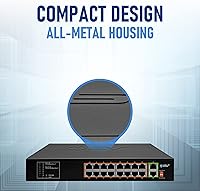
The chassis feels solid for the price — metal construction keeps it from feeling cheap on a desk or in a rack. Several installers noted it survived the occasional knock during a busy setup day without any visible damage or performance issues.
Under sustained full load, the unit runs noticeably warm. There are no active cooling fans, which keeps it quiet but means placement in poorly ventilated spaces is a genuine concern. A few buyers in warmer climates reported intermittent behavior they attributed to heat accumulation over long operating periods.
Rack Mount Flexibility
69%
31%
The included rack-mount extensions mean you are not spending extra to fit this into a 19-inch enclosure, which is a thoughtful inclusion at this price point. Desktop use is equally viable, and the form factor is compact enough to tuck into a small network closet without dominating the space.
The mounting extensions work, but the fit is not particularly rigid — buyers used to commercial-grade rack equipment noted some flex and imprecision in the bracket alignment. For a permanent, professional installation, the hardware feels like an afterthought compared to switches designed rack-first.
Device Compatibility
89%
802.3af and 802.3at compliance covers the overwhelming majority of PoE-powered devices on the market. Buyers mixing camera brands — Reolink, Hikvision, Amcrest, Ubiquiti — across the same switch reported consistent power delivery without compatibility headaches.
A small number of users with non-standard or proprietary PoE implementations hit snags. Devices relying on passive PoE or vendor-specific power negotiation occasionally required adapters, which is expected but worth flagging for buyers with mixed or unusual device ecosystems.
Surge Protection
82%
18%
The 6kV surge protection rating is meaningfully higher than what many switches at this price point offer. For outdoor camera installations where cable runs are exposed to lightning-induced transients, buyers in storm-prone regions considered this a key differentiator and reported no surge-related failures during normal weather events.
Surge protection at the switch level is only one layer of defense. A handful of buyers assumed this made individual port protectors unnecessary and encountered damage when surge events were particularly severe — the spec is reassuring but not a substitute for end-to-end protection on sensitive equipment.
Thermal Management
63%
37%
Fanless operation keeps the unit completely silent, which matters in office environments or home installs where noise is a consideration. For light-to-moderate loads — say, eight to ten cameras — thermal behavior is reported as perfectly acceptable during normal ambient temperatures.
Running the switch at near-capacity in a warm server room or enclosed cabinet without airflow is where buyers have reported problems. The lack of any thermal indicator or automatic throttling means the first sign of a heat issue might be a dropped device rather than a warning, which is a design gap at full load.
Long-Term Reliability
76%
24%
The majority of buyers who have owned this switch for one to two years report consistent, uninterrupted operation. For always-on security camera systems where uptime is critical, most users found the switch reliable enough to forget it is there — which is exactly what you want from unmanaged infrastructure.
A smaller but notable portion of longer-term owners reported individual ports degrading or the unit requiring a power cycle after extended uptime. These appear to be isolated cases rather than a systemic flaw, but it introduces some uncertainty for users who cannot afford unexpected downtime.
Indicator Lights & Diagnostics
61%
39%
Per-port LED indicators give a basic visual confirmation of link status and activity, which is genuinely useful during initial setup to confirm each camera is recognized and powered. For straightforward installations, this is all most buyers need.
Beyond basic link and activity lights, there is nothing — no PoE status indicator, no power consumption readout, no fault signaling. When a port stops delivering power or a device behaves erratically, diagnosing the cause is a process of elimination rather than informed troubleshooting.
Documentation & Support
66%
34%
Setup is simple enough that most buyers never consult the manual. For the core use case of connecting cameras and access points, the switch behaves exactly as expected from the moment power is applied, reducing reliance on documentation significantly.
For buyers who do run into issues, the documentation is thin and support responsiveness has received mixed feedback. Users troubleshooting edge cases — unusual device behavior, power budget questions, long-range mode specifics — often found community forums more useful than official channels.

Suitable for:

The BV-Tech 16-Port 135W Long Range PoE+ Switch is built for the installer or small business owner who needs to power a meaningful number of IP cameras or access points without the overhead of a managed switch. If you are setting up a security system across a retail shop, small warehouse, or a larger residential property — where cable runs regularly push past 100 meters — the extended PoE range alone justifies the consideration. DIY home networkers who want to plug in and walk away will find the zero-configuration approach genuinely refreshing compared to alternatives that demand a web interface just to get started. It also suits deployments where one or two high-draw devices like PTZ cameras need more than standard PoE can deliver, thanks to the Hi-PoE capability on the first two ports. As long as your camera or access point roster does not depend on Gigabit throughput at the edge, this unmanaged PoE switch covers the typical small-scale surveillance or connectivity build reliably and without unnecessary complexity.
Not suitable for:

The BV-Tech 16-Port 135W Long Range PoE+ Switch is the wrong tool for anyone running or planning to run a network that requires traffic control, device isolation, or any form of management visibility. If your environment needs VLANs to separate camera traffic from general business data, or QoS to prioritize voice calls over video streams, this switch simply cannot deliver — there is no management interface of any kind. Buyers deploying modern 4K cameras or high-throughput wireless access points should also look elsewhere, because the 10/100Mbps ceiling on the PoE ports will become a real bottleneck as bitrates climb. The 135W shared power budget sounds generous until you populate all 16 ports with mid-draw devices — eight cameras at 15W each already consumes 120W, leaving almost no room for anything more demanding. Organizations that need port-level diagnostics, uptime monitoring, or centralized network oversight will find the lack of any status reporting frustrating in practice. And for anyone installing in a warm, poorly ventilated space at near-full load, the fanless design introduces thermal risk that more robust switches handle with active cooling.
Specifications

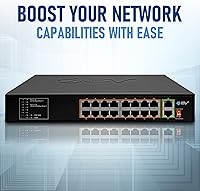
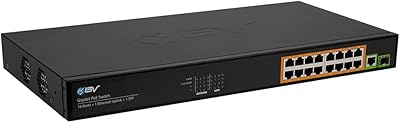
  • Total Ports: The switch provides 18 ports in total: 16 PoE+ ports and 2 Gigabit Ethernet uplink ports.
  • PoE Port Speed: All 16 PoE+ ports operate at 10/100Mbps and are not capable of Gigabit speeds at the edge.
  • Uplink Speed: The 2 dedicated uplink ports support full 10/100/1000Mbps Gigabit Ethernet for connecting to your router or core network.
  • PoE Standard: The switch is compliant with both IEEE 802.3af and IEEE 802.3at PoE+ standards.
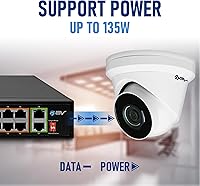
  • Total Power Budget: The maximum shared PoE power output across all ports is 135W.
  • Per-Port Power: Standard PoE+ ports deliver up to 30W per port, while ports 1 and 2 support Hi-PoE at up to 60W each.
  • Extended PoE Range: An extended range mode stretches PoE transmission distance from the standard 328ft (100m) up to 656ft (200m).
  • Surge Protection: Built-in 6kV surge protection is applied across ports to guard against electrical transients and lightning-induced spikes.
  • Management Type: This is a fully unmanaged switch with no web interface, CLI, or SNMP support — no configuration is required or possible.
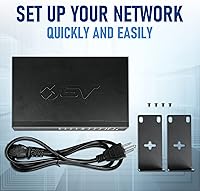
  • Form Factor: The unit supports both desktop placement and 19″ rack mounting via bracket extensions included in the package.
  • Cooling Method: The switch uses passive fanless cooling with no moving parts, making it silent during operation.
  • Item Weight: The unit weighs 2.3 kg (5.06 lbs) as packaged and ready to ship.
  • Package Dimensions: The packaged dimensions measure 14.41 x 11.89 x 3.11 inches, suitable for standard shipping and rack enclosure planning.
  • Plug-and-Play: No software installation or network configuration is required — the switch is operational as soon as it is powered on and connected.
  • VLAN Support: VLANs are not supported in any form, as this is an unmanaged switch without traffic segmentation capabilities.
  • QoS Support: Quality of Service (QoS) configuration is not available on this switch due to its unmanaged architecture.
  • Rack Compatibility: Rack-mount bracket extensions are included in the box, enabling direct installation into a standard 19″ rack enclosure without additional purchases.
  • Manufacturer: This switch is designed and sold by BV-Tech, with a UPC of 811853033493.

Related Reviews

BV-Tech 16 Ports PoE+ Switch 230W
87%
92%
Power Delivery
88%
Ease of Installation
90%
Build Quality
86%
Reliability
94%
Fan Noise
More
BV-Tech POE-SW802G 8-Port Gigabit PoE+ Switch
79%
94%
Ease of Setup
88%
PoE Reliability
67%
Power Budget
61%
Build Quality
91%
Value for Money
More
BV-Tech 6-Port PoE+ Network Switch
81%
94%
Ease of Setup
91%
Value for Money
78%
PoE Power Delivery
52%
Network Speed Performance
88%
Build Quality
More
TRENDnet TPE-LG50 5-Port Gigabit Long Range PoE+ Switch
86%
91%
PoE+ Performance
88%
Range/Distance
94%
Ease of Setup
85%
Build Quality
90%
Reliability
More
MokerLink POE-F1602G 16-Port PoE Switch
88%
91%
Setup and Installation
93%
Power Output Reliability
88%
Build Quality
87%
Network Stability
90%
Performance for Surveillance Systems
More
YuLinca 6-Port Gigabit PoE Switch with 4 PoE+ Ports
87%
95%
Ease of Installation
88%
PoE Functionality
91%
Build Quality
87%
Performance and Speed
94%
Fanless Operation (Noise)
More
NETGEAR GS116PP 16-Port PoE+ Gigabit Switch
83%
96%
Ease of Setup
93%
PoE Port Coverage
68%
Power Budget Adequacy
88%
Build Quality
97%
Noise Level
More
Sodola SL-S0181P-200W 16-Port PoE Network Switch
78%
94%
Ease of Setup
88%
PoE Power Delivery
82%
Build Quality
61%
Port Speed & Bandwidth
79%
Extend Mode Performance
More
keepLiNK 16-Port Gigabit PoE Unmanaged Switch
81%
91%
Value for Money
93%
Ease of Setup
78%
PoE Power Delivery
84%
Build Quality
71%
Thermal Performance
More
NICGIGA NIC-AI-FS1621GP 16-Port Unmanaged PoE Switch
76%
88%
Value for Money
93%
Ease of Setup
54%
PoE Port Speed
84%
PoE Power Delivery
79%
AI Watchdog Reliability
More

FAQ

It works immediately out of the box — no software, no drivers, no web interface to configure. Plug in power, connect your cameras or access points, and they will be detected and powered automatically. It is as close to zero-effort networking as you can get.

Yes, comfortably. Twelve cameras at 12W each adds up to 144W, which slightly exceeds the 135W budget on paper, but in practice most cameras draw less than their rated maximum during normal operation. That said, it is worth leaving a buffer — if any of your cameras occasionally spike in draw, you could hit the ceiling. For 10 cameras at that wattage you are well within safe territory.

Yes, but only on ports 1 and 2. Those two ports support Hi-PoE at up to 60W each, which covers most PTZ cameras and higher-wattage wireless access points. The remaining 14 ports are capped at 30W per the 802.3at standard.

You will. The PoE ports on this unmanaged PoE switch are 10/100Mbps only, so Gigabit cameras will negotiate down to 100Mbps on those ports. For standard 1080p or even most 4MP camera streams this is not a practical issue, but if you are running high-bitrate 4K cameras or need full Gigabit throughput to each device, this switch is not the right fit.

The extended range mode pushes PoE delivery to up to 656ft (200m) rather than the standard 328ft (100m). On most BV-Tech switches of this type, long-range mode is activated via a physical switch or button on the unit rather than through software. Check the included documentation for the exact mechanism, but no computer or configuration interface is required to activate it.

Both options are supported. The BV-Tech 16-Port 135W Long Range PoE+ Switch ships with rack-mount bracket extensions in the box, so you can install it directly into a standard 19″ rack enclosure without buying anything extra. The bracket fit is functional, though it is worth noting that users have found it slightly less rigid than purpose-built rack switches.

The switch itself is designed for indoor installation. However, it is well-suited for powering outdoor devices — IP cameras, access points, and intercoms installed outside — through PoE over standard Cat5e or Cat6 cable. Just keep the switch indoors in a protected location and run the cable to your outdoor devices.

It can run warm under sustained full load, and because it uses passive cooling with no fans, heat dissipation depends entirely on the surrounding airflow. In an enclosed cabinet with poor ventilation, particularly at near-full port utilization, you may encounter stability issues over long periods. If your cabinet does not have ventilation panels or a cooling fan, consider adding one or leaving space around the unit.

No. This is a fully unmanaged switch, which means there is no VLAN support of any kind. If isolating your camera network from your main LAN is a requirement — which is a reasonable security consideration — you would need a managed switch with VLAN capability, or handle the separation at the router or firewall level instead.

Any device that accepts power over Ethernet and complies with 802.3af or 802.3at should work fine — VoIP phones, wireless access points, IP intercoms, network video recorders with PoE input, and outdoor LED lighting controllers are all common use cases. Devices using passive PoE or proprietary power protocols may require a PoE injector adapter to function correctly.