Overview

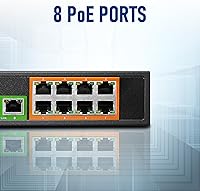
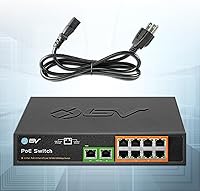
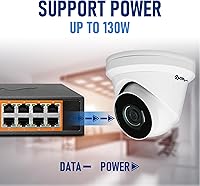
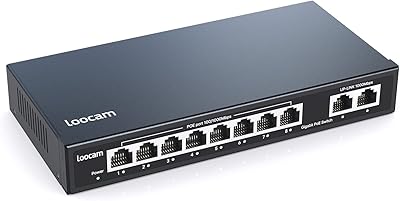
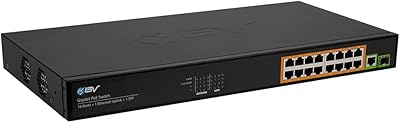
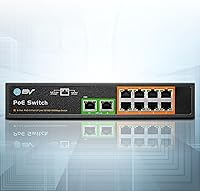
The BV-Tech POE-SW802G 8-Port Gigabit PoE+ Switch is a no-fuss, budget-conscious option for anyone who needs to power multiple network devices without running separate power adapters to each one. You get 8 PoE+ ports plus 2 dedicated gigabit uplink ports — 10 ports total — packed into a compact 1U chassis. There is no software to install, no web interface to configure; you plug it in and it works. With a 130W total power budget and full 802.3af/at compliance, it covers the most common PoE devices on the market. For small camera systems or wireless access point deployments, the value here is hard to argue with.
Features & Benefits

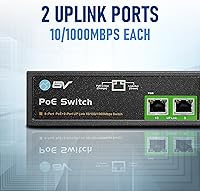
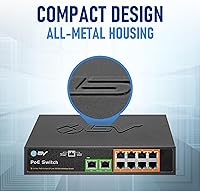
Each PoE+ port can deliver 30W per port, which comfortably handles most IP cameras, wireless access points, and VoIP phones. The two uplink ports connect straight to your router or core switch without crossover cable headaches, thanks to auto-MDI/MDI-X on every port. The built-in Power Detection circuit checks whether a connected device actually supports PoE before sending power, protecting your non-PoE equipment from accidental damage. A Green Energy mode adjusts output based on cable length and link activity, keeping idle power costs low. The compact 1U form factor fits on a shelf, in a rack, or tucked neatly into a small server closet with minimal fuss.

Best For

This PoE+ switch is a natural fit for small business owners wanting to run 4 to 8 IP security cameras without dealing with individual injectors at every location. Home lab users powering Ubiquiti or TP-Link access points will appreciate the zero-configuration approach — plug your APs in and they simply come up. IT installers handling quick office rollouts love not needing to open a browser just to get the switch running. It also covers small VoIP deployments where desk phones need both data and power over a single cable. If you need VLANs, QoS, or remote monitoring, look elsewhere — this is strictly for environments where simplicity wins.

User Feedback

Buyers consistently praise the out-of-box experience, with most reporting their camera or access point systems up and running in under ten minutes. Long-term stability earns positive marks too, with several owners citing reliable operation across extended camera network deployments. On the flip side, some users flag the shared 130W pool as a genuine constraint — load all eight ports with high-draw devices and the math gets tight fast. Heat is generally well-managed for a fanless unit, though the plastic enclosure does feel lightweight. Value sentiment leans positive compared to name-brand alternatives, but a handful of buyers note they eventually outgrew the BV-Tech switch once their network complexity increased.

Pros

  • True plug-and-play setup — most users report being fully operational within minutes of unboxing.
  • The 130W power budget comfortably supports mixed small deployments of cameras and access points.
  • Full 802.3af/at compliance means broad compatibility with virtually all standard PoE devices.
  • The Power Detection circuit actively protects non-PoE equipment from accidental power delivery.
  • Compact 1U form factor fits neatly on a shelf, in a rack, or inside a small network cabinet.
  • Green Energy mode reduces idle power draw, which adds up meaningfully over continuous 24/7 operation.
  • Auto-MDI/MDI-X on every port eliminates crossover cable headaches entirely.
  • Long-term operational stability is frequently noted by buyers running always-on camera systems.
  • At its price tier, the performance-to-cost ratio is genuinely strong compared to name-brand alternatives.

Cons

  • No management interface means zero visibility into port status, traffic, or device health.
  • The 130W shared budget gets stretched dangerously thin when all eight ports are loaded with high-draw devices.
  • Plastic enclosure feels lightweight and may not hold up well in demanding physical environments.
  • Completely unscalable — there is no upgrade path or feature expansion possible on an unmanaged switch.
  • No VLAN support makes it unsuitable for any network requiring traffic segmentation or security isolation.
  • No QoS controls mean latency-sensitive traffic like VoIP cannot be prioritized over bulk data transfers.
  • Fanless thermal management works adequately in cool spaces but has not been tested in warm enclosed cabinets.
  • Lack of redundant power input means a single power supply failure takes down all connected PoE devices.

Ratings

The scores below reflect AI-driven analysis of verified global buyer reviews for the BV-Tech POE-SW802G 8-Port Gigabit PoE+ Switch, with spam, incentivized, and bot-generated feedback actively filtered out before scoring. Each category captures both the genuine strengths users praised and the real frustrations they encountered in day-to-day deployments. Nothing has been softened — the numbers reflect what actual buyers experienced.

Ease of Setup
94%
Buyers consistently describe getting their camera systems or access points online within minutes of opening the box. There is no app to download, no login page to find, and no configuration steps to stumble through — it simply works the moment power and cables are connected.
The zero-configuration design, while great for simple deployments, leaves advanced users with no fallback when something does not behave as expected. Without any interface, diagnosing a misbehaving port or a power negotiation issue requires external tools.
PoE Reliability
88%
Users running always-on IP camera systems report stable, uninterrupted PoE delivery over extended periods — often months without a single device dropout. The 802.3af/at compliance means standard-compliant cameras and access points power up cleanly every time.
A small number of buyers noted occasional power negotiation delays at startup, particularly with certain third-party cameras. These appear isolated rather than systematic, but they are worth noting for deployments where instant boot reliability is critical.
Power Budget
67%
33%
For typical mixed deployments running 4 to 6 standard IP cameras or access points drawing 10 to 15W each, the 130W shared budget is more than adequate and rarely a concern in practice.
Filling all 8 ports with devices drawing close to the 30W maximum is simply not possible within a 130W envelope — and some buyers discovered this the hard way. The marketing of 30W per port can mislead buyers into assuming the full rated power is available simultaneously on every port.
Build Quality
61%
39%
The compact chassis stays tidy on a shelf or in a rack, and the overall assembly feels solid enough for a light commercial or home lab environment where it will not be frequently handled or moved.
The all-plastic enclosure is a recurring point of criticism, particularly from IT professionals who expect metal housings at this port count. Several buyers flagged that it feels noticeably lightweight, which raises doubts about long-term durability in busier or warmer installations.
Value for Money
91%
Compared to name-brand alternatives offering a similar 8-port PoE+ configuration, this unmanaged gigabit switch comes in significantly cheaper without sacrificing the core functionality most buyers actually need. For small installs on tight budgets, the price-to-performance ratio is difficult to beat.
The value calculation shifts once you factor in the absence of any management features. Buyers who later need VLANs or monitoring end up replacing it entirely, making the initial savings feel less compelling in retrospect.
Thermal Management
76%
24%
Running fanless means the switch operates in complete silence, which is a genuine selling point for office environments or home installations where noise matters. Under typical partial loads, passive cooling handles heat dissipation without issue.
In warmer enclosed spaces — think a closet cabinet with limited airflow — a few buyers reported the chassis getting noticeably warm under sustained full-load conditions. There is no thermal monitoring or protection indicator, so users have no way to know if heat is becoming a concern.
Port Count & Layout
83%
Ten ports total — 8 PoE+ and 2 uplink — is a practical configuration for small deployments, and having dedicated uplink ports means you are not sacrificing powered device slots just to connect to your router.
For anyone whose deployment grows beyond 8 PoE devices, there is no expansion path on this switch. Buyers who anticipated modest growth often found themselves shopping for a larger switch sooner than expected.
Device Compatibility
86%
Full IEEE 802.3af/at compliance translates to broad real-world compatibility across cameras, wireless access points, VoIP phones, and similar standard PoE devices from virtually every major brand. The Power Detection circuit adds a layer of safety for mixed environments.
Proprietary high-power PoE variants — like Cisco UPOE or certain passive PoE implementations used by some older Ubiquiti hardware — are not supported. Buyers with non-standard powered devices should verify compatibility before purchasing.
Network Performance
89%
Gigabit speeds across all 10 ports handle modern IP camera streams, 802.11ac access point backhaul, and VoIP traffic without bottlenecks in small network environments. Auto-MDI/MDI-X on every port eliminates cable-type headaches entirely.
As an unmanaged switch, there is no traffic prioritization — latency-sensitive applications like VoIP share bandwidth equally with bulk transfers. In most small deployments this is a non-issue, but it is a real limitation in busier mixed-use environments.
Energy Efficiency
78%
22%
The Green Energy feature dynamically scales power consumption based on active port usage and cable length, which adds up meaningfully for a device running continuously around the clock in a surveillance or network deployment.
The actual energy savings are difficult for end users to verify independently, and BV-Tech provides limited published data on real-world power draw under varying load conditions. Buyers expecting dramatic electricity savings may find the impact modest in practice.
Physical Footprint
82%
18%
The 1U compact form factor makes it easy to tuck into a small rack, sit on a narrow shelf, or fit inside a network closet where space is limited. Its relatively light weight also makes wall-shelf or overhead-shelf placement practical.
The lack of included rack ears or mounting hardware means users who want a clean rack installation need to source their own solution. For a product positioned partly at small business rack environments, this feels like an oversight.
Documentation & Support
58%
42%
Basic setup requires no documentation at all given the plug-and-play design, and most buyers never need to consult a manual. For straightforward installations, the lack of documentation is not a barrier.
When issues do arise, the available documentation and manufacturer support resources are thin. Several buyers reported difficulty getting meaningful technical assistance, which is a real concern for small business installers who need reliable post-sale support.

Suitable for:

The BV-Tech POE-SW802G 8-Port Gigabit PoE+ Switch is purpose-built for buyers who need a straightforward, affordable way to power multiple network devices from a single unit. Small business owners setting up 4 to 8 IP security cameras will find it particularly well-matched, eliminating the need for individual PoE injectors at every camera location. Home lab users and IT enthusiasts running Ubiquiti, TP-Link, or similar wireless access points benefit from the zero-configuration setup — there is genuinely nothing to configure, which saves time on simple deployments. VoIP installers powering a handful of desk phones in a small office will also get solid mileage here. For anyone who values simplicity over advanced control, and whose network needs fall within the 130W shared power envelope, this unmanaged gigabit switch delivers dependable performance at a hard-to-beat price point.
Not suitable for:

The BV-Tech POE-SW802G 8-Port Gigabit PoE+ Switch is not the right tool for anyone managing a network that requires even basic configuration capabilities. If your environment demands VLANs, QoS prioritization, port mirroring, SNMP monitoring, or any form of remote management, this switch simply cannot deliver — it has no management interface whatsoever. Network administrators responsible for medium or large deployments will quickly hit its ceiling, both in port count and in the 130W shared power budget, which becomes uncomfortably tight if you are running eight high-draw devices simultaneously. The plastic enclosure also raises valid concerns in commercial environments where physical durability and long-term hardware reliability are non-negotiable. Anyone anticipating network growth, increasing device complexity, or requiring redundancy and failover features should budget for a managed switch from the outset rather than replacing this one later.
Specifications

  • Model Number: The manufacturer model number for this switch is POE-SW802G.
  • Total Ports: The switch features 10 ports total: 8 PoE+ data ports and 2 dedicated Gigabit Ethernet uplink ports.
  • PoE Standard: All 8 PoE ports are fully compliant with IEEE 802.3af and 802.3at (PoE+) standards.
  • PoE Power Budget: The total shared PoE power budget across all 8 ports is 130W.
  • Per-Port PoE Output: Each PoE+ port can deliver a maximum of 30W to a connected powered device.
  • Data Transfer Rate: All ports support 10/100/1000 Mbps (Gigabit) speeds with auto-negotiation.
  • Port Interface: All 10 ports use RJ-45 connectors with auto-MDI/MDI-X, eliminating the need for crossover cables.
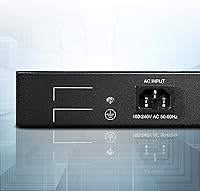
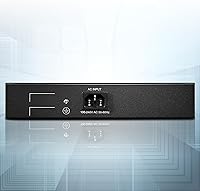
  • Power Supply: The switch uses an internal 48V DC power supply rather than an external adapter brick.
  • Management Type: This is a fully unmanaged switch with no configuration interface, web UI, or CLI.
  • Safety Circuit: A built-in Power Detection circuit ensures PoE power is only delivered to compatible powered devices.
  • Energy Efficiency: Green Energy technology dynamically reduces power output based on cable length and port activity.
  • Form Factor: The 1U compact chassis is suitable for desktop placement or shallow rack/shelf mounting.
  • Dimensions: Physical dimensions are 11.25 x 7 x 1.75 inches (L x D x H).
  • Enclosure Material: The outer housing is constructed from plastic.
  • Operating Voltage: The switch operates at 48V DC supplied internally.
  • Included Items: The package includes the PoE switch unit; no additional uplink cables or mounting hardware are specified in the box contents.

Related Reviews

LINOVISION POE-SW508G Industrial 8-Port PoE++ Switch
77%
91%
Power Delivery
88%
Build Quality
93%
PoE Watchdog
84%
Installation Ease
86%
Thermal Performance
More
YuLinca 6-Port Gigabit PoE Switch with 4 PoE+ Ports
87%
95%
Ease of Installation
88%
PoE Functionality
91%
Build Quality
87%
Performance and Speed
94%
Fanless Operation (Noise)
More
BV-Tech 6-Port PoE+ Network Switch
81%
94%
Ease of Setup
91%
Value for Money
78%
PoE Power Delivery
52%
Network Speed Performance
88%
Build Quality
More
Cqenpr 8-Port Gigabit PoE Switch
87%
91%
Value for Money
89%
Ease of Setup
86%
Performance & Reliability
88%
Build Quality & Durability
92%
Outdoor Suitability
More
Loocam 8-Port Gigabit PoE Switch
81%
92%
Ease of Setup
88%
PoE Power Budget
85%
Performance Stability
90%
Noise Level
80%
Build Quality
More
BV-Tech 16 Ports PoE+ Switch 230W
87%
92%
Power Delivery
88%
Ease of Installation
90%
Build Quality
86%
Reliability
94%
Fan Noise
More
YuanLey 8-Port 120W Gigabit PoE Switch
80%
91%
Value for Money
94%
Ease of Setup
78%
PoE Power Delivery
83%
Build Quality
74%
Thermal Performance
More
Reidubo 8-Port Gigabit PoE Switch 120W
86%
92%
Value for Money
89%
Ease of Setup
90%
Power Delivery
88%
Build Quality
85%
Performance Stability
More
MokerLink 8-Port Outdoor Gigabit PoE Switch
81%
93%
Ease of Setup
84%
Build Quality
81%
PoE Performance
77%
Weather Resistance
89%
Gigabit Throughput
More
NETGEAR GS308PP 8-Port PoE+ Gigabit Ethernet Switch
85%
93%
Setup & Installation
88%
Performance & Reliability
90%
PoE+ Functionality
84%
Build Quality & Design
91%
Noise Level (Fanless Design)
More

FAQ

None at all. You plug it into power, connect your uplink cable to your router, and start connecting devices. There is no web interface, no app, and no driver to install. It is about as close to instant deployment as a network switch gets.

Yes, most Ubiquiti UniFi access points are 802.3af or 802.3at compliant and will power up without any issue. Just plug the AP into any of the 8 PoE ports and it will negotiate power automatically. No injector needed.

The built-in Power Detection circuit checks whether the connected device is PoE-compatible before sending any power. If it is not a PoE device, only data is passed through — your equipment will not be damaged by accidental power delivery.

It depends entirely on what you are connecting. If your devices draw around 10 to 15W each — which covers most IP cameras and basic access points — you will be fine across all 8 ports. However, if you are connecting devices that pull close to the 30W maximum, you will exhaust the budget before filling all 8 ports. Always add up the expected wattage of your devices before assuming full capacity.

As long as your cameras use standard 802.3af or 802.3at PoE, they will work. The BV-Tech POE-SW802G 8-Port Gigabit PoE+ Switch is broadly compatible with cameras from Hikvision, Dahua, Reolink, Amcrest, and most other mainstream brands that follow the standard.
It runs fanless, so there is no fan noise at all. In a quiet office or home environment it is completely silent. Thermal management relies on passive heat dissipation through the chassis, which works adequately under normal load conditions.

The 1U form factor is rack-compatible in terms of height, but it does not include rack ears or mounting hardware in the box. Many users sit it on a shelf inside a rack or use a generic 1U shelf bracket. If proper rack mounting matters to you, factor in that extra step.

The 8 PoE ports are where you connect your powered devices — cameras, access points, phones. The 2 uplink ports are standard Gigabit ports without PoE, intended for connecting the switch to your router or a larger core switch. They carry data only, not power.

If your NVR accepts power via PoE and complies with 802.3af or 802.3at, then technically yes. That said, most NVRs draw significant wattage, so connecting one alongside several cameras will eat into your 130W budget quickly. Plan your power budget carefully before committing.

The core difference is control. Managed switches let you configure VLANs, set QoS rules, monitor port traffic, and remotely troubleshoot issues. This unmanaged gigabit switch does none of that — it just forwards traffic and delivers power. For simple, fixed deployments that will not change much, that trade-off is completely acceptable. For anything more complex, a managed switch is worth the extra investment.