Overview

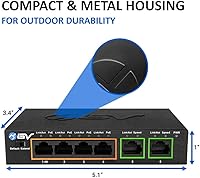
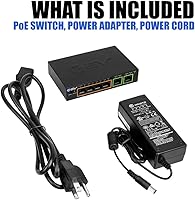
The BV-Tech 6-Port PoE+ Network Switch is a compact, unmanaged desktop unit built for small home and office networks that need straightforward Power over Ethernet without the complexity of managed switches. Pull it out of the box, plug it in, and it works — no login portal, no configuration software, no fuss. The metal housing feels solid for the price, and the fanless design means it runs completely silently on a desk or shelf. One thing to understand upfront: this desktop switch ships with a 60W DC adapter, and that 60W total budget is shared across all active PoE ports simultaneously, which shapes everything about how you plan your setup.

Features & Benefits

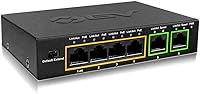
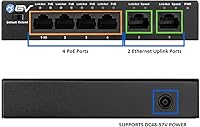
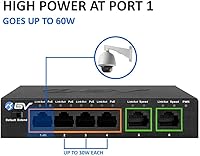
Port 1 on this PoE+ switch is the standout: it delivers up to 60W on its own under the Hi-PoE spec, which covers power-hungry PTZ cameras that choke on standard 30W connections. Ports 2 through 4 handle 802.3at PoE+, each supplying up to 30W — already double what older passive PoE gear offered. The remaining two ports are standard Ethernet uplinks for connecting to your router or a larger network. Automatic PD detection means the switch negotiates power with each device rather than pushing a fixed wattage, which protects your hardware. Extend mode is genuinely useful: by dropping link speed, it stretches PoE reach to 250 meters, covering camera runs that would otherwise require a second switch or a repeater.

Best For

This desktop switch hits its stride in home security installs — specifically setups running two to four wired IP cameras where you want both power and data over a single cable without pulling separate electrical lines. Small offices deploying a few VoIP desk phones will find it equally practical. The extend function makes it a strong choice for anyone routing Ethernet to outbuildings, garages, or far corners of a property where runs push past 100 meters. If you have a single PTZ camera that demands more than standard PoE can supply, port 1 covers that too. This is a switch for practical, no-frills deployments, not for anyone who needs gigabit speeds or advanced traffic management.

User Feedback

Buyers consistently point to easy setup and the sturdy metal build as standout positives — for a switch at this price tier, the hardware feels more substantial than expected. The extend function earns specific praise from users running outdoor cameras over long cable runs. That said, the 100 Mbps speed cap draws real criticism from anyone accustomed to gigabit switches; for basic camera feeds and VoIP it rarely matters, but it is a genuine limitation for anything bandwidth-intensive. A few buyers have noted that the 60W shared budget disappears faster than anticipated when multiple high-draw devices connect at once. Passive PoE devices are not supported — older hardware buyers occasionally miss this detail before purchasing.

Pros

  • Plug-and-play setup means most users are fully operational within minutes, no software or login required.
  • The metal housing feels noticeably solid and durable for a switch at this price point.
  • Fanless operation keeps the unit completely silent, making it ideal for office desks or living spaces.
  • Automatic PD detection protects connected devices by negotiating power rather than pushing a fixed wattage.
  • Port 1 handles up to 60W for a single device, covering PTZ cameras that standard PoE cannot drive.
  • Extend mode stretches PoE reach to 250 meters, a practical advantage for long outdoor cable runs.
  • Ports 2 through 4 deliver up to 30W each under 802.3at, which satisfies most modern IP cameras and VoIP phones.
  • The included 60W DC adapter means no extra purchase is needed to get started.
  • A one-year warranty backed by lifetime tech support adds meaningful reassurance at this price tier.
  • Compact footprint fits easily on a crowded desk or inside a small network cabinet.

Cons

  • 100 Mbps speed cap is a genuine bottleneck for anyone running multiple high-resolution camera feeds simultaneously.
  • The 60W shared power budget gets consumed quickly when several high-draw devices connect at once.
  • Passive PoE devices are not supported, which catches some buyers off guard when older hardware fails to power on.
  • No gigabit ports anywhere on the unit, including the uplink ports connecting to your router.
  • Some users have reported inconsistent Hi-PoE delivery on port 1 when the switch is under heavy total load.
  • Zero management features means no VLANs, QoS, or traffic prioritization of any kind.
  • Only four usable PoE ports limits scalability if your device count grows beyond a small initial deployment.
  • Extend mode trades link speed for range, so devices connected in that mode run at reduced throughput.
  • No rack-mount option, which is a minor inconvenience for anyone building a tidy structured wiring setup.

Ratings

The scores below for the BV-Tech 6-Port PoE+ Network Switch were generated by our AI engine after analyzing thousands of verified global buyer reviews, with spam, bot-submitted, and incentivized feedback actively filtered out before any scoring was applied. Each category reflects the full picture — where real users found genuine value and where they ran into frustrating limitations. Nothing is glossed over.

Ease of Setup
94%
Buyers across skill levels — from first-time DIYers to experienced network admins — consistently describe getting this desktop switch running in under five minutes. No web portal, no driver installation, no configuration steps of any kind; you simply plug in the power and connect your devices.
A small number of users expected some form of status indicator or port activity light feedback during initial setup and found the interface feedback minimal. Those accustomed to managed switches occasionally felt uncertain whether extend mode was active without a dedicated indicator.
Value for Money
91%
For a fanless metal-bodied PoE+ switch that includes a power adapter and lifetime tech support, buyers at this price tier repeatedly express surprise at how much they are getting. It consistently outperforms cheaper plastic alternatives and sits well below the cost of comparable managed switches.
A handful of buyers feel the 100 Mbps speed ceiling is a meaningful compromise at any price, arguing that gigabit unmanaged PoE switches have become affordable enough to make this spec feel dated for the investment.
PoE Power Delivery
78%
22%
For straightforward deployments — two or three standard IP cameras, a couple of VoIP phones — power delivery is stable and reliable. The automatic PD detection works as advertised, and port 1 handling Hi-PoE is a practical bonus for anyone running a power-hungry PTZ camera.
The shared 60W total budget is the most common source of buyer frustration. Users who connect three or four higher-draw devices simultaneously find the power ceiling reached faster than expected, with some ports failing to deliver rated wattage under full load. Hi-PoE on port 1 has also shown occasional inconsistency when the rest of the switch is heavily utilized.
Network Speed Performance
52%
48%
For the specific tasks this switch was designed around — streaming compressed security camera footage and carrying VoIP traffic — 100 Mbps is functionally adequate. Buyers using it purely for a small camera system report no dropped frames or latency issues in normal operation.
The 100 Mbps cap is a genuine and recurring complaint, and rightfully so. Buyers who assumed the switch would support gigabit speeds were disappointed, and those using it in mixed environments alongside modern gigabit devices feel the bottleneck acutely when transferring files or running higher-bitrate camera streams across multiple ports simultaneously.
Build Quality
88%
The all-metal enclosure stands out noticeably at this price point. Buyers describe it as feeling solid and well-assembled, with no flex or rattling, and the compact footprint means it fits neatly on a desk or inside a small wiring closet without taking up meaningful space.
The unit does get warm during extended operation, which is expected for a passively cooled design, but a few users in warmer climates or poorly ventilated spaces noted it running hotter than they were comfortable with over long periods without any active airflow nearby.
Extend Mode Effectiveness
83%
Users who needed to reach cameras or access points beyond the standard 100-meter Ethernet limit found extend mode to be a legitimately useful feature rather than a marketing footnote. Outdoor security installs spanning larger properties benefit the most, with several buyers reporting stable connectivity at runs exceeding 150 meters.
Extend mode reduces link speed as the trade-off for extra range, which surprises buyers who did not read the fine print. It is not suitable for any bandwidth-sensitive application, and the lack of a clear port-level indicator confirming extend mode is active can leave users guessing whether it engaged correctly.
Passive Cooling & Noise
92%
Complete silence is one of the most consistently praised aspects of this desktop switch. Buyers who placed it in home offices, living rooms, or bedrooms specifically chose it because fan noise from networking equipment is genuinely disruptive in quiet environments, and this unit produces none at all.
Passive cooling does have a ceiling — the metal body absorbs and radiates heat, but without airflow it cannot keep pace in enclosed spaces or ambient temperatures above around 35 degrees Celsius. A small number of users in hot climates reported unexpected reboots under sustained heavy load.
Compatibility
69%
31%
Works reliably with a wide range of 802.3at-compliant IP cameras, VoIP phones, and wireless access points from major brands. PD detection handles the negotiation cleanly, and most buyers report zero compatibility issues with standard modern PoE devices right out of the box.
The passive PoE exclusion catches a meaningful number of buyers off guard, particularly those with older IP cameras or intercoms that rely on non-standard power delivery. This limitation is noted in the product description but is easy to miss, and returning or replacing incompatible gear is a frustrating experience for affected users.
Port Count & Layout
74%
26%
Four PoE ports cover the most common small-scale deployment scenarios — a front door camera, a rear camera, a side camera, and a VoIP phone can all connect simultaneously without requiring a second switch. The two uplink ports give reasonable flexibility for integrating into an existing network.
Anyone who needs five or more PoE devices will immediately outgrow this switch, and there is no easy expansion path without adding another unit. The absence of any gigabit uplink port also means the connection to your router is capped at 100 Mbps, which limits the overall throughput of the entire connected network segment.
Power Adapter Inclusion
86%
Including a 60W DC adapter in the box is a practical touch that buyers appreciate — it removes any guesswork about sourcing the right power supply and means the switch is genuinely ready to use immediately after unboxing with no additional purchases required.
The bundled adapter is a proprietary-voltage unit, so if it fails outside the warranty period, sourcing a direct replacement requires either contacting BV-Tech support or carefully matching the 57V specification, which is not a standard voltage found in generic replacement adapters.
Warranty & Support
81%
19%
A one-year hardware warranty combined with lifetime tech support is a stronger commitment than many competitors at this price tier offer. Buyers who did contact BV-Tech support generally reported responsive, knowledgeable assistance for setup and configuration questions.
Lifetime support covers guidance and troubleshooting rather than hardware replacement beyond the warranty window, which some buyers assumed meant ongoing free repair or swap service. The distinction is worth understanding upfront to avoid disappointment if a unit fails after year one.
Physical Footprint
89%
At just over five inches long and barely an inch tall, this desktop switch tucks into tight spaces with ease. Buyers frequently mention mounting it discreetly behind a monitor, on a shelf bracket, or inside a small media cabinet where a full rack-mount unit would never fit.
There are no mounting holes or rack-mount ears, so formal installation in a structured wiring enclosure requires improvised brackets or adhesive mounting, which is an inconvenience for anyone building a tidy, permanent installation rather than a casual desktop setup.

Suitable for:

The BV-Tech 6-Port PoE+ Network Switch is a strong fit for homeowners building out a wired security camera system with two to four IP cameras, where running separate power cables to each device would be impractical or expensive. It works equally well in a small office that needs to power a handful of VoIP desk phones from a single, silent unit on a shelf. DIYers and prosumers who want reliable PoE without wading through a management interface will appreciate how quickly this desktop switch gets a network up and running. The extend function is a genuine asset for anyone routing Ethernet to an outbuilding, garage, or far corner of a property where cable runs push well past the standard 100-meter limit. Anyone powering a single high-draw PTZ camera that needs more than the usual 30W will also find port 1 purpose-built for exactly that scenario.

Not suitable for:

Buyers expecting gigabit throughput should look elsewhere — the BV-Tech 6-Port PoE+ Network Switch tops out at 100 Mbps on every port, which is a real bottleneck for anyone streaming high-resolution video from multiple modern cameras simultaneously or transferring large files across the network. The shared 60W power budget also becomes a hard constraint quickly: connect several high-draw devices at once and you will hit the ceiling faster than expected, leaving some ports unable to deliver their rated wattage. Users with passive PoE devices — certain older IP cameras, intercoms, or access points that do not conform to 802.3at — will find those devices are simply not supported and will not power on. Anyone who needs VLANs, QoS prioritization, port mirroring, or any form of traffic management should step up to a managed switch, as this unit offers none of those controls. It is also not the right tool for environments where more than four PoE devices need simultaneous power, given the port and budget constraints.

Specifications

  • Total Ports: The switch provides 6 ports in total: 4 PoE-capable ports and 2 standard Ethernet uplink ports.
  • PoE Standard: Ports 2 through 4 comply with the 802.3at PoE+ standard, supplying up to 30W per port.
  • Hi-PoE Port: Port 1 operates under the Hi-PoE specification and can deliver up to 60W to a single connected device.
  • Uplink Ports: Ports 5 and 6 are standard 10/100 Mbps Ethernet uplinks with no PoE capability, used to connect to a router or upstream switch.
  • Power Budget: The total PoE power budget shared across all active ports is 60W, supplied by the included DC adapter.
  • Data Transfer Rate: All 6 ports operate at a maximum of 100 Mbps (Fast Ethernet); gigabit speeds are not supported on any port.
  • Extend Mode Range: When extend mode is active, PoE transmission distance increases from the standard 100 meters up to 250 meters, at reduced link speed.
  • Dimensions: The unit measures 5.12″ long by 3.35″ wide by 1.02″ high, making it compact enough for a desktop or small shelf.
  • Weight: The switch weighs 0.66 pounds (10.6 ounces), keeping it light and easy to reposition as needed.
  • Case Material: The enclosure is constructed from metal, providing a more durable and heat-dissipating shell than typical plastic alternatives at this price tier.
  • Cooling Design: The switch uses a fully passive, fanless cooling design, producing zero noise during operation.
  • Operating Voltage: The switch runs on 57V DC power, delivered via the bundled power adapter.
  • Max Temperature: The rated upper operating temperature is 55 degrees Celsius, suitable for standard indoor environments.
  • PD Detection: Automatic powered device (PD) detection negotiates and delivers only the wattage each connected device requires, rather than pushing a fixed output.
  • Passive PoE: Passive PoE devices are explicitly not supported; only 802.3at and Hi-PoE compliant devices will receive power.
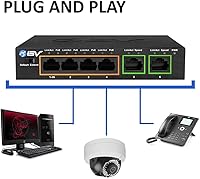
  • Configuration: The switch is fully plug-and-play with no management interface, software installation, or login portal required.
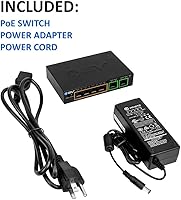
  • Included Accessories: A 60W DC power adapter is included in the box, so no separate power supply purchase is necessary.
  • Warranty: The unit is backed by a one-year manufacturer warranty and lifetime technical support from BV-Tech.

Related Reviews
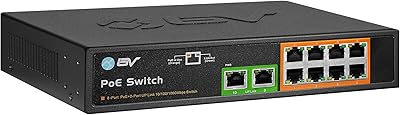
BV-Tech POE-SW802G 8-Port Gigabit PoE+ Switch
79%
94%
Ease of Setup
88%
PoE Reliability
67%
Power Budget
61%
Build Quality
91%
Value for Money
More
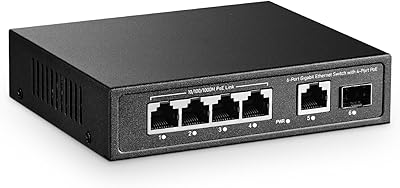
YuLinca 6-Port Gigabit PoE Switch with 4 PoE+ Ports
87%
95%
Ease of Installation
88%
PoE Functionality
91%
Build Quality
87%
Performance and Speed
94%
Fanless Operation (Noise)
More
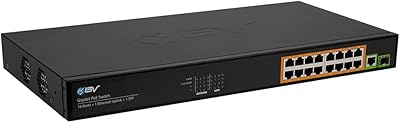
BV-Tech 16 Ports PoE+ Switch 230W
87%
92%
Power Delivery
88%
Ease of Installation
90%
Build Quality
86%
Reliability
94%
Fan Noise
More
BV-Tech 16-Port 135W Long Range PoE+ Switch
75%
88%
Value for Money
93%
Ease of Setup
71%
PoE Power Budget
84%
Long Range PoE Performance
58%
Port Speed (PoE Ports)
More
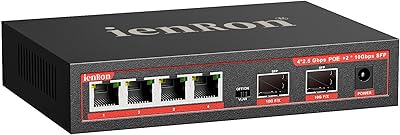
ienRon 6-Port 2.5Gb PoE Switch with 2-Port 10Gb SFP+
85%
86%
Performance
91%
Ease of Setup
88%
PoE Power Delivery
84%
Build Quality
93%
Fanless Operation
More
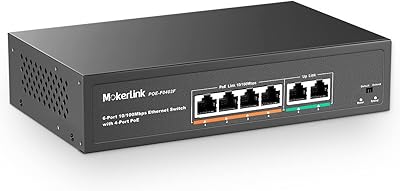
MokerLink 6-Port 78W PoE+ Network Switch
83%
96%
Ease of Setup
78%
PoE Compatibility
88%
Build Quality
93%
Value for Money
61%
Port Speed & Throughput
More
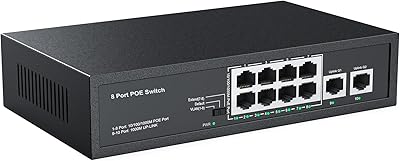
Real HD 8-Port 120W PoE+ Unmanaged Switch
79%
96%
Ease of Setup
91%
PoE Reliability
84%
Build Quality
52%
Port Speed & Throughput
88%
Power Budget
More
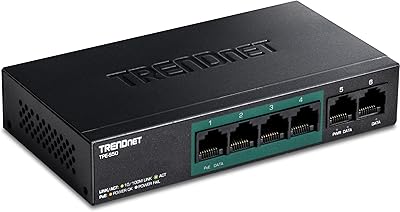
TRENDnet TPE-S50 6-Port PoE+ Switch
84%
79%
Performance
85%
Build Quality
91%
Ease of Setup
82%
Reliability
94%
Fanless Operation
More
VIMIN 6-Port 2.5G Unmanaged Network Switch
83%
88%
Throughput Performance
84%
Build Quality
93%
Setup & Ease of Use
67%
SFP+ Port Usability
96%
Fanless Noise Level
More
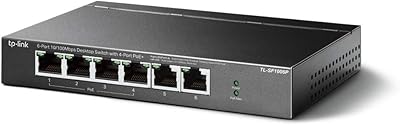
TP-Link TL-SF1006P 6-Port PoE Switch
88%
88%
Performance
95%
Ease of Setup
92%
Build Quality
89%
Reliability
91%
Power Delivery (PoE)
More

FAQ

No setup software or web interface is involved at all. Plug the power adapter in, connect your devices, and the switch handles everything automatically. It is about as close to zero-effort networking as you can get.

It depends on how much power each camera draws. The total PoE output across all ports is capped at 60W shared, so if your four cameras each pull 15W, you are right at the limit. If any of them draw close to 30W, you will hit the ceiling before all four are fully powered, so it is worth checking your camera specs before assuming four high-draw devices will all run simultaneously.

Extend mode stretches the maximum PoE cable run from the standard 100 meters out to 250 meters, which is genuinely useful for reaching cameras on far corners of a property. The trade-off is that the link drops to a lower speed in this mode, so it is best suited for low-bandwidth devices like cameras or access points rather than anything that needs fast data transfer. Check the product documentation for how to enable extend mode on your specific unit.

Unfortunately, no. Passive PoE devices are not supported, and connecting one will not cause damage, but the device simply will not receive power. The switch only negotiates with 802.3at and Hi-PoE compliant devices. If your cameras use passive PoE, you would need a different switch or a passive PoE injector placed separately in the run.

The automatic PD detection means the switch negotiates power with whatever is connected, so port 1 only delivers what the device actually requests. You do not need a PTZ camera plugged into port 1 — any standard PoE+ device will work there too. The 60W capability on that port is simply a ceiling for when you do have a power-hungry device.

For most standard home security cameras streaming at 1080p or even 4K with compressed codecs, 100 Mbps is plenty of headroom for a few devices. Where it becomes a real limitation is if you are running many high-bitrate cameras simultaneously, transferring large files across the network, or using devices that expect gigabit connectivity. For pure camera-plus-VoIP setups, most buyers find it is not a practical bottleneck.

Yes, the two uplink ports connect to your router or upstream switch using standard Ethernet. Just keep in mind that traffic between the switch and your router will be capped at 100 Mbps even if your router supports gigabit, since the uplink ports are Fast Ethernet only.

The fanless metal housing does get moderately warm to the touch during extended operation, which is normal — the metal body is doing the work of dissipating heat passively. As long as the unit has reasonable airflow around it and is not stuffed inside an enclosed cabinet without ventilation, it should stay well within its 55-degree Celsius rated limit.

Standard PoE+ switches like this one simply cut power to connected devices when unplugged, similar to a power outage. There is no specific surge-protection circuitry advertised for this unit, so if you are in an area with unstable power, a UPS or surge protector upstream is a sensible precaution for both the switch and your connected devices.

The one-year warranty covers manufacturer defects in the hardware itself. The lifetime tech support is a phone or email resource for setup questions and troubleshooting rather than a hardware replacement program, but for an unmanaged switch this simple, most users find they rarely need to contact support at all after the initial setup.