
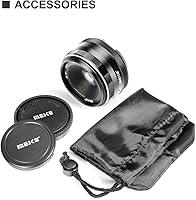
Overview

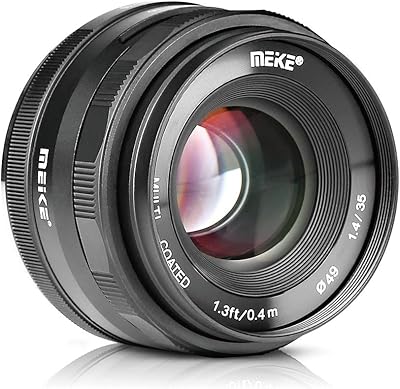
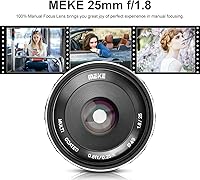
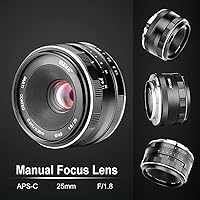
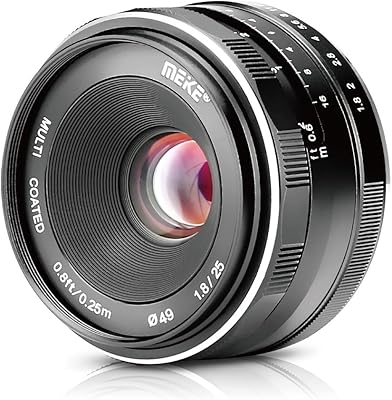
The Meike 25mm F1.8 Micro Four Thirds Lens is one of the more compelling budget manual primes available for M43 shooters who want genuine creative control without a heavy financial commitment. Meike has quietly built a reputation for producing affordable glass with surprising build quality, and this lens fits that pattern — an all-metal body that feels noticeably more solid than most plastic kit lenses in the same price range. On an M43 sensor, the 25mm focal length gives you a roughly 50mm full-frame equivalent, making it useful for everyday shooting. One thing worth stating clearly upfront: this is a manual focus only lens, which suits certain shooters perfectly and frustrates others entirely.

Features & Benefits

At F1.8, this manual prime lets in enough light to shoot comfortably in dim cafés, evening street scenes, or indoor spaces where a kit lens starts to struggle. The optical formula — 7 elements in 5 groups with multi-layer coatings — keeps flare reasonably controlled and delivers solid center sharpness. Edge softness wide open is real, but stop down to F2.8 or F4 and image quality tightens up noticeably. A minimum focus distance of 0.25m adds quiet versatility for close-up work or tight environmental shots. The focus ring feel is smooth and well-damped, something video shooters who pull focus manually will appreciate from the first time they use it.

Best For

This M43 lens is a natural fit for a few specific types of shooters. Street and travel photographers who want something light and discreet will find it easy to carry all day — at under 7 ounces, it barely registers on a compact body like the GH5 or OM-D. GH4, GH5, and GH6 videographers who already work in manual mode will adapt quickly, particularly for cinematic or run-and-gun work where smooth focus pulls matter. It is also a solid pick for M43 beginners who want hands-on practice with aperture and depth of field without a big investment. Close-up and environmental portrait work both benefit from that short minimum focusing distance.

User Feedback

Owners of the Meike 25mm F1.8 consistently praise the build quality for a lens at this price, noting the metal construction feels well above expectations. Center sharpness wide open earns solid marks, though edge performance at F1.8 draws mixed reactions — a trade-off most buyers accept once they understand it going in. Bokeh is generally described as smooth and pleasant at close range, though some chromatic aberration appears wide open in high-contrast situations. The most recurring complaint comes from buyers who did not realize the lens is manual only. Before shooting, you need to enable the release without lens option in your camera menu, or the shutter simply will not fire — a small setup step that trips up more new owners than anything else.

Pros

  • All-metal construction feels genuinely premium and durable for a lens at this price point.
  • F1.8 aperture handles low-light environments that would push a kit lens to its limits.
  • At under 7 ounces, this M43 lens barely adds bulk to a compact mirrorless body.
  • The smooth, well-damped focus ring is a real asset for video shooters pulling focus manually.
  • Center sharpness is strong at F2.8 and beyond, producing clean, detailed images.
  • Bokeh at close focusing distances is soft and pleasant for subject separation.
  • A 0.25m minimum focus distance opens up close-up shooting opportunities beyond typical primes.
  • Multi-layer coatings keep flare reasonably controlled in bright or backlit conditions.
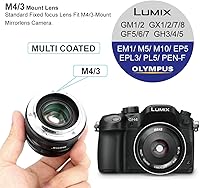
  • Compatible with a wide range of Panasonic Lumix and Olympus M43 bodies.
  • Represents a very accessible entry point into fast prime photography for M43 users on a budget.

Cons

  • No autofocus whatsoever — a hard dealbreaker for event, sports, or family photographers.
  • Edge softness wide open at F1.8 is noticeable and may bother detail-oriented shooters.
  • No electronic contacts mean zero EXIF lens data is recorded to image files.
  • Chromatic aberration appears in high-contrast areas when shooting wide open.
  • You must manually enable a release-without-lens setting in your camera before it will fire — easy to miss during setup.
  • Some M43 bodies may not compensate OIS correctly without focal length data from the lens.
  • Stopping down to F4 or F5.6 is often necessary to get edge sharpness comparable to pricier primes.
  • No weather sealing, which limits confidence shooting in light rain or dusty environments.
  • The fixed focal length offers no flexibility — you zoom with your feet or go without the shot.

Ratings

The scores below for the Meike 25mm F1.8 Micro Four Thirds Lens were generated by our AI system after analyzing verified global buyer reviews, with spam, bot submissions, and incentivized feedback actively filtered out. We examined feedback from street photographers, videographers, and everyday M43 shooters across multiple markets to ensure the ratings reflect genuine, real-world experiences. Both the standout strengths and the recurring frustrations are reflected honestly — nothing has been smoothed over.

Build Quality
88%
The all-metal barrel is the single most praised aspect of this lens across buyer reviews, with many users noting it feels more expensive than it actually is. Travelers and street shooters in particular appreciated that the body does not creak or flex under normal handling, which is not something you can say about most lenses at this price tier.
A small number of buyers noted minor inconsistencies in finish quality between units, suggesting production tolerances are not perfectly uniform. There is also no weather sealing whatsoever, which limits confidence in light rain or dusty outdoor environments.
Optical Sharpness
74%
26%
Center sharpness at F1.8 through F2.8 earns consistent praise, with users shooting street and travel photography reporting clean, detailed results in the middle of the frame. Stop down to F4 or F5.6 and the overall image quality tightens up noticeably, delivering results that many buyers described as punching well above the price.
Edge and corner sharpness wide open is a recurring complaint — subjects placed near the frame edges at F1.8 come out noticeably softer, which bothers architectural and landscape photographers in particular. This is not unusual for budget fast primes, but buyers expecting uniform sharpness across the frame will be disappointed.
Value for Money
91%
Among M43 shooters looking for an affordable fast prime, this manual lens consistently earns high marks for delivering a metal build, a bright aperture, and usable image quality at a price well below brand-name alternatives. Beginners learning manual exposure techniques found it an especially practical investment.
A subset of buyers who expected autofocus or electronic connectivity felt misled by the listing, ultimately rating value lower after realizing the limitations. For users who genuinely need AF or EXIF data recording, the value proposition collapses entirely regardless of build quality.
Aperture & Low-Light Performance
83%
The F1.8 maximum aperture makes a meaningful difference in dim shooting conditions — indoor events, evening street scenes, and low-lit cafés where kit lenses would force unacceptably high ISO values. Several vloggers and documentary-style video shooters highlighted this as the primary reason they chose this lens.
Chromatic aberration becomes visible at F1.8, particularly around high-contrast edges like window frames or bright streetlights against dark backgrounds. While manageable in post-processing, it does require an extra correction step that users shooting in JPEG straight from camera will notice in their final images.
Bokeh Quality
77%
23%
At close focus distances, the background blur produced by this lens is smooth and generally well-received for portrait and close-up work. Several users specifically mentioned shooting product photography and environmental portraits where the soft background helped subjects stand out clearly.
At longer subject distances, the bokeh becomes less smooth and can look slightly busy or nervous in complex backgrounds. Buyers comparing it directly to higher-end M43 primes noted that out-of-focus rendering lacks the polished quality of more expensive optics.
Manual Focus Feel
86%
The focus ring action is smooth and consistently well-damped, which earned strong praise specifically from video shooters pulling focus on GH5 and GH6 bodies. The resistance feels deliberate rather than loose, giving users reliable control when making slow, cinematic focus transitions.
Photographers accustomed to the tactile click stops of aperture rings on classic manual lenses may find the continuous rotation harder to use precisely for still shooting. A few users also noted the focus throw is relatively short, which makes very fine adjustments at close distances trickier than expected.
Ease of Setup
61%
39%
Once the camera's release-without-lens setting is properly enabled, the lens mounts and operates straightforwardly with no pairing, firmware, or additional configuration required. Users familiar with manual glass described the initial setup as taking under two minutes.
The requirement to enable a non-obvious camera menu setting before the shutter will fire is a consistent source of frustration in reviews, with multiple buyers initially concluding the lens was defective. This single setup hurdle accounts for a disproportionate share of negative ratings and one-star reviews across retail platforms.
Portability & Size
89%
At 6.7 ounces and a compact cylindrical form factor, this M43 lens barely registers as added weight on a small mirrorless body. Travel photographers and street shooters repeatedly cited the ability to carry it all day without fatigue as a genuine practical advantage over heavier zoom lenses.
The compact size, while generally praised, does make gripping and turning the focus ring slightly less comfortable for users with larger hands during extended shooting sessions. A few buyers noted the lens hood is sold separately, which adds cost and bulk if you want front-element protection.
Compatibility
84%
Confirmed compatibility across a wide range of Panasonic Lumix and Olympus M43 bodies — including the GH4, GH5, GH6, E-M1, E-M5, and E-M10 series — was frequently mentioned as a strong positive. The standard M43 mount fits securely with no wobble or looseness reported on any compatible body.
The complete absence of electronic contacts means in-body image stabilization on some cameras cannot auto-optimize for the 25mm focal length, requiring a manual workaround in camera settings. Additionally, no EXIF lens data is embedded in files, which complicates post-processing workflows that rely on lens profiles for automatic correction.
Flare & Coating Performance
71%
29%
Multi-layer coatings do a reasonable job of controlling flare in typical shooting conditions — overcast outdoor environments and indoor scenes present no notable issues. Users shooting with the sun positioned outside the frame reported clean results with good contrast retention.
Shooting directly toward strong light sources or including the sun in the frame reveals the coating limitations, with visible ghosting and contrast loss appearing in backlit scenarios. This is a known trade-off with budget optical glass and not unique to this lens, but it does limit its usefulness for intentional contre-jour photography.
Close-Up Capability
79%
21%
A 0.25m minimum focus distance gives this lens more close-up versatility than many standard primes, letting photographers get tight on small subjects like flowers, food, or product details without a dedicated macro lens. Several buyers used it effectively for flat-lay product photography and tabletop shooting.
At minimum focus distance, depth of field becomes extremely thin at F1.8, which demands very precise manual focus technique to keep the intended subject sharp. Users without experience in close manual focus work found this difficult to execute consistently in real shooting conditions.
Video Suitability
82%
18%
For M43 video shooters already working in manual mode, this lens fits naturally into a filmmaking workflow — the smooth focus ring, compact size, and bright aperture make it a practical B-camera or primary lens for vlogging, short films, and documentary-style work on a constrained budget.
The lack of electronic communication means aperture changes during recording are not logged and can cause exposure shifts that are difficult to control smoothly. Videographers who need precise, repeatable iris control for matched multi-camera shoots will find this limitation frustrating in practice.

Suitable for:

The Meike 25mm F1.8 Micro Four Thirds Lens is a strong match for photographers and videographers who already embrace manual control as part of their workflow rather than fighting against it. Street and travel shooters who prioritize a small, light, discreet kit will appreciate how little this lens adds to a compact GH5 or OM-D body — it genuinely disappears in a bag or on a wrist strap. For video creators on platforms like YouTube or those shooting short films on a GH4 or GH6, the smooth, well-damped focus ring makes manual pulls predictable and tactile. Beginners who want to deepen their understanding of aperture, depth of field, and focus technique will find this an affordable classroom. Anyone drawn to close-up or environmental portrait work will also benefit from the 0.25m minimum focus distance, which lets you get meaningfully close to subjects without needing a dedicated macro lens.

Not suitable for:

The Meike 25mm F1.8 Micro Four Thirds Lens is the wrong choice for anyone who depends on autofocus — whether for fast-moving subjects, family events, wildlife, or sports. There is no autofocus here at all, and no electronic communication with the camera body, which also means no EXIF lens data and no in-body optical image stabilization compensation for lens focal length on systems that require it. Photographers who shoot in unpredictable, fast-changing conditions will find manual focus a genuine liability, not a creative choice. If edge-to-edge sharpness at wide apertures is a priority — for architectural work or landscape photography where corner detail matters — this lens will disappoint wide open. Those looking for a professional-grade optic with consistent clinical sharpness across the full frame should look at more expensive alternatives from Panasonic or Olympus.

Specifications

  • Focal Length: Fixed 25mm focal length, equivalent to approximately 50mm on a full-frame sensor when used on a Micro Four Thirds body.
  • Maximum Aperture: Maximum aperture of F1.8 allows for shallow depth of field and effective shooting in low-light conditions.
  • Minimum Aperture: Minimum aperture of F16 provides flexibility for long-exposure and high-light shooting scenarios.
  • Lens Construction: 7 elements arranged in 5 groups, with multi-layer anti-reflection coatings applied to reduce flare and ghosting.
  • Focus Type: Manual focus only — no autofocus motor or electronic communication with the camera body is present.
  • Min. Focus Distance: Minimum focusing distance of 0.25m (approximately 9.8 inches) enables close-up and near-macro-style photography.
  • Field of View: Diagonal field of view of 61°, with a horizontal angle of 50° and a vertical angle of 35°.
  • Lens Mount: Designed exclusively for the Micro Four Thirds (M43) mount standard used by Panasonic Lumix and Olympus mirrorless cameras.
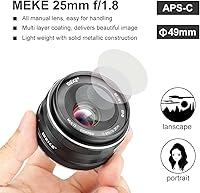
  • Body Material: Full metal barrel construction throughout, with no plastic external components.
  • Dimensions: Measures 2.38 × 2.38 × 1.61 inches (approximately 60.5 × 60.5 × 40.9 mm) in diameter and length.
  • Weight: Weighs 6.7 ounces (approximately 190g), making it one of the lighter fast prime options for M43 systems.
  • Aperture Range: Aperture adjusts manually from F1.8 through F16 via a dedicated aperture ring on the lens barrel.
  • Compatibility: Compatible with all Micro Four Thirds system cameras from Panasonic Lumix and Olympus, including the GH4, GH5, GH6, and OM-D series.
  • Filter Thread: Filter thread diameter is 46mm, accepting standard 46mm screw-on filters for UV, ND, or polarizing applications.
  • Manufacturer: Manufactured by HK Meike, a Hong Kong-based optical brand specializing in affordable lenses and camera accessories.
  • Weather Sealing: No weather sealing or moisture resistance is present on this lens.
  • EXIF Data: No electronic contacts are included, so lens metadata such as focal length and aperture are not recorded in image EXIF data.
  • Release Date: First made available for purchase in May 2018 and remains in active production as of the latest available information.

Related Reviews
Meike 25mm F1.8 Sony E-Mount Lens
78%
88%
Build Quality
74%
Optical Sharpness
81%
Bokeh & Background Blur
77%
Low-Light Performance
83%
Manual Focus Experience
More
Meike 50mm F1.8 Sony E Mount Lens
76%
93%
Value for Money
74%
Autofocus Speed & Accuracy
81%
Image Sharpness
86%
Bokeh Quality
68%
Build Quality & Feel
More
Meike 85mm F1.8 AF STM Portrait Lens
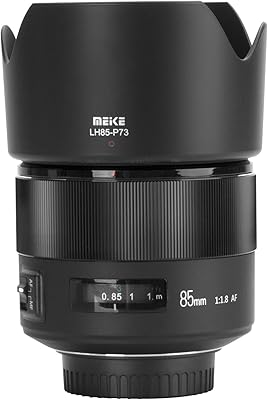
73%
76%
Image Sharpness
83%
Bokeh Quality
57%
Autofocus Speed
62%
Autofocus Accuracy
78%
Build Quality
More
Meike 85mm F1.8 Nikon F Portrait Lens
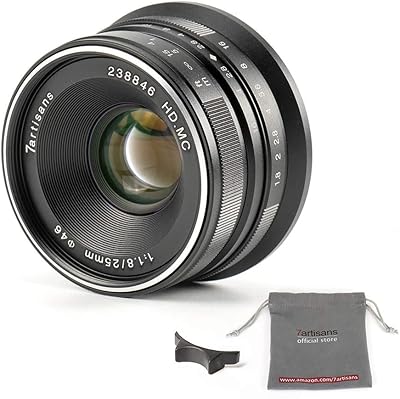
75%
91%
Value for Money
76%
Image Sharpness
83%
Bokeh Quality
61%
Autofocus Speed
72%
Autofocus Accuracy
More
7artisans 25mm F1.8 Manual Prime Lens
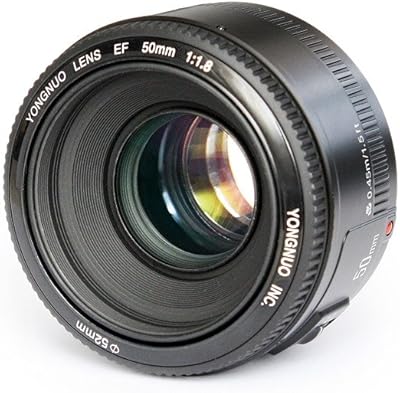
79%
88%
Build Quality
91%
Value for Money
72%
Image Sharpness
83%
Bokeh Quality
61%
Chromatic Aberration
More
Yongnuo YN50mm F1.8 Prime Lens
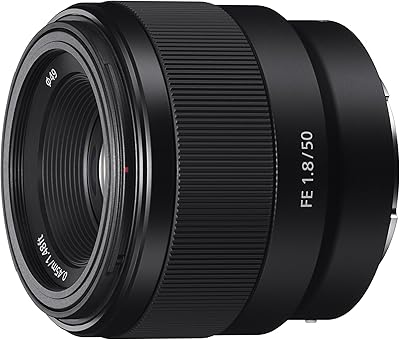
71%
93%
Value for Money
78%
Image Sharpness
58%
Autofocus Speed
61%
Autofocus Accuracy
76%
Bokeh Quality
More
Sony FE 50mm F1.8 Standard Lens
80%
88%
Image Sharpness
91%
Bokeh Quality
71%
Autofocus Performance
63%
Build Quality
93%
Value for Money
More
Meike 35mm F1.4 MFT Lens
84%
89%
Sharpness & Image Quality
74%
Manual Focus Usability
91%
Build Quality
87%
Low Light Performance
92%
Value for Money
More
Panasonic LUMIX S-S85 85mm F1.8 Lens
82%
92%
Image Sharpness
84%
Bokeh Quality
71%
Autofocus Performance
83%
Build Quality
74%
Weather Sealing
More
Sony SEL20F18G 20mm F1.8 Wide-Angle Lens
81%
93%
Optical Sharpness
91%
Autofocus Performance
89%
Aperture & Low-Light Ability
88%
Build Quality
87%
Video Usability
More

FAQ

This is the most common issue new owners run into, and the fix is simple. Because the lens has no electronic contacts, your camera does not detect it as an attached lens. You need to go into your camera settings and enable an option typically labeled something like 'Shoot Without Lens' or 'Release Without Lens.' Once that is turned on, the shutter will fire normally.

Yes, the Meike 25mm F1.8 Micro Four Thirds Lens works with any camera using the M43 mount standard, including the full Olympus OM-D lineup. Just remember to enable the release-without-lens option in your camera menu before shooting.

The aperture ring has clickless-style rotation on most versions of this lens, which is actually a plus for videographers who need to adjust exposure during a shot without audible clicks being picked up by a microphone. For still photographers who prefer tactile click stops, this may take some getting used to.

Center sharpness at F1.8 is genuinely good for a lens at this price — subjects in the middle of the frame come through with solid detail and decent contrast. The edges and corners are noticeably softer wide open, which is typical for budget fast primes. If sharpness across the full frame matters to you, stopping down to F4 or F5.6 makes a meaningful difference.

Absolutely, and it is one of the better use cases for this manual prime. The focus ring is smooth and well-damped, making deliberate focus pulls feel controlled rather than jumpy. Since the GH5 and GH6 are popular manual-focus video bodies anyway, the lack of autofocus is rarely a problem for experienced video shooters.

In-body image stabilization (IBIS) will still function on cameras that have it, but because the lens sends no focal length data to the body, some cameras may not automatically optimize stabilization for 25mm. On cameras that let you manually input the focal length for stabilization — like many Olympus bodies — you can enter 25mm yourself and get full IBIS benefit.

The all-metal barrel is genuinely the standout characteristic here. Compared to plastic kit lenses or similarly priced lenses from other budget brands, the Meike 25mm F1.8 feels noticeably more substantial in hand. It is not weather-sealed and it is not in the same league as professional glass, but for everyday handling and travel use it holds up well.

You can, with some caveats. On an M43 sensor, 25mm gives you a 50mm full-frame equivalent, which is a classic environmental portrait focal length rather than a flattering telephoto portrait length. At close distances and F1.8, subject separation is achievable with smooth background blur. If you want tight head-and-shoulders shots with significant compression and bokeh, a 45mm or longer M43 lens would serve you better.

Some chromatic aberration — color fringing around high-contrast edges — is visible when shooting wide open, particularly in backlit situations or scenes with strong contrast between light and dark areas. It is not severe, and most photo editing software can correct it automatically. Stopping down to F2.8 reduces it considerably.

The filter thread is 46mm, which is a fairly common size. A standard 46mm circular polarizing filter will attach without any issues, making it a practical choice for outdoor photography where you want to manage reflections or deepen sky tones. Since there is no autofocus motor to worry about, a regular CPL works fine — you do not need a slim or special version.

Where to Buy