Overview

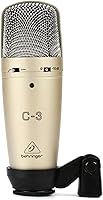
The Behringer C-3 Dual-Diaphragm Condenser Microphone sits in a peculiar spot in the market — it offers features you would expect to pay significantly more for, yet carries a price tag that makes budget-conscious home recordists stop and look twice. Behringer has always been a polarizing brand; some engineers won't touch their gear, while others have built entire project studios around it without complaint. This Behringer condenser won't silence the skeptics, but it earns its keep. It requires phantom power via XLR, so plug-and-play beginners should be aware before purchasing. Go in with calibrated expectations and you get a solid all-metal build and real recording versatility for the money.
Features & Benefits

What sets the C-3 apart from cheaper single-pattern condensers is the three switchable polar patterns — cardioid, omnidirectional, and figure-eight — all housed in one body. Cardioid handles vocals or acoustic guitar naturally, omni opens up for room recordings, and figure-eight unlocks mid-side stereo techniques without needing a second mic. The shock-mounted capsule does a decent job absorbing vibration, which matters when recording in a less-than-silent home environment. Frequency response reaches up to 18 kHz and the signal-to-noise ratio sits at 70 dB — workable figures for the price bracket, though not exceptional. The all-metal housing gives it a sturdy feel that many similarly priced plastic-bodied mics simply can't match.

Best For

This multipattern mic hits a clear sweet spot for home studio owners who record acoustic guitar or piano and want polar pattern flexibility without a serious budget commitment. It's a smart pick as a second or third mic for someone who already owns an audio interface and wants to expand their overhead or room-mic options. Drummers on a budget have used it successfully as an overhead mic with reasonable results. Content creators exploring mid-side stereo for the first time will also find the figure-eight pattern genuinely useful here. That said, if you need pristine broadcast-quality sound or work in a demanding vocal booth environment, the noise floor and transient response will likely leave you wanting more.

User Feedback

Buyer sentiment around the C-3 is genuinely mixed, and that's actually informative. The most consistent praise lands on polar pattern switching — buyers are repeatedly surprised to find this feature at this price, and many say they use it more than expected. Build quality also earns positive mentions; the metal body stands out against cheaper plastic alternatives. On the downside, some users report a slightly hyped high end that can make certain sources sound a touch brittle. Unit-to-unit consistency is another recurring concern — quality control can vary. The included accessories draw quiet but persistent complaints. And longevity is unpredictable; some units run for years without issue, while others show problems sooner than they should.

Pros

  • Three switchable polar patterns — cardioid, omni, and figure-eight — give this multipattern mic rare flexibility at the price.
  • All-metal construction feels noticeably more substantial than most competing mics in the same price bracket.
  • The shock-mounted capsule reduces handling noise and stand vibration, making sessions cleaner without extra isolation gear.
  • Buyers consistently praise the polar pattern switching as a feature they didn't expect to find at this price.
  • Works cleanly with any phantom-power-capable audio interface via standard XLR — no adapters or special cables needed.
  • Doubles as a capable overhead or room mic, giving project studio owners a genuinely useful second option.
  • The figure-eight pattern opens up mid-side stereo recording without needing a dedicated second microphone.
  • The solid metal body has a professional studio look that belies the entry-level price.

Cons

  • The high-end frequency response can sound slightly hyped, adding unwanted brightness to certain vocal sources.
  • Unit-to-unit quality control is inconsistent — some buyers receive a great sample, others don't.
  • Requires phantom power via an audio interface or mixer; beginners who lack one face an unplanned extra cost.
  • Bundled accessories — including the mount and case — feel noticeably cheap compared to the mic body itself.
  • Longevity is unpredictable; some units hold up for years, while others degrade faster than they should.
  • The 70 dB signal-to-noise ratio is workable for the price but leaves audible noise in very quiet passages.
  • Not a practical option for professional broadcast or studio vocal work where transient accuracy matters.
  • Behringer's mixed brand reputation may create challenges for second-hand resale value down the line.

Ratings

Our AI-generated scores for the Behringer C-3 Dual-Diaphragm Condenser Microphone are derived from a systematic analysis of verified buyer reviews collected globally, with spam, bot-generated feedback, and incentivized reviews actively filtered out before scoring. The ratings reflect the complete picture — where this multipattern condenser earns genuine praise and where real users have encountered meaningful frustrations. Both strengths and pain points are transparently represented across every category below.

Value for Money
84%
Buyers consistently express surprise at what this Behringer condenser delivers for the price — three switchable polar patterns alone would justify the cost on many competing mics. For home studio owners on a strict budget, it offers a breadth of recording capability that typically requires spending considerably more.
The value equation weakens when you factor in occasional quality control variability — not every unit performs identically out of the box. Buyers who need reliability for professional work may find that spending a bit more on a better-controlled product saves money in the long run.
Build Quality
79%
21%
The all-metal housing genuinely stands out in a price bracket dominated by plastic-bodied competitors. When you pick up the C-3, there is a reassuring weight and rigidity to it that conveys real durability — something buyers consistently highlight as an unexpected strength at this tier.
While the body itself is solid, the overall package tells a more mixed story — the included accessories feel noticeably cheaper than the mic body they are meant to support. Some users have also reported paint wear and minor cosmetic degradation faster than the build quality initially suggests.
Sound Quality
69%
31%
For acoustic guitar, piano, and room ambience in a home studio context, this multipattern mic produces workable, pleasant results that most beginner-to-intermediate recordists find satisfying. The dual-diaphragm capsule captures reasonable mid-range detail where acoustic instruments tend to live and breathe.
The high-end frequency response has a noticeable lift that can introduce unwanted brightness — particularly on certain vocal timbres and brighter instruments like cymbals. Users expecting a flat, neutral response will be disappointed compared to higher-tier condensers, and corrective EQ frequently becomes necessary in post-production.
Polar Pattern Versatility
91%
Three fully switchable polar patterns on a single mic at this price is genuinely rare and represents the strongest single argument for choosing the C-3 over competing budget condensers. Cardioid, omni, and figure-eight cover everything from solo acoustic sessions to mid-side stereo rigs and face-to-face interview setups.
The pattern switching works, but users report that transitions can occasionally introduce slight sonic inconsistencies — the patterns do not always feel as cleanly defined as they would on higher-end multipattern mics. For advanced stereo techniques requiring precise off-axis rejection, matched premium pairs will outperform it noticeably.
Noise Floor Performance
62%
38%
At a 70 dB signal-to-noise ratio, the C-3 performs adequately for most home recording tasks where sources are not extremely quiet or highly dynamic. In practice, when recording acoustic guitar or piano in a reasonably quiet room, most users find the noise level manageable enough to work with.
In demanding conditions — quiet vocal passages, delicate acoustic instruments, or treated rooms where capturing fine detail matters — the noise floor becomes noticeable and distracting. Users who have upgraded from this mic consistently cite self-noise as one of the primary reasons they eventually moved on to pricier options.
Frequency Response
67%
33%
The mic covers 20 Hz to 18 kHz, which is sufficient range for the vast majority of home recording applications including vocals, acoustic instruments, and room capture. In the mid-range — where acoustic guitar body resonance and vocal warmth reside — the response is reasonably balanced and musical.
The 18 kHz ceiling and hyped presence region mean the C-3 will not capture the airy top-end shimmer that higher-spec condensers reproduce cleanly. The lifted high end can also introduce harshness in post-production, requiring corrective EQ work that more neutral mics at higher price points would not demand.
Ease of Setup
73%
27%
For anyone who already owns a phantom-power-capable audio interface, setup is genuinely straightforward — plug in an XLR cable, enable phantom power, and the C-3 is ready to record. Experienced home recordists appreciate that it drops into existing signal chains without compatibility headaches of any kind.
The phantom power requirement is a real barrier for complete beginners who do not already own suitable gear — you will need an audio interface or mixer supplying 48V, which adds to the overall cost of entry. This is not a plug-and-play solution, and some buyers do not realize this before purchasing.
Capsule Isolation
76%
24%
The internal shock-mounting does a solid job of decoupling the capsule from stand vibrations during normal recording sessions. Users recording on wooden floors or in home environments with ambient mechanical noise note that the shock mount meaningfully reduces low-frequency rumble compared to fixed-capsule designs at this price.
The isolation is not on par with a quality external shock mount, and in environments with significant floor vibration or heavy-handed mic positioning, some mechanical noise still bleeds through. The included stand adapter provides no additional isolation, so a third-party shock mount is advisable for more critical recording work.
Accessory Quality
41%
59%
The box includes a carrying case and a stand adapter, which means you have the basics to get started without an immediate additional purchase. For casual use or temporary setups, the included accessories are just functional enough to get a session underway without spending extra right away.
This is one of the most consistently criticized aspects across buyer reviews — the accessories feel markedly cheaper than the mic body they are meant to support. The stand adapter in particular feels flimsy under load, and the case offers minimal real protection; most buyers end up replacing both items early on.
Unit Consistency
56%
44%
Many buyers receive units that perform exactly as described, and those users tend to be satisfied with the consistency of their particular sample over time. For buyers who land a well-produced unit, this Behringer condenser delivers predictable, repeatable results from session to session.
Quality control is a recurring concern across buyer feedback — some users report audible character differences between units of the same model, and occasional manufacturing defects have been flagged by multiple reviewers. This unpredictable variability is a legitimate purchasing risk that cautious buyers should factor into their decision.
Durability & Longevity
64%
36%
The metal body construction is a genuine asset for long-term durability — it will not crack or warp from the typical bumps that happen in a busy home studio environment. Buyers who treat it carefully report using the same unit for several years without noticeable performance degradation.
Longevity feedback is genuinely polarized — some users experience issues within a year or two, particularly with the capsule developing noise artifacts or losing sensitivity over time. Given that condenser capsules in this price range do not always use premium components, long-term reliability is simply not guaranteed.
Vocal Performance
66%
34%
For home demo recordings, voice-over scratch tracks, or podcast use in a moderately treated room, this Behringer condenser handles vocal duties competently in cardioid mode. Voices with a naturally darker timbre tend to benefit from the slight high-end lift, gaining presence without heavy post-processing.
Professional vocal recordists will quickly notice the limitations — the hyped high end can cause sibilance and harshness that requires careful de-essing and corrective EQ work. For lead vocal tracks destined for commercial release, the noise floor and tonal coloration are real hurdles that demand extra production time to address.
Instrument Recording
83%
Recording acoustic guitar, piano, or upright bass in cardioid or omni mode is where this multipattern mic genuinely earns its place — the dual-diaphragm design captures instrument body resonance naturally, and buyers consistently report satisfying results for home demos and project recordings. Overhead drum capture is another frequently noted strength.
Brighter instruments — acoustic guitar with fresh steel strings or cymbals in an overhead position — expose the high-end coloration more noticeably than warmer sources do. Some users apply gentle high-shelf cuts in post-production to tame the slight harshness, adding an extra step that a flatter mic would not require.
Physical Design
78%
22%
The silver all-metal body gives the C-3 a professional studio aesthetic that looks right at home in a home recording setup — buyers frequently mention being surprised by how substantial and polished it appears straight out of the box. The large-body form factor fits standard shock mounts without additional adapters.
The design is purely functional rather than refined — there are no premium touches like a padded pouch, a high-quality case, or a machined-finish build. Over time, some users report cosmetic wear on the silver finish, particularly around the polar pattern switch, making the mic look older than it is.
Compatibility
87%
Standard XLR connectivity means the C-3 works with essentially every audio interface, mixer, and preamp on the market — there are no proprietary connectors or drivers to deal with. For musicians who already own a recording setup, adding this mic to the signal chain is immediate and completely straightforward.
The one compatibility caveat is phantom power — some older or budget mixers supply a lower voltage or unstable phantom power source that can affect condenser microphone performance unpredictably. Users with very old or inexpensive mixers should verify their phantom power specification carefully before purchasing any XLR condenser.

Suitable for:

The Behringer C-3 Dual-Diaphragm Condenser Microphone is a strong fit for home studio owners and bedroom producers who want genuine recording versatility without committing serious money to a single-pattern mic. If you're capturing acoustic guitar, piano, or stringed instruments at home, the ability to switch between cardioid, omnidirectional, and figure-eight patterns in one body is a real practical advantage. Podcasters who occasionally need to record two people face-to-face will find the figure-eight mode surprisingly useful for that scenario. It also works well as a second or third mic in a project studio setup — particularly as an overhead for drum recording, where the shock-mounted capsule helps manage vibration noise. Musicians who already own a phantom-power-capable audio interface are best positioned to get the most from it, since the XLR connection drops right into an existing signal chain without fuss. Content creators exploring mid-side stereo recording for the first time will find this a cost-effective way to experiment with the technique.

Not suitable for:

The Behringer C-3 Dual-Diaphragm Condenser Microphone is not the right tool if your work demands pristine noise floors, exceptional transient detail, or broadcast-grade clarity. Professional vocalists recording in treated studios will likely find the slightly hyped high end and modest 70 dB signal-to-noise ratio unsatisfying compared to mid-range or high-end condensers. Broadcast journalists and podcasters running serious production setups will hit its ceiling quickly. It's also not a plug-and-play solution — if you don't already own an audio interface or mixer capable of supplying 48V phantom power, you'll need to budget for that before the mic is even usable. Buyers who need absolute consistency across units may also be frustrated, as quality control has drawn complaints and you can't always predict the sample you'll receive. If longevity under heavy daily use is a priority, the mixed durability feedback warrants serious consideration before committing.

Specifications

  • Microphone Type: This is a dual-diaphragm large-body condenser microphone designed for studio and home recording applications.
  • Polar Patterns: Three switchable pickup patterns are available: cardioid, omnidirectional, and figure-eight, selectable via a switch on the mic body.
  • Connectivity: Audio output uses a standard XLR connector, compatible with audio interfaces, mixers, and standalone preamps.
  • Phantom Power: 48V phantom power is required for operation and must be supplied by the connected audio interface or mixer.
  • Noise Ratio: The signal-to-noise ratio is rated at 70 dB, a functional specification for home and project studio recording at this price tier.
  • Frequency Response: The microphone's frequency response spans 20 Hz to 18 kHz, covering the full audible range with a modest high-end ceiling.
  • Body Material: The microphone housing is constructed from all-metal materials, providing a solid, durable build uncommon at this price point.
  • Color Finish: The mic features a silver finish, giving it the appearance of a classic large-body studio condenser.
  • Weight: The microphone weighs 0.93 lb (14.9 oz), suitable for use with standard desktop and boom mic stands.
  • Dimensions: The body measures 2.13 × 2.13 × 7.09 inches, fitting standard shock mounts and mic clips designed for large-body condensers.
  • Capsule Mount: The capsule is shock-mounted internally to minimize mechanical vibration and handling noise transmitted from the stand.
  • Channel Output: The microphone outputs a single mono channel via XLR, standard for condenser microphones in this category.
  • Power Source: The mic operates entirely on phantom power delivered through the XLR cable — no batteries or external power supply are required.
  • Brand: Manufactured by Behringer under model designation C-3, this microphone has been available since December 2007.
  • Capsule Type: The dual-diaphragm capsule design allows multiple polar pattern modes to be selected from within a single microphone body.

Related Reviews
Behringer C-2 Stereo Condenser Microphone Pair

79%
91%
Value for Money
78%
Sound Quality
74%
Stereo Matching Accuracy
83%
Build Quality
86%
Ease of Setup
More
AKG C451 B Small-Diaphragm Condenser Microphone
84%
91%
Sound Quality
89%
High-Frequency Detail
88%
Transient Response
93%
Build Quality
64%
Value for Money
More
Studio Projects C4 Small-diaphragm Condenser Microphone Pair
76%
83%
Sound Quality
81%
Stereo Matching
74%
Capsule System
78%
Build Quality
79%
Value for Money
More
Aston Microphones Origin
85%
94%
Build Quality
89%
Vocal Clarity
92%
Instrument Response
71%
Internal Pop Filtering
91%
Price-to-Performance Ratio
More
Aston Microphones Spirit Large-Diaphragm Condenser Microphone
85%
93%
Sound Quality
96%
Build Quality
89%
Polar Pattern Versatility
88%
Built-in Pop Filter
84%
Value for Money
More
Behringer B-1
Behringer B-1
82%
88%
Vocal Clarity
91%
Build Quality & Durability
94%
Value for Money
86%
Acoustic Instrument Tracking
79%
Background Noise Rejection
More
MXL 2003A Large-Diaphragm Condenser Microphone
77%
78%
Sound Character
61%
Self-Noise Level
82%
Build Quality
84%
Value for Money
86%
Included Accessories
More
Samson C01
Samson C01
84%
93%
Build Quality
86%
Vocal Clarity
82%
Ambient Noise Rejection
91%
Value for Money
74%
Internal Shock Mounting
More
Elgato Wave:3
Elgato Wave:3
86%
94%
Software Ecosystem
97%
Audio Distortion Prevention
68%
Build Quality & Materials
91%
Ease of Setup
88%
Voice Clarity & Sound Quality
More
Rode NT2000 Large-Diaphragm Condenser Microphone
82%
94%
Polar Pattern Versatility
91%
Control Flexibility
89%
Sound Quality
66%
Build Quality
93%
Warranty & Long-Term Value
More

FAQ

Yes — the C-3 runs on 48V phantom power, so you'll need an audio interface or mixer that can supply it. Most entry-level interfaces from brands like Focusrite or PreSonus include phantom power as a standard feature. An XLR cable is also required and is not included with the mic.

Cardioid is the go-to starting point — it focuses on the source in front and rejects noise from behind, which helps in home environments where room sound is a factor. If you want a more open, natural feel, omni can work well too, though you'll capture more of your room. Experiment with both to find what suits your space and playing style.

It can work for vocals in a home studio context, especially if you need a versatile mic rather than a dedicated vocal condenser. That said, the slightly hyped high end can add brightness to some voices — some singers find it flattering, others less so. If vocal recording is your primary use case, you may eventually want a mic with a flatter frequency response.

Yes, as long as your USB interface has an XLR input with phantom power — virtually all modern audio interfaces do. This multipattern mic connects via a standard XLR cable and behaves like any other condenser in that regard. Just make sure phantom power is switched on at the interface before you start a session.

It does include some accessories in the box, though buyers consistently note that these feel budget-grade relative to the mic body itself. If you plan to use it regularly in a studio setup, investing in a quality third-party shock mount and a sturdy boom stand will give you noticeably better vibration isolation and stability.

Cardioid picks up sound from the front and rejects most sound from the rear — ideal for solo instruments, single-voice podcasts, or situations where you want to minimize room noise. Figure-eight picks up equally from front and back while rejecting the sides, which is useful for recording two people face-to-face or for building a mid-side stereo setup with a second cardioid source.

The main advantage this Behringer condenser has over single-pattern competitors is the three switchable polar patterns — most similarly priced condensers only offer cardioid. If you just need a clean cardioid for vocals, there are arguably more neutral-sounding options at this price from other brands. But if pattern flexibility is a priority, it is genuinely difficult to find comparable versatility elsewhere at this tier.

You can, and some recordists do — particularly for overhead drum recording or ambient room capture. For a mid-side setup, you would use one in cardioid and one in figure-eight, which the C-3 supports on its own without needing a different mic model. Just keep in mind that unit-to-unit variation can mean two samples are not perfectly matched in character.

It can serve a podcast setup well, particularly if you need to record two hosts face-to-face using the figure-eight pattern. For a solo podcast in a treated room, cardioid mode works fine. That said, if simplicity is the priority, a USB cardioid mic might be a more convenient starting point since it removes the need for a separate audio interface.

The all-metal body holds up well physically and feels noticeably more solid than plastic-bodied mics at this price. Longevity feedback from buyers is genuinely mixed though — some report years of trouble-free use, while others have experienced issues sooner than expected. Treating it carefully, using a decent shock mount, and storing it away from humidity will help extend the life of the capsule considerably.

Where to Buy